%20%20--%3E%0A%3Csvg%20version%3D%221.1%22%20id%3D%22Layer_1%22%20xmlns%3D%22http%3A%2F%2Fwww.w3.org%2F2000%2Fsvg%22%20xmlns%3Axlink%3D%22http%3A%2F%2Fwww.w3.org%2F1999%2Fxlink%22%20x%3D%220px%22%20y%3D%220px%22%0A%09%20width%3D%2239px%22%20height%3D%2240px%22%20viewBox%3D%220%200%2039%2040%22%20enable-background%3D%22new%200%200%2039%2040%22%20xml%3Aspace%3D%22preserve%22%3E%0A%3Cpath%20fill%3D%22%23FFFFFF%22%20d%3D%22M38.5%2C7H28.2v26h10.3V7z%22%2F%3E%0A%3Cpath%20fill-rule%3D%22evenodd%22%20clip-rule%3D%22evenodd%22%20fill%3D%22%23FFFFFF%22%20d%3D%22M26.1%2C25.5c0%2C5.8-4.1%2C7.5-12.9%2C7.5C3.9%2C33%2C0%2C31.2%2C0%2C25.2v-1.1h11.6%0A%09v2.4c0%2C0.7%2C0.1%2C1.4%2C1.2%2C1.4c1%2C0%2C1.2-0.4%2C1.2-1.3v-0.9c0-1.6-0.9-1.6-3.5-2.2C2.2%2C21.7%2C0%2C19.7%2C0%2C15.3v-0.9C0%2C9.3%2C5.5%2C7%2C12.9%2C7%0A%09c10.2%2C0%2C12.8%2C2.6%2C12.8%2C7.4v1.8h-11v-2.9c0-0.6-0.4-1.1-1.2-1.1c-0.6%2C0-1.2%2C0.4-1.2%2C1.1v0.9c0%2C1.5%2C0.9%2C2%2C3.3%2C2.5%0A%09c8%2C1.6%2C10.5%2C3.3%2C10.5%2C7.5V25.5z%22%2F%3E%0A%3C%2Fsvg%3E%0A)
Arch Manning Finally Answered the Biggest Question About His Career
In this story:
AUSTIN — Arch Manning was sprinting, no helmet, all joy, signaling hook ’em to an erupting Darrell K. Royal-Texas Memorial Stadium. He was pinwheeling his right arm like a third-base coach signaling a runner to go home. He was jumping and chest bumping, the happiest person in a sweaty sea of celebratory humanity.
This was his liberation and validation. The way he ran and jumped, it was like a weight had suddenly been thrown off. In that moment, he wasn’t a millionaire pitchman with a fabled last name; he was a 22-year-old college player who had just won the biggest game of his life to date, reveling in the fun of the game.
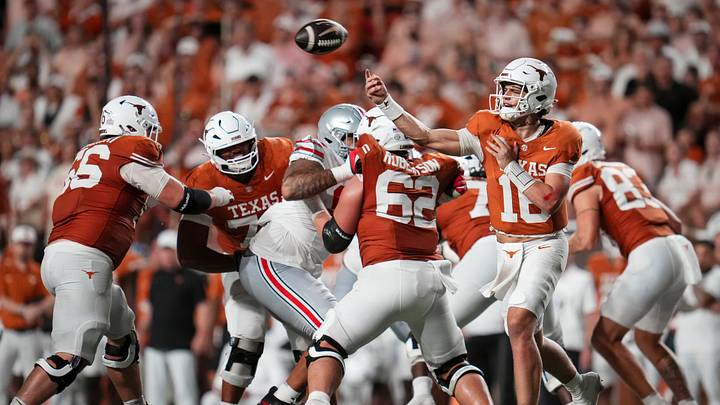
Arch was free of the heaviest of athletic burdens—unfulfilled potential. Leading a determined comeback from 20 points down against nemesis Ohio State, he lived up to an almost impossible amount of hype. It’s one game, but it felt like a defining game.
The celebration is ON in Austin 🔥 pic.twitter.com/eXHvZmCxtb
— Sports Illustrated (@SInow) September 13, 2026
“It felt great,” he said, a wide smile plastered on his face. “It’s just all emotion. You dream of playing in games like this, hosting the No. 1 team in the country at home. How about that? Let’s go, baby!”
This Saturday night spectacle—Texas 24, Ohio State 23—was what had been prophesied since the scion of America’s greatest quarterback family first revealed himself as The Next Manning. As a teenager, it was clear that Arch had the potential to follow in the massive footsteps of grandfather Archie and uncles Peyton and Eli. But it had been a bit of a slog getting to this moment.
At times since becoming the starting QB at Texas, the prophecy appeared false. It was that way for much of the 2025 season, and much of Saturday night. And then, when the world was ready to dump on him and the rest of the Longhorns, they stood up, pushed back and stopped all the narratives in mid-sentence.
“I did not want to come in [the postgame news conference] after a loss to Ohio State again and have y’all telling me we’re not good, all this stuff,” Manning said. “I could not let that happen. So I think that was going through the back of my mind, like, ‘Let’s not let that happen.’ ”
For the longest time, it sure looked like it was happening. Texas coach Steve Sarkisian called the first half “abysmal,” and nobody in burnt orange would disagree—Raleek Brown fumbled on the first play from scrimmage; Cam Coleman bobbled a deep ball that turned into a fluke interception; Ryan Wingo dropped a sure touchdown; the defense couldn’t get a third-down stop.
“I don’t know if we could have played a worse first half,” Sarkisian said, but he referenced the sign on the back of the Texas team room that reads, “Texas Fight.” That the Longhorns did, showing a mettle that some doubted they possessed.
Trailing 23–3 into the fourth quarter against a program that had beaten Texas each of the last two seasons, this looked over. Ohio State hadn’t blown a 20-point lead in 15 years, and the last time it happened—34–27 at Nebraska in 2011—there were extenuating circumstances with star quarterback Braxton Miller getting hurt.
This time, Texas flat took it from the Buckeyes, launching the fourth-largest comeback in school history. The Longhorns took it after being booed by 105,000 fans in the third quarter, with the fans in burnt orange frustrated by another flailing offensive performance against Ohio State.
“I’m very, very proud of Arch,” Sarkisian said. “When you get faced with adversity in life, you find out about yourself. And last September was a hard month for him. There were some tough moments, but he got on the other side of it. And I think him getting through that adversity last year helped him get through the adversity of tonight because we got booed.
“I thought the driving force was his grit. It was him kind of saying, ‘Screw it. Let’s just go back to letting it rip.’ ”
Here’s what happened after those boos: three long touchdown drives, of 91, 72 and 73 yards; two huge fourth-down conversions; two punch-it-in TD runs at the goal line; and a complete shutdown of the unguardable Jeremiah Smith by the Texas defense.
On the first of those touchdown drives, the Horns faced a fourth-and-9 from their own 42-yard line. There was little question Sarkisian was going to go for it. Someone asked afterward if he considered punting to avoid making the score worse.
“That’s a loser’s thinking,” he shot back. “Winners win, baby. You got to go for it. Keep it close? They didn’t hire me to keep it close. They hired me to win.”
Manning had to make a fantastic play to make Sarkisian look good on the call. Under pressure, he rolled to his right and found tight end Emaree Winston, who made a contested catch for the first down. That was the ninth play of the drive; six plays later, Manning hit Wingo in the corner of the end zone to make it 23–10.
Ohio State responded with a second straight three and out, as new offensive coordinator Arthur Smith’s balanced attack broke down. After Texas got the ball back, Sarkisian had to dial up another fourth-down call.
This one seemed like a bigger risk; there were more than 11 minutes still on the clock, it was a two-score game and the Horns were facing fourth-and-6 at their own 32. Punting and playing defense would have been an understandable decision, but Sarkisian was all in at that point. A failed fourth-and-short that wound up giving Ohio State a short field for a touchdown in the first half was ancient history.
“I just felt like we had a little bit of momentum and I didn’t want to give it back to them,” Sarkisian said. “I didn’t want to punt. … And so you roll the dice. The same way I rolled the dice on fourth-and-1 in the first half and it didn’t work. But that’s the life of a competitor, that’s the life of the head coach, making those decisions and you live with them. We knew we were going to be aggressive tonight.”
Manning threw a dart over the middle to Emmett Mosley V to move the chains, and nine plays later Texas got into the end zone again. This time it was a one-yard run by Hollywood Smothers. The Buckeyes defense began to wilt after a long night in the Lone Star State heat on that drive.
“Getting in that fourth quarter, I feel like it was wearing them down,” Smothers said.
All Texas needed at that point was one more stop. Ohio State contributed to its own collapse by failing to get Smith a reception in the fourth quarter—after he torched Texas in the first three quarters for eight catches, 164 yards and a touchdown. But the Buckeyes did move into field goal range, whereupon reliable Connor Hawkins missed one from 45 yards out with 4:16 remaining.
By that point, a final Texas scoring drive seemed inevitable. It didn’t need any fourth-down heroics, and barely any on third down—just a couple of third-and-1 runs by Smothers. The last of those was the winning score, emphasizing Texas’s short-yardage improvement after repeatedly being stonewalled in that area last season in the loss to the Buckeyes in Columbus.
“A different light switch has to come on at the goal line,” Smothers said.

It’s now time to look at Manning and Texas in a different light. There is no guarantee that the Longhorns will be a College Football Playoff team (“Have you seen our schedule?” Sarkisian asked). But this game was a differentiating factor for both Ohio State and Texas last year—the Buckeyes made the CFP, the Longhorns did not. Through two weeks, nobody has a better win than this.
For Manning, this was the kind of willpower victory that goes beyond talent. His final numbers were not dazzling—23 of 37 for 195 yards passing, plus 24 rushing, his fewest total yards in the last eight games. But he was at his best in the desperate moments, when the game was in the balance. He came of age in real time.
When Sarkisian was near the tail end of his news conference, the door to the room opened about a foot and Manning stuck his head through. He looked at Texas associate athletic director John Bianco and mouthed the words, “Let’s go!” Arch was in a hurry to get through the interviews and celebrate with his family.
After five minutes behind a microphone, he was free to go. Arch Manning hustled out of the room much like he went bounding across the field, with a new spring in his step and a weight off his shoulders.
PODCAST: Listen to Sports Illustrated’s college sports podcast, Others Receiving Votes, hosted by Pat Forde, on Apple and Spotify. Watch the show on SI’s college YouTube channel or on SI TV.
 Add us as a preferred source on Google
Pat Forde is a senior writer for Sports Illustrated who covers college football and college basketball as well as the Olympics and horse racing. He cohosts the Others Receiving Votes podcast for SI and is a regular contributor to the Tony Kornheiser Show podcast. He previously worked for Yahoo Sports, ESPN and The (Louisville) Courier-Journal. Forde has won 28 Associated Press Sports Editors writing contest awards, has been published three times in the Best American Sports Writing book series, and was nominated for the 1990 Pulitzer Prize. A past president of the U.S. Basketball Writers Association and member of the Football Writers Association of America, he lives in Louisville with his wife. They have three children, all of whom were collegiate swimmers.
Follow ByPatForde