%20%20--%3E%0A%3Csvg%20version%3D%221.1%22%20id%3D%22Layer_1%22%20xmlns%3D%22http%3A%2F%2Fwww.w3.org%2F2000%2Fsvg%22%20xmlns%3Axlink%3D%22http%3A%2F%2Fwww.w3.org%2F1999%2Fxlink%22%20x%3D%220px%22%20y%3D%220px%22%0A%09%20width%3D%2239px%22%20height%3D%2240px%22%20viewBox%3D%220%200%2039%2040%22%20enable-background%3D%22new%200%200%2039%2040%22%20xml%3Aspace%3D%22preserve%22%3E%0A%3Cpath%20fill%3D%22%23FFFFFF%22%20d%3D%22M38.5%2C7H28.2v26h10.3V7z%22%2F%3E%0A%3Cpath%20fill-rule%3D%22evenodd%22%20clip-rule%3D%22evenodd%22%20fill%3D%22%23FFFFFF%22%20d%3D%22M26.1%2C25.5c0%2C5.8-4.1%2C7.5-12.9%2C7.5C3.9%2C33%2C0%2C31.2%2C0%2C25.2v-1.1h11.6%0A%09v2.4c0%2C0.7%2C0.1%2C1.4%2C1.2%2C1.4c1%2C0%2C1.2-0.4%2C1.2-1.3v-0.9c0-1.6-0.9-1.6-3.5-2.2C2.2%2C21.7%2C0%2C19.7%2C0%2C15.3v-0.9C0%2C9.3%2C5.5%2C7%2C12.9%2C7%0A%09c10.2%2C0%2C12.8%2C2.6%2C12.8%2C7.4v1.8h-11v-2.9c0-0.6-0.4-1.1-1.2-1.1c-0.6%2C0-1.2%2C0.4-1.2%2C1.1v0.9c0%2C1.5%2C0.9%2C2%2C3.3%2C2.5%0A%09c8%2C1.6%2C10.5%2C3.3%2C10.5%2C7.5V25.5z%22%2F%3E%0A%3C%2Fsvg%3E%0A)
Ranking the 25 Greatest College Football Teams of All Time
In this story:
The first college football game took place on Nov. 6, 1869. Rutgers and Princeton faced off in New Brunswick, N.J., just four years and 211 days removed from the end of the Civil War about 400 miles to the southwest in Appomattox, Va. The sport has grown with the country in the more than 150 years since, and the modern game barely resembles that which the Tigers and Queensmen contested—or even the popular game throughout the nation in the 1940s, when Notre Dame and the service academies dominated the landscape, or the 1960s and ’70s, when many of the powerhouses we know today cemented their footholds in the sport.
For decades, the sport was primarily played on the ground—and while some programs still seem to be warming up to the downfield pass, the spread offenses of the 2000s and 2010s are virtually unrecognizable from the wishbone and Wing T offenses of old (though today’s top offensive minds have been marrying concepts from all of the above).
Comparing the greatest teams from the early 1900s and the 2020s is difficult for myriad reasons, beyond style of play. Linemen in the sport’s early days were the size of wide receivers now—and not necessarily big modern receivers. And most impactfully, the sport didn’t fully integrate until the 1970s.
That won’t stop us from trying, though. Sports Illustrated’s college football staff surveyed the sport’s history, comparing and contrasting the great teams that played from its humble beginnings to last year’s incredible 16–0 Indiana club, and the many decades in between, to bring you the 25 greatest teams of all time.
25. 1924 Notre Dame Fighting Irish (10–0)
On the 18th day of October 1924, the grandson of a Confederate soldier invented Notre Dame football.
Well, not literally—the Fighting Irish had been in the football business for decades when sportswriter Grantland Rice sat down at his typewriter at New York City’s Polo Grounds. Coach Knute Rockne had steered the team to undefeated seasons, plural. But Notre Dame was still playing home games at cozy Cartier Field (capacity: in the 20,000s) when it beat Army 13–7 in ’24, and Rice (as he was wont to do) decided to show off his classics B.A.
“Outlined against a blue-gray October sky the Four Horsemen rode again,” he wrote. “In dramatic lore they are known as famine, pestilence, destruction and death. These are only aliases.”
The Horsemen in question, as Rice proceeded to sketch out, were Fighting Irish halfback Jim Crowley, fullback Elmer Layden, halfback Don Miller and quarterback Harry Stuhldreher. All but Miller were consensus All-Americans, all were recognized across the country as spectacular, and their publicity photo atop four local horses still adorns Notre Dame bars from coast to coast.

The Fighting Irish dominated their 1924 schedule, a fact almost incidental to their legend. They beat strong Princeton and Nebraska teams by double digits, and they also won the Rose Bowl (which they haven’t done since) over Stanford. The only team aside from the Cadets to keep Notre Dame within single digits was Northwestern, a 13–6 loser on Nov. 22.
That team is not only one of the finest pre-AP poll teams, but almost certainly the most influential. The Four Horsemen acted as a force multiplier to the Fighting Irish’s already growing national profile under Rockne, and by the end of the decade Notre Dame had a reputation it has never relinquished: a program with a strong American Catholic identity, beloved by millions who’ve never set foot in Michiana and loathed by many in equal measure. —Patrick Andres
24. 2009 Alabama Crimson Tide (14–0)
On Nov. 17, 2007, in the 11th game of his tenure at Alabama, Nick Saban’s Crimson Tide fell to Louisiana-Monroe, 21–14. They’d follow that contest, the spot on the schedule typically reserved for SEC teams to play easy warmup games before rivalry week, with a loss to Auburn in Saban’s first Iron Bowl. After an Independence Bowl win over Colorado, Saban’s first Alabama team finished 7–6.
It wasn’t an overly concerning first year for Saban in Tuscaloosa, but it also wasn’t a start that seemed to foretell the defining dynasty of the next decade. In 2008, the Crimson Tide went 12–2, posting an undefeated regular season before losing to Urban Meyer’s Florida in the SEC championship game and an upstart Utah team in the Sugar Bowl.
Even so, the corner had been turned, and the following year, Saban laid the groundwork for college football’s most recent dynasty. The defense led the way, with stars like Butkus Award winner Rolando McClain and All-Americans Javier Arenas, Terrence Cody and Mark Barron allowing just 11.7 points per game against a schedule that featured four top-10 opponents.
On the offensive end, quarterback Greg McElroy was the kind of steady hand under center that thrived in the early Saban years, with one of the greatest weapons in program history, Julio Jones, on the outside, and Mark Ingram II in the backfield. Ingram exploded for 1,678 yards rushing and 17 touchdowns, winning what was amazingly the first Heisman Trophy in Alabama history.
The Tide opened the season ranked No. 5 in the AP poll, and had a statement win against Virginia Tech in Atlanta, 34–24. The first significant test came on the Third Saturday in October, when Alabama survived a 12–10 slugfest against a mediocre Tennessee team thanks to a pair of blocked field goals by Cody in the fourth quarter. Two weeks later, the Tide took down Saban’s former club, LSU, 24–15 behind 144 yards rushing by Ingram and 102 yars receiving by Jones, 73 of which came on a screen pass the future NFL star took to the house. That win clinched a spot in the SEC championship game, and Alabama got its revenge on Meyer’s Gators when McElroy outdueled Florida superstar Tim Tebow in a 32–13 win.
The BCS pitted the No. 1 Crimson Tide against No. 2 Texas for the national title, a titanic showdown that was unfortunately diminished by an early injury to Longhorns star QB Colt McCoy after a hit from Marcell Dareus. Texas put forth a valiant effort with freshman Garrett Gilbert under center, but a 24-point second quarter for Alabama put the game out of reach. With the win, the Tide captured their eighth national title, their ninth undefeated season and officially became the sport’s standard bearer for the rest of Saban’s legendary career. —Dan Lyons
23. 1987 Miami Hurricanes (12–0)
Howard Schnellenberger put Miami football on the map, taking over a Hurricanes program that the school had considered dropping in 1979 and leading it to its first national championship in just his fifth year. When Schnellenberger departed The U following that title, he was replaced by Oklahoma State coach Jimmy Johnson, a man with a relatively underwhelming 29-25-3 career record and a single bowl win to his name.
Where Schnellenberger brought the school from the sport’s doldrums into the national spotlight, Johnson turned it into a lasting power—though success didn’t come overnight. Johnson’s first team, the 1984 Canes, went 8–5 with a Fiesta Bowl loss. Miami won 10 games each of the next two years but fell short in the Sugar and Fiesta Bowls, the latter of which came in a de facto national championship game against Penn State—the top two, undefeated teams in the country.
It was natural to expect some regression from that Canes team to the 1987 edition. Heisman-winning quarterback Vinny Testaverde became the No. 1 pick in the NFL draft, and was joined by six other Miami players, including fellow top-10 picks running back Alonzo Highsmith (No. 3) and defensive tackle Jerome Brown (No. 9). Instead, Johnson fielded one of the greatest defenses in the sport’s history and finally put it all together to run out to a 12–0 record and national title.
That run included one of the great games in program history against archrival Florida State.
After dispatching No. 20 Florida and No. 10 Arkansas by a combined score of 82–11 to start the season, Miami traveled to Tallahassee for a date with the No. 4 Seminoles, while the Canes were ranked one spot higher in that week’s AP poll. Bobby Bowden’s team leaped out to a 19–3 lead which it took into the final minute of the third quarter, though the margin could have been bigger, if not for a pair of missed field goals and an extra point by kicker Derek Schmidt.
Sophomore quarterback Steve Walsh shook off a quiet start against Deion Sanders and a stacked FSU defense, finding Melvin Bratton and Michael Irvin for touchdowns, along with a pair of successful two-point conversions. With 2:32 left in regulation, Irvin, a first-team All-American a year prior, split two defenders and took the top off the Seminoles’ defense and Walsh hit him in stride for a 74-yard go-ahead score.
Florida State would answer with a quick touchdown but Bowden opted to go for two and the win, a failed attempt that gave the Canes a victory
Miami would go on a tear, dominating the next seven games, including a 24–0 drubbing of No. 10 Notre Dame. No. 8 South Carolina gave them a run, but fell 20–16 on Dec. 5, setting the Hurricanes up for another shot at the national title, where they would defeat No. 1 Oklahoma for a third consecutive season, a 20–14 victory that looked closer thanks to a late Sooners touchdown. The Canes captured the title at the Orange Bowl in front of their home crowd, a stadium that they would not leave after the start of November that season.
The win cemented Miami’s place atop college football and put a stamp on one of the great programs of the 1980s and ’90s. —D.L.
PHOTO GALLERY: The Glory Days of Miami Football
22. 1969 Texas Longhorns (11–0)
The story of the 1969 Texas football team ended in glory, but it began in desperation. Longhorns coach Darrell Royal, after delivering the program its first national championship in ’63, had endured three straight four-loss seasons, two of which saw Texas miss out on a bowl game.
Royal’s seat was quite warm—and getting warmer. The legendary coach put offensive coordinator Emory Bellard in charge of fixing the offense, and Bellard came up with something outside the box. A formation in which the quarterback was under center, the fullback directly behind him and two halfbacks positioned on either side behind the fullback.
Royal, infamously averse to the forward pass and tasked with finding work for a running back room with multiple talents, was all in.
“We didn’t know exactly what we were doing in running the offense, but they didn’t know anything on how to defend it,” he would later say.
Texas implemented the wishbone offense to great success in 1968. The Longhorns were even more dominant in ’69. With the deceptive James Street at quarterback, as well as the speedy Ted Koy, physical Steve Worster and touchdown machine Jim Bertelsen at running back, Texas overwhelmed opposing defenses.
The Longhorns averaged 41.4 points per game, rumbled to 363 yards rushing per contest and went 11–0. Texas rattled off wins against three ranked opponents, including a win over No. 2 Arkansas in a December contest known, like some others mentioned on this list, as the “Game of the Century,” and a 21–17 triumph in the Cotton Bowl over No. 9 Notre Dame.
And Texas was far from done, as they captured another championship running the wishbone in 1970. But the 1969 Longhorns are forever known for their dominance, the revival of a legend’s stagnant program and game-changing innovation that spawned many imitators, none bigger than their rivals to the north. —Tim Capurso
21. 1978 Alabama Crimson Tide (11–1)
Bear Bryant’s ’78 Crimson Tide didn’t always look like an all-time great Alabama team. Injuries hampered the squad throughout the spring, resulting in a 7–7 slog at the program’s spring game.
“Defensively, we’re going to be a fine team, but we’re still mighty thin,” Bryant said after the scrimmage. “Offensively, we have some work to do. … We have the same kickers back from last season and they are ordinary.”
After a disappointing No. 2 finish a year earlier, edged out for the top spot in the polls by Notre Dame, Bryant made sure to level-set expectations for the ever-excitable Crimson Tide fan base. A few weeks into the fall season, those concerns reared their ugly head. Alabama scored quality wins to start the season, beating No. 10 Nebraska, 20–3, and No. 11 Missouri, 38–20, but on Sept. 23, dropped a game to No. 7 USC in Birmingham, 24–14. The loss sent the Tide plummeting from No. 1 to No. 7 in the AP poll, and appeared to be a significant blow to the team’s national title aspirations.
Decades after Bryant’s legendary run, Nick Saban became famous for using his rare losses at Alabama to focus his teams. The 1978 season would indicate that Bryant had a similar gift, as the Tide would rattle off nine straight wins to end the season, including a blowout win over rival LSU, the No. 10 team in the country. Alabama reached the Sugar Bowl as the No. 2 team in the country, and scored a 14–7 win over No. 1 Penn State, a fourth-and-goal stop by Tide linebacker Barry Krauss on Nittany Lions running back Mike Guman sealing the dramatic victory.
The AP awarded Alabama the national title—the 10th claimed championship in program history and fourth won by Bryant—while USC, which finished 12–1 with a Rose Bowl win, was awarded the coaches’ poll title.
Bryant’s 1979 team would put it all together, and leave far less doubt about which college football team reigned supreme. More on that squad in a bit … —D.L.
20. 1966 Michigan State Spartans (9-0-1)
The 1960s Michigan State teams were not only dominant on the field, they were far ahead of their time off it during a contentious period of racial injustice and civil unrest, in which college football was broadly complicit. Rosters were segregated for much of the 20th century—the SEC didn’t integrate until 1966—until certain programs began to break down those barriers.
The ’66 Spartans, and MSU’s national title-winning team the year before, were trailblazers in this regard. Coach Duffy Daugherty opened doors that were shut for Black high school athletes, and coaches, in the South. Michigan State featured 17 African-American players, 10 of them from the South, in ’66, making it one of the most integrated teams of the era. It’s not only one of the most impactful recruiting runs in the sport’s history, but also one of the best.
Michigan State was a force to be reckoned with in 1966, as the program rolled to a 9-0-1 record, outscoring teams by nearly 20 points per game. The Spartans thumped No. 9 Purdue 41–20 and swept their Big Ten conference schedule. The Michigan State defense, led by future College Football Hall of Famers Bubba Smith and George Webster, was immovable against the run and surrendered just 9.9 points per game.
All-American halfback Clinton Jones, who ran for 784 yards and scored six touchdowns on the ground while finishing sixth in the Heisman Trophy vote, was the engine of one of the best offenses in the country along with wide receiver Gene Washington, another future College Football Hall of Famer.
The second-ranked Spartans tied No. 1 Notre Dame in one of the most famous games in the sport’s history, resulting in the Fighting Irish finishing first in the final AP and UPI polls, and the Spartans recognized as the nation’s top team by the National Football Foundation, among others. The debate has raged for years as to which was the top team that season. But there’s no debating one thing.
Michigan State forever changed the sport for the better. —T.C.

19. 1999 Florida State Seminoles (12–0)
The 1998 college football season brought with it a new manner by which the sport would crown its national champion: the BCS, a computer system that promised (and often, but not always, delivered) to match up the two best teams in the country in a true national title game. And Bobby Bowden’s 1998 Seminoles very nearly raised the first trophy of the sport’s new era.
After going 11–1 and finishing the season with a huge win over rival Florida, then the No. 4 team in the country, the Noles jumped up to the No. 2 spot in all of the major polls, slotting them in for a matchup against No. 1 Tennessee at the Fiesta Bowl to determine that year’s champion. Unfortunately for Bowden’s program, it would be without star quarterback Chris Weinke—a former baseball player who returned to college to begin his football career in his mid-20s—and backup Marcus Outzen could not win a duel with Vols great Tee Martin, with FSU falling 23–16.
The 1999 Seminoles became a definitional “unfinished business” team after coming within a touchdown of the national championship. Weinke recovered from the neck injury that ended his ’98 season prematurely and returned to play his junior year at the age of 27. He was joined by 15 other starters from that team, including a trio of All-Americans: wide receiver Peter Warrick, defensive tackle Corey Simon and kicker Sebastian Janikowski. Florida State began the year at No. 1 in both preseason polls and never relinquished that ranking.
The Noles ran through most of their schedule, winning by more than 21 points per game—the closest calls coming with an early season 41–35 win over No. 10 Georgia Tech and a 17–14 win at Clemson in mid-October. Florida, the No. 3 team in the country, was the only other team to come within single digits of FSU, falling 30–23 at home to the eventual national championship.
Once again, Bowden’s squad found itself in the BCS national championship—this time at the Sugar Bowl—and it dispatched No. 2 Virginia Tech, led by the young dynamo Michael Vick at quarterback, 46–29. In the process, they finished a full season at No. 1, the first team to ever do so. Only one other team in CFB history would repeat the feat; we’ll learn about them a bit later. —D.L.
18. 1946, ’47 Notre Dame Fighting Irish (8-0-1, 9–0)
The Fighting Irish truly became a national concern in 1924, when the aforementioned Four Horsemen tore up the gridiron. The greatest era of Notre Dame football, however, came in the mid-to-late 1940s, when Frank Leahy led one of college football’s most indelible dynasties.
The Irish laid claim to national championships in both 1943 and ’49, but it was the incredible two-season run in ’46 and ’47 that truly defined Leahy’s nearly unbeatable decade.
The first team of this incredible two-year run played nine total games. In five of those contests, including four consecutive games from Nov. 2 to Nov. 23, the Irish shut out their opponents. In the other four, they surrendered exactly six points in each game.
That season was not quite perfect, however. At Yankee Stadium in the Bronx—the same site at which Grantland Rice famously named the Four Horsemen—No. 2 Notre Dame played No. 1 Army to a remarkable 0–0 draw in a contest dubbed the “Game of the Century.” The Irish spent much of the year ranked No. 2 in the AP poll behind the Cadets, but in the final ballot passed Army after a blowout win over rival USC coincided with a narrow win for West Point over Navy.
Along with Leahy, the 1946 Notre Dame team featured seven players eventually inducted into the College Football Hall of Fame: offensive linemen George Connor, Zygmont Czarobski and Bill Fischer; ends Leon Hart and Jim Martin; quarterback Johnny Lujack; and running back Emil Sitko. All seven returned for 1947, and this time Leahy’s bunch went the distance, going a perfect 9–0.
The Notre Dame defense, while still incredibly stout, was just a bit more susceptible, allowing 52 total points vs. 24 the year earlier. However, the team’s All-American-laden offense improved and the Irish outscored their opponents by the same 239 points across nine games, earning some bonus points for a 27–7 drubbing of Army in a rematch of the prior year’s Game of the Century, as well as a 38–7 beatdown of No. 3 USC at the Coliseum to cement back-to-back national championships.
Repeat national championships were fairly frequent in the early days of the sport, occurring on 17 occasions before the 1946–47 Irish, including Army the two years prior (and we’ll meet one of those West Point squads later on). As college football became a more widespread game and began to approach modernity, it has become increasingly rare, with just 10 instances in the eighty years since Leahy’s teams. And for a program like the Irish, which took on all challengers—including those powerful World War II-era service academies and rivals like USC on an annual basis—the accomplishment remains something to cherish. —D.L.
17. 1979 Alabama Crimson Tide (12–0)
Alabama coach Bear Bryant won other AP national championships—four in all. He finished three other seasons unbeaten (one at Texas A&M), and two other seasons both unbeaten and untied.
But his 1979 team—the only one to win 12 games—was perfect. A year after splitting the national title with USC, the Crimson Tide allowed no doubt in a late-career Bryant masterpiece that left the rest of the SEC's head spinning.
From Sept. 8 to Oct. 13, Alabama played five unranked opponents—Georgia Tech, Baylor, Vanderbilt, Wichita State and Florida—and outscored them by a combined 219–9. With the Trojans tying Stanford 21–21 in mid-October, the Crimson Tide ascended to No. 1 and did not relinquish its standing. On two occasions late in ’79, SEC foes threatened Alabama—first LSU and then-No. 14 Auburn. The Crimson Tide warded off LSU to win a rainy 3–0 verdict, and three weeks later they closed the book on the regular season with quarterback Steadman Shealy’s fourth-quarter touchdown run. A 24–9 Sugar Bowl win over No. 6 Arkansas—the highest-ranked team on Alabama’s schedule—clinched the national title.
This Crimson Tide team was not a glamorous bunch—no stars appearing elsewhere on this list like Najee Harris, Mac Jones, DeVonta Smith or even 1960s superstar quarterback Joe Namath here. Alabama put one player, Shealy, in the top 10 of the Heisman voting (he finished 10th, having thrown four touchdowns against five interceptions, although he ran for 11 more). Offensive lineman Jim Bunch was the team’s only consensus All-American. Even its schedule was on the weaker side, with College Football Reference ranking it 62nd in Division I-A.
If ever a great college football team moved as one, though, it was that Crimson Tide team. Never again would Bryant—whose health was beginning to fail—have a squad like it: Alabama went 27-8-1 over the next three years before he retired. When he died, just 28 days after his final game as coach, the era in which the Crimson Tide churned out contributions to this list in their sleep ended, not to return for decades. —P.A.
16. 1961 Alabama Crimson Tide (11–0)
The first of legendary coach Bear Bryant’s six national titles at the helm in Tuscaloosa came in 1961. However, the championship program was truly built in ’58 and ’59, in living rooms across the country during recruiting trips and on the back fields as Bryant whipped the Crimson Tide into shape with his mentally and physically taxing practices, which had become the stuff of legend down in Junction, Texas.
By appearance alone, the ’61 Alabama roster would be almost unrecognizable by today’s standards. Where other coaches valued size and strength, Bryant searched the country for speed and stamina.
But Bryant’s teams were also known for something else: their toughness between the ears. Perhaps nothing illustrates the ’61 team’s toughness better than a moment chronicled in Chasing The Bear, Lars Anderson’s 2019 book about the Crimson Tide program. During a preseason scrimmage, backup quarterback Carlton Rankin took a cleat to the face while being tackled. Rankin’s lip was bloody and gashed and he needed stitches. But when he was told that by a doctor, the backup signal-caller had only one thought.
“You can’t do that, Doc!” Rankin said. “I might lose my place! Can’t you just put a clamp on it?”
Such toughness was not only evident in the team’s backup QB, but also in its starter, Pat Trammell, a fiery, dynamic quarterback who accounted for 17 total touchdowns and helped ignite the Crimson Tide offense in ’61 en route to being named SEC Player of the Year.
But the true strength of this Alabama team was its suffocating defense. All-American tackle Billy Neighbors headlined a tenacious, swarming unit that held opponents to just 25 points all season —an average of 2.2 points per game—and recorded six shutouts.
The Tide rolled to an 11–0 record, capping off its championship season with a 10–3 win over Arkansas in the Sugar Bowl. And with that, the Bryant dynasty had officially taken over. —T.C.
15. 1971 Oklahoma Sooners (11–1)
The 1971 Sooners didn’t win a national championship. Spoiler alert: They were defeated by another team on this list. Yet, not only is Chuck Fairbanks’s 1971 Oklahoma squad one of the best one-loss teams of all time, it takes up residence on this list for another reason: the revolutionary effect its mastery of the wishbone offense had on the sport.
The MP3 player was all the rage until Apple perfected the original idea, simplified it and took it a step further with its iPod. Oklahoma offensive coordinator Barry Switzer did the same with the wishbone—which was patented by Red River rival Texas.
Quarterback Jack Mildren and running back Greg Pruitt put up monster numbers in ’71, and were born to play in the wishbone offense. But the real difference-makers were the boys up front, as Switzer’s wishbone put more of an onus on the role of the offensive line and the fullback, two areas in which the Sooners were well-equipped.
They had an All-American and College Football Hall of Famer at center in Tom Brahaney, an All-Big Eight guard in Ken Jones and two rock-solid tackles in Dean Unruh and Robert Jensen. Whether it was as a lead blocker or runner in a fullback dive, Leon Crosswhite, who rumbled for 666 yards on the ground, was up to the task. The Sooners had the personnel to put pressure on opposing linebackers and defensive ends with the basic wishbone, and even ran potent counter plays off of the same initial formation, leading to many late nights for defensive coordinators.
With two wishbone maestros in Mildren and Pruitt, the Sooners made beautiful music in ’71. Oklahoma rushed for at least 342 yards in all but one game and averaged a whopping 472.4 rushing yards per game, a record that still stands today and will likely never be approached given the modernized changes in how offenses are run.
Oklahoma was bested by a juggernaut in Nebraska for its only loss of the season, 35–31, and were the only team to score more than 17 points against or come within 24 points of the Huskers. The Sooners brushed the loss off to thump Oklahoma State and No. 5 Auburn in the Sugar Bowl to finish the campaign strong, ending the year at No. 2 in the AP poll.
But the impact of Switzer’s genius was far-reaching, as he was elevated to the head coach’s seat in 1973 and helped power the Sooners to three national titles on the strength of the revamped wishbone. —T.C.

14. 2005 Texas Longhorns (13–0)
The 2000s: a Texan president, a war where oil was front and center, Friday Night Lights in the theater, Friday Night Lights on TV, Austin culturally ascendant vis-a-vis South by Southwest. In hindsight, a Texas national championship smack in the middle of the decade seems preordained. When the Longhorns began their greatest season, however, few in the college football world wanted to talk about that program, and many wanted to talk about USC.
Everything Texas, do-it-all quarterback Vince Young, All-American safety Michael Huff and coach Mack Brown ate, slept and breathed in ’05 was filtered through the two-time defending national champion Trojans’ lens. (Hell, this blurb is, too.) What a shame: Ohio State was the only team to play the Longhorns (No. 2 all season) within single digits, while USC (No. 1 all season) very nearly lost to Notre Dame and needed running back Reggie Bush’s superheroic performance to put away pesky Fresno State.
Texas’s Rose Bowl date with the Trojans was effectively a play-in game for this list, as well as one of the greatest sporting events in American history (a gobsmacking 36 million television viewers agreed). Both teams led the game by two possessions at points—the Longhorns after running back Ramonce Taylor’s 30-yard touchdown run late in the first half, and then USC after quarterback Matt Leinart hit wide receiver Dwayne Jarrett with a 22-yard score with 6:42 to play.
The problem for the Trojans as they attempted to ice their 38–26 lead: Young, in the midst of passing for 267 yards and running for 200 more on the biggest stage his sport could possibly offer. After stacking up USC running back LenDale White on fourth-and-2 with 2:09 left, Texas drove to the Trojans’ 9-yard line, where it faced fourth-and-5. With unnerving calm, Young broke for the corner of the end zone and scored the game-winning touchdown, soundtracked by announcer Keith Jackson’s wonderfully understated career-ending call and a crowd roar that could be heard in Galveston.
It may have taken two to tango throughout the ’05 season. But in the end, the Longhorns—without a national championship in the generation since—were one of one. —P.A.

13. 2025 Indiana Hoosiers (16–0)
What is fascinating about Indiana’s 2025 team is the extent to which it was treated as a piece of living history—less a great college football team, which it was, than a cultural phenomenon to marvel over. Not bad for a team that dropped three spots in the AP poll after its opener, a ho-hum 27–14 win over Old Dominion.
The road to the Hoosiers’ era-defining transformation from one of college football’s sad-sack programs to perennial contender began in November 2023, when they hired coach Curt Cignetti away from James Madison. Importing a glut of players and a can-do attitude, Cignetti led Indiana to the CFP in ’24, which was itself treated as a Cinderella story. Then came quarterback Fernando Mendoza, whose transfer from Cal provided the Hoosiers with the final piece needed to raise their game even further.
Paced by the dour Cignetti and sunny Mendoza’s unmissable, Lonesome Dove-esque dynamic, Indiana racked up milestone after milestone—a startling blowout of No. 9 Illinois, a bold win at No. 3 Oregon, a miracle escape at Penn State. When the Hoosiers upended a favored Ohio State team in a classic Big Ten championship and Mendoza captured the Heisman Trophy, something shifted, and Indiana’s journey became America’s.
The Hoosiers are on this list in part because modern teams simply play more top-10 teams than their ancestors, and they left no doubt in the CFP against three quality opponents. Indiana’s 38–3 Rose Bowl beatdown of Alabama felt like a sport-wide changing of the guard, while a Peach Bowl rematch with the Ducks ended in a 56–22 Hoosier victory. Finally, the Hoosiers edged out Miami in the national championship.
In the early 2020s, thanks to all manner of earthquakes—pandemic uncertainty; the advent of name, image and likeness rights; transfer liberalization; conference realignment; CFP expansion; you name it—the door to college football’s ruling class cracked slightly ajar. Indiana strode right in. —P.A.

12. 2022 Georgia Bulldogs (15–0)
For three seasons, Kirby Smart’s Georgia Bulldogs dominated college football, going 42–2 while winning a pair of national championships. But the pinnacle of the Dawgs’ dominance came in 2022, the program’s first unbeaten season since Vince Dooley was pacing the sidelines in 1980.
After vanquishing Alabama in the title game the previous year, Georgia’s road to a repeat got a bit more difficult when the NFL draft came calling. The Bulldogs had five defensive players selected in the first round of the draft, the most of any school during the draft’s common era, leaving the program with just three returning starters in 2022.
Also leaving for greener pastures (literally) was defensive coordinator Dan Lanning, who became the head coach at Oregon. And the turnover wasn’t limited to preseason, as the Bulldogs’ defense lost safety William Poole, who left the team for personal reasons, in September, and linebacker Nolan Smith to a season-ending injury in November.
No matter. With another crop of talented players, headlined by defensive lineman Jalen Carter and cornerback Kelee Ringo, the Georgia defense permitted the fewest rushing yards per game in the country and the fifth-fewest points per contest. Todd Monken oversaw one of the most balanced offensive attacks in the country, a Stetson Bennett-quarterbacked unit that went four-deep at running back while boasting two talented aerial threats in tight end Brock Bowers and wide receiver Ladd McConkey.
Georgia pasted opponents in the regular season by an average of 26.8 points, including a November victory over then-No. 1 Tennessee, then survived a real scare from a talent-laden Ohio State team in the CFP semifinal.
Smart and the Dawgs met upstart TCU, the best story of the 2022 season, in the national title game. From the moment they set foot on the field, the Bulldogs—and Smart—made it clear that they were playing the role of dream killers.
“Aggression. That’s what we want to do,” a locked-in Smart told ESPN’s Holly Rowe before kickoff of the title game. “We’re going hunting tonight.”
The poor Frogs were poached by the Dawgs, trailing 38–7 at halftime and staring down an eventual 65–7 beatdown that was the final score.
Smart talked that season about imploring the Bulldogs to “stay hungry” in their title defense and fight against complacency.
It was appropriate, then, that the Bulldogs chowed down on wings while up 59–7 as the fourth quarter of what was the biggest-ever bowl game blowout played out. —T.C.
Forde: Stetson Bennett and Georgia Redefine Dominance in College Football
11. 1956 Oklahoma Sooners (10–0)
The Sooners opened the 1953 season at 0-1-1, dropping a game by a touchdown to top-ranked Notre Dame before playing to a 7–7 tie at Pitt. From that point forward, Bud Wilkinson’s program went on the greatest winning streak in college football history.
The ’53 Sooners finished with nine consecutive victories, starting with a 19–14 defeat of Red River rival Texas and ending with a win over No. 1 Maryland in the Orange Bowl.
OU went wire to wire in 1954, with three wins against top-20 opponents Cal, TCU and Texas to start the season, but even at 10–0, the Sooners finished behind Ohio State and UCLA in the final AP and coaches polls. In ’55, they did it again, posting an 11–0 record. The schedule was not overwhelming—they played just two ranked teams during the regular season, but even so, the Sooners ended the regular season ranked No. 1 in both polls, and finished with a 20–6 win over the No. 3 Terrapins, another undefeated team, to leave no doubt about their status.
The 1956 Sooners were the greatest team of Wilkinson’s untouchable run, though. They opened the season with wins over North Carolina, Kansas State and Texas by a combined score of 145–0. They beat Notre Dame in South Bend 40–0. They shut out Oklahoma State (then Oklahoma A&M) in Bedlam, 53–0. Oklahoma won its games by an average of 41.5 points and surrendered just 51 total points across 10 games, with six shutouts.
OU dominated up front, with center Jerry Tubbs and guards Bill Krisher and Ed Gray earning All-American honors, along with running back Tommy McDonald, who accounted for 1,135 yards and 16 touchdowns from scrimmage.
The Sooners’ dominance also contributed to one of the most controversial Heisman Trophies ever awarded. McDonald and Tubbs finished third and fourth for the award, combining for 326 first-place votes and 1,697 total points. The split votes (along with institutional racism that helped cost fifth-place finisher Jim Brown of Syracuse, years before Ernie Davis became the first Black player to win the award) were a factor in the stunning victory for Notre Dame multihyphenate star Paul Hornung—leader of a 2–8 Irish team—taking home the award.
Oklahoma picked right back up where it left things in 1957, winning seven games to start the season before the Fighting Irish beat them 7–0 on Nov. 16, snapping the win streak at 47 games, by far the longest in the history of top-level college football. —D.L.
10. 1968 Ohio State Buckeyes (10–0)
The baby boomer generation’s favorite Ohio State team is known to this day in the Buckeye State by a two-word name—the Super Sophomores. Quarterback Rex Kern was a sophomore; defensive lineman Jim Stillwagon was a sophomore; defensive back Jack Tatum was a sophomore. Over a dozen sophomores saw regular action for the Buckeyes in 1968, which would’ve been anathema to hyper-conservative coach Woody Hayes a few years prior.
Times were changing, however, and Hayes needed to win. Ohio State had gone 10–8 combined in 1966 and ’67, and whispers were afoot in Columbus and beyond that the game had passed Hayes by. Hayes responded by deploying his most memorable team in the most tumultuous year in the history of American higher education.
Opening the year ranked No. 11 in the country, the Buckeyes skated past SMU and Oregon before an epic showdown with No. 1 Purdue. Ohio State held the Boilermakers, a top-10 scoring offense a year prior, scoreless in a 13–0 shutout. Unlike a number of teams on this list, the Buckeyes consistently found themselves in competitive games—winning three one-possession contests before saving their best work for the end of the season.
On Nov. 23, No. 2 Ohio State hosted No. 4 Michigan—and blew the Wolverines away 50–14. Legendarily, Hayes—whose antipathy toward the Wolverines helped popularize The Game—said postgame that he attempted a late two-point conversion “because [he] couldn’t go for three.” In the Rose Bowl, a rare-for-that-era No. 1 vs. No. 2 matchup, the Buckeyes came back from 10–0 down to beat a USC team that had spent the bulk of ’68 ranked No. 1.
The consensus among Ohio State football historians is that the 1969 team was more dominant, and that team’s formidable margins of victory back it up. The ’69 team lost to Michigan 24–12 in a November shocker, though, while the ’68 team beat the Wolverines and finished the job—kicking off a second wind for Hayes that sealed his legacy for generations to come. —P.A.

9. 2020 Alabama Crimson Tide (13–0)
No one has ever replicated Army’s precise mid-1940s recipe, but Alabama came close in 2020. Consider that the Crimson Tide that year put not one or two but three players in the top five of the Heisman voting—wide receiver DeVonta Smith (the winner), quarterback Mac Jones (third) and running back Najee Harris (fifth). The only other team to accomplish that feat is the Black Knights in 1946 with Davis (first), Blanchard (fourth) and quarterback Arnie Tucker (fifth).
Like Army in the 1940s, Alabama benefited from circumstance in 2020—because of the COVID-19 pandemic, it played an abbreviated schedule that left it a “modest” 13–0. However, more than a decade into coach Nick Saban’s tenure, the Crimson Tide left no doubt who ruled college football. Playing a difficult slate even by Alabama standards—Sports Reference’s metrics list it as the Crimson Tide’s hardest since 1978—Saban & Co. hammered opponent after opponent. A much-hyped home date with No. 3 Georgia that No. 2 Alabama trailed at halftime turned into a laugher; Ole Miss was the only team to play the Crimson Tide within two touchdowns in the regular season.
Alabama’s ’20 defense is (relatively speaking) one of the leakier defenses on this list, but all the Crimson Tide had to do was score, and score they did time and time again. It did not matter that the Crimson Tide allowed 462 yards to Florida in the SEC championship because they gained 605, winning 52–46. The general consensus was that Notre Dame fared pretty well against Alabama in the Rose Bowl—a game the Fighting Irish lost 31–14.
And then, of course, the coup de grace. Against an Ohio State team that had demolished Clemson in the Sugar Bowl, the Crimson Tide absolutely romped to a 59–20 victory. There wasn’t a lot to smile about in the United States in 2020, but Alabama fans will always remember that fall fondly, and perhaps as the end of an era—Saban retired after the ’23–24 season and the program hasn’t won a national title since. —P.A.
8. 2018 Clemson Tigers (15–0)
Almost no one in the history of college football can say that they gave the legendary Nick Saban trouble. Clemson coach Dabo Swinney can make that claim. While younger fans might not know it by the state of the Tigers program today, Swinney was once a legitimate thorn in Saban’s side, right smack in the heart of the 2010s no less, when Alabama was at the peak of its dynastic powers.
And there’s no team that proves this point better than the 2018 Clemson Tigers. The season began with an early roll of the dice: Swinney, after opening the year 2–0 with a two-pronged approach at quarterback, decided to start former No. 2 recruit and freshman Trevor Lawrence over incumbent Kelly Bryant, who had led the Tigers to the College Football Playoff the previous year.
Swinney was betting that one of the most prized recruits in the nation would raise the Tigers’ ceiling come playoff time—and boy was he right. Just a year after Bryant was flummoxed by the Saban defense to the tune of 3.4 yards per pass attempt and two interceptions in a Sugar Bowl defeat, Lawrence rose to the occasion.
Clemson played an easier regular-season schedule, so it was only fitting that the two winningest teams in terms of national championships in the poll era (dating back to 1936), Notre Dame and Alabama, stood in the way. What ensued was a CFP dominance that arguably hasn’t been equaled since.
First, Lawrence, looking like a seasoned veteran, carved up the Fighting Irish defense, one of the best units in the country, to the tune of 327 yards passing and three touchdowns. The end result was a 30–3 laugher.
Then, with a vaunted Crimson Tide defense looming once again, Lawrence and the Clemson offense put together a performance for the ages, scoring five touchdowns in a 44–16 romp over Saban’s squad.
Even more impressive? A defense that went on to send nine of 11 starters to the NFL draft in 2019 and ’20 held a machine-like Alabama offense to just 16 points, forcing two turnovers, one of which was a 44-yard interception return for a touchdown by A.J. Terrell on the Crimson Tide’s first drive of the title game.
If the 2017 national title game—a 35–31 win for the Tigers—proved that Alabama could bleed, the 2019 title game proved that the Tide could be knocked out. And once again, it was Swinney and Clemson who delivered the blow. —T.C.
7. 2004 USC Trojans (13–0)
Many great championship teams have a motto, and the 2004 USC Trojans were no different. Pete Carroll’s ’04 squad, which returned 15 starters from the 2003 AP title-winning team, strove to “Leave No Doubt” in its quest to repeat in ’04. They did that, and then some. While it was a weaker year for the Pac-10 and annual rival Notre Dame, the Trojans conquered all opponents by an average of 25.2 points finishing wire-to-wire as No. 1 in the AP poll—just the second team in history to do so.
The offense beat teams in multiple different ways, with the fearsome aerial attack led by Heisman Trophy winner Matt Leinart, and the formidable running game powered by the thunder-and-lightning combo of LenDale White and Reggie Bush. On the defensive side of the ball, the “Wild Bunch II” lost a pair of its members entering 2004, but the likes of Shaun Cody, the ’04 co-Pac-10 Defensive Player of the Year, and Mike Patterson more than held down the fort on the defensive line, opening up opportunities for a ball-hawking back end of linebackers and defensive backs.
It all came together beautifully in the ’04 Orange Bowl, a 55–19 pasting of No. 2 Oklahoma in which the Trojans led 38–10 at the half, Leinart hurled five touchdown passes and the defense forced as many turnovers.
Unfortunately for the Trojans, doubts began to seep in off the field nearly a decade after the program’s dominance on the field. An investigation into improper benefits received by Bush resulted in the proverbial hammer from the NCAA, which in June 2010 levied a two-year bowl ban, four years of probation, the loss of as many as 30 football scholarships in three years, 14 vacated wins and Bush of his Heisman. A year later, the Trojans were stripped of their ’04 national title.
And while there has been pushback as to the legitimacy of the NCAA’s punishment and its processes in the investigation into the Trojans, the prevailing commentary about the team to this day is that they did what they set out to do on the field. And Bush’s Heisman was finally reinstated in 2024.
Leave no doubt. —T.C.
Forde: The 25 Best College Football Teams of the Past 25 Years
6. 1945 Army Cadets (9–0)
Aside from being formidable collections of football talent, the teams on this list all had one element in common: They were beneficiaries of their time and place. No team in the history of college football used its circumstances as a jumping-off point for success more effectively than Army in 1945.
The buzzword of fall ’45 across the U.S. was demobilization, as the nation began the messy process of downshifting after almost four years of a devastating global war. That, however, would be a lengthy process—and football seasons are comparatively short. The result: The Cadets were able to retain, and run roughshod with, the bevy of talent the war's primacy and lenient transfer rules had thrust upon them.
Led by coach Red Blaik—in his fifth year at West Point after a successful tenure at Dartmouth—the team rolled through a tough early schedule before laying claim to college football’s greatest November. Over the course of a four-week span, Army shut out No. 2 Notre Dame 48–0, shut out No. 6 Penn 61–0 and topped No. 2 Navy 32–13 before 102,000 (including President Harry Truman) in Philadelphia. Cadets running back Doc Blanchard, “Mr. Inside,” won the Heisman Trophy thanks to his 16 touchdowns on 7.1 yards per carry. Fellow Army running back Glenn Davis, “Mr. Outside,” finished second thanks to his 15 touchdowns on 10.9 yards per carry.
More happy days were ahead for Army, which made the final AP Top 10 on six more occasions under Blaik. After World War II, however, service academy football necessarily lost its most-favored-nation status in a changing game. A society accustomed to the Cold War’s uneasy peace scattered the kind of talent that once would've been gobbled up by the Cadets across the country, never to replicate its ’45 heights as kings of the new postwar world. —P.A.
5. 1971 Nebraska Cornhuskers (13–0)
In terms of pure on-paper résumé, the 1971 Cornhuskers are a tough team to top.
In the season’s final AP Top 25, released on Jan. 3, Nebraska was ranked No. 1 after demolishing then-No. 2 Alabama 38–6 in the Orange Bowl. Rival Oklahoma, whom the Huskers defeated 35–31 on Nov. 25 in what was deemed the “Game of the Century” finished No. 2, the same spot they held when that game took place. Another Big Eight program, Colorado, finished No. 3 at 10–2, with its only losses to Nebraska and OU. It was No. 9 at the time of its game against the Huskers on Oct. 30.
The 1971 Nebraska squad dispatched of the three teams ranked directly below it to finish the season, two of which came in blowouts. That was a common theme for the season. The Huskers won by an average of 31 points per game. Only the Sooners managed to score more than 17 points against them, and three opponents—Missouri, Kansas and Iowa State—didn’t manage to score at all. Another seven were held to seven or fewer points, including those vaunted Crimson Tide and Buffaloes squads.
Twenty-two members of the 1971 Huskers were selected in the NFL drafts between ’72 and ’74, five of whom went on to be first-round picks. The team featured three consensus All-Americans in wide receiver Johnny Rodgers (who would go on to win the Heisman the following year), and defensive linemen Larry Jacobson and Willie Harper. Five other Nebraska players earned second- or third-team All-American honors.
Notre Dame was the preseason No. 1 team in the AP poll. After the Huskers opened with a dominant 34–7 home win against Oregon, the voters moved Nebraska up to No. 1, before the Fighting Irish even had a chance to play a game. They’d never relinquish that position, and while the 1971 season was a competitive one across the sport, by season’s end Nebraska held all 55 first-place votes as one of just two undefeated teams in University Division football that year. —D.L.

4. 1972 USC Trojans (12–0)
Sept. 9, 1972. In the grand scheme of things, it’s a forgotten date when it comes to the greatest team in USC football history, at least compared to some of the highest highs that these Trojans reached.
What’s the significance, you ask? It marked eighth-ranked USC’s opening game of the 1972 season and also, more significantly, the final time that year that the Trojans were ranked anything but No. 1 in the country.
USC, coming off back-to-back disappointing six-win seasons under legendary coach John McKay, needed to start the season strong, particularly with the bad taste of a loss to Alabama in the previous year’s home opener still lingering in the mouths of many in Los Angeles.
The Trojans boat-raced No. 4 Arkansas 31–10 on the road in a victory that certainly set the tone for the remainder of the year. The lone close call came in October against longtime rival Stanford, who played USC to their closest game of the year, a 30–21 Trojans triumph.
It was the equivalent of the “All that for a drop of blood?” moment involving Thanos from Avengers: Infinity War, as USC went on to thump their remaining opponents by a 249–71 margin.
For the season, USC outscored its opponents by an average of 28 points per contest and never trailed in the second half all year long. Mike Rae and Pat Haden quarterbacked the offense to perfection, while Anthony Davis, who didn’t start until more than halfway through the year, thrived in McKay’s patented I-formation to the tune of 1,034 rushing yards and 16 touchdowns.
The defensive front, while not quite the “Wild Bunch” from three years earlier, was quite formidable with the likes of Richard Wood, John Grant and Jeff Winans headlining a front that permitted just 2.5 yards per carry.
After beginning the year ranked No. 8, USC fittingly became the first team to be unanimously chosen No. 1 in the final AP poll. —T.C.
3. 2019 LSU Tigers (15–0)
Today, 2019 LSU is known as arguably the greatest offense in college football history—and one of the sport’s greatest teams, full stop.
Entering the season, however, you could argue that the Tigers were a bit of an underdog story, at least by the standard of the football-crazed LSU program. Coach Ed Orgeron was the home state product with a checkered past both on and off the field who had flamed out at SEC rival Ole Miss. After a run of successful interim stints across the country, he finally had his second chance, as the coach of his local SEC powerhouse. Joe Burrow was anything but a superstar. The Ohio State castoff had a decent first season with the Tigers, but was mentioned among the likes of Feleipe Franks, Kellen Mond and Brian Lewerke in the third tier of SI’s June 2019 Heisman rundown in a group called “good quarterbacks on good or pretty good teams.” Not exactly the group from which you expect a gunslinger to emerge with 5,671 passing yards and 60 touchdowns.
You could argue that the 2019 LSU wide receiver duo of Justin Jefferson and Ja’Marr Chase went on to become the two best pass catchers in the entire NFL, but Jefferson was a true diamond in the rough, ranked No. 2,174 in his class coming out of high school by 247 Sports. Offensive coordinator Joe Brady, now the head coach of the Buffalo Bills, was plucked from deep on Sean Payton’s New Orleans Saints staff and handed the keys of the offense along with veteran assistant Steve Ensminger. In his first year calling plays, Brady modernized a decent LSU offense, ranked 29th by ESPN’s Football Power Index a year earlier, into the most explosive attack in the sport’s history, and helped Burrow surge from mid-to-late-round NFL draft hopeful into the No. 1 pick.
Along the way, the Tigers knocked off top-10 Texas, Florida, Auburn and Alabama squads in the regular season, No. 4 Georgia in the SEC championship and No. 4 Oklahoma and No. 3 Clemson in the CFP to capture the national title. LSU’s average margin of victory in those seven showdowns against elite competition? More than 15 points per game, with the postseason victories coming by a stunning 26.3 points per game.
The Orgeron era would not turn dynastic, and he was fired less than two seasons later (he has now returned with a role on Lane Kiffin’s 2026 staff), but for one fateful fall he put all the pieces together and brought a national championship back down to the bayou, his bayou. —D.L.
MORE: Joe Burrow, LSU Ace Final Test of Historic Season
2. 1995 Nebraska Cornhuskers (12–0)
Tom Osborne coached Nebraska for 25 years, and he ended the season ranked in the AP Top 25 in every one of those 25 years. However, it took him 21 seasons to win a national championship, and 22 to reach the apotheosis of his life’s work—the platonic ideal of an Osborne team and the best squad of the 1990s.
The Cornhuskers began the season ranked No. 2, and actually did not jump persistent No. 1 Florida State until Halloween; it took a minute for the strength of the Big Eight Nebraska rampaged through to register with people. Osborne’s squad reacted by playing hot knife to Division I-A’s butter: the Cornhuskers opened ’95 by ripping off blowouts of Oklahoma State (64–21), Michigan State (55–10), and Arizona State (77–28). Pacific, playing its last year of football, must’ve been relieved to keep Nebraska within 49–7.
By regular season’s end, the Cornhuskers had stacked up three top-10 victories by 20 points or more. No team played Nebraska closer than Washington State, a 35–21 loser on Sept. 30 that was outrushed 428–72. It wasn’t all roses for the Cornhuskers: Running back Lawrence Phillips’s Sept. 10 arrest for assaulting his ex-girlfriend and subsequent six-game suspension, coupled with Osborne’s refusal to dismiss him from the program, attracted widespread controversy.
Nebraska’s north star was All-American and Heisman runner-up quarterback Tommie Frazier, who piloted Osborne’s vaunted option with unprecedented savvy. They’re still talking about Frazier’s performance in the Fiesta Bowl against No. 2 Florida, in which he rushed for 199 yards on just 16 carries—and a 75-yard touchdown run in the third quarter that may be the greatest in history. (Phillips, long back from his suspension, ran for 165 yards and two scores as well.)
“I don’t go out there and try to do anything I can’t,” Frazier said in ’95, and there was the Osborne on-field philosophy in a nutshell. Like the old line about North by Northwest being the Alfred Hitchcock movie to end all Alfred Hitchcock movies, Osborne had created the Osborne team to end all Osborne teams. —P.A.
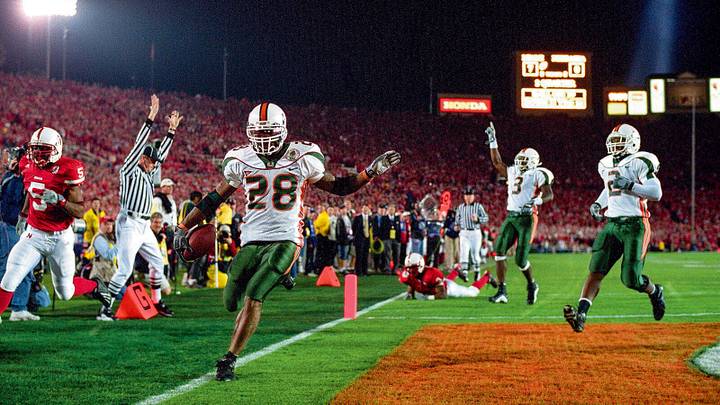
1. 2001 Miami Hurricanes (12–0)
It’s hard to believe, but there were actually a lot of question marks surrounding Miami entering the 2001 season. Coach Butch Davis seemed destined to remain at Miami for the long haul after resurrecting the scandal-ridden program and turning it into a perennial winner once again. Only Davis, after weeks of denying he’d leave Miami for the Cleveland Browns head coaching job, departed the program in January.
Then, something remarkable happened.
Miami players banded together and pushed then-athletic director Paul Dee to promote Larry Coker from offensive coordinator to head coach, which Dee eventually did. Coker’s familiarity with the players would be a boon for the close-knit team. Two games in particular really tell the story of this Hurricanes team.
The season began with a trip to Penn State to face the unranked Nittany Lions. Miami linebacker D.J. Williams believed the hosts were too confident ahead of their game against the then-No. 2 Canes.
“We felt very disrespected, for the simple fact that we were coming into the season highly ranked, and they had a White Out game,” Williams told ESPN. “And whenever you do stuff like that, you believe you’re going to win.”
The Hurricanes took it personally, pouncing on the Nittany Lions and taking a 30–0 lead into the locker room, effectively ending the game at the break.
Fast forward to Week 5, another defining moment of the season for the legendary squad. Miami was set to take on No. 14 Florida State, whom it had beaten in the regular season the previous year. The programs finished with identical records, but the BCS system picked the Seminoles to play in the title game, snubbing the Hurricanes and placing an enormous chip on their shoulders in the process.
Miami raced out to a 21–0 lead, but the defense let up on the gas pedal at the end of the first half, allowing Florida State to score 13 points and pick up some momentum heading into the locker room.
Hurricanes safety Ed Reed wasn’t having it. In an iconic halftime speech, Reed took his teammates to task for not dominating the Seminoles.
Miami came out of the locker room and rolled to a 49–27 win.
After surviving tough road tests at Boston College and Virginia Tech, Miami breezed past No. 4 Nebraska in the Rose Bowl to capture the national title. The Hurricanes defeated opponents that year by an average of 33.8 points. The program had a staggering amount of depth, as evidenced by its 38 NFL draft picks, 17 of which were first-rounders.
But more than any numbers, the Hurricanes were defined by accountability, resilience, discipline and an insatiable desire to win. —T.C.
SI writers Pat Forde and Bryan Fischer contributed to these rankings.
PODCAST: Listen to Sports Illustrated’s college sports podcast, Others Receiving Votes, hosted by Pat Forde, on Apple and Spotify. Watch the show on SI’s college YouTube channel or on SI TV.
 Add us as a preferred source on Google
Dan Lyons is a staff writer and editor on Sports Illustrated's Breaking and Trending News team. He joined SI for his second stint in November 2024 after a stint as a senior college football writer at Athlon Sports, and a previous run with SI spanning multiple years as a writer and editor. Outside of sports, you can find Dan at an indie concert venue or movie theater.

Patrick Andres is a staff writer on the Breaking and Trending News team at Sports Illustrated. He joined SI in December 2022, having worked for The Blade, Athlon Sports, Fear the Sword and Diamond Digest. Andres has covered everything from zero-attendance Big Ten basketball to a seven-overtime college football game. He is a graduate of Northwestern University's Medill School of Journalism with a double major in history .
Follow PAndres2001
Tim Capurso is a staff writer for Sports Illustrated, primarily covering MLB, college football and college basketball. Before joining SI in November 2023, Capurso worked at RotoBaller and ClutchPoints and is a graduate of Assumption University. When he's not working, he can be found at the gym, reading a book or enjoying a good hike. A resident of New York, Capurso openly wonders if the Giants will ever be a winning football team again.
Follow TimCapurso