%20%20--%3E%0A%3Csvg%20version%3D%221.1%22%20id%3D%22Layer_1%22%20xmlns%3D%22http%3A%2F%2Fwww.w3.org%2F2000%2Fsvg%22%20xmlns%3Axlink%3D%22http%3A%2F%2Fwww.w3.org%2F1999%2Fxlink%22%20x%3D%220px%22%20y%3D%220px%22%0A%09%20width%3D%2239px%22%20height%3D%2240px%22%20viewBox%3D%220%200%2039%2040%22%20enable-background%3D%22new%200%200%2039%2040%22%20xml%3Aspace%3D%22preserve%22%3E%0A%3Cpath%20fill%3D%22%23FFFFFF%22%20d%3D%22M38.5%2C7H28.2v26h10.3V7z%22%2F%3E%0A%3Cpath%20fill-rule%3D%22evenodd%22%20clip-rule%3D%22evenodd%22%20fill%3D%22%23FFFFFF%22%20d%3D%22M26.1%2C25.5c0%2C5.8-4.1%2C7.5-12.9%2C7.5C3.9%2C33%2C0%2C31.2%2C0%2C25.2v-1.1h11.6%0A%09v2.4c0%2C0.7%2C0.1%2C1.4%2C1.2%2C1.4c1%2C0%2C1.2-0.4%2C1.2-1.3v-0.9c0-1.6-0.9-1.6-3.5-2.2C2.2%2C21.7%2C0%2C19.7%2C0%2C15.3v-0.9C0%2C9.3%2C5.5%2C7%2C12.9%2C7%0A%09c10.2%2C0%2C12.8%2C2.6%2C12.8%2C7.4v1.8h-11v-2.9c0-0.6-0.4-1.1-1.2-1.1c-0.6%2C0-1.2%2C0.4-1.2%2C1.1v0.9c0%2C1.5%2C0.9%2C2%2C3.3%2C2.5%0A%09c8%2C1.6%2C10.5%2C3.3%2C10.5%2C7.5V25.5z%22%2F%3E%0A%3C%2Fsvg%3E%0A)
Forde-Yard Dash: 10 Biggest Power Brokers in the College Football Playoff Race
In this story:
Forty names, games, teams and minutiae making news in college football, where last week’s helmet contrast in the Western Kentucky–Delaware game was an all-timer. First Quarter: The Vanishing Difference Between Hero and Bum. Second Quarter: The Collapse—and Potential Rebuild—of Florida State.
Third Quarter: The 10 Main Characters in Decision ’26
The first College Football Playoff rankings roll out Tuesday night, alongside voter tallies of lesser importance from around the nation. Which means it is time for the sport to venture down its version of the campaign trail. The Dash looks at the people who will bear the biggest weight over the weeks between now and Selection Sunday.
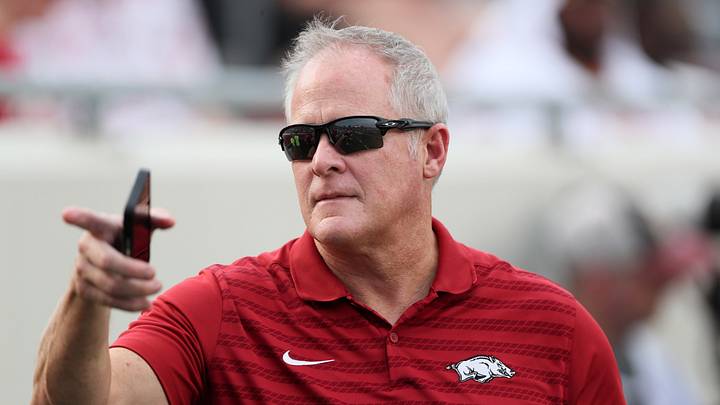
Hunter Yurachek (21), Arkansas athletic director and CFP selection committee chair
When 2025 chair Mack Rhoades went on a leave of absence late in the season, Yurachek earned a battlefield promotion into arguably the worst job in the sport—having to explain the committee’s logic on live TV and in a subsequent media call. Now he’s back in the hot seat again.
Having done mock selection exercises before, here’s the inherent difficulty of that duty: After two days of scrubbing résumés and staring at numbers, your brain is pretty scrambled. The resulting rankings may make sense, but trying to articulate exactly how the sausage came to be put in the casing and on the platter is not easy. Especially when the questions can come in from very specified interests—Why is Houston ranked behind Tennessee?—that may not be top of mind in that moment.
That said, the committee chair over the years has had some pretty nonsensical answers. Notable from Yurachek last year: his tortured explanation for how Alabama barely getting by 5–7 Auburn vaulted the Crimson Tide ahead of Notre Dame.
“It’s just Alabama in a rivalry game on the road. Auburn has been an extremely tough place to play for many teams this year, such as Georgia and Vanderbilt, and the committee gave Alabama a little respect for winning that game, getting out early 17–0. The game got tied again, and Alabama, a gutsy call there late in the game to go for it on fourth-and-2 and then getting a turnover again late in the game. The committee just felt like that was enough of a win, of a metric, to push Alabama ahead of Notre Dame.”
The problem: Auburn was 3–4 at home last season, and its game against Vanderbilt was on the road. Crediting Alabama with “guts” for a fourth-down call also doesn’t seem like the kind of thing that should affect a team’s playoff standing.
The problems tend to come when the committee chair: A. Talks too much, B. Tries to sound like a Football Guy, and C. Cites something that should be immaterial to the rankings. Best general answer to most of the questions: “The committee believes Team X’s résumé merits that particular ranking.”
Godspeed, Hunter.
Greg Sankey (22), SEC commissioner
The strength-of-schedule drumbeat has begun from Just Means More Territory. An email went out last week from the conference noting the league’s 10–2 record against other Power 4 conferences, and prominent standing in various ESPN metrics. Pushy? Perhaps. Accurate? Without question.
The SEC put together the best nonconference results of any league by a wide margin. (Unfortunately the sample size is pretty small, since all the Power 4 teams would rather play Kent State and Samford than multiple nonconference games against each other.) The league’s middle and lower tiers are probably as good as they’ve ever been, but what about the top?
The committee’s single most difficult job will be ranking the SEC’s multi-loss teams—there are eight of them either 6–2 or 5–3—and deciding where they stand against the rest of the sport. Expect to see Sankey pop up on The Paul Finebaum Show repeatedly in the coming weeks to reinforce talking points.
Tony Petitti (23), Big Ten commissioner
Fortunately, we can wait until next year for Petitti to explain why 4–4 Penn State is a perfect candidate for the No. 23 seed in the very exciting 24-team playoff. But here and now, he (or his staff) will likely be doing some lobbying of their own for more than three bids. At this rate, though, the conference’s best argument for that is to fall back on past results—winning three straight national championships with three different schools. As it stands now, the third-place team in the league has a major quarterback issue (see below) and the fourth-place team swapped out a game against Notre Dame in favor of a nonconference slate of San José State, Louisiana and Fresno State.
Luke Fahey (24), Ohio State quarterback
And by extension, coach Ryan Day and offensive coordinator Arthur Smith. To be clear, Fahey was not the Buckeyes’ biggest problem in their dud of a performance at USC on Saturday. His first college start was pretty good—the freshman didn’t make any catastrophic errors and never seemed overwhelmed by the stage. It was more a factor of defensive breakdowns and critical pre-snap penalties on the offensive line.
But if Ohio State’s résumé reads 0–1 in terms of the team it could field in the playoff, it probably needs to win out—and the rest of the defenses Fahey will face are tougher. In terms of yards allowed per play, USC ranks 14th in the Big Ten; upcoming opponents are Oregon (10th), Northwestern (12th), Nebraska (seventh) and Michigan (third). Fahey and his teammates have to keep improving in November or the preseason No. 1 team could miss the playoff.

Corey Hetherman (25), Miami defensive coordinator
The nation’s No. 1 team has a growing weakness, and it’s Hetherman’s side of the ball. The Hurricanes have given up 93 points and more than 1,200 yards in their last three games to teams quarterbacked by Billy Edwards Jr. (North Carolina), Holden Geriner (Pittsburgh) and Ashton Daniels (Florida State). Miami is 89th nationally in pass efficiency defense against FBS opponents. To land a potential No. 1 seed, the Canes might need to outscore everyone between now and Selection Sunday.
They can lose Saturday to Notre Dame and still make the playoff. A second loss could make it dicey. The Wake Forest win is doing a lot of work in an otherwise unremarkable résumé.
Mike Shanahan (26), Indiana offensive coordinator
No highly ranked team has a more demonstrable issue than the Hoosiers’ quarterback play. Josh Hoover has played hurt and been ineffective. It’s hard to know which of those two factors led to seventh-year backup Grant Wilson (who started his career at Fordham in 2020) taking over in the second half of the latest great escape, against Minnesota. But this week’s open date will be critical for Indiana to get healthy or get better at that position.
The Hoosiers have averaged 17.8 points over the last four games, just 14.3 in regulation. Their defense and resourcefulness have led to wins in three of those four, but they are walking on a knife’s edge every game. Sixty-yard field goals by a former Gaelic football player from Ireland are not a sustainable victory plan.
Joey McGuire (27), Texas Tech coach
McGuire changed quarterbacks after being routed at Cincinnati and got the desired result from dual-threat backup Thomas Castellanos—117 rushing yards, 144 passing and three touchdowns in a bounce-back win over Arizona. Next opponent West Virginia has a horrible run defense, so that should be a Castellanos game as well. Eventually, though, does McGuire go back to starter Will Hammond? Or have the Red Raiders reinvented their offensive identity on the fly for the rest of the season? With a 7–1 record and no games against BYU or Utah, there is a path to the Big 12 title game and back to the CFP. But a second loss could easily put Tech on the wrong side of the bubble.
Kirby Smart (28), Georgia coach
Smart could hold the fate of several SEC bubble teams in his hands. He already imperiled 5–3 Florida with a thumping Saturday. Next comes 6–2 Mississippi, followed by 6–2 Missouri and 5–3 South Carolina. If any of them upset the Bulldogs, it could be the quality win that vaults them into the bracket. If they all lose to Georgia, the SEC’s hopes for four or more bids could take a hit.
Marcus Freeman (29), Notre Dame coach
After last year’s snub, the theme was “Leave No Doubt.” After the close loss to BYU, there is doubt. That raises the stakes on an already hugely anticipated game Saturday against No. 1 Miami—the team that lobbied hard for its playoff inclusion over the Fighting Irish in 2025 based on head-to-head victory.
Beat the Hurricanes and take care of business against Boston College, SMU and Syracuse and the Irish are in, likely with a first-round bye. Lose to the Hurricanes and the Irish slip back into the anxious territory they inhabited last year at this time.
Max Cutforth (30), Boise State quarterback
The backup to Maddux Madsen had a star turn off the bench in the Broncos’ rally to beat Texas State on Saturday, but more could be needed of him down the stretch in the race for the Group of 6 automatic bid. Cutforth got extensive experience last year and performed capably, so it’s not like Boise State is doomed if he has to be its QB the rest of the way. But the Group of 6 bid is something of a beauty contest, and it would help if Cutforth plays beautiful football while keeping Boise State on the inside track for that bid.
PODCAST: Listen to Sports Illustrated’s college sports podcast, Others Receiving Votes, hosted by Pat Forde, on Apple and Spotify. Watch the show on SI’s college YouTube channel or on SI TV.
 Add us as a preferred source on Google

Pat Forde is a senior writer for Sports Illustrated who covers college football and college basketball as well as the Olympics and horse racing. He cohosts the Others Receiving Votes podcast for SI and is a regular contributor to the Tony Kornheiser Show podcast. He previously worked for Yahoo Sports, ESPN and The (Louisville) Courier-Journal. Forde has won 28 Associated Press Sports Editors writing contest awards, has been published three times in the Best American Sports Writing book series, and was nominated for the 1990 Pulitzer Prize. A past president of the U.S. Basketball Writers Association and member of the Football Writers Association of America, he lives in Louisville with his wife. They have three children, all of whom were collegiate swimmers.
Follow ByPatForde