%20%20--%3E%0A%3Csvg%20version%3D%221.1%22%20id%3D%22Layer_1%22%20xmlns%3D%22http%3A%2F%2Fwww.w3.org%2F2000%2Fsvg%22%20xmlns%3Axlink%3D%22http%3A%2F%2Fwww.w3.org%2F1999%2Fxlink%22%20x%3D%220px%22%20y%3D%220px%22%0A%09%20width%3D%2239px%22%20height%3D%2240px%22%20viewBox%3D%220%200%2039%2040%22%20enable-background%3D%22new%200%200%2039%2040%22%20xml%3Aspace%3D%22preserve%22%3E%0A%3Cpath%20fill%3D%22%23FFFFFF%22%20d%3D%22M38.5%2C7H28.2v26h10.3V7z%22%2F%3E%0A%3Cpath%20fill-rule%3D%22evenodd%22%20clip-rule%3D%22evenodd%22%20fill%3D%22%23FFFFFF%22%20d%3D%22M26.1%2C25.5c0%2C5.8-4.1%2C7.5-12.9%2C7.5C3.9%2C33%2C0%2C31.2%2C0%2C25.2v-1.1h11.6%0A%09v2.4c0%2C0.7%2C0.1%2C1.4%2C1.2%2C1.4c1%2C0%2C1.2-0.4%2C1.2-1.3v-0.9c0-1.6-0.9-1.6-3.5-2.2C2.2%2C21.7%2C0%2C19.7%2C0%2C15.3v-0.9C0%2C9.3%2C5.5%2C7%2C12.9%2C7%0A%09c10.2%2C0%2C12.8%2C2.6%2C12.8%2C7.4v1.8h-11v-2.9c0-0.6-0.4-1.1-1.2-1.1c-0.6%2C0-1.2%2C0.4-1.2%2C1.1v0.9c0%2C1.5%2C0.9%2C2%2C3.3%2C2.5%0A%09c8%2C1.6%2C10.5%2C3.3%2C10.5%2C7.5V25.5z%22%2F%3E%0A%3C%2Fsvg%3E%0A)
Forde-Yard Dash: If the SEC Kicks Out LSU, Where Do the Tigers Go?
In this story:
Forty names, games, teams and minutiae making news in college football, where Arch Manning took a sack before the first snap of the season. First Quarter: All the Problems With the Bail Mary in the Big House. Second Quarter: Debut Reviews.
Third Quarter: What to Do With Your Problematic League Member
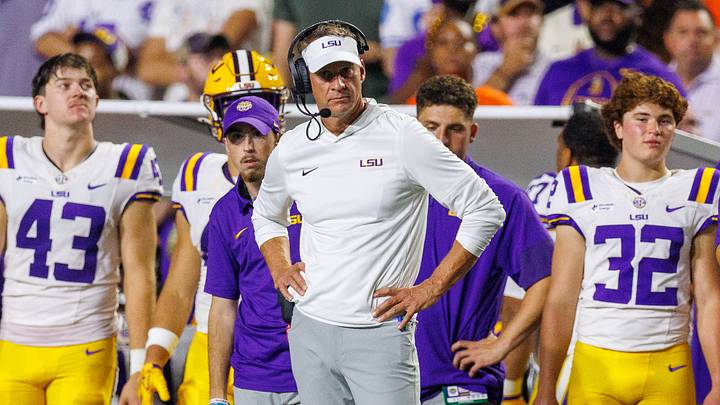
You may have heard that the SEC is threatening the nuclear option with its most rogue member, LSU (21). A previously scheduled meeting of conference presidents and chancellors has been amended to include discussion about booting the Tigers out of the league.
When you are the readily identifiable corruption leader in the SEC, of all places, you’ve really done something. LSU has earned that lofty title, between all the legal fights, eligibility shenanigans and other outrages across multiple sports. The provocations include taking the SEC to court to directly refute its rules, and now SEC leadership is working to reassert its right to apply those rules.
From the SEC’s amended complaint filed in federal court in Birmingham on Tuesday: “... [T]he consensus of the [league] CEOs was and continues to be that LSU’s continued membership in the conference would be inconsistent with the publicly stated values and principles of the conference and its remaining member institutions …” That is a high-payload sentence.
Rhetorically and procedurally, holding a formal discussion about expelling a conference member is a major escalation. Will there be an actual vote? That would be a shock.
In the long and shady history of college athletics, schools have maintained league affiliation through some terrible scandals—consider the fact that Penn State is still in the Big Ten and Baylor is still in the Big 12, for starters. And the SEC is arguably the most scandal-scarred league of them all. Impossible to foresee it suddenly finding religion and jettisoning LSU, which is a charter member and a highly successful one.
Louisiana Gov. Jeff Landry weighed in with a comment to Yahoo Sports on the showdown, saying, “Ridiculous. Can we just play football?” But let’s face it, one of the reasons why LSU is in this situation is because the governor feels compelled to interject himself in the school’s athletics.
One SEC source referred to the meeting as “applying a pressure point” to LSU. But the source warned not to entirely dismiss the remote possibility of drastic action. At the very least, this seems to offer another step toward an SEC self-governance model, applying its own rules outside of what other NCAA members are doing. Several prominent administrators in the league have been pushing for that for more than a year.
Regardless, this got The Dash to thinking about everyone’s favorite bar napkin exercise, realigning conferences based on whim. Specifically: If LSU were cut loose, where would it go?
Never underestimate the Big Ten’s bottom-line hunger for profit maximization, but that would be a tough fit on numerous fronts. The Big 12 makes the most sense, with Brett “Open For Business” Yormark in need of a bell cow football program. The ACC would probably also be interested, if its members could wrap their arms around inviting in a school that is hardwired to cause problems. (But also bring TV eyeballs and win stuff.)
For the purpose of this exercise, let’s send LSU to the Big 12, where Landry can posture and pot-stir with Cody Campbell and Texas Tech (22). Then what does the SEC do?
Here’s what doesn’t happen: adding Florida State (23) or Clemson (24), two schools being beaten to a bloody pulp by karma a couple years after filing their own suits against their league, the ACC. Boy howdy, how times have changed since they declared themselves—FSU loudly, Clemson quietly—too good for that conference.

The Seminoles have fallen and cannot get up, with an 8–19 record since being snubbed for the 2024 College Football Playoff. What the program put on display Monday night was especially embarrassing—a delay of its ACC opener against SMU for about 100 minutes due to a power outage at the stadium, followed by another loss. This one came despite a +3 turnover margin (it was +4 until the last play, an intercepted lateral), and it came against an opponent that FSU legally argued against including in the ACC in 2023.
Florida State argued at the time that adding SMU would lower the league’s football media profile as opposed to helping it. The Seminoles are now 0–2 against the Mustangs with both games at home—where hopefully they can keep the lights on for the rest of the season.
Clemson, meanwhile, is also fleeing from relevance at top speed. Nobody had a worse season-opening performance than the Tigers (well, maybe Rutgers), who are trapped in a Dabo Swinney career spiral with no easy way out. The greatest coach in school history, winner of two national championships and earner of seven playoff bids, plummeted to 7–6 last year and could be ticketed for worse this season, after being bludgeoned beyond recognition by LSU.
Even now, after a 51–10 loss that statistically was worse than that, Swinney seems completely unprepared to accept that his way isn’t working. He barked back at beat writer Chapel Fowler of The State Newspaper on Tuesday for asking Swinney whether he regrets his offseason roster construction. While Swinney is correct that his team has 11 more games to play, a 41-point loss to open the season underscores how far the program has slipped from the days when it competed for national championships.
Of course, current struggles are not the only reason Florida State and Clemson wouldn’t get into the SEC. Current league members Florida and South Carolina are as well. Why should they be accomplices in helping their in-state rivals elevate their conference affiliation?
So let’s theorize that the SEC would look elsewhere. (And no, the Big Ten wants neither FSU nor Clemson, either.) The long-speculated first choice would be North Carolina (25), which checks a lot of boxes. One that it historically has not: football prowess, which is why the Tar Heels took a big swing on former NFL coaching legend Bill Belichick. So far, Chapel Bill is 5–8 and overseeing a toxic dump off the field, with his handpicked general manager resigning and his defensive coordinator son on medical leave, with an alarming report about the ongoing independent investigation into the program.
Even with a surprising 1–0 start on the season, there seems to be mounting evidence that hiring Belichick and giving him free rein was a massive mistake.
If that’s enough to avert the SEC’s eyes elsewhere, what about the other half of the presumed ACC desired duo, Virginia (26)? The Cavaliers are on a football upswing and very solid in men’s basketball. Adding them, but not North Carolina, would still maintain one of Greg Sankey’s favorite expansion bragging points compared to other leagues—the SEC is comprised of schools in contiguous states. (Virginia borders both Tennessee and Kentucky.)
Miami (27) would assuredly like a word as well. The Hurricanes have trended back to elite status in football and boast other quality programs, including men’s basketball. They are aggressively marketing their academic brand as well. And SMU (28), after money-whipping its way into the ACC, wouldn’t be above trying to do the same to the SEC.
Both would likely face resistance, possibly heavy. So on The Dash napkin, let’s divide it up thusly:
- SEC: LSU out, North Carolina in.
- Big 12: LSU in, Florida State in, Clemson in. Nobody out.
- ACC: North Carolina, FSU and Clemson out. Maryland (29) comes home and Rutgers (30) comes to its senses, jumping to the ACC before being kicked out of the Big Ten. Stanford and California contemplate going back to the rebuilt Pac-12. Connecticut and West Virginia keep their noses pressed against the glass at ACC headquarters, just in case someone takes pity and lets them in.
PODCAST: Listen to Sports Illustrated’s college sports podcast, Others Receiving Votes, hosted by Pat Forde, on Apple and Spotify. Watch the show on SI’s college YouTube channel or on SI TV.
 Add us as a preferred source on Google
Pat Forde is a senior writer for Sports Illustrated who covers college football and college basketball as well as the Olympics and horse racing. He cohosts the Others Receiving Votes podcast for SI and is a regular contributor to the Tony Kornheiser Show podcast. He previously worked for Yahoo Sports, ESPN and The (Louisville) Courier-Journal. Forde has won 28 Associated Press Sports Editors writing contest awards, has been published three times in the Best American Sports Writing book series, and was nominated for the 1990 Pulitzer Prize. A past president of the U.S. Basketball Writers Association and member of the Football Writers Association of America, he lives in Louisville with his wife. They have three children, all of whom were collegiate swimmers.
Follow ByPatForde