%20%20--%3E%0A%3Csvg%20version%3D%221.1%22%20id%3D%22Layer_1%22%20xmlns%3D%22http%3A%2F%2Fwww.w3.org%2F2000%2Fsvg%22%20xmlns%3Axlink%3D%22http%3A%2F%2Fwww.w3.org%2F1999%2Fxlink%22%20x%3D%220px%22%20y%3D%220px%22%0A%09%20width%3D%2239px%22%20height%3D%2240px%22%20viewBox%3D%220%200%2039%2040%22%20enable-background%3D%22new%200%200%2039%2040%22%20xml%3Aspace%3D%22preserve%22%3E%0A%3Cpath%20fill%3D%22%23FFFFFF%22%20d%3D%22M38.5%2C7H28.2v26h10.3V7z%22%2F%3E%0A%3Cpath%20fill-rule%3D%22evenodd%22%20clip-rule%3D%22evenodd%22%20fill%3D%22%23FFFFFF%22%20d%3D%22M26.1%2C25.5c0%2C5.8-4.1%2C7.5-12.9%2C7.5C3.9%2C33%2C0%2C31.2%2C0%2C25.2v-1.1h11.6%0A%09v2.4c0%2C0.7%2C0.1%2C1.4%2C1.2%2C1.4c1%2C0%2C1.2-0.4%2C1.2-1.3v-0.9c0-1.6-0.9-1.6-3.5-2.2C2.2%2C21.7%2C0%2C19.7%2C0%2C15.3v-0.9C0%2C9.3%2C5.5%2C7%2C12.9%2C7%0A%09c10.2%2C0%2C12.8%2C2.6%2C12.8%2C7.4v1.8h-11v-2.9c0-0.6-0.4-1.1-1.2-1.1c-0.6%2C0-1.2%2C0.4-1.2%2C1.1v0.9c0%2C1.5%2C0.9%2C2%2C3.3%2C2.5%0A%09c8%2C1.6%2C10.5%2C3.3%2C10.5%2C7.5V25.5z%22%2F%3E%0A%3C%2Fsvg%3E%0A)
Pat Forde: Why Indiana’s Loss to Ohio State Was a Milestone for the Hoosiers
In this story:
BLOOMINGTON, Ind. — Indiana football has crossed the last threshold. It arrived Saturday as a big, serious, victory-or-else program. The final evidence was audible in a Memorial Stadium stairwell walking down to ground level.
“Two million dollars,” a man barked, his words echoing off the concrete walls.
“I could have f---ing caught that inbounds,” a woman yelled back to him over her shoulder.
“Butt naked, wide f---ng open,” he responded. “I’m so sick of this NIL s---.”
Outside the stadium, another fan could be heard ripping the placekicker. Someone else groused about high throws by the quarterback. Nobody, at least, was calling for Curt Cignetti’s head.
It’s one thing to go 16–0 and win a national title, to rack up a 22-game winning streak, to become the most astounding success story in college football history. But to truly enter elite status, you need your fans to adopt the mindset of a blueblood. You need them to be sailor-cussing apoplectic after a narrow loss as an underdog to a historic giant.
Here the Hoosiers are, after a Saturday that looked and felt like what you’d see in Tuscaloosa, Ala., or Austin or, yes, Columbus, Ohio. They’re now 6–1 after a 19–15 defeat against Ohio State in what was either the biggest or second-biggest home game in school history. (The 1967 upset of rival Purdue to clinch the program’s first Rose Bowl bid would like a word.)
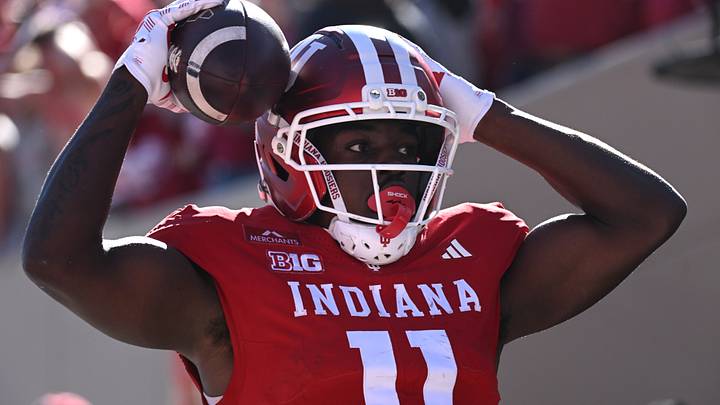
The loss was sealed by a toe-tap gone wrong, when the left foot of receiver Nick Marsh landed just out of bounds with what could have been the winning touchdown catch. It was Indiana’s anti–Omar Cooper Jr. moment. That was an impossible 2025 catch to defeat Penn State and sustain an undefeated season; this was a very manageable catch that became an incomprehensible incompletion.
Josh Hoover finds Nick Marsh - BUT HE'S OUT OF BOUNDS pic.twitter.com/WCcs1mUefF
— FOX College Football (@CFBONFOX) October 17, 2026
The result caught most everyone in the stadium by surprise, including the game operations crew. They shot off fireworks over the south end zone to celebrate. Whoops.
This was a potentially pyrrhic victory for Ohio State, which lost 2025 Heisman Trophy finalist quarterback Julian Sayin to a shoulder injury that coach Ryan Day said will sideline him “several weeks.” With the national picture teetering toward mayhem, the 6–1 Buckeyes are now one more uncertainty. But the way it was decided also stung the home team deeply.
As the fuming fan in the stairwell noted, Marsh was indeed wide open on the decisive play. (The Michigan State transfer’s NIL paycheck is reportedly half the fan’s alleged $2 million, though.) This was an unexpected deliverance, a seemingly easy shot to cap another Indiana comeback and win a dogfight of a game.
Seeing the Buckeyes lined up for a full-house blitz on fourth-and-4 from the Ohio State 27-yard line with 1:07 left, quarterback Josh Hoover checked to a streak by Marsh. He burned Buckeyes defensive back Cam Calhoun off the line of scrimmage and sprinted to the end zone, needing only to safely haul in the Hoover spiral that arched down through the blue Indiana sky.
Instead, his white cleat came down on the white sideline.
Marsh revealed the truth himself. He immediately put his hands on his helmet, an oh-no gesture. He then briefly tried to recover, sticking his arms in the air to half-heartedly signal touchdown, but gave up the act. The officials signaled the truth.
No touchdown. Incomplete pass. Game effectively over.

“We had it and we just didn’t make it happen,” Cignetti said, carefully avoiding mentioning any specific players. “So it’s a hard one to swallow.”
Marsh had made a more difficult, contested touchdown catch earlier in the fourth quarter to get the Hoosiers back in the game. With 32 catches for nearly 600 yards and seven touchdowns, he’s been a productive sidekick to stellar wideout Charlie Becker. But when your foot comes down six inches wide, an entire fan base collapses.
This is college football.
Indiana’s historic penchant for self-destruction had been eradicated by Cignetti over 2 ½ miraculous seasons, with 33 wins in 35 games heading into Saturday. The reigning national champions had crossed off everything on the rising blueblood checklist prior to Saturday. All that remained was to play a legitimately massive home game.
As the story goes, Indiana at one point (maybe more than once) commissioned an aerial photographer to get overhead shots of Memorial Stadium when Ohio State came to town. The reason: The stadium was full and everyone was wearing red. The reality: At least half those fans were wearing Ohio State scarlet, not Indiana crimson. But from thousands of feet up, it all looked roughly the same and made for a good publicity shot.
For decades, the Buckeye horde invaded this football-indifferent town and took over. The results on the field followed accordingly: Indiana entered Saturday 2-30-1 at home against Ohio State, with the only victories in 1988 and 1904.
How comfortable were the Buckeyes in Bloomington? Thirty years ago, after defeating Indiana 17–10 to clinch the Big Ten championship, their fans rushed the field and tore down one of the goalposts. Indiana athletic director Clarence Doninger sent Ohio State a bill for that one.
The scene here this weekend was the same, but also drastically different—downtown was mobbed as usual the day before an Indiana–Ohio State game, but this was no longer a Buckeye takeover. The Hoosiers kept their tickets and filled the bars, hotels and stadium seats themselves.

By 5 p.m. Friday, the lines were long all over Kirkwood Avenue—outside Nick’s English Hut, Kilroy’s and The Upstairs Pub. There were some Ohio State fans among them, because they travel like nobody else. But mostly this was a home-team crowd—and almost all of them were wearing fresh gear that commemorated last year’s national title or Big Ten title.
Ohio State has won far more championships. But Indiana owns the most recent hardware. Bragging rights are an of-the-moment thing, and the Hoosiers had them right up until kickoff.
“Buckle up Buckeyes, this is Hoosier Country,” read the marquee on the Indiana Theater. Various businesses co-opted Cignetti’s trademark “google me” boast as part of their signage. An expansive mural on the wall of a downtown building features Fernando Mendoza’s immortal, lunging touchdown in the title game and a rendition of Cig’s meme-spawning scowl.
At The Indiana Shop, a Hoosier spirit wear outlet, the hot-selling items have all changed radically since 2024.
“We sell way more football stuff than basketball now,” says one of the store clerks.
“It’s totally switched around,” says another. “Which is crazy.”
The walls in Nick’s reflect the generational pecking order, with pictures of the 1936 Big Ten basketball co-champions and the ’53 national champions. But the times are changing.
Indiana students once lined up for hours outside Assembly Hall, the hoops venue, waiting to get in for hot-blooded rivalry games against Purdue. Saturday morning, they were camped out before dawn on Kirkwood to get breakfast beers before heading to Fox’s Big Noon Kickoff stage.
They flooded into student seating when the stadium gates opened at 10:30. No late arrivals for this one. By kickoff, every seat was full—and the only discernible shade of red was crimson. The most honest aerial publicity shot in school history was laid out below.
The foundation of Cignetti’s success at Indiana has been a maniacal devotion to clean football. Penalties are scarce, turnovers scarcer. In general, errors are anathema. Nobody is better at not betting themselves than the Hoosiers.
Yet the most buttoned-up program in America was uncharacteristically error-prone Saturday. After 1,460 consecutive offensive snaps without a lost fumble, dating back to the first quarter of the first game of 2025, the Hoosiers coughed two of them. They were flagged for 42 yards in penalties after coming in averaging 28.8 per game, fourth best in the nation. They missed a pair of field goals. And then Marsh’s foot came down on the wrong side of victory.
“Shoot, it’s a game of inches, right?” Hoover said. “I think Nick played awesome today. I’m so proud of him. And unfortunately the last play when it comes down like that, it does stink. But we ran 75 plays and we had a lot of opportunities to score at other moments.”
This is achingly true. The game’s biggest turning point, prior to the final one: Leading 7–3 late in the first half, Hoover did not see tight end Brock Schott breaking wide open in the end zone and threw elsewhere, into traffic, for an incomplete pass. On the following play, kicker Nico Radicic clanged a short field goal off the upright. Radicic also missed a 55-yard bomb (a lot to ask), and uncertainty about his reliability might have led Cignetti to go for at least one fourth down on the edge of field goal range.

Yet Indiana’s mettle was evident as the game wore on. The defense stubbornly stopped Ohio State drives and knocked Sayin out of the game. (Perhaps out of the entire season, which could leave the Buckeyes’ national title hopes in the hands of freshman Luke Fahey.) The offense made enough plays to be in position to win, despite a day of erratic accuracy from Hoover.
This looked like another Indiana great escape, like the comebacks at Iowa and Penn State last year and the rally last week at Nebraska. From 12 points down in the fourth quarter to a ball in the air for the win, it was all right there for the tanning. Until a white shoe came down on white turf, instead of green.
“Sun comes up tomorrow,” Cignetti said firmly.
It comes up on a world in which Indiana fans have now crossed the final frontier into heavyweight program territory. The fans are fuming that they lost to almighty Ohio State.
PODCAST: Listen to Sports Illustrated’s college sports podcast, Others Receiving Votes, hosted by Pat Forde, on Apple and Spotify. Watch the show on SI’s college YouTube channel or on SI TV.
 Add us as a preferred source on Google
Pat Forde is a senior writer for Sports Illustrated who covers college football and college basketball as well as the Olympics and horse racing. He cohosts the Others Receiving Votes podcast for SI and is a regular contributor to the Tony Kornheiser Show podcast. He previously worked for Yahoo Sports, ESPN and The (Louisville) Courier-Journal. Forde has won 28 Associated Press Sports Editors writing contest awards, has been published three times in the Best American Sports Writing book series, and was nominated for the 1990 Pulitzer Prize. A past president of the U.S. Basketball Writers Association and member of the Football Writers Association of America, he lives in Louisville with his wife. They have three children, all of whom were collegiate swimmers.
Follow ByPatForde