%20%20--%3E%0A%3Csvg%20version%3D%221.1%22%20id%3D%22Layer_1%22%20xmlns%3D%22http%3A%2F%2Fwww.w3.org%2F2000%2Fsvg%22%20xmlns%3Axlink%3D%22http%3A%2F%2Fwww.w3.org%2F1999%2Fxlink%22%20x%3D%220px%22%20y%3D%220px%22%0A%09%20width%3D%2239px%22%20height%3D%2240px%22%20viewBox%3D%220%200%2039%2040%22%20enable-background%3D%22new%200%200%2039%2040%22%20xml%3Aspace%3D%22preserve%22%3E%0A%3Cpath%20fill%3D%22%23FFFFFF%22%20d%3D%22M38.5%2C7H28.2v26h10.3V7z%22%2F%3E%0A%3Cpath%20fill-rule%3D%22evenodd%22%20clip-rule%3D%22evenodd%22%20fill%3D%22%23FFFFFF%22%20d%3D%22M26.1%2C25.5c0%2C5.8-4.1%2C7.5-12.9%2C7.5C3.9%2C33%2C0%2C31.2%2C0%2C25.2v-1.1h11.6%0A%09v2.4c0%2C0.7%2C0.1%2C1.4%2C1.2%2C1.4c1%2C0%2C1.2-0.4%2C1.2-1.3v-0.9c0-1.6-0.9-1.6-3.5-2.2C2.2%2C21.7%2C0%2C19.7%2C0%2C15.3v-0.9C0%2C9.3%2C5.5%2C7%2C12.9%2C7%0A%09c10.2%2C0%2C12.8%2C2.6%2C12.8%2C7.4v1.8h-11v-2.9c0-0.6-0.4-1.1-1.2-1.1c-0.6%2C0-1.2%2C0.4-1.2%2C1.1v0.9c0%2C1.5%2C0.9%2C2%2C3.3%2C2.5%0A%09c8%2C1.6%2C10.5%2C3.3%2C10.5%2C7.5V25.5z%22%2F%3E%0A%3C%2Fsvg%3E%0A)
Ranking the 12 Best Home Field Advantages in College Football
In this story:
There’s nothing quite like the lead-up to a big college football game. Whether it’s the sizzling smells of food cooking up on tailgate grills, the rowdy student sections ready to unleash pandemonium or the tried-and-true game-day traditions, the biggest football stadiums in America deliver some of the best atmospheres in sports.
These game-day environments also pose challenges for visiting teams, both strategic and psychological. It’s difficult to quantify home field advantage, but players, coaches and even fans know it when they see it, or rather, feel it.
So with college football back in the swing of things, we thought it would be fun to rank the best home field advantages across the country. We focused on a blend of record, environment and reputation among coaches and players to land these rankings. In honor of this potentially being the final year of a 12-team College Football Playoff, we decided on a ranking of a dozen stadiums, as well as several others who didn’t quite make the cut. These 12 schools stand out for boasting some of the best home field advantages in the sport.
12. Jordan-Hare Stadium, Auburn Tigers
The electricity in Jordan-Hare Stadium sizzled in the 2000s and early 2010s and has fizzled somewhat since as Auburn has fallen on hard times. And yet, the Tigers still routinely rank among the attendance leaders while the program has managed to put a real scare in some of the SEC’s best during the recent lean years: a seven-point loss to No. 1 Georgia in 2023, a four-overtime win over No. 15 Texas A&M in 2024 and losses to No. 11 Oklahoma, No. 9 Texas A&M and No. 10 Georgia by 10 points or less this past season.
It remains a tough place to play, but with a new coach in Alex Golesh and exciting quarterback in Byrum Brown, the Tigers have a chance to restore Jordan-Hare Stadium’s reputation to its former glory.
11. Gaylord Family - Oklahoma Memorial Stadium, Oklahoma Sooners
Gaylord Family Oklahoma Memorial Stadium might not be the biggest in the SEC, but it holds its own in terms of creating an advantage for the Sooners, who have compiled a 38–7 record at home against Power 4 teams and the Group of 6’s best over the last 10-plus years, according to The Athletic.
Beyond the numbers, Oklahoma’s stadium also boasts one of the most iconic and timeless traditions in the sport: the Sooner Schooner, a horse-pulled Conestoga wagon that has raced onto the field before the start of games and after Oklahoma scores since 1964.
Forde-Yard Dash: College Football Playoff Expansion Is the Sport’s Worst Idea Yet
10. Ben Hill Griffin Stadium, Florida Gators
Playing in The Swamp can sometimes feel like getting tossed into a gator pit. The field is a below-ground playing surface surrounded by orange wing walls in a bowl design, trapping noise and giving the sense that the crowd is right on top of you.
Rather than build a new stadium, Florida is planning $1.45 billion renovations to Ben Hill Griffin Stadium for 2030, though the hope among the fans is that the adjustments don’t mess with a good thing. The Gators have ambushed ranked teams at the Swamp in consecutive seasons, No. 9 Ole Miss and No. 22 LSU in 2024, No. 9 Texas last season.
9. Memorial Stadium, Clemson Tigers
The debate about which is the real Death Valley—Clemson or LSU—will seemingly rage on forever. One thing that’s not up for debate is how tough it is to play at Clemson’s Memorial Stadium, routinely cited as one of the most difficult environments in the ACC.
Its reputation certainly took a hit in 2025 after Clemson lost some winnable games at home, but the Tigers own a 26–7 record at the venue over the last five years, a testament to Memorial Stadium’s muscle.

8. Saban Field at Bryant-Denny Stadium, Alabama Crimson Tide
How’s this for a home field advantage? Since 2014, the Crimson Tide are 79–4 at home. Part of the reason for that is the fact that the massive stadium seats 101,821 fans and doesn’t skimp in the sound department. The Crimson Tide faithful at a 2023 game once roared to a decibel level of 113.1, which is roughly as loud as a rock concert or a chain saw in close quarters.
And while seven-time national championship-winning coach Nick Saban no longer paces the sidelines, the Crimson Tide are still as intimidating a draw for a road opponent as any in the country.
7. Rice-Eccles Stadium, Utah Utes
In terms of home field advantages, Rice-Eccles Stadium offers the Utes quite a few. For starters, the stadium sits at 4,600 feet above sea level, which can make a visiting team tire more quickly. Then, there’s The MUSS (Mighty Utah Student Section), one of the most electric and rambunctious student sections in the country that never fails to pack the house. To that end, the Utes have sold out 96 consecutive games at Rice-Eccles.
From 2018 to the early parts of the ’24 season, the Utes dropped just three home games, playing a number of ranked programs during that span. And while the Utes have stumbled at home in recent seasons, there’s a reason new Utah coach Morgan Scalley was told that Rice-Eccles Stadium is the conference’s “loudest” and “toughest” environment by multiple coaches at the Big 12 coaches meetings.
6. Sanford Stadium, Georgia Bulldogs
The biggest advantage Georgia has had in recent years is, of course, its top-to-bottom roster talent, but Sanford Stadium is slept on in terms of its atmosphere, which is hostile and unrelenting, particularly when the Bulldogs defense is bearing down on its opponents.
Georgia has dropped just one game at home in the last three years and had won 34 home games in a row before losing to Alabama by three points at Sanford Stadium last September.
5. Beaver Stadium, Penn State Nittany Lions
If you doubt the atmospheric capabilities of one Beaver Stadium, simply take to YouTube and type in “Mo Bamba Penn State.” The clip that surfaces hearkens back to a 2019 White Out game in Happy Valley between the Nittany Lions and Michigan, in which the visiting Wolverines were forced to burn a timeout on the first play from scrimmage thanks to a cavernous wall of sound from 106,572 strong with Sheck Wes’s 2018 rap anthem blaring from the stadium speakers.
The Nittany Lions have stumbled at home in recent years, but that is the kind of tangible impact Penn State’s home crowd can have on games. It’s a large reason why the program boasts a .785 winning percentage at home in the College Football Playoff era.

4. Kyle Field, Texas A&M Aggies
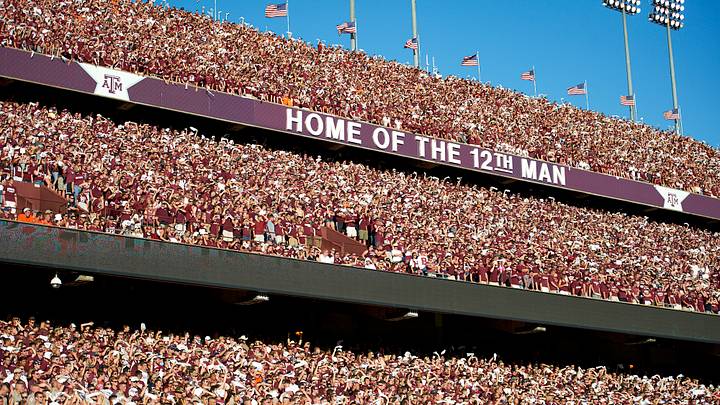
Kyle Field’s—and the 12th Man’s—reputation has taken a bit of a hit after the Aggies dropped three high-profile home games in the last two seasons to Notre Dame, Texas and then Miami in the College Football Playoff. But College Station remains an arduous road trip for visiting teams. Just ask the SEC’s own players, five of whom picked Kyle Field as the toughest and “loudest” road environments in the conference in a July 2026 survey conducted by AL.com.
3. Ohio Stadium, Ohio State Buckeyes
At a capacity of 102,780, Ohio Stadium is the third-largest college football stadium in the country, and while the noise levels can sometimes feel underwhelming for a venue of that size, there is absolutely no doubting the Buckeyes’ home field advantage.
Ohio State simply plays better at Ohio Stadium and has lost just three home games since 2016. Plus, it can get quite loud at The Shoe, particularly when the ever-imaginitive Ohio State marching band is blaring.
NEXT: Ranking the 25 Greatest College Football Teams of All Time
2. Autzen Stadium, Oregon Ducks
Autzen Stadium might be small compared to its peer venues; at a capacity of 54,000 fans it is the smallest stadium on this list. But what it lacks in size it makes up for with one of the most ferocious environments in all of college football.
The Ducks have dropped just two home games since Dan Lanning was hired in 2022 and are among the leaders in opponent pre snap penalties over the last five years. One of the biggest engine-revvers of this stadium? The Oregon Duck, who roars onto the field at the start of games in a Harley Davidson.
1. Tiger Stadium, LSU Tigers
While LSU has stumbled a bit in the 2020s, its reputation at Tiger Stadium, aka Death Valley, hasn’t taken a hit. Death Valley, which seats over 102,000 fans, is known for its deafening noise and intimidating environment—and the numbers back that sentiment up. Since 2000, the Tigers are 154–26 at home, and have particularly owned night games at the venue, when the noise hits another octave after fans have had all day to tailgate and simmer in the emotions of the game.
And while he’s no longer on the field at games, Mike the Tiger, LSU’s live bengal tiger mascot, used to menacingly stalk his enclosure, parked next to the opponent’s locker room, serving as one of many unnerving welcomes to visiting teams.

Honorable Mentions
Neyland Stadium, Tennessee Volunteers
Multiple SEC players told AL.com that Rocky Top was the toughest place to play in the conference.
Husky Stadium, Washington Huskies
How about a 30–4 record at home since 2022? Husky Stadium is slept on.
Galaxy Stadium, Texas Tech Red Raiders
While the infamous tortilla toss is now banned, Texas Tech still boasts an intimidating atmosphere.
NEXT: Ranking the 50 Best College Football Players of All Time
Kinnick Stadium, Iowa Hawkeyes
With seating rows close to the field, it can feel like the Hawkeyes faithful are right on top of opposing players.
Camp Randall Stadium, Wisconsin Badgers
Once House of Pain’s “Jump Around” starts blaring, you know Camp Randall Stadium is about to reach peak decibel levels.
Notre Dame Stadium, Notre Dame Fighting Irish
There have been some stumbles but the Fighting Irish have dropped just two home games in the last two years.
Williams-Brice Stadium, South Carolina Gamecocks
When Williams-Brice is at a full-throated roar, the building can literally shake.
Davis-Wade Stadium, Mississippi State Bulldogs
Davis-Wade Stadium never needs more cowbell and, for one of the smaller SEC stadiums, can create a wall of noise.
Vaught-Hemingway Stadium, Ole Miss Rebels
Vaught-Hemingway will never have a better environment than when Oxford’s most wanted Lane Kiffin comes to town in Week 3 of the 2026 season.
Boone Pickens Stadium, Oklahoma State Cowboys
Birthplace of the “Tarps Off” trend, no one can ever doubt the passion of Oklahoma State fans.
Darrell K. Royal Memorial Stadium, Texas Longhorns
One of the more underrated home field advantages in the country is Darrell K. Royal Memorial Stadium, where Texas is 21–1 in their last 22 games.
Albertsons Stadium, Boise State Broncos
The famous blue turf doesn’t just look cool. Boise State is 218–46 since installing the turf in 1986.
Michigan Stadium, Michigan Wolverines
The scare in Week 1 vs. Western Michigan aside, the Wolverines have been tough to beat at The Big House, college football’s largest stadium.
LaVell Edwards Stadium, BYU Cougars
LaVell Edwards Stadium combines picturesque views with one of the most raucous crowds in the country.
Lane Stadium, Virginia Tech Hokies
Hands down one of the coolest college football atmospheres is Lane Stadium right before a game, when the whole place starts jumping to Metallica’s “Enter Sandman.”
PODCAST: Listen to Sports Illustrated’s college sports podcast, Others Receiving Votes, hosted by Pat Forde, on Apple and Spotify. Watch the show on SI’s college YouTube channel or on SI TV.
 Add us as a preferred source on Google
Tim Capurso is a staff writer for Sports Illustrated, primarily covering MLB, college football and college basketball. Before joining SI in November 2023, Capurso worked at RotoBaller and ClutchPoints and is a graduate of Assumption University. When he's not working, he can be found at the gym, reading a book or enjoying a good hike. A resident of New York, Capurso openly wonders if the Giants will ever be a winning football team again.
Follow TimCapurso