%20%20--%3E%0A%3Csvg%20version%3D%221.1%22%20id%3D%22Layer_1%22%20xmlns%3D%22http%3A%2F%2Fwww.w3.org%2F2000%2Fsvg%22%20xmlns%3Axlink%3D%22http%3A%2F%2Fwww.w3.org%2F1999%2Fxlink%22%20x%3D%220px%22%20y%3D%220px%22%0A%09%20width%3D%2239px%22%20height%3D%2240px%22%20viewBox%3D%220%200%2039%2040%22%20enable-background%3D%22new%200%200%2039%2040%22%20xml%3Aspace%3D%22preserve%22%3E%0A%3Cpath%20fill%3D%22%23FFFFFF%22%20d%3D%22M38.5%2C7H28.2v26h10.3V7z%22%2F%3E%0A%3Cpath%20fill-rule%3D%22evenodd%22%20clip-rule%3D%22evenodd%22%20fill%3D%22%23FFFFFF%22%20d%3D%22M26.1%2C25.5c0%2C5.8-4.1%2C7.5-12.9%2C7.5C3.9%2C33%2C0%2C31.2%2C0%2C25.2v-1.1h11.6%0A%09v2.4c0%2C0.7%2C0.1%2C1.4%2C1.2%2C1.4c1%2C0%2C1.2-0.4%2C1.2-1.3v-0.9c0-1.6-0.9-1.6-3.5-2.2C2.2%2C21.7%2C0%2C19.7%2C0%2C15.3v-0.9C0%2C9.3%2C5.5%2C7%2C12.9%2C7%0A%09c10.2%2C0%2C12.8%2C2.6%2C12.8%2C7.4v1.8h-11v-2.9c0-0.6-0.4-1.1-1.2-1.1c-0.6%2C0-1.2%2C0.4-1.2%2C1.1v0.9c0%2C1.5%2C0.9%2C2%2C3.3%2C2.5%0A%09c8%2C1.6%2C10.5%2C3.3%2C10.5%2C7.5V25.5z%22%2F%3E%0A%3C%2Fsvg%3E%0A)
The SEC Is Losing the Battle for College Football Supremacy
In this story:
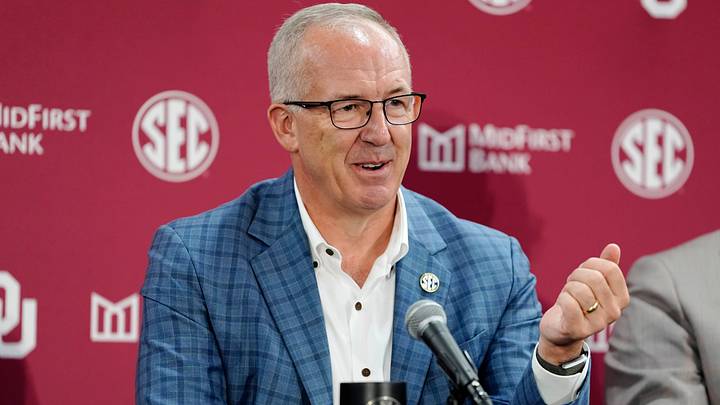
TAMPA — This was Greg Sankey at Southeastern Conference media days in 2023: “As a conference we’ve won four straight College Football Playoff national championships, earned by three different teams, and over the past 17 years we’ve had five programs win 13 national college football titles.”
This was Sankey at SEC media days Monday: “Our football programs draw an average of 80,000 fans per game. That’s our average number. This was the stat of my summer.”
That rhetorical pivot was necessitated by results on the field. When you no longer win the championships, tout the fan turnout. Those bragging rights belong to the SEC’s former punching bag and current nemesis, the Big Ten, which has had three different members capture three straight football national titles.
It’s one thing when you’re losing to bluebloods Michigan and Ohio State, which went a combined 3–0 in the playoff against SEC teams. When Indiana rises up and beats lordly Alabama into ectoplasm in the Rose Bowl, on its way to a 16–0 season, the 9–1–1 call from Dixie is legit.
This has not just been a series of narrow misses for the SEC. The league hasn’t placed a team in the CFP title game since 2022, and its playoff record against outside competition over the past three seasons is 3–7—including absolute beatdowns for Alabama and Tennessee at the hands of the last two champions, Indiana and Ohio State. In bowls and playoff games last season, the SEC went 2–7.
It might still mean more in the SEC, but the payoff is less. That unavoidable reality makes some of the continued posturing by the league a bit harder to take.
The first question to Sankey here concerned “how real” conversations are within the SEC about breaking away from the rest of the college structure. That bluster was a prominent topic of conversation at league spring meetings in May, as the SEC expressed frustration about how business is being conducted elsewhere.
“They’re real,” Sankey responded. “People have talked about [a breakaway]. They’ve opined about the frustrations that bring them to the point of saying we should look at something significantly different.
“I do not believe that is a leverage point. I think that’s just honest communication.”
There is a dash of unintended irony here. The conference that at times has been the biggest outlaw locale in college sports now wants to see the rules enforced? Got it.
That wasn’t the only kvetching coming out of the SEC on Monday. The league’s coaches were grudgingly pushed into accepting a nine-game conference schedule for the first time this year—same as the Big Ten and Big 12 play, and that the ACC has also adopted—and you’d think the sky was falling given some of the reactions. The SEC keeps pounding the table for strength-of-schedule consideration from the CFP selection committee, but it already got the benefit of the doubt last year when Alabama was included over Notre Dame despite being flattened by Georgia in the SEC title game.
As previously written here, an attempted SEC breakaway would be ruinous for everyone—including the SEC. Toying with that nuclear option is the riskiest of business. (Slightly less risky, but also potentially ruinous, is the Big Ten–led push for a potential 24-team playoff. But that proposed gluttony is a story for another day.)
The SEC can’t reasonably break away—especially while it is feverishly negotiating with Congress on a bill that could provide college sports with antitrust protection and potentially rein in the transfer and NIL markets. So for now, consider that empty posturing.
While the NIL and free-transfer era has trended in favor of the Big Ten, it’s not necessarily a permanent shift. Nobody did more work in the portal this offseason than LSU and Texas (both of which used the downtime of missing the playoff to their advantage). Texas A&M is assembling a monster high school recruiting class for 2027. Donor demographics favor the Big Ten, but the ardor of the SEC should not be dismissed.
Besides, blaming the current free-for-all marketplace for everything that ails the SEC would be a colossal cop-out. Economics have tilted the playing field in favor of the biggest and richest donor bases, which is a long-term concern. But there are other ways in which the SEC has lost its iron grip on the gridiron.
Coaching: No league has spent more money on accomplished coaches who couldn’t get it done at their latest stops: Brian Kelly at LSU, Jimbo Fisher at Texas A&M, Hugh Freeze and Bryan Harsin at Auburn, Billy Napier and Dan Mullen at Florida. Meanwhile, Kalen DeBoer is still trying to prove he’s the guy for the toughest job in the sport, succeeding Nick Saban. (Watching Ohio State swoop into the state for high school talent is not helping instill confidence.)
The one SEC coach who has fulfilled all expectations is Kirby Smart at Georgia. Everyone else has work to do. The Big Ten, meanwhile, has two coaches with championship rings (Ohio State’s Ryan Day and Indiana’s Curt Cignetti) plus a third who is knocking on the door after consecutive CFP berths (Oregon’s Dan Lanning).
The coaching churn in the league has been such that Missouri’s Eli Drinkwitz has the SEC’s second-longest tenure at the same school, entering his seventh year. Oklahoma’s Brent Venables is the oldest coach at age 55. When you’re counting on squirrelly Lane Kiffin to provide gravitas, the outlook is fluid and ephemeral.
Quarterbacking: Since LSU’s Jayden Daniels won the Heisman Trophy in 2023, the SEC’s QB bragging points have consisted of Vanderbilt’s Diego Pavia and Mississippi’s Trinidad Chambliss—who arrived in the league from New Mexico State and Ferris State, respectively—plus a bunch of other guys who are just O.K. The league had just two of the top 15 QBs nationally in pass efficiency in both ’24 and ’25. The Big Ten had five in the top 15, three of which are back this season.
The QBs who are back in the SEC are unfinished works.
The Chosen One, Arch Manning, got better at Texas as last season progressed, but was only 42nd nationally in efficiency. Texas A&M’s Marcel Reed threw three touchdowns and six interceptions in the Aggies’ final three games last year against FBS competition. Gunner Stockton has been pretty good at Georgia, but has not hit the high notes Stetson Bennett did when the Bulldogs were winning playoff games. Oklahoma’s John Mateer and South Carolina’s LaNorris Sellers did not deliver on sky-high expectations (Mateer was hampered by a midseason thumb fracture).
If the SEC is going to get its groove back this season, there are some important yardstick games. None are bigger than a pair of Big Ten–SEC showdowns in the second week: Ohio State at Texas and Oklahoma at Michigan. On the undercard throughout the season are nine SEC games against ACC competition, four against Big 12 teams and one other Big Ten–SEC matchup (Mississippi State at Minnesota).
Ultimately, though, the proof will be in the playoff, which has been an SEC bloodbath the last three years. Until Greg Sankey’s league steps up in the postseason, expect to hear more bragging about attendance.
More College Football From Sports Illustrated
Listen to SI’s college sports podcast, Others Receiving Votes, below or on Apple and Spotify. Watch the show on SI’s College YouTube channel.
 Add us as a preferred source on Google
Pat Forde is a senior writer for Sports Illustrated who covers college football and college basketball as well as the Olympics and horse racing. He cohosts the Others Receiving Votes podcast for SI and is a regular contributor to the Tony Kornheiser Show podcast. He previously worked for Yahoo Sports, ESPN and The (Louisville) Courier-Journal. Forde has won 28 Associated Press Sports Editors writing contest awards, has been published three times in the Best American Sports Writing book series, and was nominated for the 1990 Pulitzer Prize. A past president of the U.S. Basketball Writers Association and member of the Football Writers Association of America, he lives in Louisville with his wife. They have three children, all of whom were collegiate swimmers.
Follow ByPatForde