%20%20--%3E%0A%3Csvg%20version%3D%221.1%22%20id%3D%22Layer_1%22%20xmlns%3D%22http%3A%2F%2Fwww.w3.org%2F2000%2Fsvg%22%20xmlns%3Axlink%3D%22http%3A%2F%2Fwww.w3.org%2F1999%2Fxlink%22%20x%3D%220px%22%20y%3D%220px%22%0A%09%20width%3D%2239px%22%20height%3D%2240px%22%20viewBox%3D%220%200%2039%2040%22%20enable-background%3D%22new%200%200%2039%2040%22%20xml%3Aspace%3D%22preserve%22%3E%0A%3Cpath%20fill%3D%22%23FFFFFF%22%20d%3D%22M38.5%2C7H28.2v26h10.3V7z%22%2F%3E%0A%3Cpath%20fill-rule%3D%22evenodd%22%20clip-rule%3D%22evenodd%22%20fill%3D%22%23FFFFFF%22%20d%3D%22M26.1%2C25.5c0%2C5.8-4.1%2C7.5-12.9%2C7.5C3.9%2C33%2C0%2C31.2%2C0%2C25.2v-1.1h11.6%0A%09v2.4c0%2C0.7%2C0.1%2C1.4%2C1.2%2C1.4c1%2C0%2C1.2-0.4%2C1.2-1.3v-0.9c0-1.6-0.9-1.6-3.5-2.2C2.2%2C21.7%2C0%2C19.7%2C0%2C15.3v-0.9C0%2C9.3%2C5.5%2C7%2C12.9%2C7%0A%09c10.2%2C0%2C12.8%2C2.6%2C12.8%2C7.4v1.8h-11v-2.9c0-0.6-0.4-1.1-1.2-1.1c-0.6%2C0-1.2%2C0.4-1.2%2C1.1v0.9c0%2C1.5%2C0.9%2C2%2C3.3%2C2.5%0A%09c8%2C1.6%2C10.5%2C3.3%2C10.5%2C7.5V25.5z%22%2F%3E%0A%3C%2Fsvg%3E%0A)
SEC’s Latest Scandals Ask an Uncomfortable Question: Where Is Greg Sankey?
In this story:
The two hottest current controversies in college athletics have one thing in common: a Southeastern Conference school has pushed the envelope to the point of breaking.
You’re shocked, I know.
Mississippi’s (successful) (alleged) tampering with erstwhile Clemson linebacker Luke Ferrelli pushed Tigers football coach Dabo Swinney and athletic director Graham Neff to the point of an extraordinary public calling out of Rebels coach Pete Golding and his general manager, Austin Thomas. “Tampering 301,” Swinney called it, while announcing that the school has turned in Ole Miss to the NCAA.
And in men’s basketball, Alabama is shredding all precedent and abandoning all shame—again—in pursuit of winning. The Crimson Tide used a homer local judge ruling to put former player and—until Jan. 17—current G League professional Charles Bediako on the floor Saturday night against Tennessee. The Crimson Tide lost the game but gained a 7-footer, who will remain eligible to play pending further legal proceedings. At the very least, Bediako should be in uniform for the next three Crimson Tide games, starting Tuesday night against Missouri.
Based upon what is currently known, both are clear cases of NCAA violations. Ole Miss staff members, Golding included, allegedly reached out to Ferrelli personally to money-whip him away from Clemson—where he had already enrolled for the current semester. (He was not in the transfer portal as a recruitable athlete at the time.) And playing Bediako violates NCAA eligibility rules regarding the use of a professional player, having gone through the 2023 draft process and signing multiple NBA contracts. But Alabama got Tuscaloosa Circuit Court judge James Roberts—a six-figure donor to Crimson Tide athletics—to grant a temporary restraining order that essentially paralyzes the NCAA’s ability to enforce those rules.
Transfer tampering has become epidemic. Former pros wiggling their way into college basketball has become standard procedure. But these are next-level examples of abusing not just the rules but the spirit and intent of fair competition. This is brazen disregard.
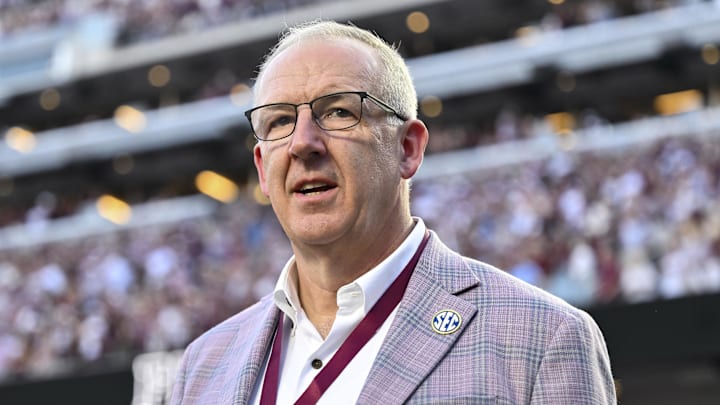
As these situations simmer, we’re all free to wonder: Where is Greg Sankey?
The SEC commissioner is the most powerful man in college athletics, someone who has rolled up his sleeves and dug into virtually every major issue in the industry over the last decade-plus. His influence is such that last fall his league led an 11th-hour overthrow of a very bad idea—permissible gambling on professional sports by athletes and staffers. His counsel has been critical on complex matters ranging from private equity to the formation and implementation of the College Sports Commission.
Yet he’s apparently unable to exert any control over at least a couple of SEC members intent on doing whatever the hell they want.
The league has outlaw traits that were baked in generations ago, with skeletons in virtually every SEC closet. But this twin blast of reckless disregard for compliance and protocol is remarkable even by SEC standards. In the afterlife, Mike Slive is fuming.
If Swinney’s assertions are accurate—Ole Miss has said nothing to date—Golding’s seven-week tenure as head coach is off to a Jeremy Pruitt–esque start. He’s not only cheating, he’s doing it personally, texting Ferrelli while he was in class at Clemson to find out what the buyout was on his contract. Tigers general manager Jordan Sorrells complained to his counterpart at Ole Miss, Thomas. The response, according to Swinney: “Pete Golding just does what he does.”
What he’s allegedly done is likely a Level II NCAA violation, though the facts of the matter could change that. There is no telling how long it might take the case to be investigated and adjudicated, but the result could be a suspension—and even higher approval ratings for Golding, because Ole Miss fans do not care what happens in the course of winning a major recruiting battle.
The Bediako farce has been similarly defended by Alabama fans for one reason—it gives their team a chance to win more. For the second time in three years, coach Nate Oats has gotten full administrative backing to do something the rest of the nation finds nakedly shameless.
In 2023, amid much more serious circumstances, Oats never benched star player Brandon Miller after he transported a teammate’s weapon to what became a murder scene. Former Crimson Tide player Darius Miles is facing capital murder charges for supplying the gun that killed a woman in a shootout—and in a remarkable coincidence, Miles’s defense attorney is the wife of the Roll Tide Jurist himself, Roberts. No wonder the NCAA has asked Roberts to recuse himself from the Bediako case due to conflict of interest.
The NCAA let the pro basketball horse out of the barn with the influx of several European players with international experience. Then Baylor kicked it up a notch with the Christmas Eve addition of big man James Nnaji, who was drafted by the NBA in 2023 but never played. But Nnaji had never been a college player prior to joining the Bears as an emergency rotation addition, whereas Bediako logged two seasons with the Tide before putting his name in the draft, staying in the draft and then signing pro deals.
By means of justifying what Oats is doing, Alabama athletic director Greg Byrne has declared Bediako’s situation as “a distinction without a difference” from other pros trickling into college. Yet the difference is clear.
The door doesn’t swing both ways, per NCAA rules. There is no going back to school three years later. And the worst part of the Crimson Tide spin on all of this has been to voice concern for “the system” in one sentence while eagerly exploiting said system in the next.
“The system is clearly broken, and I’m all for figuring out a way to fix it,” Oats said. “But since the NCAA has already allowed professionals to play …”
Sure, Nate. Can’t wait to hear your thoughts on fixing it. In the meantime, we hate to see you forced into a situation of playing someone due to a broken system. Similarly, if auto theft suddenly became trendy and your neighbors were driving better cars, we would encourage you to hot-wire the nearest Mercedes-Benz and make it your own. Gotta stay competitive, right?
These two episodes continue an inglorious run for the Just Means More league.

The Lane Kiffin fiasco at Ole Miss was met with a shrug and a sidestep by the commissioner. Fellow league members LSU and Florida actively recruited Kiffin to be their next coach in the midst of Ole Miss’s magical season, with the end result being an ugly split from the Rebels before they competed in the College Football Playoff.
“I think we have as many presidential openings,” Sankey told me in mid-November, as the tampering with Kiffin was ongoing. “Nobody reports about those and nobody really talks about the timing of those being filled. I can control what I can control. I don’t worry about things like that. That’s not something that I control.”
(Where Kiffin goes, controversy follows. His tone-deaf decision to tag President Trump over the weekend in a social media post featuring purple-and-gold “Make Baton Rouge Great” hats was met with massive backlash, and Kiffin subsequently took Trump’s name off the post. Meanwhile, LSU is fracturing its academic calendar to make room this week for Colorado transfer offensive lineman Jordan Seaton, two weeks after the semester began and nearly a week after the deadline to enroll passed. Because there is always a way to make magic happen when a five-star left tackle is involved.)
On the field of competition, the once-dominant SEC has watched three different Big Ten schools win the last three national championships. The league hasn’t even had a participant in the title game during that span, and has a 5–9 playoff record over the last three iterations. All claims to superiority have been put to rest until further notice.
Perhaps the Big Ten’s recent dominance of the SEC has empowered its commissioner, Tony Petitti, to stand firm in his push for a 24-team playoff. It’s the dumbest idea imaginable, and Petitti doesn’t seem to have much support among his fellow commissioners. But Sankey, who is the other half of that decision-making playoff axis, has not been able to bring Petitti around to a 16-team model. Thus we have a 12-team format for 2026, which isn’t a bad result at all.
In terms of fall sports, the league had one smash success—Texas A&M defeating Kentucky in an all-SEC volleyball championship—and some other notable advancements. But Texas, the all-sports kingpin of the last five years nationally, ranks just 31st in the Learfield Cup standings through the fall—its lowest ranking at this juncture since 2016–17. The SEC as a whole will probably be just fine when all precincts have reported come June, but we’ll see whether the Longhorns can maintain primacy.
Coming off its best-ever men’s basketball season, there is some slippage. No SEC team currently ranks in the KenPom Top 10, compared to four from the Big Ten. The league is still good, but it’s not as dominant as 2024–25. March will tell the full story.
It’s certainly true that the SEC does not have a monopoly on conference drama. The ACC famously fought itself in recent years. The Big Ten was very publicly at odds over private capital and Connor Stalions. The Big 12 had a similar private equity impasse, with Utah going its own way.
And it’s true that the SEC is accustomed to a baseline level of chaos, which some might argue is one of the league’s charms. Nobody watches a reality show full of well-grounded, well-behaved characters, after all.
But the current scofflaw episodes at Ole Miss and Alabama are embarrassing—or should be, if anyone at either school is capable of embarrassment. And Greg Sankey, of all authority figures, doesn’t seem to have much control of the situation.
More College Football from Sports Illustrated
Listen to SI’s college sports podcast, Others Receiving Votes, below or on Apple and Spotify. Watch the show on SI’s YouTube channel.
 Add us as a preferred source on Google
Pat Forde is a senior writer for Sports Illustrated who covers college football and college basketball as well as the Olympics and horse racing. He cohosts the Others Receiving Votes podcast for SI and is a regular contributor to the Tony Kornheiser Show podcast. He previously worked for Yahoo Sports, ESPN and The (Louisville) Courier-Journal. Forde has won 28 Associated Press Sports Editors writing contest awards, has been published three times in the Best American Sports Writing book series, and was nominated for the 1990 Pulitzer Prize. A past president of the U.S. Basketball Writers Association and member of the Football Writers Association of America, he lives in Louisville with his wife. They have three children, all of whom were collegiate swimmers.
Follow ByPatForde