%20%20--%3E%0A%3Csvg%20version%3D%221.1%22%20id%3D%22Layer_1%22%20xmlns%3D%22http%3A%2F%2Fwww.w3.org%2F2000%2Fsvg%22%20xmlns%3Axlink%3D%22http%3A%2F%2Fwww.w3.org%2F1999%2Fxlink%22%20x%3D%220px%22%20y%3D%220px%22%0A%09%20width%3D%2239px%22%20height%3D%2240px%22%20viewBox%3D%220%200%2039%2040%22%20enable-background%3D%22new%200%200%2039%2040%22%20xml%3Aspace%3D%22preserve%22%3E%0A%3Cpath%20fill%3D%22%23FFFFFF%22%20d%3D%22M38.5%2C7H28.2v26h10.3V7z%22%2F%3E%0A%3Cpath%20fill-rule%3D%22evenodd%22%20clip-rule%3D%22evenodd%22%20fill%3D%22%23FFFFFF%22%20d%3D%22M26.1%2C25.5c0%2C5.8-4.1%2C7.5-12.9%2C7.5C3.9%2C33%2C0%2C31.2%2C0%2C25.2v-1.1h11.6%0A%09v2.4c0%2C0.7%2C0.1%2C1.4%2C1.2%2C1.4c1%2C0%2C1.2-0.4%2C1.2-1.3v-0.9c0-1.6-0.9-1.6-3.5-2.2C2.2%2C21.7%2C0%2C19.7%2C0%2C15.3v-0.9C0%2C9.3%2C5.5%2C7%2C12.9%2C7%0A%09c10.2%2C0%2C12.8%2C2.6%2C12.8%2C7.4v1.8h-11v-2.9c0-0.6-0.4-1.1-1.2-1.1c-0.6%2C0-1.2%2C0.4-1.2%2C1.1v0.9c0%2C1.5%2C0.9%2C2%2C3.3%2C2.5%0A%09c8%2C1.6%2C10.5%2C3.3%2C10.5%2C7.5V25.5z%22%2F%3E%0A%3C%2Fsvg%3E%0A)

00:09:24 |
Up Next

The Champs Come to Boston | The Story with Rachel Nichols
Oct 23, 2026

Did the Cowboys Quietly Become a Great Team?
Jul 23, 2026

Albert Breer on Hall’s Jets Extension, Njoku to Chargers, Love Inks Deal in AZ
May 12, 2026

Michigan's Warde Manuel On The Way Out –– ACC Media Day Preview | Others Receiving Votes
Jul 14, 2026
The Champs Come to Boston | The Story with Rachel Nichols
Oct 23, 2026
Did the Cowboys Quietly Become a Great Team?
Jul 23, 2026
Albert Breer on Hall’s Jets Extension, Njoku to Chargers, Love Inks Deal in AZ
May 12, 2026
Michigan's Warde Manuel On The Way Out –– ACC Media Day Preview | Others Receiving Votes
Jul 14, 2026

The Vikings Have a QB Problem | MMQB
Jul 9, 2026

The Heat May Have Mortgaged Their Future For Giannis
Jul 29, 2026

Jimmy Uso Talks Solo WWE Title Hopes & SummerSlam
Jul 30, 2026

Rashid Shaheed Ready to Break Out? | Albert Breer's Top 5 Seahawks Camp Takeaways
Jul 28, 2026

Albert Breer on Aaron Rodgers’ Final Season, Jalen Hurts’ Future, Bryce Young’s Contract
May 28, 2026

Do Teams Really Care About Strength of Schedule?
May 11, 2026

The Thunder Will Have a Lot of Questions This Summer
Jun 1, 2026

We Predict Who Will Win the NFL MVP Award
Jun 15, 2026
Transcript
Well, you're coming to one of the best small stadiums in the whole country.
Places like this are what make college football great.
It's in the mountains in Western North Carolina.
You can't buy, you can't wish or any of that stuff on winning.
Winning is special and it's hard.
It's hard to have a winning program and that's one thing I think that we have above anybody else when you, when you talk about app it's a winner.
I mean we've won for years and years.
You're gonna see good football played out here.
You're gonna see aggressive guys playing hard, and you're gonna have a fan base that's second to none that are screaming and yelling and they're having a great time, and it's a beautiful setting this weekend here.
You'll have the changing of the leaves.
I, I'd say it's a place you actually fall in love with.
People don't realize what Appalachian means.
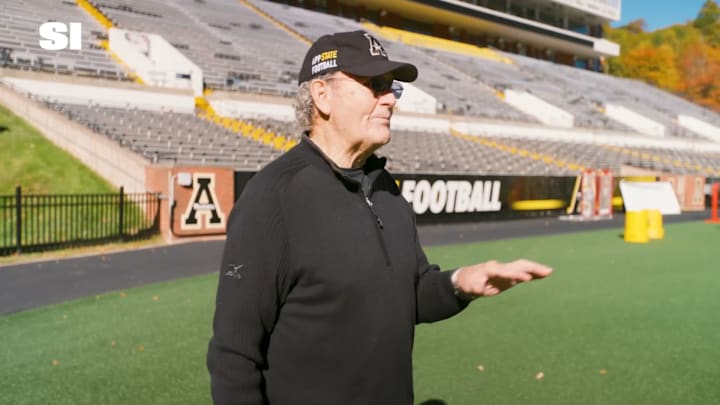
There isn't a better setting for a college football game than an Appalachian State's Kidd Brewer Stadium in mid-October.
I mean, just look at that backdrop.
App State is located in Boone, North Carolina, in the heart of the Appalachian Mountains.
It's a small town, home to only about 19,000 people, but it's one unlike any other in this part of the country.
Sitting 3,333 ft above sea level, it has the highest elevation of any town its size in the eastern half of the United States.
Life here is much different than the rest of North Carolina, and the locals embrace the tight-knit community that comes along with being sandwiched in a mountain valley 90 miles from any major city.
The Mountaineers football program is also unique.
You probably know them from their historic 2007 upset over number 5 Michigan, but there's more to the program than that.
After establishing itself as a powerhouse at the FCS level in the mid 2000s, App State made the jump to FBS in 2014 and hasn't missed a beat, winning at least a share of the Sun Belt Conference championship in four straight seasons from 2016 to 2019.
People like Larry Hand and Tommy Sofield were responsible for laying the foundation for the program's current success and turning App State football into part of the fabric of the Blue Ridge region.
Hand, who went on to play 14 seasons for the Detroit Lions, is among the greatest players in App State history and one of 5 to have his number retired by the program.
Schofield too was a former Mountaineers team captain who has gone on to become one of the program's primary boosters.
If you want to know what App State football means to this area, these two are the guys you should talk to.
This is it.
This is the real deal, real deal.
That's for sure.
So to me.
I think this is places like this are make college football great, you know, like the NFL, all those stadiums, they're all basically the same, all the cities are basically the same.
College football is played in places like this, in the mountains in Western North Carolina.
You understand why people feel so strongly about this place because it's, it's unique even within the state of North Carolina.
You talk about the best small stadium in America.
I mean, it truly is.
And currently right now our current plan is we're gonna come over here, we're gonna redo this.
Side, so we're gonna try and match up this other side here and tie the whole stadium together.
So that's the newest plan that will bring us up to about 40,000 ft, which then again then you got the best 40,000 seat stadium in America.
I mean it'll be unbelievable and our fans are just excited about it.
Everybody's just passionate about this new growth that we're trying to go do so now we won't get rid of the field over here this weekend when you come in, this will be full of students and that will stay, you know, we're protecting what students love and what they do.
But we also want to grow.
We're gonna have all kinds of new sweet boxes for your, your suites and, and club seats over there and things like that.
So there's been a big demand for our people wanting the suites and wanting the, uh, the more luxury boxes and stuff.
So you mentioned the, the really, you know, rabid support here for App State football.
Small town.
It's, it's a, it's a, you know, it's a rural kind of area, but it's really supported heavily.
What, why do you think fans are so passionate about App State football?
I, I'd say it's a place you.
Actually fall in love with you meet your wife here.
58 years now and she's up up there waiting for me right now to go out to lunch.
So yeah, so you, you meet and, and your friendship and the people that you meet and, and they're the ones that are coming back and they're the ones that have gotten to be in their 40s and 50s and started making a decent living and they've been able to come back financially and help us.
We do not have a big corporate structure where big corporations can help us.
It's mostly it's.
Mostly the, the fan base.
One of the key also is when Appalachian, when the football coaches recruit, they're gonna say, look, we want you not just to get ready for 4 years here, but we want you to get, you know, tell the parents is, get your students ready for a student athlete for the rest of his life, and that's the key with Appalachian.
A lot of people have left here and they're, they have jobs waiting for them.
They want because they've seen what a lot of the kids have gone through here.
Yeah, uh, the academic program was the average is what, about 3.1 right now, I think GPAs.
Our student athletes across the board have over 3.0 average for, I think it's like 789, 10 years.
It's incredible.
I, that's really interesting to me.
I think it goes to the fact that like this is, you know, it's a.
It's a small community and you embrace a small community by being really tightly knit.
Do you know what the average career is right now in the NFL?
It's under 4 years, you know, when they signed the signing day and parents are screaming and hollering.
Well, guess what?
they say, how many years will he be gone?
So it's, it's, it's great in Appalachian and people like Tommy have been.
I gotta give him a lot of credit.
That man has done more to help Appalachian than anybody I know.
He, he's one of the first ones.
Uh, when he went to the Detroit Lions, I'll never forget I was in Virginia Beach.
I'm watching football and Alex Kris and him were the two defensive tackles down there for years and years.
So I can think my injuries 68 Dallas 73 New Orleans broke my wrist in Kansas City on Thanksgiving Day.
So I have a history.
Sometimes I pull against those teams a little bit, but as Tommy said, but the problem is with that right now people don't realize what Appalachian means.
It's, it's academics along with, you know, going to, you know, going on, on the field and winning your accolades there.
You guys have been here, you know, around this program a long, long time.
Is it possible for you to pick out one favorite memory from inside the stadium?
Oh man, I, I know one in particular, we call it Miracle on the Mountain.
In a Miracle on the mountain we're sitting here and we're playing Furman and they go for 2.
They could have kicked the field goal and won the game.
They chose to go for 2.
The quarterback was Napier who's down in Florida right now.
And he throws an interception and we pick it up and and our, our, our defensive end catches the ball and he's running down the, the, uh, field and pitches it back to a running back.
He runs in for a touchdown and we end up beating him and went on to the playoffs and I think that was one of our first national championships.
That game there was one of our first ones we did.
We have one of the names that.
Up there the national championship and guess who he beat Joe Flacco, who's still in the pros, and Monty Edwards.
Monty Edwards, and he, you know, you talk about lighting up.
He won, he was drafted in Carolina and I saw him a couple times.
How many games you can go out there, remember Montana in the snow, and we should have all it takes a catch we win that at that, but that game when we beat.
Out at the Chattanooga and Flacco, what a great you talk about fans going wild.
It was Dela he played for Delaware.
We beat Delaware for the national championship.
That was one of our national championship games.
Yeah, that was something and some of our other games, you think about them now, not just here at this stadium, but we go into Penn State and almost beat Penn State.
We should.
Beat them we almost beat Auburn at Auburn that time we were down there and we, we, we had Tennessee in overtime.
Should have gotten them, you know, so we're right there just ready to get some of these guys, but I tell you what we did get, and that was Michigan and it's still unbelievable.
That's the difference with these kids.
Our kids are, are they didn't go to the big schools because the big schools overlooked them.
They didn't have a chance to go, so they had that chip on their shoulder.
They worked hard and they wanted to go play those guys and they knew that we were gonna be able to play the Carolinas and the and the Michigan's and the Tennessee's.
They knew they'd have a shot at them and buddy, when they line up, they gave it everything they had and that's, you know, just that type of kids we, that's kind of student athletes that we've always recruited.
You know, I think at college level, building a program identity is so important, even more so than in the pros.
How does this setting, this town, the stadium, you know, how does everything that goes into.
The culture in Boone, how does that feed into what the program wants to be?
I mean, just some of the things, for example, when all the kids start school first, the first day of school, our student athletes are all at every single elementary school over the high school, meeting the kids, getting them off the buses, letting them know we, they, you know, we're just part of, of one big community and we.
We had a terrible storm here about a year ago flooded.
Oh man, you talk about the, the community coming together is incredible.
Our chancellor went up here and, and we fed over 80,000 people, 80,000 meals.
People kept everybody fed from around the community and stuff.
We didn't have any power or anything.
It's, it's incredible how we come together as a community.
One thing I, I, I know the stadium is called the Rock, but I couldn't figure out why.
Can you guys tell me why, why it's known as the Rock?
The, uh, that's a good question.
Nobody stole the rock, did they?
No, there's an actor called The Rock.
Maybe we, we need to get you guys need to get him up here.