%20%20--%3E%0A%3Csvg%20version%3D%221.1%22%20id%3D%22Layer_1%22%20xmlns%3D%22http%3A%2F%2Fwww.w3.org%2F2000%2Fsvg%22%20xmlns%3Axlink%3D%22http%3A%2F%2Fwww.w3.org%2F1999%2Fxlink%22%20x%3D%220px%22%20y%3D%220px%22%0A%09%20width%3D%2239px%22%20height%3D%2240px%22%20viewBox%3D%220%200%2039%2040%22%20enable-background%3D%22new%200%200%2039%2040%22%20xml%3Aspace%3D%22preserve%22%3E%0A%3Cpath%20fill%3D%22%23FFFFFF%22%20d%3D%22M38.5%2C7H28.2v26h10.3V7z%22%2F%3E%0A%3Cpath%20fill-rule%3D%22evenodd%22%20clip-rule%3D%22evenodd%22%20fill%3D%22%23FFFFFF%22%20d%3D%22M26.1%2C25.5c0%2C5.8-4.1%2C7.5-12.9%2C7.5C3.9%2C33%2C0%2C31.2%2C0%2C25.2v-1.1h11.6%0A%09v2.4c0%2C0.7%2C0.1%2C1.4%2C1.2%2C1.4c1%2C0%2C1.2-0.4%2C1.2-1.3v-0.9c0-1.6-0.9-1.6-3.5-2.2C2.2%2C21.7%2C0%2C19.7%2C0%2C15.3v-0.9C0%2C9.3%2C5.5%2C7%2C12.9%2C7%0A%09c10.2%2C0%2C12.8%2C2.6%2C12.8%2C7.4v1.8h-11v-2.9c0-0.6-0.4-1.1-1.2-1.1c-0.6%2C0-1.2%2C0.4-1.2%2C1.1v0.9c0%2C1.5%2C0.9%2C2%2C3.3%2C2.5%0A%09c8%2C1.6%2C10.5%2C3.3%2C10.5%2C7.5V25.5z%22%2F%3E%0A%3C%2Fsvg%3E%0A)
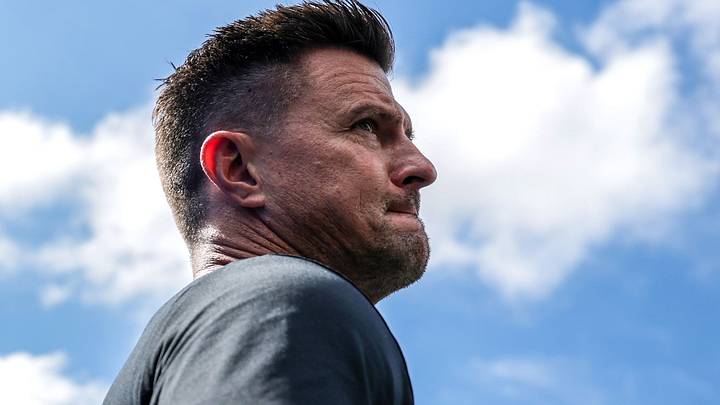
What Bob Chesney Is Building at UCLA Defies Modern College Football
In this story:
LOS ANGELES — The whiteboard on the wall in UCLA offensive line coach Chris Smith’s office features a few blocking schemes sketched out in black marker. It also has a maze drawn by a child’s hand, and a message in red marker: “Hi dad! Ston (sic) is Ston Cold Steav Austin and Rock is The Rock. From Calvin.” Calvin is the second of Smith’s three kids.
Down the hallway, the whiteboard in defensive coordinator Colin Hitschler’s office features a tidy drawing of two bears in blue marker. One is labeled “Joe” and the other “Josephine,” the names of UCLA’s Bruin mascots. This is the handiwork of Hitschler’s 10-year-old daughter, Catherine, the oldest of his three children.
The writing is on the wall at UCLA, with a subtext that is plain to see and easy to feel. One of the essential building blocks of a gravity-defying 8–0 season is a family atmosphere that goes well beyond empty platitudes and worn-out cliches. As opposed to many football programs, this is real, and it’s lived out daily.
“That’s my mom,” head coach Bob Chesney says as he walks down a hall at the Wasserman Football Center, waving to a gray-haired woman going through mail in a glass-walled lounge area. Claudia Chesney smiles and waves back. His dad, Bob Sr., a former high school coach and daily presence, is in the facility somewhere—probably watching film with the defensive coaches (or perhaps napping through the session).
There was a Halloween party at the facility last week, with the children of every staff member invited to dress up. Chesney, who has three kids of his own, gathered them all in the weight room for a group picture before sending them off to trick-or-treat through every office in the building.
Wednesday nights are a weekly family night at the facility, with wives and kids coming in for dinner. Same with Sunday nights, even after a long coaching day of putting to bed the last game and starting prep for the next one. On most Sundays, 12-year-old Bo Chesney is leading a group of coaches’ kids out to the UCLA practice field to play ball.
“We have our families here all the time, constantly open,” Smith says. “I’ve been in places where families are tolerated, like this is a place of business. Here it’s not tolerated, it’s encouraged.”
Sometimes, the little ones escape containment. Offensive coordinator Dean Kennedy’s young daughter wandered onto an elevator one day recently. She’s not even old enough to know how to operate one. Some screaming, some crying, some runaway children—it’s just like home.
“The atmosphere is very serious and people act like it’s fourth-and-1 all the time in certain programs,” Kennedy says. “This lightens the mood. But more importantly, it’s like the players get to see that. If you stress family but you never have your kids around, you never have your family members around, they see right through that b.s.”
In one of the great modern triumphs in college football bonding, Chesney has erected a tent and invited everyone inside.
It was a January Friday night. Chesney was sitting on the deck of his new California house with his special teams coordinator, Drew Canan. They’d been hired about at UCLA a month earlier. Chesney’s family was still back in Virginia, finishing the school year, and Canan was living with his boss for the time being until he got a place for his family.
There may have been a cocktail or two. There certainly was a sense of wonder. Two guys who had worked together the previous 12 seasons were processing the journey—from Division II Assumption to FCS Holy Cross to FBS Sun Belt program James Madison to this place, where the pay scale and lifestyle are totally different, and the weather permits sitting on a deck during the winter.
“This is unbelievable,” said Canan, whose first coaching job was at a middle school.
“I know,” responded Chesney, who made $30,000 coaching linebackers at Johns Hopkins and $52,000 as the head coach at D-III Salve Regina. “Think about how it got started.”
They dove down the nostalgia rabbit hole, reminiscing about games and players from Assumption, Holy Cross and JMU. That’s when Chesney pulled out his phone and said, “Let’s FaceTime some of them.”
Chesney called six players … and none of them answered.
“Damn, dude,” Chesney said to Canan. “I thought we made an impact on these kids.”

They didn’t take into account the time difference—it was 9 p.m. in Los Angeles, midnight on the East Coast, where most of those former players live. But within minutes, the calls started being returned—bleary-eyed men getting out of bed to talk to their old coaches. Five of the six called back that night, and the sixth did so in the morning.
“The thing that’ll stay with me forever is no one talked about football,” Canan says. “It was all, ‘Coach Chesney, how are the kids? How’s your wife? Can you believe I have two kids now?’ And he reciprocated with, ‘How’s your mother? How’s your father?’ ”
That tent Chesney put up? It has room inside for not just nuclear family. Football family is always welcome, too.
After UCLA beat Michigan State on Oct. 24, a throng of 50 to 60 people went back to Chesney’s house for a postgame party. About 10 of those were former players under Chesney at previous stops. The coach made sure to get a picture with all of them before the night was over, celebrating the connective tissue that runs through them.
Postgame parties are something Chesney was literally born into. Bob Sr. was teaching social studies and coaching in Pennsylvania coal country by the time his second child came into the world. In order for Our Lady of Lourdes Regional High School’s football program to function, Bob Sr. enlisted anyone he could find in the one-stoplight town of Kulpmont to do whatever odd jobs were necessary. He paid them back with weekend gatherings.
“It just felt like that’s what a family does,” Chesney says. “My grandfather, my uncle, my father, the neighbor across the street, the neighbor a couple doors down, every male in my life was somehow recruited by my father to help this football team. We’d play the game on Saturday, and then Saturday afternoon we’d all go back to my grandfather’s house or my uncle’s house.
“Everybody from the week’s work was all together, three generations that come together for this common cause. I thought of it as a way of life.”

Bob Sr. wasn’t the only football recruiter in town. In elementary school, Bob Jr. would get on his bike early in the morning and ride to every boy’s house in the neighborhood with a message: Meet at Legion Field at 9 a.m. to play a pickup tackle game. This was not a two-hand touch operation. Never the biggest kid on the field, Bob Jr. was usually the hardest hitter.
“This is no joke—if I could play tackle football every day of my life growing up, I would’ve,” Chesney says. “I loved tackling and I loved the game of football and I loved the toughness.”
Energy and ambition were constants from Chesney. Claudia remembers getting a call from a neighbor one day in the late 1970s, when Bob Jr. wasn’t quite a year old, with an update on her toddler.
“We think he’s trying to run away from home,” the neighbor said.
Bob Jr. had gotten out of the house and somehow crawled over the wrought-iron fence in the front yard. He was heading down the block in his pajamas and diaper.
“He was ready to be out in the world at 11 months,” Claudia says with a laugh. “He was born with that personality. I look at each of our children and I see them before they’re born in heaven with God, who is saying, ‘All right, here’s the assembly line of all of the traits that you can choose.’ Bobby just walked through and picked all the positive attributes. And God kept saying, ‘Sure, take it, take it, take it.’ ”

For football season, Bob Sr. and Claudia have relocated from their home base in Pennsylvania to an Airbnb rental home a half-mile from the UCLA campus—she walks to the Wasserman Center, her husband drives because he’s going to stay until all the staff work is done. Claudia is taking classes at UCLA in yoga and qigong, a breathing exercise. As was the case at Bob Jr.’s previous stops, the 76-year-old Bob Sr. is a volunteer coach who immerses himself in everything.
That includes a handmade sign for the locker room that reads, “Pride and Pads.” The players touch it on their way out to the field. The message: Take pride in your work, and put on your pads with the intent of hitting someone. T-shirts bearing that slogan have started to pop up at the Wasserman Center.
From Chesney’s parents to everyone’s kids having free run of the place, the real world beyond football remains present at UCLA. The football certainly counts, and the program is as hard-working as any in the country, but there is a human touch to it all.
“Obviously, winning helps,” says Hitschler. “But after every game, there’s still a party at his house. He still comes from a high school world of hanging out. There are places where it is so intense that it kind of squeezes the joy out of it.”

The winning has been consistent over time: a 23–9 record at Salve Regina; 44–16 at Assumption; 44–21 at Holy Cross; 21–6 at James Madison; 8–0 at UCLA. Chesney’s predecessor at JMU, Curt Cignetti, paved the way for power-conference schools to have more respect for coaches who won their way up the ladder. But after being bypassed in previous years for other Power 4 jobs, Chesney has crushed this opportunity.
Between JMU and UCLA, Chesney has won 19 straight non-playoff games. The staff talks about their last regular-season loss, 28–14 at Louisville on Sept. 5, 2025, like it happened yesterday (they’re still appalled they didn’t win). The College Football Playoff loss to Oregon provided a road map for how to build the first roster at UCLA. The goal: Be good enough to beat the Ducks.
As Cignetti did at Indiana, Chesney exported several players (and most of his staff) from James Madison. Many of the players were considered a little too small or a tenth too slow for Big Ten football, until they proved otherwise. Wayne Knight, a 5'7" ball of fury, is UCLA’s leading rusher with 680 yards and 14 total touchdowns. Riley Robell and Carter Sweazie have started every game on the offensive line. Receiver Landon Ellis, edge rusher Sahir West and defensive tackle Aiden Gobaira have been key contributors as well.

“I just came in ready to work,” Robell says. “I’m ready to go show everybody. I heard the same thing about my height, about my size all through high school. I wanted to put my hand in the dirt and go show people that I could play football.”
The proof has been on display for eight straight games. The highlight to date: a grit-infused road win over the same Oregon program that eliminated James Madison from the playoff last year. Chesney delivered fire to his team pregame, then watched his players persevere through a wave of in-game injuries. Most notable: starting quarterback Nico Iamaleava, who was lost for the season during the game.
. via West Wood Bruin instagram pic.twitter.com/uxXJJ0srqs
— College Football Enthusiast (@cfbwatcherr) October 13, 2026
UCLA turned over the offense to FCS transfer Ty Dieffenbach, who had unremarkable numbers last season at Cal Poly. He got just enough done and the Bruins defense rose to the challenge, allowing just 15 points and 272 yards while generating a whopping seven takeaways.
The most telling team culture moment came when the third quarter ended with the Bruins clinging to a 10–6 lead behind a backup QB. When the Autzen Stadium sound system cranked up the school’s traditional song between the third and fourth periods, “Shout,” it galvanized the visitors more than the hosts.
“I think from the minute we got in here [from JMU], everybody just started really emphasizing, bring that energy, man,” Robell says. “Let’s live in this energy. This energy’s our identity. Once the [UCLA holdovers] finally felt free to show that energy and dance when we’re winning in the fourth quarter and put a smile on things, it opens up everything.”
The Bruins offense has dipped a bit since the injury to Iamaleava, now ranking 33rd nationally in yards per game (427.6) and 36th in points (33.5). Dieffenbach has filled in admirably, and the defense has stepped up remarkably. UCLA is fifth in points allowed (13.4), seventh in yards (260.8) and first in takeaways (26).
For defensive coordinator Hitschler, reuniting with Chesney has been a validating career move. He’d first worked for him at Salve Regina as a $3,000-a-year part-timer, then moved on to eventually join Luke Fickell’s staff at Cincinnati and Wisconsin before spending the 2024 season at Alabama under Kalen DeBoer. Hitschler was fired after that 9–4 debut year for DeBoer succeeding Nick Saban.
“It was the worst experience of my life just being down there with DeBoer,” Hitschler says. “Culturally, just didn’t fit what I had been around.”

Last year at James Madison, Hitschler’s defense was fifth in the country in yards allowed. He imported some of what he calls “our old Cincy toughness and nastiness,” first to the Dukes and now to the Bruins. Hitschler makes the point that UCLA had some tough guys already who are simply now playing in a more conducive defense to bring that out.
The larger, program-wide import is the Chesney culture, which he has memorialized on his office wall: attention to detail, positive attitude, urgency and relentlessness. Equal parts charismatic and dogmatic, the head coach exudes all those things on a daily basis.
“Even when I was with him 15 years ago at Salve Regina, he made people love football,” Hitschler says. “He cares about some of the stupidest little things that other coaches don’t care about—back then it was how you held your helmet during the national anthem on the sidelines. But those things work.”
The current “stupid little thing” that resonates throughout the UCLA building: keeping everything clean. Years ago, Chesney made a habit of telling himself “just won a football game” when stooping to pick up a piece of trash on the ground—forming the kind of attention-to-detail habits that winners possess. Smith remembers one time at a prior stop when a candy wrapper was on the stairs; he picked it up and Chesney popped out from behind a door to congratulate him on passing a small test.
More recently, Chesney found a paper towel on the ground outside the staff bathroom. Blessed with in-building security cameras, he got the tape to see who the perpetrator was. As it turned out, a coach had accidentally dropped it while throwing away other paper towels. An executive pardon was granted.
“If you’re not going to take care of the little things,” Chesney says, “then what is the standard you’re going to uphold?”
Like many of us, Chesney has an internal age that is at odds with how old he really is. When LeBron James wound up with the Philadelphia 76ers during the summer, he was discussing it with his son in the car. He asked Bo to look up James’s age. The answer: 41.
“Older than I am,” Chesney thought to himself.
A day or so later, the realization hit the 49-year-old that, no, LeBron James is not older than he is.
“I was like, ‘Wait, I’m not almost f---ing 40, I’m almost 50!’ ” he exclaimed. “That was the first time I was like, ‘Oh s---, 50.’ ”
Here’s hoping Chesney never fully grows up. The Peter Pan thing is working.

Being around UCLA right now is a little like being around the unspoiled beauty of Butler men’s basketball under Brad Stevens. One scene from the 2010 Final Four, which the Cinderella Bulldogs crashed in their hometown of Indianapolis, remains indelible: Stevens and his staff had their young children and wives spread out on the floor of Lucas Oil Stadium eating McDonald’s Happy Meals while Butler held its open practice.
Butler had something special and intimate and was trying to hold onto it as it grew into something unimaginably large—eventually taking Stevens up and away to the Boston Celtics. Chesney’s career arc has taken the son of a high school coach from grassroots college football to the top five of the AP poll and the No. 8 spot in the first College Football Playoff rankings.
Bob Chesney is trying to keep his changing circumstances—runaway success, heightened attention, much more money—from changing his identity. So he keeps the kids around. And the parents. Keeps them coming to the football facility. Keeps the invitation open for everyone to join him under his tent.
PODCAST: Listen to Sports Illustrated’s college sports podcast, Others Receiving Votes, hosted by Pat Forde, on Apple and Spotify. Watch the show on SI’s college YouTube channel or on SI TV.
 Add us as a preferred source on Google

Pat Forde is a senior writer for Sports Illustrated who covers college football and college basketball as well as the Olympics and horse racing. He cohosts the Others Receiving Votes podcast for SI and is a regular contributor to the Tony Kornheiser Show podcast. He previously worked for Yahoo Sports, ESPN and The (Louisville) Courier-Journal. Forde has won 28 Associated Press Sports Editors writing contest awards, has been published three times in the Best American Sports Writing book series, and was nominated for the 1990 Pulitzer Prize. A past president of the U.S. Basketball Writers Association and member of the Football Writers Association of America, he lives in Louisville with his wife. They have three children, all of whom were collegiate swimmers.
Follow ByPatForde