%20%20--%3E%0A%3Csvg%20version%3D%221.1%22%20id%3D%22Layer_1%22%20xmlns%3D%22http%3A%2F%2Fwww.w3.org%2F2000%2Fsvg%22%20xmlns%3Axlink%3D%22http%3A%2F%2Fwww.w3.org%2F1999%2Fxlink%22%20x%3D%220px%22%20y%3D%220px%22%0A%09%20width%3D%2239px%22%20height%3D%2240px%22%20viewBox%3D%220%200%2039%2040%22%20enable-background%3D%22new%200%200%2039%2040%22%20xml%3Aspace%3D%22preserve%22%3E%0A%3Cpath%20fill%3D%22%23FFFFFF%22%20d%3D%22M38.5%2C7H28.2v26h10.3V7z%22%2F%3E%0A%3Cpath%20fill-rule%3D%22evenodd%22%20clip-rule%3D%22evenodd%22%20fill%3D%22%23FFFFFF%22%20d%3D%22M26.1%2C25.5c0%2C5.8-4.1%2C7.5-12.9%2C7.5C3.9%2C33%2C0%2C31.2%2C0%2C25.2v-1.1h11.6%0A%09v2.4c0%2C0.7%2C0.1%2C1.4%2C1.2%2C1.4c1%2C0%2C1.2-0.4%2C1.2-1.3v-0.9c0-1.6-0.9-1.6-3.5-2.2C2.2%2C21.7%2C0%2C19.7%2C0%2C15.3v-0.9C0%2C9.3%2C5.5%2C7%2C12.9%2C7%0A%09c10.2%2C0%2C12.8%2C2.6%2C12.8%2C7.4v1.8h-11v-2.9c0-0.6-0.4-1.1-1.2-1.1c-0.6%2C0-1.2%2C0.4-1.2%2C1.1v0.9c0%2C1.5%2C0.9%2C2%2C3.3%2C2.5%0A%09c8%2C1.6%2C10.5%2C3.3%2C10.5%2C7.5V25.5z%22%2F%3E%0A%3C%2Fsvg%3E%0A)
From Jerry World to Wrigley Field: Women’s Volleyball Is Taking Over Your Favorite Stadium
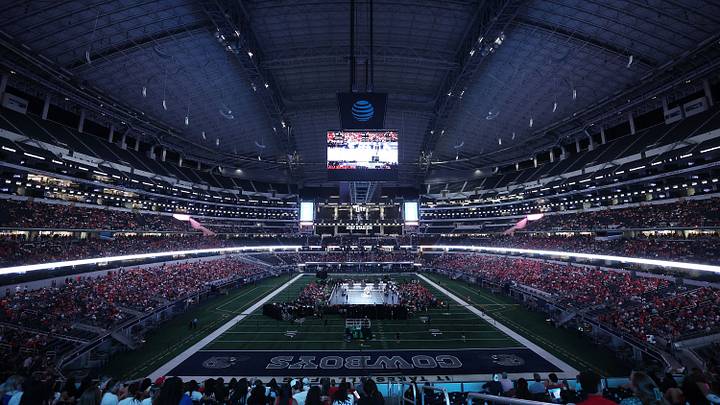
Even the worst seats in the house could feel the heat.
Columns of fire shot skyward in a darkened AT&T Stadium, illuminating players as they bolted hand-in-hand out of the smoke-enveloped tunnel and onto the field. Waiting on the 50-yard line was no coin toss or pre-snap huddle, but a volleyball court staged atop the Dallas Cowboys’ home turf.
Four ranked women’s college volleyball teams—No. 1 Nebraska, No. 10 Penn State, No. 11 SMU and No. 17 Florida—gathered for the first iteration of Spikes Under the Lights, a new showcase aiming to spotlight the sport’s best. Befitting the showcase’s grandeur was its prize pool, a total of $1 million split among the participants, a record sum for any tournament in collegiate women’s sports history.
Big stadiums, bigger investment and gritty competition. Women’s college volleyball is taking up space in a growing market, with more eyes taking notice.
Anyone who has spent time in Dallas, Las Vegas or Chicago over the past two weeks has had a great chance of spotting at least one Nebraska fan. The top-ranked Huskers women’s volleyball program has bounced around the U.S. from showcase to showcase, a busy travel schedule amidst impressive venues.
After winning Spikes Under the Lights at AT&T Stadium on Aug. 27, Nebraska went straight to Las Vegas to play at T-Mobile Arena, the home of the NHL’s Golden Knights, for the Players Era Showcase. This weekend, the team will participate in the first-ever volleyball tournament at Wrigley Field, home of MLB’s Cubs, in the Big Ten/SEC Challenge.
The boom of fans filling stadiums for women’s volleyball can be traced to Aug. 30, 2023, when 92,003 fans sold out Memorial Stadium in Lincoln, Neb. The venue usually reserved for the Huskers’ football team was packed to set the record for attendance at a women’s sporting event in the U.S. In many ways, Volleyball Day in Nebraska was a jolt of energy for the sport.
Nebraska’s senior setter Bergen Reilly, then a freshman, got to experience the atmosphere that day firsthand. She knew the sport would never be the same.
“Volleyball Day, I think, changed the trajectory of the sport as a whole,” Reilly, who recently signed with Adidas as an NIL partner, told Sports Illustrated. “We saw Tom Brady at our game this weekend. We’ve had some other awesome people at our games, and I think that Volleyball Day really started that. It kind of put volleyball on the map… getting to be a small part of that is such an honor.”
Roughly 50,000 fans filled AT&T Stadium for Spikes Under the Lights last week, with Husker fans painting the crowd red. For a town that supports women’s volleyball with the vigor of its college football team, the turnout was of little surprise.
Nebraska took home a total of $350k from the tournament—$200,000 for participating, and another $150,000 for winning. SMU, which placed second, earned an additional $50,000.
The record-setting prize pool was a key aspect in planning the tournament to apply the proper “wow” factor and attract the country’s best programs.

“We wanted to set the bar really high,” says Nickole Tara, who was key in planning the event as chief business officer of production company Words + Pictures. “It’s a number that has the iconography as much as the venue, as much as the teams that are playing here. So it was important to us to have that biggest statement and to be able to set that bar at the highest levels from the very beginning.”
For coaches, participating in events at football and baseball venues can be an extra lift in terms of travel and logistics, but the benefits that emerge from their participation are undeniable. The most obvious, in the case of Spikes Under the Lights, is the money involved.
Each program will get to decide how the prize money is utilized, whether it be improving program facilities or cuts among players. Each of the four participating teams went home with at least $200,000 that can be used to grow the program and improve facilities to attract new players.
“I want to be on the forefront of pushing along women’s athletics and to have this kind of investment and this kind of interest,” SMU coach Sam Erger says. “It’s not philanthropic, right? If you have a great product, people want to come and want to invest and want to be a part of it, and I’m really excited to be in this wave of women’s college athletics and volleyball where these events are happening.”
Another layer is the competition itself. These showcases attract the top teams in the country, providing motivation for players to perform against tough competition and get an early temperature check on their squad.
By creating these nonconference tournaments, coaches and players can test their schemes against top teams they may not see again until the NCAA tournament.
“I was like, Is this for real? What is going on?,” Florida junior middle blocker Alec Rothe said of her reaction to the tournament. “Like, no way we’re playing in a football stadium against Nebraska, but it very much so is real. I thought, Wow, what an incredible opportunity to play amazing volleyball in such a cool place.”
There’s a reason these showcases are taking place at large venues—organizers want to continue to draw eyes to the game in this period of investment and growth. Fans who did not grow up watching volleyball are learning the rules, with hopes of that interest turning into continued support. From there, that fandom can extend beyond the college game into professional women’s volleyball leagues Major League Volleyball and League One Volleyball.
The game is also proving it can expand beyond the U.S. Another inaugural tournament, the Paradise Invitational, is taking place later this month in Nassau, Bahamas. No. 3 Kentucky, No. 8 SMU, No. 14 Purdue and Houston will compete indoors at a local resort in what will be a final tune-up before conference play begins.
When it comes to growing the program and the sport, longtime Kentucky coach Craig Skinner is not afraid to try new ventures, as long as the level of play isn’t compromised. Even after more than two decades as the Wildcats’ coach, Skinner is enthusiastic to be a “trailblazer” for future opportunities.
“I think programs and sports that get comfortable and just kind of tread water, they don’t make headway,” Skinner says. “I think we have to continue to keep it fresh. … We want to keep our sport relevant, and so we have to keep doing it, but we can’t do it at the expense of the game. I would not want to do Wrigley Field multiple times. … I don’t want to compromise the quality of our game, but we have to be innovative at the same time.”
The morning of the Spikes Under the Lights tournament, long before fans filled the stands, players emerged from the tunnel for practice with smiles beaming across their faces. Cell phones in hand, the players captured the moment they walked onto the field for the first time. Playing in an NFL venue was something that was almost unimaginable. Now, the moment was real.
For players like Penn State’s Caroline Jurevicius and Kennedy Martin, being in a venue like AT&T Stadium was a full-circle moment, as both of their dads were NFL wide receivers. Jurevicius’s dad, Joe, was in the league from 1998 to 2008, while Martin’s dad, Ruvell, played from 2005 to ’13.
“My dad was in the NFL for 11 years and doesn’t have any sons, so I didn’t really think it would be in the cards to have one of his kids playing at an NFL stadium,” Jurevicius says. “But here we are.”
Players’ excitement to reach new fan bases in larger venues is refreshing in the constantly shifting world that is college sports. For the freshmen, their first games are being played in stadiums that host football and baseball games, concerts, soccer matches and more. Right away, they’re being afforded opportunities that have been provided with increased investment and stages for the sport.
“I just am really happy to be included; being a part of history is such a big deal,” Nebraska sophomore middle blocker and Adidas partner Manaia Ogbechie says. “I came to Nebraska in the first place to make a difference in any type of way, even to one little girl, and I feel like participating in tournaments like this really helped me see that firsthand, and that really means the world to me.”
With increased support, collegiate women’s volleyball will continue to take hold in the country’s most iconic venues. For Spikes Under the Lights, the tournament is considering a return to AT&T Stadium next year, but is also intrigued to bring its showcase to a new host city.
As long as they bring the fire.
 Add us as a preferred source on Google