%20%20--%3E%0A%3Csvg%20version%3D%221.1%22%20id%3D%22Layer_1%22%20xmlns%3D%22http%3A%2F%2Fwww.w3.org%2F2000%2Fsvg%22%20xmlns%3Axlink%3D%22http%3A%2F%2Fwww.w3.org%2F1999%2Fxlink%22%20x%3D%220px%22%20y%3D%220px%22%0A%09%20width%3D%2239px%22%20height%3D%2240px%22%20viewBox%3D%220%200%2039%2040%22%20enable-background%3D%22new%200%200%2039%2040%22%20xml%3Aspace%3D%22preserve%22%3E%0A%3Cpath%20fill%3D%22%23FFFFFF%22%20d%3D%22M38.5%2C7H28.2v26h10.3V7z%22%2F%3E%0A%3Cpath%20fill-rule%3D%22evenodd%22%20clip-rule%3D%22evenodd%22%20fill%3D%22%23FFFFFF%22%20d%3D%22M26.1%2C25.5c0%2C5.8-4.1%2C7.5-12.9%2C7.5C3.9%2C33%2C0%2C31.2%2C0%2C25.2v-1.1h11.6%0A%09v2.4c0%2C0.7%2C0.1%2C1.4%2C1.2%2C1.4c1%2C0%2C1.2-0.4%2C1.2-1.3v-0.9c0-1.6-0.9-1.6-3.5-2.2C2.2%2C21.7%2C0%2C19.7%2C0%2C15.3v-0.9C0%2C9.3%2C5.5%2C7%2C12.9%2C7%0A%09c10.2%2C0%2C12.8%2C2.6%2C12.8%2C7.4v1.8h-11v-2.9c0-0.6-0.4-1.1-1.2-1.1c-0.6%2C0-1.2%2C0.4-1.2%2C1.1v0.9c0%2C1.5%2C0.9%2C2%2C3.3%2C2.5%0A%09c8%2C1.6%2C10.5%2C3.3%2C10.5%2C7.5V25.5z%22%2F%3E%0A%3C%2Fsvg%3E%0A)
The ‘World’s Greatest College Weekend’: Welcome to Indiana’s 75th Annual Little 500
When your school’s football team goes undefeated and wins the national title, the other campus sporting event scheduled for the semester can carry an anti-climactic stench.
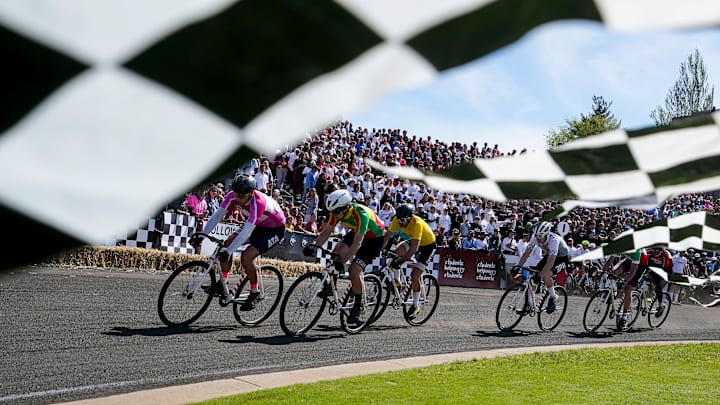
But the self-proclaimed “World’s Greatest College Weekend” commences this Friday (Thursday?...Wednesday?) at Indiana University. And this year, the centerpiece event of this bacchanalia/tradition celebrates its milestone 75th running. We speak, of course, of the Little 500 bicycle race.
After the grand marshall instructs riders to “mount your state bicycles,” 33 teams will hop aboard standardized single-speed State brand bikes, put mettle to pedal and try to become the first cyclist to circle a quarter-mile track 200 times. This will play out before a crowd of 25,000 or so—yes, students, but also Bloomington locals, IU alumni, cycling enthusiasts and celebrities.
Curt Cignetti, the race grand marshal last year, will be in attendance, as will various members of the Hoosiers football team. (Fernando Mendoza likely will not, NFL draft weekend and all). Barack Obama has attended the Little 500, making an unscheduled campaign visit in 2008. So has Lance Armstrong. So have the musical acts that have played the post-race concert: The Red Hot Chili Peppers, the Foo Fighters and, naturally, John Mellencamp. Same for Lil Wayne, Nicki Minaj and Mac Miller. (This year it’s Magdalena Bay.)
“[The Little 500] keeps getting bigger, even with more [ways] than ever to spend free time,” says Peter Schulz, the 25-year-old race director, who was a Hoosiers offensive lineman for three seasons, dropped 50 pounds, and rode in the 2023 Little 500 as a senior “It’s just a great tradition for everyone involved.”
The Little 500 origin story is one worth telling. In the early ‘50s, Howard “Howdy” Wilcox was working for the school’s student foundation. He was walking around campus one afternoon, when he heard a commotion in front of the Hickory Hall dormitory, male and female students leaning out of windows, shrieking. It turned out they were watching an impromptu bike race, pitting three undergrads against each other as they zipped around the dorm.
The concept of competitors orbiting a track carried a particular resonance for Wilcox. His father—also nicknamed Howdy—was the 1919 Indy 500 champion (average speed of 88 mph) and a popular driver in those early days of auto racing. Tragically, four years later, he died in a crash at a Pennsylvania race, leaving his son an orphan to be raised by his grandmother.
That day on campus, Wilcox seized on an idea: What if—mimicking the world’s most famous auto race an hour up the road in Indianapolis—Indiana University staged a bike race? It, too, would be set on a flat, oval track encompassing 200 laps. There would be the same 33 entrants, eleven rows of three. There would be a pace car and pre-race ceremony and checkered flag consecrating the winner.
With typical Indiana self-deprecating modesty, they’d call it The Little 500.

Apart from the vehicles, there would be material differences. Racing on the running track circumscribing the school’s football field, the 200 laps would encompass 50 miles, not 500. Instead of one person maneuvering the wheels and doing all the work, this bike race would be relay style, enabling more students to participate. There would be no prize money; any surplus revenues would go toward funding scholarships, “students helping students,” as he put it.
The inaugural race was held in 1951. It was a social success, if not a financial one. Records show that, after expenses, total profits came to roughly $100, or $1,300 in today’s dollars. But everyone there had a good time. It was a burst of school spirit and school bonding, a way to knit together a student body that, thanks to the GI Bill, had been growing rapidly.
Like a cycling team picking up the pace, the race grew steadily in the subsequent years. Not only were winners crowned each year, but IU students began broadcasting the race. It was at the Little 500 that one such student-commentator, Dick Enberg, says he learned the art of wrapping stories around the rising and falling action of a sporting event.
Then, in the late 1970s, the race really caught a gear.
As an Indiana undergrad in the ‘60s, Steve Tesich had an older fraternity brother, Dave Blase, who grew obsessed with cycling. He was particularly interested in the Italian riders, to the point of belting out opera in the shower. At the 1962 Little 500, he rode 138 of the 200 laps for the winning Phi Kappa Psi team.
A decade or so later, Tesich began working on a movie screenplay, a sweet coming-of-age story centered on cycling and the Little 500. Filmed in Bloomington, Breaking Away was released in 1979. The antagonist is named Dave (not Blase, but Stoller, played by Dennis Christopher). He’s a cycling-obsessed townie and his endearingly shiftless townie pals (Dennis Quaid, Daniel Stern and Jackie Earle Haley) call themselves Cutters—a nod to the local limestone quarries that employ their parents who, anonymously, cut the stones for the university’s building. They enter the Little 500 and take on the school’s privileged frat boys.
Breaking Away—which, as a film, still holds up, by the way—grossed more than $20 million, roughly ten times its budget. Tesich would win an Oscar for Best Original Screenplay. And, through this sleeper film, the Little 500 would become something like the Army-Navy game, a college sports tradition that, soaked in pageantry, became bigger than the event itself.
In Bloomington, thanks to Breaking Away, by 1981, enough earmarked donations poured in to fund a new venue specifically for soccer and the Little 500: Bill Armstrong Stadium, named for Wilcox’s successor at the Indiana Foundation. The following race was covered by CBS Sports, with Brent Musburger introducing the event before tossing to the network’s on-site color commentator and analyst… Dave Blase. A fledgling national all-sports network, ESPN, ran highlights as well.
At that point, there was a separate women’s event… sort of. The “Mini 500,” held the night before the men’s race, entailed co-eds converging inside Assembly Hall, the basketball venue, to race each other… on tricycles. (This actually was progress compared to the event a few years earlier when sorority sisters raced on bikes while balancing eggs on spoons; winning teams were gifted eggbeaters for their future homemaking.)
In the mid-1980s, a women’s team from Kappa Alpha Theta sorority was told that if it wanted to compete in the Little 500 proper, it could attempt to qualify for the field like the other aspiring teams. They finished 34th, just one slot out of the field, but then prevailed on administrators to stage a proper women’s only event. Since 1988, the Women’s Little 500—covering a distance of 100 laps—has been a staple of the weekend.

One proposed change that has not—and likely will never—come about: The scrappy Cutters-versus-the-frat-boys made for a strong plotline in Breaking Away. But it was artistic license. The race is only open to enrolled Indiana students. (If there’s a cultural rift, it’s the frat teams versus the dorm teams. A team of independents calling themselves “The Cutters” commenced in 1984 and have won a record 15 times, including five straight from 2007 to ‘11.)
Predictably, as the race has grown, competition has grown fiercer. Even within teams there are rivalries and bruised feelings over who gets chosen. A team organizer faced a lifetime ban from the Little 500, since reduced, on the grounds that he offered students scholarships on the condition they ride in the race. While there has never been a positive test, there are, perhaps inevitably, periodic rumors of doping. (Schulz says that, as race director, he has the authority to request a drug test “if someone drops a crazy time,” but doesn’t anticipate having to do so.) There are also occasional whispers of teams using illegal devices and practicing dark arts à la Team Cinzano; but each bike is meticulously checked the day of the race. “
But the ever-lowering of the winning times—now just a hair over two hours, an average of 24 or so miles an hour—are more a function of how seriously the competitors take the Little 500. Riders routinely log 10,000 miles in year-round preparation. Drive around Bloomington and—even on the coldest, rainiest days—you’ll see packs on training rides.
It’s not uncommon for well-financed fraternity teams to venture to Florida for Spring Break, not to cavort, but for a week of “centuries,” 100-mile days. Less funded teams stay in Bloomington and ride in state parks and forests, figuring if they can build endurance doing long rides on surprisingly hilly terrain, that will pay off in April on the flat track.
History as a guide, Saturday’s milestone race—grand marshall: 2013 Indy 500 champ Tony Kanaan—will be decided by a few seconds. There will be controversy. There will be crashes. (Running joke: “You haven’t ridden in the Little 500 until you’ve broken a collarbone.”) There will be commerce, adding to the $2 million the Little 500 has raised throughout the years. This year, proceeds will help students struggling with basic needs like housing and food.
Yet, this is the rare instance when the term student-athlete doesn’t provoke a smirk or a cringe. There are no NIL deals. No Little 500 transfer portal. “Great as it is,” says Schulz, “it’s still an intramural bike race.”
Afterwards, most of the cyclists will get back on their bikes and—caked in dirt, sweat and blood—pedal back to their frat houses and dorm rooms. They’ll likely spend the night, like most everyone else on campus, getting apocalyptically drunk, this, after all, being the World’s Greatest College Weekend. Then they’ll sober up.
Final exams start in a little more than a week.
More College Sports from Sports Illustrated
 Add us as a preferred source on Google
Jon Wertheim is a senior writer for Sports Illustrated and has been part of the full-time SI writing staff since 1997, largely focusing on the tennis beat, sports business and social issues, and enterprise journalism. In addition to his work at SI, he is a correspondent for “60 Minutes” and a commentator for The Tennis Channel. He has authored 11 books and has been honored with two Emmys, numerous writing and investigative journalism awards, and the Eugene Scott Award from the International Tennis Hall of Fame. Wertheim is a longtime member of the New York Bar Association (retired), the International Tennis Writers Association and the Writers Guild of America. He has a bachelor’s in history from Yale University and received a law degree from the University of Pennsylvania. He resides in New York City and Paris with his wife, who is a divorce mediator and adjunct law professor. They have two children.
Follow jon_wertheim