%20%20--%3E%0A%3Csvg%20version%3D%221.1%22%20id%3D%22Layer_1%22%20xmlns%3D%22http%3A%2F%2Fwww.w3.org%2F2000%2Fsvg%22%20xmlns%3Axlink%3D%22http%3A%2F%2Fwww.w3.org%2F1999%2Fxlink%22%20x%3D%220px%22%20y%3D%220px%22%0A%09%20width%3D%2239px%22%20height%3D%2240px%22%20viewBox%3D%220%200%2039%2040%22%20enable-background%3D%22new%200%200%2039%2040%22%20xml%3Aspace%3D%22preserve%22%3E%0A%3Cpath%20fill%3D%22%23FFFFFF%22%20d%3D%22M38.5%2C7H28.2v26h10.3V7z%22%2F%3E%0A%3Cpath%20fill-rule%3D%22evenodd%22%20clip-rule%3D%22evenodd%22%20fill%3D%22%23FFFFFF%22%20d%3D%22M26.1%2C25.5c0%2C5.8-4.1%2C7.5-12.9%2C7.5C3.9%2C33%2C0%2C31.2%2C0%2C25.2v-1.1h11.6%0A%09v2.4c0%2C0.7%2C0.1%2C1.4%2C1.2%2C1.4c1%2C0%2C1.2-0.4%2C1.2-1.3v-0.9c0-1.6-0.9-1.6-3.5-2.2C2.2%2C21.7%2C0%2C19.7%2C0%2C15.3v-0.9C0%2C9.3%2C5.5%2C7%2C12.9%2C7%0A%09c10.2%2C0%2C12.8%2C2.6%2C12.8%2C7.4v1.8h-11v-2.9c0-0.6-0.4-1.1-1.2-1.1c-0.6%2C0-1.2%2C0.4-1.2%2C1.1v0.9c0%2C1.5%2C0.9%2C2%2C3.3%2C2.5%0A%09c8%2C1.6%2C10.5%2C3.3%2C10.5%2C7.5V25.5z%22%2F%3E%0A%3C%2Fsvg%3E%0A)
Why Does Tiger Woods Drive? The Question Now Demands Further Examination
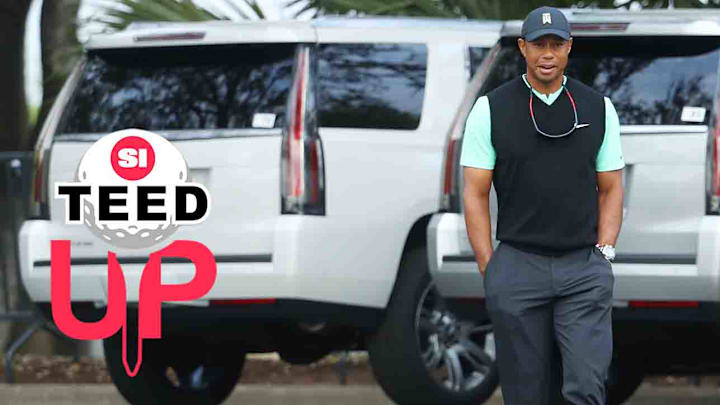
Over the years, long before his driving a vehicle became a subject of concern, Tiger Woods elicited both amusement and awe over his propensity for getting behind the wheel, even in the most public of settings.
Woods often drove himself to tournament sites, arriving in a courtesy car with his caddie, Steve Williams or later Joe LaCava, in the passenger seat.
It wasn’t always, but often—Williams, too, had a stubborn streak and you could envision a scenario where they might have fought over the car keys.
Another story came to mind the other day in the aftermath of Woods’s arrest on DUI charges near his Florida home, where police say he drove at a high rate of speed, clipped the back of a pickup truck and swerved to avoid contact before his Land Rover ended up on its side.
Woods took a breathalyzer test, which showed he had not been drinking, but refused a urine test that automatically led to his arrest and, by Florida law, will see a suspension of his driver’s license for a year, pending legal outcomes.

On the day before Woods would begin pursuit of his 2019 Masters title, the golfer was being honored by the Golf Writers Association of America at its annual awards banquet. Woods, who had been named Player of the Year by the GWAA on numerous occasions over the years and always attended, was getting the Ben Hogan Award, which goes to a player who overcomes serious illness or injury.
At that point, Woods was in the midst of an amazing return to golf after 2017 spinal fusion surgery. He won the 2018 Tour Championship and would go on to win that Masters. But it struck me that night that Woods arrived at the banquet facility six miles from Augusta National all by himself. Despite his agent and another representative attending the dinner, Woods drove himself.
One of the most famous people in the world pulled into a random parking spot at the Savannah Rapids Pavilion and casually strolled into the building without an entourage.
What was mildly humorous at the time has taken a far more serious tone in the last few days after another driving incident that could have endangered his life or others.
One question outside of all the legal wrangling is simple: why does Woods drive?
Even if there were no issues in his life, the idea of a celebrity having someone else wheel him around is far from uncommon. While it is obviously not the same thing, Woods has a captain for a yacht and a couple of pilots for his plane. Why not a driver for his car?
And it doesn’t even have to be his car. It could be a limo service or simply someone or multiple people he employs who are on call to take him wherever he goes. He has other close confidants and business associates as well who could do the same.
So why not?
To my knowledge, Woods has never been asked this question in a formal setting. But it is fairly easy to see why he has never gone that route: he likes to drive. He likes the control.
As someone who is enormously famous and often times constrained by all that goes with it, Woods quite conceivably enjoys the freedom that comes with getting in a car and going where he needs to go on his own.
Several years ago, Woods was playing a practice round at TPC Sawgrass in advance of the Players Championship. It was warm and there was no hint of precipitation, but Woods was wearing rain pants.
Turns out he had made the drive north from his South Florida home to Ponte Vedra Beach earlier that day and spilled coffee on his pants. Having not yet unpacked, he simply pulled the rain gear out of his bag.
This is not to excuse what has occurred. Certainly it is fair in the aftermath of what has happened over the years to wonder why this has happened again.
The horrific car crash in February 2021 that severely injured his right leg was preceded in 2017 by an incident where he was found asleep and incoherent behind the wheel of his car on a four-lane road. In that instance, he spent the night in jail after being arrested around 3 a.m. A breath test then revealed he had not been drinking but blood tests revealed he had five prescription drugs in his system.
Woods’s agent, Mark Steinberg, said at the time that the golfer was “receiving in-patient treatment. Tiger has been dealing with so much pain physically. And that leads to insomnia and sleep issues. This has been going on for a long time.”
Woods addressed the matter in a social media post but never spoke about it again.
Clearly Woods has dealt with pain issues for more than a decade, perhaps longer. He’s had multiple knee surgeries. He’s had at least seven back procedures in the last 12 years. There were numerous surgeries on his leg in the aftermath of the 2021 crash.

Following that, California police elected not to test his blood, despite the circumstance of the crash. When Woods was questioned months later, he said: “It’s all in the police report.” And while it wasn’t in the police report at all—other than to say the officers didn’t believe there was probable cause to test him—it was a stance Woods could easily fall back on. Why would he offer more?
The media has understandably been called out for not being tougher on Woods, which is an easy broad-based assertion but one mired in nuance.
As someone who has been there for most of this, it should be pointed out that Woods was grilled the first time he faced the media in 2010—at the Masters, of all places—following the infidelity scandal that rocked him.
Those questions persisted for months.
Following the 2017 incident, Woods was not made available to the media for months. His arrest was roughly six weeks following the spinal fusion surgery and he did not face media questions until four months later—in his role as an assistant captain at the Presidents Cup.
The circumstances were not such that you’d grill Woods on this topic. He was on a dais with seven other assistant captains who were all fielding questions. While he got the majority, most were about golf and Woods referenced managing the pain. It’s where he uttered the ominous line “I don’t know what my future holds for me.”
Perhaps the reference to pain should have led to a question about the medication that was found in his system months earlier. Then again, Woods was not convicted of DUI, the charge being reduced to reckless driving, and as typically the case in such a setting, a moderator can steer such queries to golf.
Woods wasn’t in front of the media again that year until he played in the Hero World Challenge in the Bahamas, where he was playing for the first time since spinal fusion surgery. The focus had shifted to his comeback.
Following the 2021 car crash in February, Woods did not face the media again until his event in the Bahamas—some 10 months later—where he was not playing. When asked about the crash after several questions, Woods was not going there.
“Yeah, all those answers have been answered in the investigation, so you can read about all that there in the police report,” he said.
And with that, Woods shut it down.
With no charges filed, what did he have to gain by talking about it? Woods left that morning at 7 a.m. for a sponsor event. Again, he was driving alone. He was found to have traveled at a high rate of speed, more than 85 mph, his SUV rolling into a mangled mess.
Why not grill him more? Because the idea that you can keep peppering him with questions until you get the answer you want is folly. The police report made it easy for him to deflect. And if you keep peppering him with such questions, there is the risk of the news conference going awry and being cut off.
Unsatisfying? Sure. But reality is not simple.
And thus here we are again. Woods faces fresh legal questions, and if he were to show up at the Masters next week, good luck getting him to touch this subject.
But clearly there is concern about him in the aftermath of another embarrassing incident.

Kevin Kisner, who played on Woods’s TGL team and was with him last week is also an analyst for NBC, called the incident “very disturbing” during his broadcast duties on Saturday.
“He was really working hard on his game, trying to practice and get back in shape,” Kisner said. “He signed up for the U.S. Senior Open [Friday]. He was trying to do anything he could to come back and try and help our TGL team get ready, hopefully try and play the Masters.”
“Just a really unfortunate incident. The only positive is that nobody was injured in the incident and we can all move forward and hopefully help him get better.”
Hopefully, if he makes a Masters appearance, Woods rides in the passenger seat of the car that brings him down Magnolia Lane.
Rory, the Masters and a Biography
With only a week to go until the Masters, there will be plenty of talk about Rory McIlroy’s 2025 victory that saw him complete the career Grand Slam.
And just in time, former Sports Illustrated writer Alan Shipnuck is out with a biography of the five-time major champion from Northern Ireland titled Rory: The Heartache and Triumph of Golf’s Most Human Superstar.
Shipnuck went into overdrive to get the project done in time for this year’s tournament, with a release date of April 7.
I asked Shipnuck about his work on the book.
Bob Harig: Was the Rory biography in the works for a while? How much did the Masters victory speed up the process?
Alan Shipnuck: Well, I like to say it’s been two decades in the making, since I’ve been covering Rory for his whole career. But I didn’t commit to the project until the spring of 2024. The plan was to finish the book in the fall of ’25 so it would come out around the ’26 Masters. Then a lot of life happened. I wasn’t as far along on the typing as I had hoped, so in February 2025, I called my editor and told him I needed another year. He was like, “Of course, take as long as you need—all I care about is your mental health and well-being.” Then, two months later, Rory won the Masters. As soon as the final putt dropped I got a text from my editor: “Type fast, book is due in October.” I’m happy it happened that way because I needed the adrenaline rush. The Masters victory animated the whole project and gave it an unforgettable crescendo.

BH: From personal experience, it seems that golfers are averse to being the subject of books even though we write thousands upon thousands of words about these guys online and in print. Why do you think that is?
AS: That is a recent phenomenon. The golden oldies like Palmer and Nicklaus always sat with their biographers—they understood the value of burnishing their legend and telling their side of every story. And there is also a human element: they knew they could charm the writer along the way. But Tiger made the process adversarial. He was a mercenary who felt personally wronged if, God forbid, a writer tried to support his family by typing a book about him. And of course Tiger influenced in every way the generations that followed. There is also the changed media environment. Every player under 40 came into stardom during the social media age, in which they learned they could talk (and market) directly to fans. That made the golfers even more disinclined to open themselves up to writers.
BH: O.K., all of that said, how was your relationship with Rory prior to the project and since its completion?
AS: Rory is very tribal. I’ve had a solid working relationship with him through the years—not to spoil too much, but the book begins with us flying across China together in a private jet—but I was never one of the chosen ones in the media he has let into his world. That’s fine, I’ve always liked to have more distance with the players. I came up at SI when it was run by old-school hardasses who would have laughed you out of the building if you tried to be bros with the athletes. Anyway, I wanted to do a sit-down interview with Rory for the book but it didn’t happen. As his manager Sean O’Flaherty told me, “If it’s not our book, there’s not much incentive for Rory to participate.” Fair enough. I continued on my merry way.
But at the 2025 U.S. Open, Rory and I had a very animated discussion about the book. He said, “It pisses me off that you’re making money off my name.” I assured him that book money is a teeny tiny fraction of Grand Slam money, but I don’t think it’s about the dollars. It’s about control. As we were saying above, Rory is used to having dominion over every facet of his image, but he knew he’d have no control over this book and that’s unsettling to him.

There is a happy ending, though. At Pebble Beach this year I gave O’Flaherty a couple copies of the book. Later that day, Rory came into the media center for his scheduled press conference and he made a beeline for me. He shook my hand and said thanks for the book and that he was looking forward to reading it. This was in front of the whole press corps and felt like a peace offering. I appreciated that.
Fast forward to that Sunday. I filed my game story from the press room and was then walking to my car. It was dark and drizzly but I saw a figure in the distance walking toward me and immediately recognized Rory’s gait. He was on his way to the Tap Room. Of all the gin joints … he told me he had read the foreword to the book and that he liked it and it made him laugh. There’s some pretty spicy stuff in that chapter so if he’s cool with that, then I’m confident he has enjoyed the rest of the book.”
BH: After Rory won the Masters, there was this sense that he’d be freed up after 11 years without winning a major to knock off several more, especially starting with the PGA at Quail Hollow. It didn’t exactly work out that way. What was going on?
AS: Just your garden variety existential crisis! But he found himself again at the Irish Open—other than the Masters, no tournament had haunted him like his national open. That victory showed that he was back to being himself again, and it carried into the Ryder Cup, where he was a towering figure.
BH: Rory turns 37 this year. He’s had a long career already and yet he’s still ranked second in the world. What do you see as his future?
BH: There are so many good voices in this book: Paul McGinley, Jimmy Dunne, Shane Lowry, Bob Rotella, Adam Scott, Justin Rose, Brad Faxon, Brandel Chamblee, Jim Nantz, Chubby Chandler …. all of them were incredible interviews, and that’s just a tiny fraction of the folks with whom I spoke. But Padraig Harrington has some indelible cameos and I posed the same question to him that you just asked me. He said, “I know because I asked Rory. It was his wedding night, and he had a few drinks in him, so it was a good time to ask. He said nine [major championship victories]. So that’s what he’s thinking. That’s the deep-down thing. So he’s just getting started.”
That has the ring of truth. Rory is very aware of his place in history. He wants the crown jewels: to win a U.S. Open at Pebble Beach, to win an Open Championship at St. Andrews, etc. He’s already one of the dozen greatest players of all time. (I lay out this case in great detail in the final chapter of the book.) But if he can pick off a few more majors he gets into very rarified air. I think he is going to keep marching forward. More thrills await, and no doubt some heartbreak, too. With Rory, you can’t have one without the other.”
The Masters field grows, with room for one more
Gary Woodland earned his way into the Masters field with his feel-good victory at the Houston Open, his first since capturing the 2019 U.S. Open. Woodland has been through considerable personal trauma in recent years with brain surgery that he just recently acknowledged has led to PTSD issues. The fact that he won so soon after that is an amazing occurrence and puts him back at Augusta National after missing out last year.

Woodland will be joined by four others who qualified for invitations via the Masters’ top 50 Official World Golf Ranking designation as of Monday: Nicolai Højgaard, who finished second to Woodland and was all but assured of staying in the top 50; Daniel Berger, Jake Knapp and Matt McCarty also got in via the top 50.
The field now stands at 93 players, which for now includes Tiger Woods. It can only increase by one more player—the winner of this week’s Valero Texas Open, if not already exempt.
The field of 93 is in line with what Augusta National prefers, if not a little bit higher. Last year there were 95 who started and in 2024 it was 89.
More Golf from Sports Illustrated
 Add us as a preferred source on Google
Bob Harig was a senior writer covering golf for Sports Illustrated. He has more than 25 years experience on the beat, including 15 at ESPN. Harig is a regular guest on Sirius XM PGA Tour Radio and has written two books, “DRIVE: The Lasting Legacy of Tiger Woods” and “Tiger and Phil: Golf’s Most Fascinating Rivalry.” He graduated from Indiana University where he earned an Evans Scholarship, named in honor of the great amateur golfer Charles (Chick) Evans Jr. Harig, a former president of the Golf Writers Association of America, lives in Clearwater, Fla.
Follow bobharig