
Could Taylor Rogers Offer Astros Solution for Their Bullpen?
In this story:
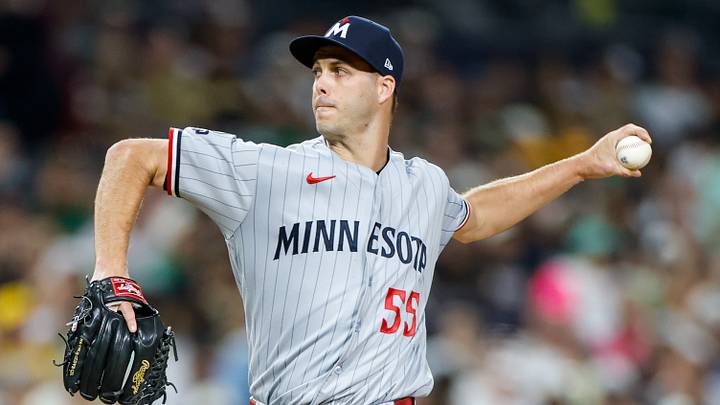
It is clear to me that the projections for left-hander Taylor Rogers, whom we will refer to later, are far from approaching the level of stability and dominance that Steven Okert generated in the Houston Astros' bullpen over the last two seasons.
His impact speaks for itself, as Okert recorded 2.8 fWAR in 139 ⅓ innings, with a 3.83 xFIP and a great improvement in two aspects that made a difference compared to his previous two-year stretch, between 2023 and 2024: his Location+ made a considerable jump from 97 to 103, and Okert managed to become more of a strikeout pitcher and have better control, increasing his K-BB% rate from 16.2 to 22.2, while reducing hard contact by allowing a lower Barrel% rate, with 6.9% compared to 9.9%.
Steven Okert was one of Houston's most reliable bullpen arms, but replacing his production without overpaying won't be easy. Could JoJo Romero be the answer? Here's what the numbers reveal.
— Yirsandy Rodríguez (@Yirsandy) November 12, 2026
🔗 https://t.co/nI6Ejv5Q24
However, the Houston Astros have still not secured his return and, for now, we still do not know how much they will try to change their expectations: whether they will look for a left-hander who can add similar value and strengthen the bullpen or go after a right-handed arm who can bring a different profile combination.
In any case, even if one of the 2026 starters —probably Ronel Blanco or Cristian Javier— ends up being sent to the bullpen, without Okert the left-handed profile loses a great deal of impact value, since both Bryan King and Bennett Sousa have had many problems stabilizing their performance over the last two seasons.
That said, I think there are some reasons why Rogers could be an interesting candidate on the market if it is a matter of exploiting the most consistent side of his profile. Let's analyze some of what could be “positive” and “negative.”
The Negative

Is it okay if we start with the worst part? Good, let's move on! Look, since we are talking about this recent period starting in 2025, it would be convenient to stay there, as Rogers is an 11-season veteran who will turn 36 next December 17, just like his twin brother Tyler, one of the main relievers in the Toronto Blue Jays' bullpen. Both brothers have stood out for being relievers with the ability to take on significant workloads during most of their careers.
Since 2022, Taylor has averaged 68 relief appearances per 162 games (and 62 per season), with a combined 1.5 bWAR, a 3.76 ERA (109 ERA+) and a 3.88 FIP in 312 appearances during that stretch. However, he has suffered a somewhat concerning deterioration in some aspects since 2025, ranking as the fourth reliever with the highest walk rate (4.38 BB/9), the fifth with the worst xFIP (4.73) and the eighth who allows the most contact within the strike zone (88.6%) in the entire league among qualified relievers with at least 100 innings pitched during that period.
Rogers is coming off his second season around the 21st to 30th percentile in Pitching (21 in 2025 and 28 this year), five seasons after appearing between the 69th and 83rd percentiles of the league between 2017 and 2019, when he experienced the best moment of his career. He also finished this year with a significant drop from the 76th percentile in Breaking to the 45th, which influenced his Whiff% and K% rates to decline by 4.3 and 4.4 percentage points, respectively, compared to the impact of his four-pitch mix: the sweeper, sinker, cutter and slider (he used it only 1% of the time against right-handers).
At the same time, none of those weapons was able to maintain a positive Run Value against both profiles, as the sweeper, which Rogers used 54% of the time against left-handed hitters, finished with +2 RV, but dropped to -2 against right-handers. Something similar also happened with his cutter, recording -1 against left-handers and +1 when he threw it against right-handers, using it 20% of the time, at a higher frequency than the 8% against left-handers.
Now, unlike the sweeper and the cutter, Rogers' sinker finished with a Run Value of -3 this year, which increased the uncertainty surrounding his problems, as he has recorded a combined -10.9 with the sinker since 2025, the worst value among all qualified relievers. That is where any team willing to include Rogers in its plans runs the greatest risk, because he has lost part of his ability to limit contact, falling to the worst combined Chase% and Whiff% marks of his entire career, closing out 2026 in the 4th and 6th percentiles, respectively.
The Positive

Although it may seem that Rogers does not offer enough impact to be considered a bullpen option, there are notable differences that offer some of the roles in which he still excels. First, Rogers remains a left-hander with the ability to avoid hard contact and he demonstrated it again in 2026, finishing in the 98th percentile in Hard Hit% and the 79th in Barrel%.
Okay, in 2025 he was terrible in both aspects (19th and 22nd percentiles, respectively), but a year earlier he had ranked in the 90th and 77th, marking a notable difference compared to King and Bennett, who have had problems related to both aspects. King has allowed a high 14.3 HR/FB rate since 2025, while Bennett has endured a 9.9 Barrel% rate, well above the league average of 7.6, along with his control difficulties, which result in a 4.60 BB/9 rate.

For these reasons, the fact that Rogers reduced his allowed Hard Hit% rate by 16.4 percentage points creates an interesting point in the conversation, but, if it were not him, it is clear that Houston is going to need reinforcements to make up for this lack of depth. Before finishing, I wanted to offer one additional point, and that is the fact that Rogers has also been a consistent arm when he pitches with just one day of rest.
In that situation, he has been able to find a good rhythm and finished with ERAs of 2.63 and 2.66, with a reduction in his allowed OPS from .761 to .672 over the last two seasons. So perhaps the key lies in how he is used by the team willing to sign Rogers, who, although he does not stand out among the power arms, has known how to respond in other important situations that are also necessary in any bullpen.
 Add us as a preferred source on Google

Yirsandy is a baseball writer specializing in MLB coverage with experience across multiple teams and storylines. He currently writes for Diamond Centric, where he covers the New York Mets, San Diego Padres, Chicago Cubs, Milwaukee Brewers, and Kansas City Royals. My work focuses on game coverage, player analysis, and storytelling that connects performance with context. My Substack has also been an important part of my writing development, where I’ve built much of my baseball coverage and storytelling voice over time. I’m passionate about combining reporting, research, and thoughtful analysis to produce engaging baseball content for readers.
Follow Yirsandy