
Letting Bryan Abreu Go Could Be Astros’ Biggest Offseason Mistake
In this story:
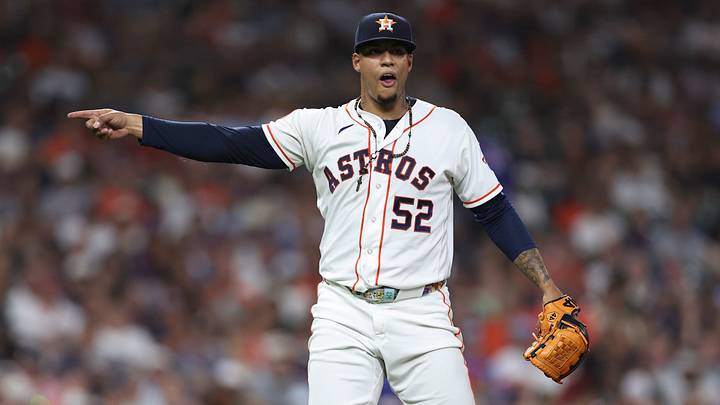
I would still not rule out the possibility of the Houston Astros becoming interested in bringing right-hander Bryan Abreu back, especially because of the little movement they have made to try to strengthen their starting rotation and bullpen this offseason.
His track record with the organization also matters, since he has been an impactful reliever in the bullpen since his debut in 2019, with a consistent track record in 23 postseason appearances, pitching to a 2.49 ERA, a 14.92 strikeout rate, and a 2.71 xFIP.
Between 2022 and 2023, Abreu recorded a streak of five postseason series and 15 consecutive relief appearances without allowing a run, accumulating seven holds with 30 strikeouts, just four walks, and six hits allowed after facing 61 batters in 16 ⅔ innings.
The only home run Abreu has allowed in the postseason against 102 opponents was the three-run homer hit by Chicago White Sox second baseman Chase Meidroth in the sixth inning of Game 2 of the Wild Card Series, which sealed the Astros’ fate last September 30.

Granted, the present carries the most weight in Houston’s decision, as Abreu went through difficult situations, especially during the first half of the season, when he pitched to a 5.81 ERA with seven home runs allowed in 31 innings, which raised his HR/9 rate to a concerning 2.03.
Up to that point, Abreu’s future generated so many doubts that the Astros were on the verge of sending him to the Minnesota Twins in a trade for outfielder Trevor Larnach, which was blocked at the last minute by Astros owner Jim Crane.
After staying with Houston, Abreu made the expected adjustments to his repertoire to improve his command and gave his season a complete turnaround, finishing with a 1.73 ERA after limiting the opposition to just 0.57 HR/9.
Those two home runs came at key moments. One was a walk-off home run by Junior Caminero (his 40th of the year and the first walk-off home run of his career) to give the Tampa Bay Rays the victory on September 12.
One week later, Ronald Acuña Jr. hit a grand slam at Daikin Park that put the Braves ahead 5-2. Aside from that, Abreu reduced his allowed slugging percentage from .477 in the first stretch to just .275, while his K-BB% rate rose to the expected levels, from the puzzling 9.9% to 19.8%.
Should the Astros Trust Abreu’s Recovery?

When we analyze Abreu’s season overall, several of his indicators remained at the level of his ability, such as his ability to generate swings and misses, strike out batters, and maintain high velocity, with percentiles of 97, 91, and 71, respectively. In addition, he has recorded a Whiff% at the 95th percentile or higher over the last five seasons and a K% at the 90th percentile or higher during that same period.
However, as a power reliever, he has not been in that same range when it comes to limiting hard contact, although this year he improved in Barrel%, from the 49th to the 70th percentile. As we have previously analyzed here, his lack of control has been the biggest problem in becoming more consistent. Abreu finished at the 1st percentile in BB%, and here are two reasons why his walks became a much bigger problem. Let’s analyze both turning points:
1) Hitters just averaged a 24.6 Pull AIR% rate, the highest of his entire career. There are many reasons why the lack of control that often resulted in walks also created situations in which Abreu fell behind in the count, and this was the overall result when his plate appearances ended with a ball put in play that was pulled.
Season | xSLG | BABIP | Pull AIR% | HR% |
|---|---|---|---|---|
2024 | .536 | .377 | 14.7 | 0.8 |
2025 | .577 | .264 | 17.9 | 0.7 |
2026 | .589 | .317 | 24.6 | 1.2 |
As you can see, the Pull AIR% rate jumped by 9.9 percentage points, resulting in some interesting numbers, right? Where would you prefer to start? Okay, I suspect the increase in home runs must have been a concerning point, since pulled balls resulted in an increase from 0.7% in 2025, the lowest during this period of the last three seasons, to 1.2%. xSLG also shows that perhaps a few more batted balls could have generated danger, although BABIP also gives us a small improvement compared to the 2024 season. That said, keep things in perspective and let’s move on to the next point, where we will see an even more compelling and revealing reason:
2) Obviously, there is no statistic that measures the confidence hitters feel in the batter’s box, but at the Major League Baseball level, it is very difficult for a pitcher to often survive falling behind in the count. That is the reason why, when Abreu improved his control after the All-Star break, his season took the turn we all expected. The situation improved once he got more counts in which he got ahead of his opponents. In this table, we can explore some of the results that had the greatest impact in that context, in a comparison covering the last three seasons.
Season | BF% | xOBP | xSLG | BABIP | K% |
|---|---|---|---|---|---|
2024 | 13.6 | .204 | .318 | .407 | 39.2 |
2025 | 12.6 | .212 | .290 | .407 | 42.6 |
2026 | 15.7 | .174 | .178 | .222 | 44.4 |
I think you already know where I wanted to go with this. To be fair, the fact that Abreu increased his rate of batters faced (BF%) in counts in which he managed to get ahead makes a very interesting difference when it comes to his last three campaigns and, above all, answers the question of how sustainable his performance could be after making the adjustments. The metrics speak for themselves: lower xOBP, which leads to fewer difficult situations with runners on base, a very interesting reduction in xSLG and BABIP, and the best strikeout rate during that period.

For a bullpen that will no longer have left-hander Steven Okert, who was one of the most consistent arms over the last two seasons, losing Abreu and turning to free agency at the last minute could be one of the Astros’ biggest mistakes this winter.
 Add us as a preferred source on Google

Yirsandy is a baseball writer specializing in MLB coverage with experience across multiple teams and storylines. He currently writes for Diamond Centric, where he covers the New York Mets, San Diego Padres, Chicago Cubs, Milwaukee Brewers, and Kansas City Royals. My work focuses on game coverage, player analysis, and storytelling that connects performance with context. My Substack has also been an important part of my writing development, where I’ve built much of my baseball coverage and storytelling voice over time. I’m passionate about combining reporting, research, and thoughtful analysis to produce engaging baseball content for readers.
Follow Yirsandy