
The Astros Face a Key Decision That Will Define the Team’s Future in 2027
In this story:
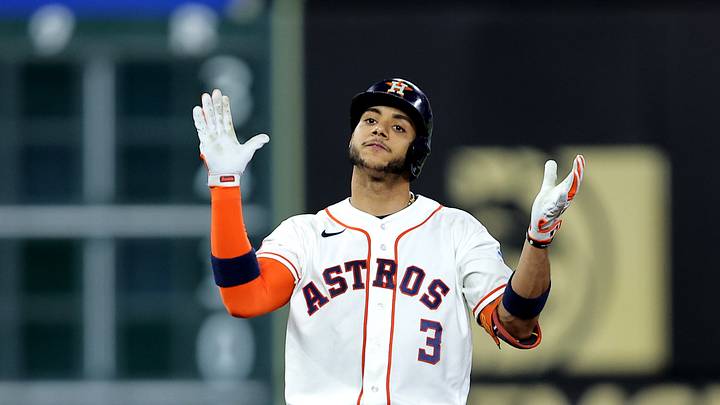
The Houston Astros exercised their $13.35 million club option on Isaac Paredes, which ensures his presence on the roster for 2027 and prevents his salary from being determined through arbitration. The agreement also keeps him under the team’s control until after next season, when he will be able to reach free agency.
That is a first step to begin making important decisions about the future of the roster and the big question mark that has followed Houston this winter, since Paredes’ and Jeremy Peña’s status has placed them as two possible pieces capable of generating great interest in the market.
For his part, Peña is in another situation: he enters his final year of arbitration eligibility; after winning $9.5 million in 2026, he has a salary projection close to $13.1 million for 2027 and will also be able to become a free agent at the end of the season. We have analyzed here again and again some of the Astros’ best options and how they should resolve their pressing situation with five elite infielders. That will be one of the most complicated tasks that new general manager Randy Flores will have to resolve and, from what we see, the decision is beginning to turn toward Peña, although we cannot rule out that the first baseman and recent Gold Glove winner, Christian Walker, will be the trade piece this winter.
The difficult situation if the Astros choose to take Walker out of their plans

As I have written before, it will not be so easy for the Astros to get rid of Walker, above all because his $20 million salary for 2027 reduces the number of teams willing to assume the final year of his contract. At 36 years old, the first baseman is coming off a 29-home run season, but also from a marked offensive decline in the second half, when he registered a .611 OPS in his last 90 games. In addition, we should take into account another factor that reduces Houston’s room to negotiate, and that is that Walker’s contract includes a limited no-trade clause that allows him to block a trade to six teams.
Paredes and Peña concentrate the most attractive options to negotiate

There is a possibility that we still cannot rule out, and it is that the Astros decide to find a way to be able to offer playing time to each of their five elite infielders. Peña would be the starting shortstop, and Carlos Correa could start at third base, although he could also move to first base just like Paredes. Of course, if Yordan Alvarez appears more frequently in left field, the designated hitter spot could be open to Paredes, Correa, or even Walker.
There could also be other trade possibilities if Correa or Paredes could move to second base and share playing time with veteran Jose Altuve. Those are some of the possible variations, but it is clear that the most likely outcome will be for Paredes or Peña to become trade pieces, depending on how Flores approaches the market.
Paredes is coming off a season of 25 home runs, 94 RBIs and 4.4 fWAR, driven by a Batting Run Value of +27 and 130 wRC+, although his exit velocity and hard-hit ball percentiles —8 and 10, respectively— do not highlight an outstanding contact ability. Defensively, his Fielding Run Value improved from -3 in 2025 to 0 in 2026, although he finished with -2 in his appearances at third base and placed in the 29th percentile in OAA, a performance that does not make him a defender capable of raising his value in the market.

On the other hand, Peña’s ability and pedigree present a different projection in terms of negotiations. Despite missing a good part of the season, his 3.4 fWAR in 112 games showed that offensive production from shortstop continues to be an important argument.
That said, his defense had a decline from +8 OAA in 2025 to -6 in 2026, with a Fielding Run Value of -5, which adds a little doubt about his future despite his speed and experience at the position. So Houston will have to decide whether it will offer an extension to Peña or whether it will use him as a trade piece, if the return value compensates for the fact of losing him. If any team is interested in Peña, it would have a season of control that could serve to evaluate his status before free agency.
Without Peña, Correa would be the main option for shortstop in Houston, which would be a rather risky bet, assuming his injury history, since he has missed 224 games in the last three seasons, two with the Minnesota Twins and the most recent one with the Astros, playing just 32 games in the 2026 season.
 Add us as a preferred source on Google

Yirsandy is a baseball writer specializing in MLB coverage with experience across multiple teams and storylines. He currently writes for Diamond Centric, where he covers the New York Mets, San Diego Padres, Chicago Cubs, Milwaukee Brewers, and Kansas City Royals. My work focuses on game coverage, player analysis, and storytelling that connects performance with context. My Substack has also been an important part of my writing development, where I’ve built much of my baseball coverage and storytelling voice over time. I’m passionate about combining reporting, research, and thoughtful analysis to produce engaging baseball content for readers.
Follow Yirsandy