
Blue Jays’ Sean Keys Showed Why His Power Is Worth the Patience
In this story:
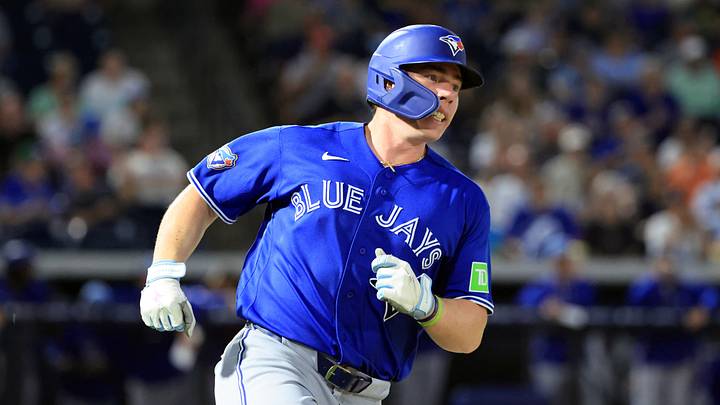
We know it’s a small sample, but that’s not a problem when it comes to appreciating Sean Keys’ talent.
I would have been left with doubts if his reports from his first call-up had shown a chart of Keys crushing the curveball or the splitter, the two pitches that gave him the most trouble after sinkers in the minor leagues this year. But it was quite the opposite.
Keys averaged a 52.5 Hard Hit% and a 10.0 Barrel/BBE% rate in his 67 plate appearances per his Statcast page. Forget his averages, his 29.3% whiff rate, and his 34.3 K% for a moment. Let’s focus only on his contact, since Keys showed that he remains a legitimate talent.
Of course, he didn’t even have 100 plate appearances, but his power ranked above the 90th percentile in Hard-Hit% and LA Sweet Spot%, and his Bat Speed ranked above the 80th percentile, averaging 74.8 mph.
That’s what catches my attention most about his contact, because strikeouts will remain part of his profile as a hitter. He’s not an all-or-nothing hitter, either, since his recognition ability and bat speed allow him to hit to the opposite field and up the middle.
Keys posted a 37.5% Pull%, a percentage that I’m sure will change as he looks for more power with fly balls toward his pull side, but it was good to see a little bit of everything in his approach at the plate during the first test he faced in the Major Leagues.
The Signs We Should Be Watching From Keys

Two interesting details to start with. Remember Keys’ problems against the curveball and the splitter? He crushed them when pitchers threw them to him in the Major Leagues. Against curveballs, he recorded a 40% Hard-Hit%, and against splitters, 100%, with a 6.0 Run Value/100.
But here’s another detail we could miss if we look only at the results of swings, where strikeouts come into play, and the success of balls put in play. Keys recorded at least a 40% Hard-Hit% against seven of the eight pitch types thrown to him. He was limited to just 0.0% against the sweeper, despite averaging a .301 xBA.
The most interesting part comes next, when we look at how he worked his swing against pitches inside and outside the strike zone.

Keep your eyes on Hard Hit per ball put in play. Notice how he crushed pitches in the upper third of the strike zone and how his swing extension also allowed him to produce hard-hit balls against pitches low and away. Further down, in xBA, you can see some impressive results that don’t match the .197/.242/.328 line he posted in 25 games.
The xBA (contact) and xSLG results are once again revealing in the upper third and outside the strike zone, while still showing impact on the inner part. It won’t be that easy, and it will require time and patience from the Blue Jays if they want to develop Keys, but it’s encouraging to appreciate his great talent and what he could accomplish if he expands the variety of his contact and manages to reduce his high strikeout rate.
 Add us as a preferred source on Google
Yirsandy is a baseball writer specializing in MLB coverage with experience across multiple teams and storylines. He currently writes for Diamond Centric, where he covers the New York Mets, San Diego Padres, Chicago Cubs, Milwaukee Brewers, and Kansas City Royals. My work focuses on game coverage, player analysis, and storytelling that connects performance with context. My Substack has also been an important part of my writing development, where I’ve built much of my baseball coverage and storytelling voice over time. I’m passionate about combining reporting, research, and thoughtful analysis to produce engaging baseball content for readers.
Follow Yirsandy