
Three Ways A Lockout Could Shape The Blue Jays Offseason
In this story:
On the final day before the lockout in 2021, Major League Baseball teams channeled their inner Oprahs.
"You get a contract! You get a contract! Everybody gets a contract!"
Across Major League Baseball, MLB teams officially signed 27 free agents to $1.4B in contracts on Dec. 1, 2021, before the clock struck midnight and free agents turned into unsignable pumpkins. Teams couldn't sign them until the players and owners agreed to a new Collective Bargaining Agreement, which happened 99 days later on March 10, 2022.
In total, MLB clubs spent $2.16B ahead of the 2021-2022 lockout, with $1.67B going to free agents and another $489B in extensions.
Typically, around 15% of total off-season free-agent spending happens in November. Before the 2021 lockout, including Dec. 1, it was nearly 60%. The hard deadline created an NBA-style free-agent frenzy. The table below shows the largest free agent contracts teams handed out before the lockout. Toronto made the best deal.
Player | Team | Dollars ($M) | Years | AAV ($M) |
|---|---|---|---|---|
Corey Seager | TEX | 325 | 10 | 32.5 |
Marcus Semien | TEX | 175 | 7 | 25 |
Javier Baez | DET | 140 | 6 | Far too much |
Max Scherzer | NYM | 130 | 3 | 43.3 |
Kevin Gausman | TOR | 110 | 5 | 22 |
Spending Big on Free Agents Ahead of A Lockout
There were five nine-figure contracts before the 2021 lockout. The Rangers captured the headlines for shelling out a half billion dollars to Corey Seager ($325M/10 years) and Marcus Semien ($175M/7 years), but the Blue Jays were also big spenders, doling out over $300M between extensions and free-agent acquisitions.
In mid-November, Toronto signed a 7-year, $131M extension with Jose Berrios, whom the Blue Jays had acquired from the Twins at the trade deadline. Toronto still owes Berrios $48M even though he will still be recovering from Tommy John surgery in 2027.
On Nov. 29, they agreed to a 5-year, $110M contract with free agent Kevin Gausman to lead their rotation and fill the void left by departing Robbie Ray. The deal wasn't officially processed until the evening of Dec. 1.

Then, just ahead of the deadline, they agreed to a 2-year, $11M contract with Yimi Garcia.
This year, Toronto has been linked to power bats, including Seiya Suzuki, who would be a great fit in right field. The Blue Jays may need to strike before the lockout to sign Suzuki.
Both sides benefit from signing before the deadline. For players, especially those with families, signing early means they know where they'll live the following season, which helps them find housing and schools and gives them more time to move than signing just before a new season begins, whenever that might be.

Clubs can fill holes and gain cost certainty heading into the offseason, letting them move faster once the lockout ends. More critically, depending on the new agreement, it might also allow contracts to be grandfathered under the old rules if the owners succeed in getting a salary cap, limiting contract lengths, or prohibiting deferred money, all of which have been floated.
Accelerating Signing a Japanese Superstar
When players are posted by Japanese teams, there is a 45-day window for MLB clubs to sign them once they have been officially posted. If they do not sign with an MLB team, they return to their club in Japan.
Last season, three Japanese stars were posted: Munetaka Morikami, Kazuma Okamoto, and Tatsuya Imai. In all three cases, they signed just before the window expired.
Teams typically post Japanese players in mid-to-late November. While it is expected that the 45-day clock would be frozen in the case of a lockout, the same dynamic that applies to free agents could apply to Japanese players, who face an even more difficult transition culturally and logistically if they sign during what might be a condensed timeline between the end of a lockout and the start of the regular season.
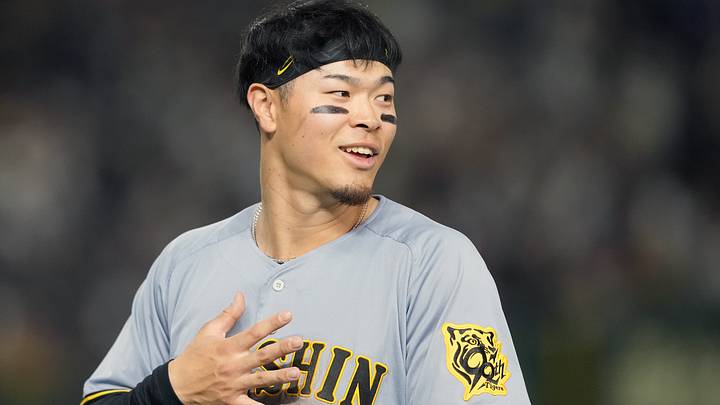
The biggest Japanese star likely to be posted this off-season is Triple Crown winner Teruaki Sato of the Japanese Central League. The Blue Jays have been linked to Sato, whose current club, the Hanshin Tigers, is expected to post him in early November. While the Blue Jays have a third baseman in Okamoto, Sato also has experience playing the corner outfield spots, but he is not a strong defender, so he could also DH.

The Rule 5 Draft Dilemma
Blue Jays fans know from Spencer Miles how valuable a Rule 5 Draft pick can be.
Teams must decide by Nov. 17 whether to add Rule 5 Draft-eligible players to the 40-man roster to protect them from the Rule 5 Draft. In Toronto's case, Rule 5-eligible players
Toronto's No. 2 prospect, Nolan Perry, Rule 5 Draft-eligible for the first time because he signed out of high school in 2022, is considered a lock to be added to the 40-man roster. Jay Harry will likely stay, but Toronto will face tougher decisions on pitchers like Gage Stanifer and Daniel Guerra and infielder Josh Kasevich.
The Blue Jays currently have 39 players on their active 40-man roster. However, teams must add players returning from the 60-day IL back to their 40-man rosters before the Rule 5 Draft, which will create a roster crunch for Toronto regardless of the lockout. Pending free agents will open up some room, but a logjam of bullpen arms and middle infielders is still likely.
With a lockout, though, there likely won't be a Rule 5 Draft, reducing the need to protect borderline Rule 5-eligible players. It would be risky, but if Toronto strongly believes the Rule 5 Draft will be canceled, it might choose not to add a player like Josh Kasevich to the 40-man roster to keep a veteran like Myles Straw.
Of course, the hope is that there won't be a lockout and that these implications will be irrelevant, but that seems as likely right now as Oprah giving me a brand-new Ferrari.
 Add us as a preferred source on Google
Adam Steinmetz writes about the Toronto Blue Jays for On SI. Adam is also the editor and publisher of the Boston Sunday Sports Section, a weekly digital publication covering the Patriots, Red Sox, Celtics, and Bruins. A two-time winner of the Best Collegiate Sports Writer award in Philadelphia, he began his career with freelance work for The Philadelphia Daily News and The Palm Beach Post before building a successful career outside of journalism. He returned to sports writing last year, contributing to Pitcher List—including coverage of the Toronto Blue Jays—before launching Authorenticity on Substack, where he explores the human stories within baseball. The Boston Sunday Sports Section is his most ambitious project — the thinking fan’s modern Sunday Sports Section focused on the Patriots, Red Sox, Celtics, and Bruins.