
Metrics That Provide Hope to Braves for Austin Riley Bounce Back
In this story:
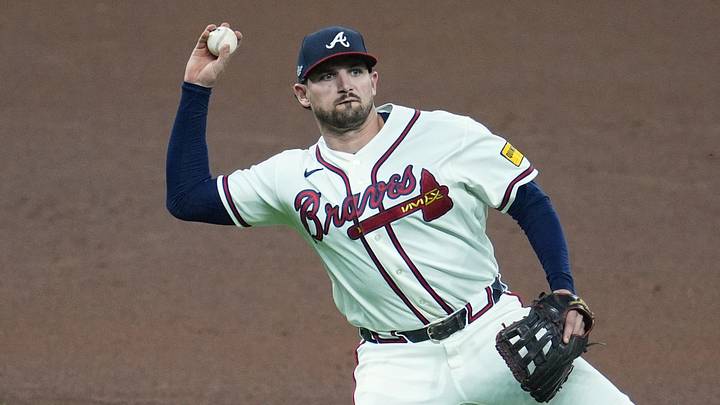
With a roller coaster 2026 in the books, all Atlanta Braves third baseman Austin Riley can do is look ahead. There's no doubt work was put in to course-correct. To an extent, some progress showed through, but he's still on the long and winding road to a return to form.
It really can't be said that Riley is someone who is at a crossroads. It feels dishonest to tell you that he is, and I'm not in the business of drumming up offseason melodrama that doesn't exist.
He's not a pending free agent. He's far from being one, with job security until after the 2032 season. After that, a club option would have to be decided upon for 2033.
At $22 million per season, the Braves aren't going to cut him loose. They can try to trade him, but good luck with that. There is no indication that that's even a possibility anyway.
Some may choose to go scorched-earth on that salary given his performance, but saying his contract isn't aging well isn't a new take. It's so stale that biting into it would break your teeth.
The real question is: What now? Since he's here long-term, all that can be done is ponder what the Braves can get from him going forward.
Fortuantely for him, some metrics give him some type of lifeline.
In 2026, he posted a hard-hit rate and a barrel rate that were in the 82nd and 74th percentiles, respectively. His average exit velocity of 91.3 mph is in the 84th percentile.
His batting average on balls in play (BABIP) after the break was .336, which would be on par with his All-Star seasons.
If he's squares it up, a small chunk of the baseball world will bash it harder than him.
His second-half stats also show that there was some improvement as well. His OPS improved by nearly 100 points after the All-Star break from .618 to .711. His slugging improved from .329 before the break to .417 after it. He hit more home runs in that 64-game span (10) than he did in the first 95 games (9).
Are these the numbers that most are expecting from him? Not at all, but it's something to at least point out when discussing what they could get from him going forward.
The metrics indicated that he gave the Braves some of the best defensive output of his career. Normally, he posts a negative outs above average (OAA), with a career high coming in at zero in 2023. This year, he posted a plus-2. Where he didn't rebound offensively, he at least found a way to make up for it defensively.
Ok, so a lot of benefit of the doubt has been given to him here. Let's look at a key stat to be concerned about. Plate discipline is the first place to look.
He's in the third percentile for strikeout rate (31.9%), and his whiff rate (also 31.9%) is in the 10th percentile. That discipline has never been stellar, never above the 36th percentile in either of these categories. But they have noticeably dipped, and in a game like baseball, a change from a 27% strikeout rate to a 31% strikeout rate is substantial.
Since his walk rate actually rebounded in 2026, the casualty was balls in play. That's an area that will be key for next season. If he can find a way to consistently curb the chases and the strikeout rate, he could truly experience a return to form.
Where the reality sinks in is that it's easier said than done to do that. Riley was the first to make that clear when discussing how work in the cages translates to real at-bats.
"I think that the biggest thing that I've done is simplify some things, you know?" Riley said in an interview with Atlanta Braves on SI in September. "Trying to, I think, I think there for a minute, trying to fix too many things and trying to hit 100. That's hard to do those combinations of things."
We'll see if he's able to slowly sort through those combinations of things. He'll certainly have the time due to his contract.
He's not going anywhere. That's a certainty if there ever is one. All he can do is keep trying to find his way, and all the Braves can do is keep trying to help him make it happen.
 Add us as a preferred source on Google

Harrison Smajovits is a reporter covering the Atlanta Braves and the Florida Gators. He also covers the Tampa Bay Lightning for The Hockey Writers. He has two degrees from the University of Florida: a bachelor's in Telecommunication and a master's in Sport Management. When he's not writing, Harrison is usually listening to his Beatles records or getting out of the house with friends.
Follow HarrisonSmaj