%20%20--%3E%0A%3Csvg%20version%3D%221.1%22%20id%3D%22Layer_1%22%20xmlns%3D%22http%3A%2F%2Fwww.w3.org%2F2000%2Fsvg%22%20xmlns%3Axlink%3D%22http%3A%2F%2Fwww.w3.org%2F1999%2Fxlink%22%20x%3D%220px%22%20y%3D%220px%22%0A%09%20width%3D%2239px%22%20height%3D%2240px%22%20viewBox%3D%220%200%2039%2040%22%20enable-background%3D%22new%200%200%2039%2040%22%20xml%3Aspace%3D%22preserve%22%3E%0A%3Cpath%20fill%3D%22%23FFFFFF%22%20d%3D%22M38.5%2C7H28.2v26h10.3V7z%22%2F%3E%0A%3Cpath%20fill-rule%3D%22evenodd%22%20clip-rule%3D%22evenodd%22%20fill%3D%22%23FFFFFF%22%20d%3D%22M26.1%2C25.5c0%2C5.8-4.1%2C7.5-12.9%2C7.5C3.9%2C33%2C0%2C31.2%2C0%2C25.2v-1.1h11.6%0A%09v2.4c0%2C0.7%2C0.1%2C1.4%2C1.2%2C1.4c1%2C0%2C1.2-0.4%2C1.2-1.3v-0.9c0-1.6-0.9-1.6-3.5-2.2C2.2%2C21.7%2C0%2C19.7%2C0%2C15.3v-0.9C0%2C9.3%2C5.5%2C7%2C12.9%2C7%0A%09c10.2%2C0%2C12.8%2C2.6%2C12.8%2C7.4v1.8h-11v-2.9c0-0.6-0.4-1.1-1.2-1.1c-0.6%2C0-1.2%2C0.4-1.2%2C1.1v0.9c0%2C1.5%2C0.9%2C2%2C3.3%2C2.5%0A%09c8%2C1.6%2C10.5%2C3.3%2C10.5%2C7.5V25.5z%22%2F%3E%0A%3C%2Fsvg%3E%0A)
The Last Baseball of the 2026 World Series Told the Story of the Brewers
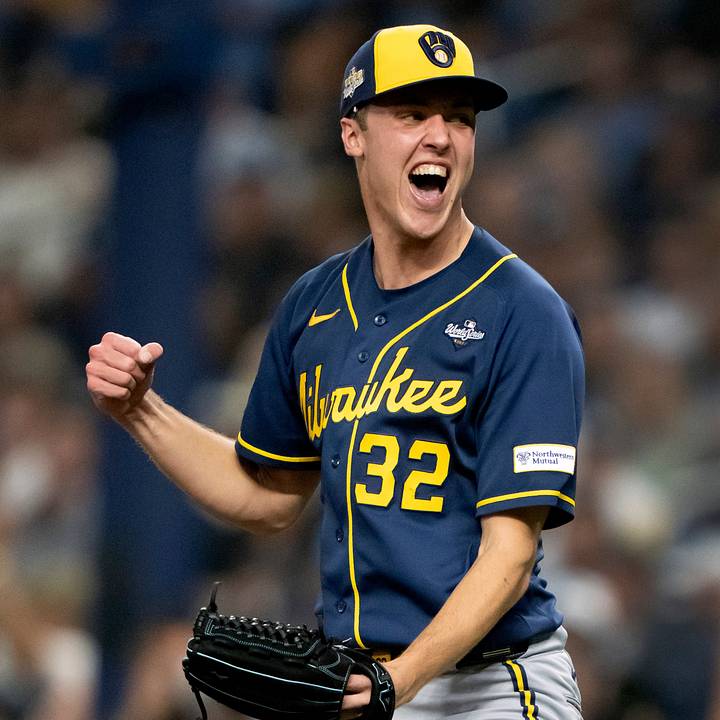
ST. PETERSBURG — The most valuable baseball in the history of the Milwaukee Brewers, the hallowed totem at the end of a grail quest 57 years in the searching, sat stuffed in back pocket of the uniform pants of Jake Bauers, a quintessential Brewer in that he was discarded by six organizations before he was dipped into the River Styx that is Milwaukee.
“I’m not gonna lie,” Bauers said. “I was thinking about keeping it.”
This was the baseball Bauers caught in his first baseman’s mitt upon it being thrown by Brice Turang, after the second baseman caught a ground ball that resulted from a pitch by Trevor Megill, who until he found the restorative springs of Brewers baseball was out of baseball and trying to reinvent himself by throwing against a concrete wall between cars in an underground parking garage. It was the baseball from the last out of a 4–1 victory over the Tampa Bay Rays in World Series Game 5 Wednesday that clinched the first world championship in Brewers history.

Despite the brief temptation of claiming ownership, Bauers knew exactly what he had to do with it. The first thing he did was get it authenticated by an MLB official. Then he returned it to his pocket, where it stayed for about 20 minutes as the Brewers received their championship trophy and posed for a keepsake team picture in the Tropicana Field outfield.
And then, amid a confetti-tossed sea of family, friends, players and staff, Bauers saw the rightful heir to the baseball and put his hand on the man’s shoulders, wide as a Thanksgiving dining table.
“Here,” Bauers told him, “this is for you.”
The 67-year-old man with the granite jaw and the 5th Street Gym nose looked perplexed. Bauers read his puzzled face.
“It’s the game ball,” Bauers said. “The one from the last out.”
The man said nothing, but pulled Bauers close for the kind of relieved survivors’ embrace that soldiers, world champions and few others truly understand. They made it. But Pat Murphy, being the kind of sharp-edged provocateur and no-nonsense butt-kicker that he honed with years of hard work and words, could not let a tender moment go without some proper brimstone.
“You’re gonna be a rich man,” Murphy told Bauers, a coming free agent. “Just remember, when you’re playing at Yankee Stadium and you guys are all playing for yourselves, just remember, ‘This is the way we used to do it.’”
Jake Bauers gives Pat Murphy the last out ball. #Brewers #WorldSeries #WinOurWay #ThisIsMyCrew pic.twitter.com/E3pblrbzf8
— Spectrum News 1 Wisconsin (@SpectrumNews1WI) October 29, 2026
Bauers explained later, “My first year here was Murph’s first year [as manager]. He is the one who brings everyone together. I wanted him to have it because no one is more important to us being such a team. He deserved it.”
How can this little white sphere with 216 red stitches exert this emotional gravitational force on us? So perfectly sized and weighted, it can make you think your hands were made for it, rather than the other way around.
The art critic Peter Schjeldahl liked to say, “baseball explains everything but winter.” His colleague at the New Yorker, the exquisitely observant Roger Angell, went one better in deciding “baseball seems to have been invented solely for the purpose of explaining all things in life.”
This last baseball of the 2026 World Series, and more specifically, its hand-picked owner, explains the Milwaukee Brewers to all of us. They were the best team in baseball over seven months, winning 114 times. That would be a big enough legacy itself. But how they won becomes their identifier as much as what they won.
The Brewers brought back a beautiful, craftsman style of baseball that the analytics, scientific-driven revolution tried to kill. They hit the most ground balls, used the opposite field the most, used the lowest launch angle and bunted the most, all heretical to the power-loving new schoolers who preferred pulling the ball in the air and avoiding the risk of outs on the bases.
But that style could only work when the players bought in fully, like a symphony orchestra playing from the same sheet of music. Riffing not allowed. That many of the players in this case were young, discarded or overlooked made such teamwork more possible. The camaraderie of the humbled.

Murphy was their maestro. He proudly referred to his players as woodpeckers, such was their diligence, or orange Life Savers, because while everyone wants to grab a red one when a pack is opened, Murphy prefers the orange because the overlooked will be more motivated.
“That checks,” said right fielder Sal Frelick, the 5'9" corner outfielder whose grit and tenacity made him Murphy’s teacher’s pet.
Murphy made it work by alternating impishness and biting criticism. He once called out catcher William Contreras for not running hard out of the box—after the team had already clinched. How could such a style still work in an everybody-gets-a-trophy era?
“Because of the guys,” said DH Christian Yelich, Murphy’s quiet clubhouse consigliere. “Especially, the guys on this team are humble enough and hungry enough to want to win the World Series. And when that's your goal, that's your end game, everything that happens until then is geared towards winning the World Series.
“And so nobody is going to say anything about it, being held accountable. I know we heard a lot of things about getting benched or doing this or doing that. And it's all because we're going to win the World Series. And that's what we need to do to make sure that happens. And that's what Murph does. He holds us to a high standard and makes sure that we live up to it.”
On the morning of Game 5, Murphy was busy preparing notes on how to run spring training next year, such as drills that better simulate the pressure of game play rather than comfy ground balls off the fungo bats of coaches. His work ran 10 pages, even as the potential clincher drew nigh.
Bauers knew where the last baseball belonged. To understand how the Brewers proved an unselfish analog style of baseball cribbed from the 1980s could win while most teams played a lab-driven game, you had to understand the most diligent woodpecker of them all.

Pat Murphy heard the ambulance arrive outside the two-bedroom apartment in DeWitt, New York. Cirrhosis had already come for his father, Robert, though everybody knew him as Ty because he was just as irascible as Ty Cobb. Ty was soaked with his own urine, as thick as syrup. His lungs met every shallow breath with hacks of protest. There was nothing the son could do but hold his father’s hand until help arrived. And when he did, Pat, then 31, had an epiphany.
I’ve never held my father before. We’ve never hugged. Never touched. This is the first time.
His father was an alcoholic. Young Patrick was terrified even more for his brief bouts of not drinking than when he was drinking. Ty would be wailing and shaking from detoxing. With piercing anguish, he would beg his adolescent son to run to the package store “just this once.”
“I know it sounds terrible,” Pat said, “but there were times I thought it would be easier if he would die. That’s how bad it was.
“But anybody who wants to say I was some abandoned kid who wasn’t loved, they’re wrong. That wasn’t the case at all. He may have had his problems, but I knew he loved me. I was loved.”
The paramedic entered Ty’s bedroom to take him to the hospital.
“Don’t worry, Mr. Murphy,” the paramedic said, “we’ll take good care of you.”
“Son,” Ty said, “you’re not taking me anywhere. You can sit yourself down right there and wait. I’m not going anywhere until I finish this cigarette and this beer.”
Of course, that’s what Ty did. He eventually relented and was carried out of his apartment. He never made it back. While his father was dying in the hospital, Pat wrote him a letter. All the words they never spoke needed to be said, even if it had to be on paper.

Pat was an extraordinary athlete. As a kid, he was as strong as a bull and “I could rip off a five-mile run just like that, no problem.” He played all sports but dove into boxing with a special vigor. The alcoholic’s son loved it for the confidence it gave him. He was an aggressive kid, and leaning into a sport that rewarded persistence suited him. He went 17–0 as a light heavyweight, once winning a tournament at Madison Square Garden.
An Irish Catholic, his goal in life was to enroll at Notre Dame, his father’s favorite school. He applied five times. He was rejected five times. He enrolled at Le Moyne College and played junior varsity basketball there. He moved on to Bowling Green, where he played football and baseball, though the baseball coach seemed to have little use for him.
When the team’s 1980 spring trip to Florida approached, Pat got the message he would not be playing much. He hung a sign on his door that said, “Gone South,” jumped into his Datsun B210 and pointed it toward Miami and the famous 5th Street Gym in Miami Beach, where a friend had arranged for him to train under Ray Dundee to become a professional boxer.
Pat went through Coca-Cola on the trip even faster than the Datsun did oil. As he neared Exit 45 on I-95, Glades Road in Boca Raton, Murphy pulled off to find a restroom. He saw a sign for Florida Atlantic University. He had never heard of the place. He followed the signs and decided to check it out, as well as use one of its restrooms. He was at a urinal when he struck up a conversation with a man at an adjacent urinal, at least as Murph tells the story. The man was the coach of the newly established baseball team at FAU. Murphy quickly talked himself onto the team.
The boxing career never happened. That day at FAU, Murphy became a baseball man, though in his spare time he coached Division III football in California and Tennessee. He pitched three years in the minors. At 26, he was hired by Bobby Brett to manage the Tri-City Triplets, a co-op team in Richland, Wash., of castoffs from seven major league organizations. He was the youngest manager in pro baseball—and the angriest. He led the league in ejections with eight. He was suspended three games. He spoke his mind.
“I thought most of the players would know the fundamentals and be motivated to play,” he said during the Triplets’ 25–49 season. “They weren’t.”
In another Murphism dripping with brutal honesty, “Our relief pitching has been horsecrap.”
Anybody who watched him work, though, knew they were watching a born coach. Wrote the Tri-City Herald in 1986, “Don’t be surprised if someday Murphy isn’t the head baseball coach of the Fighting Irish.”
The next year, he picked up the phone and called Notre Dame Athletic Director Gene Corrigan and said to his secretary, “I’m Pat Murphy. I’m going to be your next baseball coach.” Corrigan hired him.
Murphy coached at Notre Dame and Arizona State for the next 21 years. Along the way he coached national teams in the Netherlands and Australia. He earned a master’s in developmental studies. After things turned sour at ASU, in 2011, at age 52, he was managing in low A ball in the Padres’ system for $30,000 a year. Four years later, Craig Counsell, one of his former Notre Dame players, hired him as his bench coach when Counsell took the job as Brewers’ manager. When Counsell left Milwaukee to manage the Cubs, Murphy replaced him.

It was some time in midsummer when Yelich knew the Brewers were going to win the World Series.
“We started talking about it in the middle of the year where we just committed to each other that we're gonna win the World Series,” Yelich says. “And that's how we referred to it the rest of the time. It was not ‘if.’ Not ‘if’ we win the World Series or ‘maybe if we get to the World Series.’ It was like, ‘No, when we win the World Series we're gonna have to do this, this and this. And this is why we're doing this, this and this. It’s because we're going to win the World Series.’
“And that's just how we refer to it around here, and how we committed to each other that that's how it's going to be. And there's not going to be any maybes about it. Like, we're going to go do it.”
The curmudgeonly Murphy was not so sure. But then even Murph gave in to what was happening.
“I knew we were kind of special when it got to September,” he said. “We just kept winning and it was like, one, two, three. A little bit weird. Things were coming together. Guys were still holding each other accountable. And then once we got in the postseason when Ueck knocked that ball down and then Jack Jack's walk-off hit, I mean, that was when I knew. I'm like, Hey, you know what? We might do this.”
The Brewers beat the San Diego Padres in NLDS Game 1 when a flyball by Ty France, which had the look of a possible go-ahead home run, caromed off the roof of American Family Field and into the glove of left fielder Jackson Chourio.
Former Brewer Ryan Braun texted Murphy, referring to the late Brewers announcing legend Bob Uecker, “That was Ueck who knocked down that ball.”
The next day Chourio beat the best closer in baseball, Mason Miller.
From there the Brewers blitzed the two-time defending Dodgers in a sweep, winning the clincher by coming back from four runs down. With the Brewers trailing 4–0, Yelich walked up behind Murphy in the dugout and said, “You know we’re going to win this.”
Said Murphy, “He believes it. And, he said it real convincing.”
The Rays were next to stand in the way of this relentless band of brothers. There was no stopping them, not even after Tampa Bay stole the title out from under them for one night in Game 4 with a 12th-inning rally. The Brewers simply responded in Game 5 behind Jacob Misiorowski, the planet’s hardest thrower who grew into a workhorse ace and came out his shutout start in the sixth inning only because his leg cramped. The Brewers won all of his last 13 starts, including four in the postseason. They went 7–0 behind Misiorowski and Logan Henderson, two pitchers picked out of junior colleges after more than 60 players were drafted by other teams.
“I thought he stayed in the moment,” pitching coach Chris Hook said of the Miz. “You know, he didn't try to do too much tonight. He didn't get the breaking ball going until the middle of the game, but it worked. The fastball was good enough. They couldn't square it up, so that was really, really special. I think he's gotten calmer, and the competitiveness level has come up. He’s had an A game most of the year. This past four weeks probably is, I would say, B-minus game. Tonight was probably in that A range again.”
The last out belonged to Megill, another of Murph’s woodpeckers. The Brewers closer has been waived twice and nearly left to play in Japan. A fix to his breaking pitch changed his career—but it wasn’t because of some pitching lab.

Megill considered leaving MLB after his rookie season, 2021, when he posted a 8.37 ERA with the Cubs as a 27-year-old rookie. The Cubs put him on waivers. He contemplated an offer from the Yokohama Bay Stars.
“I had a kid on the way, didn’t have enough money and everything like that,” he said. “I was a little stagnant with the career. I was just exploring options to make money. Yokohama was on me and I liked what they had with their city. It’s kind of the Japanese Santa Monica. It was interesting to explore the market and see what’s what.
“Fortunately for me, the GM of the Twins called me and said, ‘You’re going to the big leagues’ [the Twins claimed him on waivers from the Cubs] and squashed all that.”
Megill had a 4.80 ERA in 39 games with the Twins in 2022. Then he was released a second time. It was April 2023. They put him on waivers. He waited 10 days for a team to claim him or the Twins to work out a trade. That’s when his career turned around in a most amazing way.
“I did it underground in my apartment complex,” he says. “I was throwing in between rows of cars. It was early April. It was 40 degrees outside in Minnesota, so I wasn’t going to throw outside.
“Some people with the Twins had asked me, ‘Have you ever thought about combining your curveball and slider?’ We really didn’t do it at that time. Still had the curveball and slider. Once the waivers hit, I was like, ‘You know what? Let’s try something different here.’ I did it on my own between rows of cars. Got it a little more tighter, a little more tunnel-y. And I haven’t looked back since.”
On April 30, the Twins traded Megill to the Brewers for a player to be named (pitcher Taylor Floyd, now 29 and with his fourth organization without reaching the big leagues.) Megill has thrived.
Murphy had relief ace Aaron Ashby ready to close Game 5. Megill came off the mound after the eighth inning and barked, “I’ve [bleeping] got this.”
Upon seeing that resolve, Murphy rode him to the end.

It all worked. The fit of the people, the style of offense, the youngest and one of the hardest throwing staffs in baseball ... it’s a template for the way to play baseball in the modern game of hyper velocity and spin. As GM Matt Arnold likes to say, “We like athletic hitters.” Fast twitch players with bat angles that can shoot the ball the other way.
But if a team wants to win the Brewers’ way, they’ll have to have the hunger of a fighter, of someone raised by an alcoholic father, who rode his players hard until he raised a son of his own as a single father. Murphy’s son Kai is an outfielder in the Padres’ system.
“He changed me when he came along,” Murphy said. “I looked at players differently. I knew I had to love them.”
At 67, Murphy was the second youngest first-time World Series manager, behind Jack McKeon. His dues were paid in full, and then some. His life experience never played better than with this group this year. As much as its opposite-field hitting and speed on the bases are pushing the game forward, the first World Series champion in Brewers’ history will occupy a more special place for its fellowship, not its stats. As Megill explains it, “It’s the power of friendship.”
Said Murphy, “It’s all about these guys and the way the guys came together. That's just something different. It’s that uncommon mindset that people just want to win. They want to win first. ‘I'll take my 0 for 4, but I'll move guys over.’ ‘I'll run the pitch count up.’ ‘I'll do all those types of things,’ or ‘I'll come in in any role and get outs.’
“They were willing to be uncommon. And, yeah, I'm just lucky. I'm lucky to be part of it.”
The Brewers finally got their trophy, presented with a stage and a barrage of confetti and fireworks. It was, finally, the moment 57 seasons of Milwaukee Brewers baseball in the making. But it was a much smaller, quieter presentation a few minutes after all the confetti had fallen that put the most beautiful of bows on this beautiful season. The last baseball of the greatest season in Brewers’ history passed with gratitude from Bauers to Murphy, a last tribute to the power of teamwork.
 Add us as a preferred source on Google

Tom Verducci is a senior writer for Sports Illustrated who has covered Major League Baseball since 1981. He also serves as an analyst for FOX Sports and the MLB Network; is a New York Times best-selling author; and cohosts The Book of Joe podcast with Joe Maddon. A five-time Emmy Award winner across three categories (studio analyst, reporter, short form writing) and nominated in a fourth (game analyst), he is a three-time National Sportswriter of the Year winner, two-time National Magazine Award finalist, and a Penn State Distinguished Alumnus Award recipient. Verducci is a member of the National Sports Media Hall of Fame, Baseball Writers Association of America (including past New York chapter chairman) and a Baseball Hall of Fame voter since 1993. He also is the only writer to be a game analyst for World Series telecasts. He lives in New Jersey with his wife, with whom he has two children.