%20%20--%3E%0A%3Csvg%20version%3D%221.1%22%20id%3D%22Layer_1%22%20xmlns%3D%22http%3A%2F%2Fwww.w3.org%2F2000%2Fsvg%22%20xmlns%3Axlink%3D%22http%3A%2F%2Fwww.w3.org%2F1999%2Fxlink%22%20x%3D%220px%22%20y%3D%220px%22%0A%09%20width%3D%2239px%22%20height%3D%2240px%22%20viewBox%3D%220%200%2039%2040%22%20enable-background%3D%22new%200%200%2039%2040%22%20xml%3Aspace%3D%22preserve%22%3E%0A%3Cpath%20fill%3D%22%23FFFFFF%22%20d%3D%22M38.5%2C7H28.2v26h10.3V7z%22%2F%3E%0A%3Cpath%20fill-rule%3D%22evenodd%22%20clip-rule%3D%22evenodd%22%20fill%3D%22%23FFFFFF%22%20d%3D%22M26.1%2C25.5c0%2C5.8-4.1%2C7.5-12.9%2C7.5C3.9%2C33%2C0%2C31.2%2C0%2C25.2v-1.1h11.6%0A%09v2.4c0%2C0.7%2C0.1%2C1.4%2C1.2%2C1.4c1%2C0%2C1.2-0.4%2C1.2-1.3v-0.9c0-1.6-0.9-1.6-3.5-2.2C2.2%2C21.7%2C0%2C19.7%2C0%2C15.3v-0.9C0%2C9.3%2C5.5%2C7%2C12.9%2C7%0A%09c10.2%2C0%2C12.8%2C2.6%2C12.8%2C7.4v1.8h-11v-2.9c0-0.6-0.4-1.1-1.2-1.1c-0.6%2C0-1.2%2C0.4-1.2%2C1.1v0.9c0%2C1.5%2C0.9%2C2%2C3.3%2C2.5%0A%09c8%2C1.6%2C10.5%2C3.3%2C10.5%2C7.5V25.5z%22%2F%3E%0A%3C%2Fsvg%3E%0A)
The Standards for Catchers Have Rapidly Changed
In this story:
This article was originally published as part of Verducci’s View, a new weekly baseball newsletter from Sports Illustrated senior writer Tom Verducci. Every Monday, Tom empties out his notebook over email and covers MLB’s hottest topics, provides in-depth analysis through both text and video breakdowns, looks forward to what’s worth watching during the week and more.
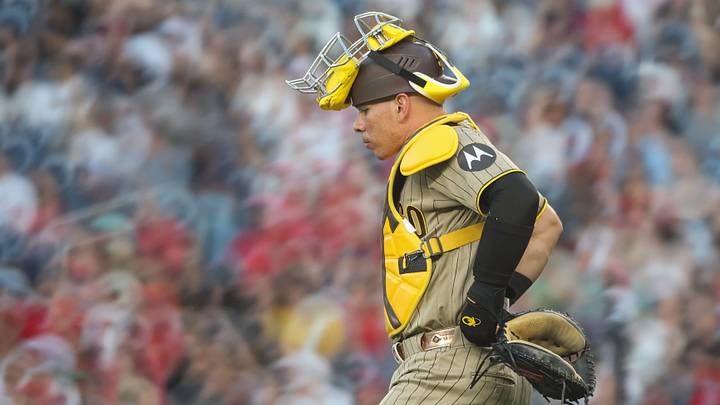
The job requirements for a catcher keep getting harder. The flood of information added more game-planning preparation to pregame work. The increase in pitchers used added more homework in learning a staff. The pitch clock reduced recovery time within and between innings. The limits on pickoff throws increased the importance of defending the running game. And now the catcher must be a strategic wizard and strike zone Zen master with the introduction of the ABS challenge system. Medieval kings on feast days had less on their plate.
Given what the game asks from catchers in preparation and responsibility, it should not be a surprise that their offense is suffering. How bad is offense from catchers this year? This bad:
- Catchers are hitting .228. Only once in the game’s history, in the Deadball days of 1918, have catchers hit worse.
- Three of the six all-time worst averages for team catching are from this season.
- The Yankees, White Sox, Phillies and Padres all have franchise-worst averages at catcher (full seasons).
- Only six catchers have enough plate appearances to be qualified hitters. None of them are older than 28.
- Only five qualified catchers have at least an average OPS+: William Contreras of the Brewers, Shea Langeliers of the Athletics, Dillon Dingler of the Tigers, Hunter Goodman of the Rockies and Drake Baldwin of the Braves.
- Until 2021, only twice did catchers hit below .230. This is the third time it will happen in the past six seasons:
Lowest MLB Batting Average for Catchers | Batting Average | Relative to League |
|---|---|---|
1. 1918 | .225 | -.029 |
2. 2026 | .228 | -.014 |
2. 2022 | .228 | -.015 |
4. 2021 | .229 | -.015 |
4. 1967 | .229 | -.013 |
Maybe we should lower our expectations for what a catcher can do offensively. Look at the Guardians, who are thrilled with Patrick Bailey, a career .222 hitter, and Austin Hedges, a career .188 hitter, because they provide so much defensive value. Yankees manager Aaron Boone, whose catchers are hitting .161, well below the previous franchise low of .199 in 2021, isn’t ready to concede lower expectations.
“Without question it’s demanding,” Boone says. “And it’s critically important that you have a guy back there or a tandem that know what they’re doing. But I don’t think it means you can’t hit. Cal Raleigh just threw up a pretty good campaign with a lot on his plate. So, I don’t think it’s out of the realm.
“I actually think the physical demand is less today than it was back when Brad Ausmus was back there. Honestly, the knee down thing has taken a lot of the physical demand away from these guys. I don’t think it’s more physically demanding. In fact, it may be less physically demanding than ever. But they have a massive amount of information that they’ve got to be on top of and have a good feel for.”
Guardians manager Steven Vogt, a former catcher, agreed with Boone that teams should not settle for lower offensive expectations just by the nature of the job.
“My personal opinion is no,” he says. “We do ask a lot out of our catchers. This is my unhinged opinion. You have a kid who can hit? You don’t want them catching. You have a good player on your team, whether it’s in college or the minor leagues, if you have a catcher who can really hit, what do we do? We move them to another position because we know the workload and the magnitude in our game today. There’s what, five or six really good two-way catchers?
“I think it’s industry wide. Bryce Harper came up as a catcher. There was no way Scott Boras or anybody else was going to let him catch. We’ve done that to ourselves in the industry. But I still think there’s an expectation that catchers can hit. I don’t think we’re asking too much of them.”
More MLB from Sports Illustrated
 Add us as a preferred source on Google
Tom Verducci is a senior writer for Sports Illustrated who has covered Major League Baseball since 1981. He also serves as an analyst for FOX Sports and the MLB Network; is a New York Times best-selling author; and cohosts The Book of Joe podcast with Joe Maddon. A five-time Emmy Award winner across three categories (studio analyst, reporter, short form writing) and nominated in a fourth (game analyst), he is a three-time National Sportswriter of the Year winner, two-time National Magazine Award finalist, and a Penn State Distinguished Alumnus Award recipient. Verducci is a member of the National Sports Media Hall of Fame, Baseball Writers Association of America (including past New York chapter chairman) and a Baseball Hall of Fame voter since 1993. He also is the only writer to be a game analyst for World Series telecasts. He lives in New Jersey with his wife, with whom he has two children.