%22%3E%0A%3Cpath%20d%3D%22M0%2013.6924L2.73846%2010.4302C4.40773%2011.6958%206.3061%2012.2304%208.10629%2012.2304C9.02275%2012.2304%209.41552%2011.9904%209.41552%2011.5758V11.5321C9.41552%2011.0957%208.93547%2010.8557%207.28802%2010.5284C3.85131%209.83016%200.829177%208.84824%200.829177%205.6079V5.56426C0.829177%202.65124%203.10941%200.392822%207.33167%200.392822C10.2883%200.392822%2012.4704%201.09108%2014.2487%202.49849L11.7503%205.95703C10.3102%204.90965%208.57543%204.45142%207.1571%204.45142C6.39339%204.45142%206.04426%204.71327%206.04426%205.08421V5.12785C6.04426%205.54244%206.45885%205.80429%208.08447%206.10977C12.0012%206.82985%2014.6306%207.97542%2014.6306%2011.063V11.1067C14.6306%2014.3252%2011.9794%2016.2999%207.86627%2016.2999C4.75685%2016.2999%201.95293%2015.4271%200.0109105%2013.7142L0%2013.6924Z%22%20fill%3D%22white%22%2F%3E%0A%3Cpath%20d%3D%22M15.3076%2012.5902V12.5466C15.3076%2010.1573%2017.0751%208.82622%2019.8572%208.82622C20.8609%208.82622%2022.1592%209.04443%2022.6829%209.26263V9.06625C22.6829%207.97523%2022.0065%207.33153%2020.4681%207.33153C19.2462%207.33153%2018.2097%207.59337%2017.1624%208.00796L16.2895%204.70216C17.6642%204.17847%2019.2462%203.82935%2021.3301%203.82935C23.763%203.82935%2025.3341%204.33122%2026.3924%205.3786C27.287%206.27323%2027.6362%207.44063%2027.6362%209.16444V15.9724H22.672V14.7723C21.8428%2015.6669%2020.7191%2016.2561%2019.2353%2016.2561C16.9332%2016.2561%2015.3185%2014.9469%2015.3185%2012.5793L15.3076%2012.5902ZM22.7266%2011.5647V11.0628C22.4429%2010.9537%2022.0065%2010.8664%2021.5919%2010.8664C20.61%2010.8664%2020.0645%2011.4556%2020.0645%2012.1975V12.2411C20.0645%2012.9394%2020.5663%2013.3976%2021.1991%2013.3976C22.0719%2013.3976%2022.7266%2012.6993%2022.7266%2011.5538V11.5647Z%22%20fill%3D%22white%22%2F%3E%0A%3Cpath%20d%3D%22M29.1191%204.0366H34.0833V5.70586C34.847%204.72394%2036.058%203.75293%2037.7382%203.75293C40.2585%203.75293%2041.8295%205.42219%2041.8295%208.1061V15.9833H36.8545V9.699C36.8545%208.67344%2036.2435%208.08428%2035.5016%208.08428C34.7597%208.08428%2034.0833%208.67344%2034.0833%209.699V15.9833H29.1191V4.02569V4.0366Z%22%20fill%3D%22white%22%2F%3E%0A%3Cpath%20d%3D%22M49.1064%200.665771H61.9369V5.04077H54.2342V6.99369H61.3913V10.9759H54.2342V15.9946H49.1064V0.665771Z%22%20fill%3D%22white%22%2F%3E%0A%3Cpath%20d%3D%22M63.1045%204.03676H68.0686V6.44792C68.7451%204.83321%2069.847%203.77492%2071.8108%203.8622V9.14274H71.2871C69.1815%209.14274%2068.0686%2010.2992%2068.0686%2012.9504V15.9944H63.1045V4.03676Z%22%20fill%3D%22white%22%2F%3E%0A%3Cpath%20d%3D%22M71.7461%2012.5902V12.5466C71.7461%2010.1573%2073.5135%208.82622%2076.2957%208.82622C77.2994%208.82622%2078.5977%209.04443%2079.1214%209.26263V9.06625C79.1214%207.97523%2078.445%207.33153%2076.9066%207.33153C75.6847%207.33153%2074.6482%207.59337%2073.6008%208.00796L72.728%204.70216C74.1027%204.17847%2075.6847%203.82935%2077.7576%203.82935C80.1906%203.82935%2081.7617%204.33122%2082.82%205.3786C83.7146%206.27323%2084.0637%207.44063%2084.0637%209.16444V15.9724H79.0996V14.7723C78.2704%2015.6669%2077.1466%2016.2561%2075.6629%2016.2561C73.3608%2016.2561%2071.7461%2014.9469%2071.7461%2012.5793V12.5902ZM79.1759%2011.5647V11.0628C78.8923%2010.9537%2078.4559%2010.8664%2078.0413%2010.8664C77.0594%2010.8664%2076.5139%2011.4556%2076.5139%2012.1975V12.2411C76.5139%2012.9394%2077.0157%2013.3976%2077.6485%2013.3976C78.5213%2013.3976%2079.1759%2012.6993%2079.1759%2011.5538V11.5647Z%22%20fill%3D%22white%22%2F%3E%0A%3Cpath%20d%3D%22M85.5684%204.0366H90.5325V5.70586C91.2962%204.72394%2092.5073%203.75293%2094.1874%203.75293C96.7077%203.75293%2098.2788%205.42219%2098.2788%208.1061V15.9833H93.3037V9.699C93.3037%208.67344%2092.6927%208.08428%2091.9508%208.08428C91.2089%208.08428%2090.5325%208.67344%2090.5325%209.699V15.9833H85.5684V4.02569V4.0366Z%22%20fill%3D%22white%22%2F%3E%0A%3Cpath%20d%3D%22M99.4033%2010.07V10.0264C99.4033%206.67694%20102.033%203.76392%20105.928%203.76392C108.557%203.76392%20110.412%205.11678%20111.339%207.06971L107.771%209.0881C107.357%208.32438%20106.833%207.88798%20106.026%207.88798C104.978%207.88798%20104.182%208.80443%20104.182%209.99365V10.0373C104.182%2011.2811%20104.968%2012.1866%20105.96%2012.1866C106.833%2012.1866%20107.335%2011.7502%20107.815%2010.9865L111.426%2013.0485C110.357%2015.0451%20108.535%2016.3107%20105.688%2016.3107C102.055%2016.3107%2099.4033%2013.4413%2099.4033%2010.0918V10.07Z%22%20fill%3D%22white%22%2F%3E%0A%3Cpath%20d%3D%22M112.233%200H117.372V3.17487H112.233V0ZM112.321%204.03678H117.296V15.9944H112.321V4.03678Z%22%20fill%3D%22white%22%2F%3E%0A%3Cpath%20d%3D%22M118.06%2014.5431L119.74%2011.7174C121.18%2012.612%20122.806%2013.0484%20124.159%2013.0484C124.639%2013.0484%20124.879%2012.9393%20124.879%2012.6557V12.612C124.879%2012.372%20124.661%2012.2193%20123.46%2011.9138C120.438%2011.1719%20118.573%2010.3645%20118.573%207.8879V7.84426C118.573%205.2149%20120.678%203.75293%20123.788%203.75293C125.763%203.75293%20127.705%204.2548%20129.156%205.12762L127.574%208.08428C126.308%207.38603%20124.77%206.97144%20123.766%206.97144C123.286%206.97144%20123.068%207.10236%20123.068%207.34239V7.38603C123.068%207.62606%20123.33%207.7788%20124.53%208.08428C127.552%208.82618%20129.363%209.65536%20129.363%2012.1102V12.1538C129.363%2014.7613%20127.41%2016.2669%20124.17%2016.2669C121.846%2016.2669%20119.751%2015.6778%20118.038%2014.5322L118.06%2014.5431Z%22%20fill%3D%22white%22%2F%3E%0A%3Cpath%20d%3D%22M130.115%2010.07V10.0264C130.115%206.67694%20132.745%203.76392%20136.64%203.76392C139.269%203.76392%20141.124%205.11678%20142.051%207.06971L138.483%209.0881C138.069%208.32438%20137.545%207.88798%20136.738%207.88798C135.69%207.88798%20134.894%208.80443%20134.894%209.99365V10.0373C134.894%2011.2811%20135.679%2012.1866%20136.672%2012.1866C137.545%2012.1866%20138.047%2011.7502%20138.527%2010.9865L142.138%2013.0485C141.069%2015.0451%20139.247%2016.3107%20136.4%2016.3107C132.766%2016.3107%20130.115%2013.4413%20130.115%2010.0918V10.07Z%22%20fill%3D%22white%22%2F%3E%0A%3Cpath%20d%3D%22M142.291%2010.059V10.0154C142.291%206.64414%20145.095%203.75293%20149.034%203.75293C152.972%203.75293%20155.732%206.60049%20155.732%209.97175V10.0154C155.732%2013.3866%20152.928%2016.2779%20148.99%2016.2779C145.051%2016.2779%20142.291%2013.4303%20142.291%2010.059ZM150.965%2010.059V10.0154C150.965%208.83709%20150.092%207.8879%20148.99%207.8879C147.888%207.8879%20147.059%208.82618%20147.059%209.97175V10.0154C147.059%2011.1937%20147.932%2012.1429%20149.034%2012.1429C150.135%2012.1429%20150.965%2011.2046%20150.965%2010.059Z%22%20fill%3D%22white%22%2F%3E%0A%3Cpath%20d%3D%22M0%2028.0355V27.9919C0%2023.4205%203.61128%2020.0056%208.45542%2020.0056C11.0848%2020.0056%2013.2014%2020.8784%2014.8706%2022.3295L12.0012%2025.788C10.9975%2024.937%209.87374%2024.457%208.60816%2024.457C6.61159%2024.457%205.17145%2025.9844%205.17145%2028.0683V28.1119C5.17145%2030.283%206.67705%2031.7668%208.82636%2031.7668C9.69918%2031.7668%2010.1901%2031.6359%2010.5829%2031.4177V29.8903H7.95354V26.6063H15.3725V33.6979C13.7032%2035.0508%2011.3903%2036%208.60816%2036C3.8404%2036%200%2032.8033%200%2028.0574V28.0355Z%22%20fill%3D%22white%22%2F%3E%0A%3Cpath%20d%3D%22M16.7695%2019.6675H21.9083V22.8424H16.7695V19.6675ZM16.8677%2023.7043H21.8319V35.6619H16.8677V23.7043Z%22%20fill%3D%22white%22%2F%3E%0A%3Cpath%20d%3D%22M22.9883%2032.258V32.2143C22.9883%2029.825%2024.7667%2028.4939%2027.5379%2028.4939C28.5416%2028.4939%2029.8399%2028.7122%2030.3636%2028.9304V28.734C30.3636%2027.643%2029.6872%2026.9992%2028.1488%2026.9992C26.9269%2026.9992%2025.8904%2027.2611%2024.843%2027.6757L23.9702%2024.3699C25.3449%2023.8462%2026.9269%2023.4971%2028.9998%2023.4971C31.4328%2023.4971%2033.0039%2023.9989%2034.0622%2025.0463C34.9568%2025.941%2035.3059%2027.1084%2035.3059%2028.8322V35.6401H30.3418V34.44C29.5126%2035.3347%2028.3888%2035.9238%2026.9051%2035.9238C24.603%2035.9238%2022.9883%2034.6146%2022.9883%2032.2471V32.258ZM30.4182%2031.2324V30.7305C30.1345%2030.6214%2029.6981%2030.5342%2029.2835%2030.5342C28.3016%2030.5342%2027.7451%2031.1233%2027.7451%2031.8652V31.9088C27.7451%2032.6071%2028.247%2033.0653%2028.8798%2033.0653C29.7526%2033.0653%2030.4072%2032.3671%2030.4072%2031.2215L30.4182%2031.2324Z%22%20fill%3D%22white%22%2F%3E%0A%3Cpath%20d%3D%22M36.8115%2023.7041H41.7757V25.3733C42.5394%2024.3914%2043.7504%2023.4204%2045.4306%2023.4204C47.9508%2023.4204%2049.5219%2025.0897%2049.5219%2027.7736V35.6508H44.5578V29.3665C44.5578%2028.3409%2043.9468%2027.7518%2043.194%2027.7518C42.4412%2027.7518%2041.7757%2028.3409%2041.7757%2029.3665V35.6508H36.8115V23.6932V23.7041Z%22%20fill%3D%22white%22%2F%3E%0A%3Cpath%20d%3D%22M51.9327%2031.647V27.5339H50.5361V23.7044H51.9327V20.7041H56.8968V23.7044H59.6571V27.5339H56.8968V30.556C56.8968%2031.4507%2057.3114%2031.778%2058.0969%2031.778C58.5551%2031.778%2059.0788%2031.647%2059.6025%2031.407V35.2365C58.817%2035.6511%2057.6278%2035.9129%2056.4277%2035.9129C53.4928%2035.9129%2051.9217%2034.5492%2051.9217%2031.647H51.9327Z%22%20fill%3D%22white%22%2F%3E%0A%3Cpath%20d%3D%22M60.0168%2034.2106L61.6969%2031.3849C63.1371%2032.2795%2064.7627%2032.7159%2066.1156%2032.7159C66.5956%2032.7159%2066.8356%2032.6068%2066.8356%2032.3231V32.2795C66.8356%2032.0395%2066.6175%2031.8867%2065.4173%2031.5812C62.3952%2030.8394%2060.5405%2030.032%2060.5405%2027.5554V27.5117C60.5405%2024.8824%2062.6461%2023.4204%2065.7446%2023.4204C67.7194%2023.4204%2069.6614%2023.9223%2071.1124%2024.7951L69.5414%2027.7518C68.2758%2027.0535%2066.7375%2026.6389%2065.7337%2026.6389C65.2537%2026.6389%2065.0355%2026.7698%2065.0355%2027.0099V27.0535C65.0355%2027.2935%2065.2973%2027.4463%2066.4974%2027.7518C69.5196%2028.4937%2071.3307%2029.3228%2071.3307%2031.7776V31.8213C71.3307%2034.4288%2069.3777%2035.9344%2066.1374%2035.9344C63.8135%2035.9344%2061.7188%2035.3453%2060.0059%2034.1997L60.0168%2034.2106Z%22%20fill%3D%22white%22%2F%3E%0A%3Cpath%20fill-rule%3D%22evenodd%22%20clip-rule%3D%22evenodd%22%20d%3D%22M165.368%204.36764C171.191%20-1.45588%20180.632%20-1.45588%20186.456%204.36764C192.279%2010.1912%20192.279%2019.6324%20186.456%2025.4559L175.912%2036L165.368%2025.4559C159.544%2019.6324%20159.544%2010.1912%20165.368%204.36764ZM168.009%207.55761C167.948%207.86849%20167.916%208.39718%20167.916%209.14566V10.4189C167.916%2011.1832%20167.948%2011.7198%20168.013%2012.0267C168.078%2012.3317%20168.278%2012.6168%20168.617%2012.8762C168.956%2013.1376%20169.403%2013.3316%20169.958%2013.4623C170.512%2013.593%20171.1%2013.6584%20171.837%2013.6584C172.573%2013.6584%20173.217%2013.591%20173.769%2013.4524C174.322%2013.3158%20174.761%2013.1178%20175.086%2012.8604C175.411%2012.6029%20175.605%2012.3178%20175.666%2012.0069C175.728%2011.6961%20175.759%2011.1674%20175.759%2010.4189V9.14566C175.759%208.38134%20175.728%207.84473%20175.662%207.53781C175.597%207.23287%20175.397%206.94971%20175.058%206.68834C174.72%206.42696%20174.272%206.23291%20173.718%206.10223C173.163%205.97154%20172.536%205.90619%20171.839%205.90619C171.102%205.90619%20170.459%205.97352%20169.906%206.11213C169.352%206.24875%20168.914%206.44677%20168.589%206.70418C168.265%206.9616%20168.071%207.24673%20168.009%207.55761ZM173.276%2024.8638C176.876%2024.8638%20178.557%2024.2064%20178.557%2021.862V21.858V21.3155C178.557%2019.6581%20177.516%2018.971%20174.252%2018.3136C173.278%2018.1136%20172.908%2017.9136%20172.908%2017.3136V16.9414C172.908%2016.6543%20173.177%2016.5117%20173.413%2016.5117C173.749%2016.5117%20173.918%2016.7137%20173.918%2016.9414V18.1136H178.391V17.3988C178.391%2015.4563%20177.347%2014.4266%20173.177%2014.4266C170.15%2014.4266%20167.896%2015.3414%20167.896%2017.3711V17.7433C167.896%2019.5155%20168.805%2020.3155%20172.201%2021.0303C172.28%2021.0472%20172.355%2021.063%20172.427%2021.0781C173.329%2021.2674%20173.647%2021.3341%20173.647%2021.9174V22.2897C173.647%2022.6619%20173.546%2022.8045%20173.142%2022.8045C172.67%2022.8045%20172.637%2022.5471%20172.637%2022.262V21.2897H167.894V21.7471C167.894%2024.149%20169.476%2024.8638%20173.276%2024.8638ZM179.424%2024.5569H183.925V14.7355H179.424V24.5569ZM180.955%2013.5019H183.925V6.06064H181.092V9.411L179.193%206.06064H176.359V13.5019H179.193V10.1199L180.955%2013.5019ZM172.269%2012.152C172.204%2012.2688%20172.055%2012.3262%20171.825%2012.3262L171.827%2012.3282C171.604%2012.3282%20171.459%2012.2767%20171.398%2012.1758C171.336%2012.0748%20171.305%2011.8074%20171.305%2011.3758V7.90068C171.305%207.51852%20171.352%207.28684%20171.445%207.20962C171.538%207.13239%20171.675%207.09279%20171.851%207.09279C172.059%207.09279%20172.198%207.14031%20172.265%207.23734C172.332%207.33239%20172.366%207.55416%20172.366%207.90068V11.3203C172.366%2011.7579%20172.334%2012.0352%20172.269%2012.152Z%22%20fill%3D%22white%22%2F%3E%0A%3C%2Fg%3E%0A%3Cdefs%3E%0A%3CclipPath%20id%3D%22clip0_15232_2604%22%3E%0A%3Crect%20width%3D%22191%22%20height%3D%2236%22%20fill%3D%22white%22%2F%3E%0A%3C%2FclipPath%3E%0A%3C%2Fdefs%3E%0A%3C%2Fsvg%3E%0A)
The Giants Are Betting on Coaching. Ron Washington and Luis Arraez Will Determine If It Works.
In this story:
The Meeting
Ron Washington arrived in Nashville on the Tuesday before Thanksgiving with two confirmation numbers and one promise to his wife.
He had only one item on his schedule – a lunch meeting. One conversation that could hold the key to getting him back in uniform. Only months removed from life-saving quadruple bypass heart surgery, Washington was operating with a new lease on life, and on a quest for a second lease on his professional one.
But the timing was delicate; it was a holiday week, and after a lifetime of summers sweeping him away, holiday weeks, especially this one, were sacred ground for he and Gerry, his wife of over five decades.
Understanding those stakes, he wouldn’t leave their home in New Orleans without her blessing.
“I had to get the ‘OK’ from my wife, and she gave me the ‘OK’, Washington recalled. “So I flew in on Tuesday, we had lunch, and I flew back Tuesday night.”
It wasn’t quite the diner scene between De Niro and Pacino in Heat, but that afternoon’s introduction between Washington and freshly named San Francisco Giants manager Tony Vitello blended two men from the same game, but different worlds.
They sat on opposite sides of the table, and at opposite ends of their Major League careers. One with a surplus of Major League experience – as a player, coach, and manager. The other with none, at any level, on the diamond or in the dugout.
But Washington has long valued disposition over distinction. What separated the two men in experience did not separate them in ethos. Vitello had turned a Tennessee program once labeled “moribund” into a swaggering powerhouse that took on his own magnetic personality. Washington recognized the type immediately.
Vitello showed that in how he went after Washington. He made repeated phone calls in the weeks prior, even offering to travel himself to New Orleans before his increasingly crowded calendar forced a change of plans.
Their visit was more about getting to know one another than conducting a recruiting pitch or job interview. Two baseball men talking about life, people and background – just not much about the game that united them.
“We didn’t talk about baseball much at all, we just talked about life in general,” Washington recalled. The people I know in the game and the people he know in the game. That’s where it went.”
It never went toward a job offer.
“At no time did Tony ever say I’d like to have you on my staff,” Washington said.
Then, for added emphasis:
“No time.”
Later that evening, Washington was back with Gerry in New Orleans and time to spare before Thanksgiving dinner.
His wait to return to baseball would extend just five more days. The following Monday, his phone rang. On the other end was Zack Minassian, the Giants general manager. By the time the line disconnected, Washington was a San Francisco Giant.
The Idea
There is a short list of MLB executives that would have the resolve to hire Tony Vitello. Fewer still have the authority to act on it.
Buster Posey has both. For all the stoicism and calculated cool he exhibited as a player, Posey has shown an appetite for aggression early in his tenure as an executive. None of his decisions have been more bold than selecting Vitello, who he picked from uncharted waters in a managerial search that was navigated by a fixed set of values.
High-intensity commitment, direct decisiveness, and a fierce competitive edge. Posey believes Vitello embodied that better than any other option, a conviction he made clear to the media after Vitello’s introductory press conference in October:
“He’s very direct in his thoughts,” Posey said of Vitello. And there’s not a lot of hemming and hawing. He has what he believes.”
Vitello is often loquacious with his comments. Posey is often lean with his. They might differ in how they express their competitive drive, but they are kindred spirits.
“I wasn’t necessarily going to be a guy that was going to cause friction,” Posey said after the press conference. “But I can promise you, you can ask guys who went to the plate, I wasn’t being friendly with them when they came to the plate. So there’s an edge to be had with that type of mentality, and I think it’s something that (Vitello will) bring.”

Over the offseason, nearly one-third of MLB teams changed managers, but only the Giants bet their franchise on one. In doing so, Posey has invited risk – but it is not a blind gamble.
The hand the franchise is playing is backed by experience: over six decades of managerial tenure across ten organizations in Dusty Baker, Bruce Bochy, and Washington. All there to act as support columns for the new manager.
“He has experience,” Baker said of Vitello at Giants FanFest in Sacramento. “To me, he has as much experience or more than some of the new managers who were hired that don’t have any experience.”
While Posey brought in Baker and Bochy as senior advisors to himself, he empowered Vitello to find that final piece. Someone to carry that vision alongside him each day – on the field, on team flights, and in the dugout.
Before Washington boarded his return flight that November evening in Nashville, Vitello knew he had his man.
The Giants did not hire Ron Washington to be their manager. They hired him to be Ron Washington.
The game has changed. He hasn’t. And in an era of conformity, where information is shared quickly and the margins between clubs grow thinner by the year, the Giants are betting that unmistakable expertise still creates separation.
If Posey has assembled a Jedi council of baseball coaches, Washington is its Yoda.
“Well, that’s all they’re going to get so they’re going to have to let me be Ron Washington,” Washington said. “I’ve been around too long to all of a sudden somebody gonna say you got to conform to this ... Everything I do I’m doing to enhance what we can get done here as the San Francisco Giants.”
And the Giants are trusting Washington to shape his next apprentice – a former batting champion attempting a return to second base, Luis Arraez, a test of whether even the best instruction can reshape a player’s limits.
The Routine
During the spring, the Giants shared a glimpse into their backfields in Scottsdale – a window into the early work between Ron Washington and Luis Arraez.
What the footage reveals is a study in the intersection of familiarity and novelty.
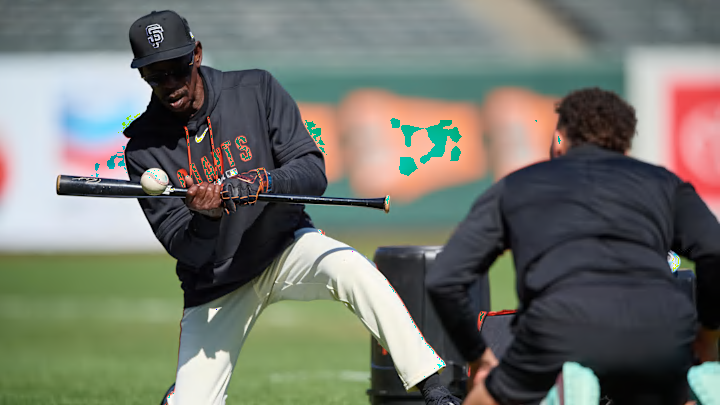
There’s Washington, underhanding ground balls toward his new student. He’s back in the Cactus League, and although the facility and the parking space are different, the instruction isn’t.
“Lui, you’re letting it get too far in (between your legs),” Washington reminds Arraez. “Get it a little more out front.”
There’s Arraez, now in an orange and black sweatshirt, representing his fourth Major League team, returning to the keystone position. His glove lies five feet behind him. Instead, he starts with a 9.5-inch donut pad, a flat, unforgiving disc designed to demand precision and soft hands. On this day, and for each day that follows, he will have to earn his way to glove work.
Another ground ball. Arraez sticks it with two hands, arms moving forward – a detail of fundamental importance to Washington – and sends a backhand feed toward second base, with his new manager on the receiving end.
There’s Vitello. The manager doesn’t have to be handling this minutia; anyone in Giants camp could set a target at second base for Arraez. But what it represents is a flicker of familiarity for Vitello from his time as a collegiate coach, and another opportunity to reinforce a tone set in this camp.
“I can tell you what, this camp is loaded with teaching,” Washington said. “Every single minute of it is teaching, and Tony Vitello is the leader. He doesn’t miss anything. He sees baseball really well.”
Three men from three different generations, none of them Giants a year ago, now intertwined in the club’s immediate fate, working to reshape Arraez at second base.
Arraez has always been a supremely evocative player over his professional career. He is the most prolific contact hitter since Tony Gwynn, and holds a career strikeout percentage lower than Rod Carew.
To watch Arraez is to see a relic in the present tense, like spotting a 1957 Chevrolet Bel-Air at a stoplight. He is a design from another era that somehow still holds the road.
Arraez has won three consecutive batting titles with three different teams — Minnesota (2022), Miami (2023), and San Diego (2024) — the first player in Major League history to do so. He once went 141 plate appearances without a strikeout, the longest stretch in two decades, and entered the 2026 season as a career .317 hitter, more than 70 points above the current league average.

But despite those notable numbers on his career statline and silver hardware in his trophy case, the Giants were able to land him on somewhat of a bargain, signing the 28-year-old to a one-year, $12 million deal in February.
For as much as his profile makes Arraez a coveted piece in a lineup, he has been labeled as a liability in the middle infield from the beginning, where his deficiencies have acted as an ankleweight to his overall value.
Even while winning his third-consecutive batting title in 2024,Arraez posted a -7 Outs Above Average (OAA) in 339 innings at second base with San Diego. OAA is a cumulative stat, meaning if he played a full season worth of innings at the position, he would have posted a -19 OAA, far and away the worst mark for any MLB infielder.
Despite that, Arraez has always viewed himself as a second baseman, and he used that as his North Star in free agency.
Other teams offered more money and more security. Only the Giants offered him that chance to prove himself.
“They want me to go out there and enjoy it and play my natural position,” Arraez told reporters on his first day of Giants camp. “That’s why I picked this job here.”
Washington has always believed the best coaching begins with listening; he cannot help a player without first understanding their own aspirations. And when one of the league's statistically most challenged infielders met the greatest infield instructor in baseball on their first day working together, the intent was direct.
“He just told me that he wanted to be the best second baseman in the National League,” Washington said. “And my answer to that is, I can help you go toward that goal, but it’s gonna take your effort every single day for that to come to fruition.”
With Washington, ambition is valuable, but repetition is critical. He approaches coaching not as a series of corrective suggestions, but as a proprietary clinical protocol. These efforts are the Wash Drills: a high-repetition, high-intensity ritual designed to function as the molecular building blocks of elite infield work.
“What we do is a routine,” Washington said of his infield drills. “Just like hitters have their routine, we’ve got a routine on the defensive end too.
And it’s daily.
It is daily.”
The drills are applied universally, agnostic of a player’s pedigree, and serve as a living record of Washington’s baseball life, fine-tuned by more than five decades of trial and error, and the influences that made Washington the game’s foremost professor of the fundamentals, starting with the man who mentored him, Chico Fernandez.
While Fernandez was coaching a Dodgers infield in the 1970s locked down by the legendary “Longest-Running Infield” of first baseman Steve Garvey, second baseman Davey Lopes, shortstop Bill Russell and third baseman Ron Cey, he still carved out time for a young, unheralded Washington, instilling a technical foundation that has served as part of the blueprint for Washington’s own coaching career.
“He taught me work ethic,” Washington said of Fernandez. “I was a youngster in the Dodgers organization when I was there. And Chico went about his business the way I go about my business. There everyday, willing to help anybody that’s available, and just want you to do right, that’s all. That’s what he meant to me.”
Washington has refined his routine over time, but its DNA remains unchanged, beginning with its beginning.
“The close-up stuff is what Chico used to do with us every morning starting at 7:30 in the morning,” Washington said. “And I’ve never forgotten that.”
“So guess what? My work starts at 7:30 in the morning.”
On these backfields, that lesson is still alive.
Washington feeds one more ground ball to Arraez. He sticks the pad and sends another backhand shovel to second. That rep was strong. It’s time to move to the next phase.
“Now get your glove,” Washington says.
Moments later, Washington wields his fungo bat, flicking ground balls to Arraez with a marksman’s accuracy. Arraez picks, pivots, and fires toward Vitello, who offers his own one-word verdict: “Money.”
By the time Arraez hustles back to his position, the next ball is already in his kitchen. The up-tempo pace of the Wash Drills is entirely by design.
“That’s the thing that’s going to make him what he needs to be,” Washington said of his routine. “Always stimulating his mind and his brain. You can’t have downtime, you always got to be doing something that stimulates and makes you want to be competitive, and that’s where I’m trying to get him right now.”
Washington wants the backhand now, preempting his next flick of the fungo with a piece of instruction.
“I want you to go downhill,” Washington says, exhibiting the movement he wants to see from Arraez. “I want you to go downhill and play with it. I don’t want you to just go across and wait on it.”
On the first rep, Arraez is tentative, drifting laterally instead of decisively. Before the throw even leaves his hand, Washington is on him.
“Luis, the first thing you did was went across,” Washington states, shadowing the incorrect motion. “Go straight.”
This time, Arraez glides toward the grounder with confidence, working through the backhand dig with newfound fluidity.
“There you go. There you go!” he exclaims, his voice rising in octaves with approval.
Arraez is in a groove now, and Washington is booming. “Beautiful!” he labels the next rep. “Oh yeah!” follows the one after.
That is the fundamental essence of Washington’s teaching style: he is never afraid to tear into a player for a shortcut, but he will never tear them apart.
As the session comes to a close, Washington returns to one of the pillars of his fundamentals. He crouches low, side-by-side with Arraez, demonstrating the exact extension of the arms needed to meet the ball out front.
When they stand, the uncompromising architect vanishes, replaced by the man his players adore. They conclude with a brief embrace, Washington delivering two firm pats on Arraez’s midsection.
“Hell of a job, brother,” he says.
There is plenty of progress in the process already, but the total transformation of Arraez will not be complete on this day. This project may be Washington’s steepest climb yet, but with nearly six decades of experience, he has never been better equipped for it.
He has done this before, in several different locations, and his impact remains a living force across the league.
The Proof
Across the country, where the dry desert air has long since given way to a humid Florida breeze, Austin Riley and Matt Olson settle into a quiet space in the back room of the Atlanta Braves’ clubhouse in North Port.
Now established stars – anchors of the corner infield for Atlanta — the pair allow their conversation to drift back to the lean years of the minor leagues. For Riley, that time was defined by a bruising defensive reality: 30 errors at third base in his first full professional season in 2016.
Still, Riley would make his first big-league camp the following spring. His potential as a prospect – regarded as the heir to Atlanta icon Chipper Jones at third base – burned too bright to slow his ascent.
Shouldering those lofty expectations and intent on delivering a strong first impression, Riley entered the complex before the sun had risen. Amidst the stillness, where the most present noise was the HVAC system, he saw Washington – recently hired as the Braves’ new third base coach, in quintessential form.
“It was 6 ‘o clock in the morning, and he’s standing there, drinking a coffee and smoking a cigarette,” Riley recalled. “I remember vividly (telling myself), ‘Be the first one out there, don’t be the last, don’t be in the middle, be the first one.”
Riley was the first player on the field that morning, and every ensuing morning that spring. Each day, he worked with Washington – developing the intricate movements that have now become foundational pieces of his infield work.
Improvement followed commitment, as it seemingly always does with Washington. Two years later in 2019, Riley would make his debut with Atlanta. A season after that, he became the Braves’ regular third baseman. By 2023, he was a Gold Glove finalist.

“Getting to meet Wash and spend time with him, obviously the errors have cut down and now I get to play third base for a living,” Riley said. “It helped a lot.”
It was a case of the right person for the right moment in Atlanta. Washington arrived just as a young infield core of Riley, shortstop Dansby Swanson, and second baseman Ozzie Albies were hitting the big time.
Few took to Washington’s tutelage like Ozzie Albies, who was an outlier in his own right as a slugging second baseman despite a diminutive 5-foot-7 frame. Their work together helped turn Albies into a defensive anchor on a team that would blossom into a World Series winner in 2021, finally delivering Washington the championship he had chased for decades.
“He helped me a lot,” Albies said. “I can say he helped me 90 percent of my career. He was everything for our whole infield and the whole team. We are World Series champs forever.”
He worked every day with young players to help turn them into everyday players. But the clearest measure of Washington has always been something simpler: his willingness to work with anyone, on any day, so long as they show up the right way.
The Standard
Chris Dimino is not a Braves player, but his voice has been as recognizable in the Atlanta market as any Atlanta athlete for over three decades as a radio host for the Braves’ flagship station – 680 The Fan.
In 2019, he found himself on the infield dirt on a backfield in North Port, with three baseballs in his view and not much breathing space between himself and Washington.
He had asked Washington not just for an explanation or a demonstration of his drills, but to be an active participant in them. The purpose was not about video content – although that was the manifestation of the moment – but rather perspective, and gaining an understanding of the players he talked about for his living.
“I think he understood that,” Dimino said. “He could have easily said no – that’s just a player thing. But I sensed he wasn’t going to say that because I had watched it enough to know why he was doing it and why players kept showing up the next day.”
It isn’t just a player thing. Washington’s temple on the infield is accessible to anyone who respects the craft. There might be others who view themselves as above it, but Washington is always in it, and those who meet the standard, get to work with the master.
Over the years, he has opened his drills up to radio hosts, sports writers, and sideline reporters. He was even once captured on video hitting fungoes to a Philadelphia Phillies’ bat boy in 2017.
“What compels me to do it is those guys come and ask me to do it,” said Washington, explaining his open-door stance.
“And what am I going to tell them, no? I’ll support what they want me to help them with and that’s how that goes.”
When Dimino had arrived that morning – making sure to be there five minutes early – he told Washington “I’m here to do the whole thing.” And they did.
Washington put Dimino through the entire routine. From the ground to the flat pad to the fungo. It didn’t matter that Dimino was in his mid-50s. It didn’t matter that he wasn’t Miguel Tejada, Scott Hatteberg, Austin Riley, or Luis Arraez. What mattered was that Dimino had earned the time.
“It turned out to be everything I had hoped for,” Dimino said. “We just put it out in the world and hoped people understood that if you said you were going to be there and you were, he was going to do something like that with you.”
But Dimino also went a step further past earning Washington’s time: He gained Washington’s trust while he was in Atlanta.
Leaning on that relationship, Dimino and the station launched a YouTube series titled ‘Storytime with Wash!’ which, for all the national profiles and publicity about Washington, exist as some of the most honest portraits of the man in a corner of the internet few have visited.
The series features some well-told stories, like the one of Eric Chavez and the Gold Glove.
In 2004, Oakland Athletics’ third baseman Eric Chavez placed his Gold Glove trophy – part of six Chavez won while working with Washington – in Washington’s locker, with the writing “To Wash – not without you.”
Washington approached Chavez, thinking it was a prank, until he noticed the writing.
“I said, ‘E, there’s no crying in baseball, but if there was, I’d be shedding all kinds of tears right now,’ Washington recalled in his conversation with Dimino.
The trophy was kept in Washington’s home in New Orleans until it was destroyed in Hurricane Katrina in 2005. Two years later, with Washington now managing the Texas Rangers and Oakland in town on a road trip, Chavez presented Washington with a replica, inscribing the same message.
“That was awesome,” Washington said. “That was awesome.”

There are also the lesser known stories, like the one Washington tells of his minor league time in Waterloo, Iowa, where he struck a deal to run up a tab at the local IHOP because he could not afford to pay for the meal himself.
“I went up there with a cause and I explained to (the manager) what I was doing and what my financial status was,” Washington shared with Dimino. “If you are forthright with people, people will help you.”
It’s a lesson Washington has taken with him through the remainder of his life. He is honest with his players, sometimes brutally so, but the fundamental essence of his success is that Washington wants what is best for them
“There is an old saying: People don’t care how much you know, until they know how much you care,” Washington said to Dimino. “That’s a true saying, you can pull anything out of anyone, if they know you care.”
To his players, Washington isn’t a staff member; he is an extension of their family. He grinded in his playing days, survived the struggle, and has returned as a coach to show them the map.
It’s why, despite having only worked with Washington for only a few weeks in Scottsdale this spring, Arraez joined the ‘The Murph & Markus Show’ on KNBR 680 in late February and told the Bay Area radio hosts, “He’s like my grandfather now. He wants me to get better every day.”
The Measure
The regular season has begun, and the early returns for Arraez – like the Giants themselves – are still taking shape.
But there have already been flashes.
On Opening Night, Arraez charged a ground ball – the kind of play that has given him trouble throughout his career – and retired Yankees left fielder Cody Bellinger with a clean underhand flip to first.
The game was already decided by that point, which gave the Giants’ radio broadcasters space to focus on the details beginning to emerge.
“Watching Arraez play second base tonight, he has really looked good,” Giants analyst Mike Krukow said on the KNBR broadcast.
“I thought he looked good all Spring Training, like a guy who could definitely handle the position,” added Dave Flemming.
“He turned a double play, I thought it was a very nice turn that ended the seventh inning,” Jon Miller said. “So far, so good, I guess we’re saying for Arraez.”
The moments have continued. A ranging play into the outfield grass in San Diego, spinning and throwing to a covering pitcher to take a hit away from Jackson Merrill. A lunging snag on a line drive in Cincinnati.
Flashes, for now. But for the moment, that’s been enough.
Because for those who have worked with Ron Washington, the results have never come before the work.
“I’ve always said there’s only one Ron Washington,” said Riley. “He’s unique. He sees it differently than a lot of infield guys. He can see it, visually, and coach you on very specific things. He’s one of the best in the game. (The Giants) are lucky to have him.”
That belief extends beyond the players he’s coached. It’s shared by those who have watched Washington up close and understand what the Giants are trying to build around Vitello.
“Buster Posey didn’t hire him to mess around. He’s trying to win,” Dimino said. “And when you hire Ron Washington, whether it works or not, you understand the vision. Tony’s gonna be doing managerial stuff, press and meetings. Ron’s gonna be on the field more, pregame, with players. The best managers let the clubhouse be the players’ clubhouse. But coaches enforce culture and accountability.”
There may be uneven stretches early in the Tony Vitello era. That much is expected when a franchise chooses to lean this heavily into its belief in coaching.
Luis Arraez may never become a great defensive second baseman, and this experiment may not pay off.
But after four years spent searching for answers in the middle – not bad enough to rebuild, not good enough to contend – the Giants have chosen conviction. The franchise has placed its future on coaching.
“I will say that if this for some reason doesn’t work, then people will look back and say, well, that was a dumb decision and it was too much risk to take,” Posey said when Tony Vitello was introduced as manager. “And I’m fully aware of that. But obviously I don’t think that, or we wouldn’t be standing here.”
And if that belief is going to hold, it will show up somewhere. For the Giants, Arraez is where the belief meets reality.

He is the measure of Washington’s magic. The next player entrusted to a process built over a lifetime.
In San Francisco, that process has come full circle for Washington.
As a kid in New Orleans, he watched his favorite team, the San Francisco Giants, on a flickering television screen, dreaming of his own place in the game.
“I have the memory of Willie Mays, and (Willie) McCovey, and Juan Marichal with that high leg kick,” Washington said. “Those are things as a youngster you don’t forget. I remember sitting on my dad’s lap looking at a black-and-white TV, and it was the San Francisco Giants. We got them a lot.”
Now, decades later, he has one.
Over the course of the season, there will be numbers to measure Arraez – metrics to parse, percentages to debate, data points to confirm or reject whether he can stick at second base.
Everyone else can sort through the data. Washington saw enough early on.
“I know already,” he said. “I know he’s taken that step already. But to answer the question about whether he will be a very good second baseman, we can’t answer that question until he go between them lines, in real time.
“I mean, if you’re watching him down here in the Spring, you’ll see. You’ll see, ‘I thought this kid couldn’t play second base?’ Well, he’ll change that attitude.
“It won’t be Ron Washington changing that attitude. It will be Luis Arraez changing that attitude.”
Recommended Articles
 Add us as a preferred source on Google
Jack Johnson covers the San Francisco Giants for OnSI. A Bay Area native and graduate of Arizona State University’s Walter Cronkite School of Journalism, Jack combines his background in writing, reporting, and live broadcasting to deliver comprehensive coverage of Giants baseball. In addition to his work with OnSI, Jack serves as the Play-by-Play Broadcaster and Media Relations Manager for the Columbus Clingstones (Double-A, Atlanta Braves) and has called games across MiLB.TV, ESPN+, and the Arizona Fall League. He specializes in storytelling, player features, and game analysis designed to connect fans with the team on and off the field.
Follow jackjohnson25