%20%20--%3E%0A%3Csvg%20version%3D%221.1%22%20id%3D%22Layer_1%22%20xmlns%3D%22http%3A%2F%2Fwww.w3.org%2F2000%2Fsvg%22%20xmlns%3Axlink%3D%22http%3A%2F%2Fwww.w3.org%2F1999%2Fxlink%22%20x%3D%220px%22%20y%3D%220px%22%0A%09%20width%3D%2239px%22%20height%3D%2240px%22%20viewBox%3D%220%200%2039%2040%22%20enable-background%3D%22new%200%200%2039%2040%22%20xml%3Aspace%3D%22preserve%22%3E%0A%3Cpath%20fill%3D%22%23FFFFFF%22%20d%3D%22M38.5%2C7H28.2v26h10.3V7z%22%2F%3E%0A%3Cpath%20fill-rule%3D%22evenodd%22%20clip-rule%3D%22evenodd%22%20fill%3D%22%23FFFFFF%22%20d%3D%22M26.1%2C25.5c0%2C5.8-4.1%2C7.5-12.9%2C7.5C3.9%2C33%2C0%2C31.2%2C0%2C25.2v-1.1h11.6%0A%09v2.4c0%2C0.7%2C0.1%2C1.4%2C1.2%2C1.4c1%2C0%2C1.2-0.4%2C1.2-1.3v-0.9c0-1.6-0.9-1.6-3.5-2.2C2.2%2C21.7%2C0%2C19.7%2C0%2C15.3v-0.9C0%2C9.3%2C5.5%2C7%2C12.9%2C7%0A%09c10.2%2C0%2C12.8%2C2.6%2C12.8%2C7.4v1.8h-11v-2.9c0-0.6-0.4-1.1-1.2-1.1c-0.6%2C0-1.2%2C0.4-1.2%2C1.1v0.9c0%2C1.5%2C0.9%2C2%2C3.3%2C2.5%0A%09c8%2C1.6%2C10.5%2C3.3%2C10.5%2C7.5V25.5z%22%2F%3E%0A%3C%2Fsvg%3E%0A)
Reliever Negotiations, Drums and Tears of Joy: Inside Venezuela’s WBC Triumph
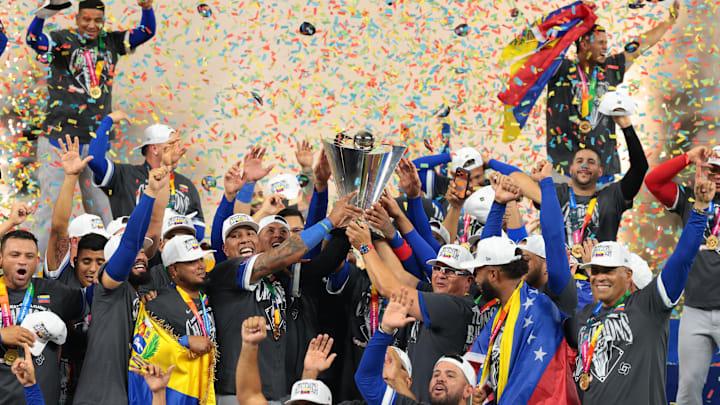
MIAMI — Not in dirt or sweat was the story of the World Baseball Classic written but in tears. To see these grown, hardened soldiers of baseball sobbing on the field where they had just secured their ultimate victory was to best understand what baseball and this championship mean to Venezuela.
Venezuela vanquished Team USA in the final, 3-2, Tuesday. It would be difficult to imagine a victory that would move a U.S. team to tears. That’s not a knock. It’s more reflective of how deeply the causes of baseball and country mean to Venezuela, which had never been in a WBC final, never mind won one.
It is not a matter of “wanting it more.” It is a matter of wanting it from a more deeply embedded place in the heart, rather than simply meeting the responsibility of expectations. The country let people out of work at the two in the afternoon for the eight o’clock start, just to allow them to prepare for the seizing of the Golden Fleece. Maybe stock up on heart medicine. Or Kleenex. With the country stopped for the night, a respite from geopolitical and economic hardship, Venezuelans saw a triumph of the heart. It is a force far more powerful than the muscular Team USA lineup.
TEAM VENEZUELA 🇻🇪
— World Baseball Classic (@WBCBaseball) March 18, 2026
CHAMPS 🏆#WORLDBASEBALLCLASSIC pic.twitter.com/1hDTJWcI5V
So spirited did the Venezuelans play—with the same joyful intensity as their dugout tambores celebration—that the outcome was well earned more than shocking. The U.S. began with a huge break by entering the final after a day off while grand chessmaster Omar Lopez, the Venezuelan manager, had to make do with running back bullpen pieces without a day off.
No, the most shocking part of the tournament was that Team USA did not hit. How does a $1.5 billion lineup not hit? How do nine players who hit 255 home runs last year—more than 29 entire MLB teams —do a slow fade out of the WBC? It wasn’t just scratching out three hits against Venezuela in the final amid a littering of pop-ups and grounders. It also was hitting .223 and scoring just 20 runs in its last five games after they no longer had undermanned and overwhelmed Brazil and Great Britain handing out walks like Halloween candy.
Team USA will need to do an autopsy on what went wrong beyond the 3–2 loss. Sure, you can write it off to “small sample size,” the easiest and laziest of excuses. But when you have nine guys in your starting lineup playing under contracts worth an average of $167 million per player, something just isn’t right. U.S. manager Mark DeRosa was as perplexed as anyone.
“Ultimately it’s who gets hot at the right time, who gets a big swing,” DeRosa said. “It just seemed like we couldn’t get the offense going the entire tournament.
“We came out of Arizona just absolutely smoking the ball in the two exhibition games we played, and for what whatever reason, we just couldn't get it rolling offensively.”
I would begin the autopsy with a tissue sample from a sequence in the sixth inning, which spoke to the savvy of Venezuela and the passive-aggressive nature of the U.S. offense, which seemed lost without its comfort food: walks and home runs.
The U.S. trailed, 2–0, and was down to its last 10 outs with nobody on base. Due up were Bryce Harper and Aaron Judge, five MVPs and 731 home runs worth of muscle. José Buttó, a reliever with less than two years of service time, was on the mound.
Harper singled. That meant Judge stood as the potential tying run. Buttó threw Judge two sliders without conviction. Judge watched them skitter well below the zone as if bored. He was not tempted a bit.

Catcher Salvador Perez called time and ran to the mound. Second baseman Gleyber Torres, a former teammate of Judge’s, joined them. Perez, 35, and Torres, 29, are two of the more experienced players on Team Venezuela.
“I know Judgy,” Torres said. “I know what he’s trying to do there. He’s looking to tie the game. I just wanted José to know that he did not have to give in there. He had to continue to make his pitches. Don’t feel like you have to give in.”
Here is what Perez told me he told Buttó: “Hey, this is the guy that cannot beat us. So, if you walk him, you walk him. Keep attacking but try to make your perfect pitch. We know what you can do.”
Said Perez, “I mean, he’s the best hitter in the league, you know?”
Perez returned to plate and waited on Buttó’s 2-and-0 pitch. Judge last year hit .538 and slugged .963 on 2-and-0 pitches. Uh-oh. But here’s the thing about Judge in a hitter’s count like that: He is more likely to take than to swing. Last season he swung less than half the time on 2-and-0 pitches over the plate (44%).
Buttó threw a cookie of a slider. Middle-middle. A mistake, considering Perez’s warning to avoid a home run at the cost of a walk.
Judge took it for a ball.
Buttó came back with another slider. This fourth one was as misfired low as the first two.
Now it was 3-and-1. Perez called for a sinker, a daring call. Judge is the best fastball hitter of this generation, especially on ones in the zone. Buttó’s job was to paint a corner with the sinker down. Instead, he left it in the middle of the plate. Another mistake.
“I thought, ‘Oh, no!’ ” Perez said.
Judge took it for a strike.
“No, it was not where we wanted it,” Torres said. “We got lucky. He must have been looking for something else.”
Said Perez, “He missed that. Oh, yeah. He missed that. Good for us.”
Now it was 3-and-2. Buttó made a third mistake. It was a slider in the middle of the plate, the third pitch in a hitter’s count in that one at-bat in such a dangerous area. Judge hit it hard but pounded it into the ground to third base for the third out. Judge hit .222 for the tournament.
José Buttó gets Team Venezuela through the 6th inning unscathed! pic.twitter.com/WaVnDTiOws
— World Baseball Classic (@WBCBaseball) March 18, 2026
Harper briefly rescued the team with a two-run homer in the eighth to tie the game. It was a dramatic, no-doubt blast he ranked second among his career highlights behind only the 2022 pennant clinching homer for the Phillies against the Padres. It was Harper’s second hit of the game. The rest of the team went 1-for-26.
BRYCE HARPER TIES THE GAME FOR TEAM USA! pic.twitter.com/zRVBaURBTm
— World Baseball Classic (@WBCBaseball) March 18, 2026
“I mean, [I’m] surprised because of the names at the back of the jersey,” DeRosa said, “but not surprised because of where they're at in spring training. Yeah, that's my answer. I really don't have a rhyme or reason to why. I just think you're either hot or not in a seven-game blast like this.”
The Americans could not play rally baseball—string together hits like pearls on a necklace, move runners by going the other way. They scored four runs in two games in Miami, on two solo homers and one two-run homer.
The Venezuelan drum line of pitching to thwart them unofficially began at 8:30 in the morning. Lopez and his staff had huddled until three in the morning to game-plan against the Americans. At 8:30 a.m., the manager was awakened by a string of calls from MLB executives giving him instructions on what to do with their relief pitchers who will be returning to their spring camps.
The Tigers told Lopez he could not use Enmanuel De Jesus, a journeyman reliever with his eighth organization, including the KT Wiz and Kiwoom Heroes of Korea. The Cubs told Lopez he could not use Daniel Palencia, the closer for Chicago and Venezuela. Lopez fought back. The Cubs asked Lopez what other clubs were telling him about their pitchers going back-to-back. Lopez fudged a little and said he had been granted clearance. It was true that Seattle permitted Lopez to use Eduard Bazardo for a second straight day, but only for one inning.
Lopez kept pressing for Palencia to be available. He finally won a concession. He could pitch only in one narrow window: only the ninth inning and only in a save situation.

DeRosa had his own issues. The Padres did not want Mason Miller, even with a day off, throwing in a tie game or in the middle of an inning, which is how the U.S. wound up losing a one-run game without getting its best reliever to the mound.
Venezuelan starter Eduardo Rodriguez eased some of Lopez’s bullpen issues by carving up the U.S. with 4 1/3 scoreless innings. It was only the seventh time in his career Rodriguez had a scoreless start while giving up no more than one hit, the first time for him in three years.
Rodriguez is the owner of the two tambor drums in the dugout. Each game the Venezuelan players would gather round the pounding drums and dance and chant to their rhythm. The dance is called tambores. “It comes out of Afro-Venezuelan tradition,” Rodriguez said. They mimic the drumming motion when the reach base with a hit or hit a home run. Back home the drumming and dancing often are performed in beach villages and as the highlight of weddings and parties at midnight, when it is referred to as the loca hora, or “crazy hour.”
IT'S GAME TIME 🇻🇪🕺#WorldBaseballClassic pic.twitter.com/5aizQToiTa
— World Baseball Classic (@WBCBaseball) March 15, 2026
“It is the beat of Latin baseball,” Lopez said. “Attack, attack, attack.”
It is the antithesis of the passive-aggressive “waiting for a good pitch” rhythm.
From Rodriguez, Lopez turned to Bazardo, Buttó and Angel Zerpa. Those four in one stretch of brilliant managing by Lopez faced 11 batters with the platoon advantage in seven of them. Only two balls even left the infield, one for a hit. It was the sturdy bridge to Lopez’s best two arms, Andrés Machado and Palencia.

Harper nearly blew up the plan with his home run. With the game tied at 2 heading to the ninth, Lopez, because of his negotiated settlement with the Cubs, could not use Palencia in the bottom of the ninth.
DeRosa, unable to use Miller, brought in Whitlock. The righthander walked Luis Arraez on five sliders. Arraez had just 27 walks last year on four or five pitches.
Lopez then made another savvy move. He replaced Arraez (25th percentile in sprint speed) with Javier Sanoja (67th). The pinch runner swiped second base on a close play. Second baseman Brice Turang, in catching a short-hop throw from Will Smith, was unable to keep his glove low and toward the base. The upward give of his glove permitted the fraction of time for Sanoja to beat the tag.
Garrett Whitlock hung a 3-and-2 changeup to Eugenio Suárez. The veteran DH blasted in for a double to drive home the tournament-deciding run. With the narrow window re-opened, Palencia was allowed to pitch, thanks to the Treaty of Chicago. He closed the game with a dominant, 11-pitch ninth.
EUGENIO SUÁREZ PUTS TEAM VENEZUELA AHEAD IN THE 9TH! pic.twitter.com/LtpLdYII5f
— World Baseball Classic (@WBCBaseball) March 18, 2026
What happened next was even more beautiful than how the Venezuelans had played ball. They converged around and near Palencia and Perez in the vicinity of the mound. Players and coaches sobbed openly, some of them so heavily they used the sleeves of their championship T-shirts to dry their eyes. Rodriguez was one of the emotional wrecks, as were tough-guy hitting coaches Miguel Cabrera and Victor Martinez. It went on for some time, equal measures of catharsis, relief and happiness.
“When we play,” said third baseman Maikel Garcia, the tournament MVP, “we play not just for ourselves. We play for 30 million people.”
In short time somebody remembered Rodriguez’s tambor drums. They were fetched from the dugout. Bazardo, the master drummer, led another round of tambores. Drum, drum, drum. It is how the Venezuelans played. It is how they throttled a billion and a half dollars’ worth of Team USA hitters. Relentless and resilient.
The clock said it was a few minutes past 11. But you could tell the time by just the sound—the rhythm of the drums. Midnight coming. It was the last hour of the greatest night in the proud history of Venezuela baseball. Loca hora. It had finally arrived.
More MLB from Sports Illustrated
 Add us as a preferred source on Google
Tom Verducci is a senior writer for Sports Illustrated who has covered Major League Baseball since 1981. He also serves as an analyst for FOX Sports and the MLB Network; is a New York Times best-selling author; and cohosts The Book of Joe podcast with Joe Maddon. A five-time Emmy Award winner across three categories (studio analyst, reporter, short form writing) and nominated in a fourth (game analyst), he is a three-time National Sportswriter of the Year winner, two-time National Magazine Award finalist, and a Penn State Distinguished Alumnus Award recipient. Verducci is a member of the National Sports Media Hall of Fame, Baseball Writers Association of America (including past New York chapter chairman) and a Baseball Hall of Fame voter since 1993. He also is the only writer to be a game analyst for World Series telecasts. He lives in New Jersey with his wife, with whom he has two children.