%20%20--%3E%0A%3Csvg%20version%3D%221.1%22%20id%3D%22Layer_1%22%20xmlns%3D%22http%3A%2F%2Fwww.w3.org%2F2000%2Fsvg%22%20xmlns%3Axlink%3D%22http%3A%2F%2Fwww.w3.org%2F1999%2Fxlink%22%20x%3D%220px%22%20y%3D%220px%22%0A%09%20width%3D%2239px%22%20height%3D%2240px%22%20viewBox%3D%220%200%2039%2040%22%20enable-background%3D%22new%200%200%2039%2040%22%20xml%3Aspace%3D%22preserve%22%3E%0A%3Cpath%20fill%3D%22%23FFFFFF%22%20d%3D%22M38.5%2C7H28.2v26h10.3V7z%22%2F%3E%0A%3Cpath%20fill-rule%3D%22evenodd%22%20clip-rule%3D%22evenodd%22%20fill%3D%22%23FFFFFF%22%20d%3D%22M26.1%2C25.5c0%2C5.8-4.1%2C7.5-12.9%2C7.5C3.9%2C33%2C0%2C31.2%2C0%2C25.2v-1.1h11.6%0A%09v2.4c0%2C0.7%2C0.1%2C1.4%2C1.2%2C1.4c1%2C0%2C1.2-0.4%2C1.2-1.3v-0.9c0-1.6-0.9-1.6-3.5-2.2C2.2%2C21.7%2C0%2C19.7%2C0%2C15.3v-0.9C0%2C9.3%2C5.5%2C7%2C12.9%2C7%0A%09c10.2%2C0%2C12.8%2C2.6%2C12.8%2C7.4v1.8h-11v-2.9c0-0.6-0.4-1.1-1.2-1.1c-0.6%2C0-1.2%2C0.4-1.2%2C1.1v0.9c0%2C1.5%2C0.9%2C2%2C3.3%2C2.5%0A%09c8%2C1.6%2C10.5%2C3.3%2C10.5%2C7.5V25.5z%22%2F%3E%0A%3C%2Fsvg%3E%0A)
‘Lab-Grown’ Pitches Are Making Hitting More Difficult Than Ever
In this story:
Welcome to Verducci’s View, a new weekly baseball newsletter from Sports Illustrated senior writer Tom Verducci. Every Monday, Tom will empty out his notebook and cover MLB’s hottest topics, provide in-depth analysis through both text and video breakdowns, look forward to what’s worth watching during the week and more. This week, we’re focusing on “lab-grown” pitches, the Mets’ dreadful start and more.
Hitting is more difficult than ever. Hitters must try to crack a code that involves more velocity, more spin and—here’s the latest subterfuge—more choices than ever. Over the past two seasons a massive change has gained widespread adoption among pitchers: adding pitches to make the ball move in multiple directions. Pitchers can call on a suite of pitches decided specifically for left- and right-handed hitters or certain swing paths.
Max Fried of the Yankees has been at the forefront of this shift. In 2024 with the Braves, he threw his four-seam/curveball combination 53.2% of the time. Now he is a seven-pitch mix master who throws that combo just 33.2% of the time.
Examples are everywhere, both with veterans and young pitchers. Padres righthander Walker Buehler has reinvented himself as a groundball pitcher who throws seven pitches, none more than 21% of the time. Shohei Ohtani of the Dodgers is a seven-pitch pitcher who mostly reserves his sinkers and sweepers for righties and curveballs and splits to lefties. When Garrett Crochet moved to the rotation in 2024, he threw 82.1% four-seamers and cutters. With Boston now he has cut the bread-and-butter portion of his selection to 57.6% while mixing more sinkers and sweepers and even the occasional changeup.
One of the most popular strains of this trend of more shapes is throwing three fastballs: a four-seamer with ride, a sinker that runs arm side and a cut fastball that runs glove side. Imagine you are a hitter reading a high-velocity fastball out of the pitcher’s hand. The difficulty is knowing whether that fastball is going to hold its plane, dart right or dart left.
Ten years ago, only 32.5% of pitchers threw three fastballs. Now 49.2% of pitchers throw three fastballs, including Yankees righthander Cam Schlitter, who has a 1.92 ERA while throwing three fastballs 90% of the time between 90 and 100 mph.
The top of the ERA leaderboard is filled with pitch-makers, not hard throwers. Of the top five, four have below average velocity but all of them throw at least five pitches and four of them have the three-fastball menu:
Pitcher | ERA | FB Velocity | Pitches | Fastballs |
|---|---|---|---|---|
Jose Soriano, Angels | 0.28 | 96.8 | 5 | 2 |
Bryce Elder, Braves | 0.77 | 92.7 | 5 | 3 |
Michael Wacha, Royals | 1.00 | 93.0 | 6 | 3 |
Parker Messick, Guardians | 1.05 | 93.2 | 6 | 3 |
Seth Lugo, Royals | 1.48 | 91.7 | 9 | 3 |
Once lasers started measuring spin, not just velocity, a new world opened. Now pitchers boast “lab-grown” pitches that they can develop with technology in pitching labs.
Pitchers are defeating hitters more with multiple pitches and shapes than they are with increased velocity.
“You’re exactly right on that. I think that’s the biggest change in pitching here recently,” said San Diego Padres manager Craig Stammen, a former pitcher. “You have guys who have multiple shapes on their fastball, multiple shapes on their breaking balls ... no longer is the guy just throwing a curveball or just throws a sinker, like I did. Now it’s cutter, slider, sweeper, gyro slider, curveball, sweeping curveball.
“It’s kind of like the Yu Darvish method. Everybody’s becoming what Yu Darvish was. We’ve got different shapes of the same pitch.”
Hitters have adopted to increased velocity by hitting off high-velocity pitching machines. They are trying to solve the riddle of multiple shapes in part by training more in the cage with the high-tech Trajekt pitching machine, which can exactly duplicate the shapes of the pitches of the opposing starting pitcher that night. One problem: the machine is not portable, putting the road team at a disadvantage.
“Some guys have used the Joc Pederson method,” says Arizona manager Torey Lovullo. “If he knew he was going to see a new starter on the next trip he would dial up that pitcher on the machine before the trip, so he could see the pitch shapes.”
The pitching world has changed so quickly that it’s especially hard on veteran hitters who were raised in a different world and now might not have the same bat speed or quick twitch skill they had in their 20s. Xander Bogaerts, 33, of the Padres, for instance, has retooled his swing path to get his bat in the zone earlier and to keep it on path longer to adjust to all the late movement.
Bogaerts especially has been challenged by the rise of the different shaped fastballs. The right-on-right two-seamer was a particular problem for a hitter who likes to dive into off-speed and spin. Look how much the pitch-shaping game changed for Bogaerts:
Bogaerts vs. Sinkers | Percentage Seen | MPH |
|---|---|---|
2014 | 20.5% | 91.9 |
2026 | 31.9% | 94.1 |
Bogaerts’s countermove this season is showing early dividends. He has hit two home runs off sinkers this season—after hitting none last year.
“I think we’re seeing it’s very hard for hitters to be able to cover all those pitches,” Stammen says. “It’s like Xander [Bogaerts]. He had to make an adjustment from who he was in the past, just to be able to really dominate the four-seam and be able to cover some of those other pitches.”
Trout’s Happy Zone

An unprecedented run of five homers in a four-game series at Yankee Stadium brought the spotlight back to Mike Trout, who hasn’t had 500 at-bats in a season in a decade. A healthy Trout looks dangerous again. His fast start includes his lowest strikeout rate since 2019 (20.2%), a career-best walk rate (21.2%), an average exit velocity he hasn’t seen since 2020 (93.7 mph) and a top-30 sprint speed for the first time since 2023. It’s only 97 plate appearances, but the Angels center fielder looks terrific in every way.
The Yankees, however, should be shaking their heads about how they pitched to Trout, who is the greatest low-ball slugger of his generation. Look at the pitch locations of the five home runs New York pitchers allowed to Trout:

The Yankees threw him 16 pitches in his happy zone. Trout hit six of them at least 102.3 mph. Just how dangerous is Trout at the bottom of the zone? He’s the best there is over the past 18 seasons:
Player Name | SLG in Zone Bottom Third, 2008–26 |
|---|---|
1. Mike Trout | .743 |
2. Yordan Alvarez | .740 |
3. Yoenis Cespedes | .684 |
4. David Ortiz | .642 |
5. Carlos Gonzalez | .632 |
And Trout has hit 34% of his career home runs on low strikes, despite seeing them only 16% of the time:
Trout Career by Pitch Location | Pct. | AVG | SLG | HR |
|---|---|---|---|---|
In Zone Bottom Third | 16% | .377 | .743 | 141 |
All Other Pitches | 84% | .264 | .508 | 270 |
Breakdown of the Week, Shohei Comp, Part 1
In honor of the incomparable Shohei Ohtani, who has hit five homers and allowed none, I’ve got two breakdowns for you that refer to Ohtani as the template—for hitting and pitching.
The word is out on White Sox first baseman Munetaka Murakami: don’t challenge him with fastballs. Murakami is slugging .750 against fastballs with six of his seven home runs coming off heaters. Check out the pitch locations of his home runs off fastballs:

Murakami is tied with Sal Stewart of the Cincinnati Reds for the most home runs off fastballs. Murakami’s set up, trigger and swing look remarkably like those of Ohtani. You can check out the comparison here, which includes a key tip Ohtani gave Murakami during the World Baseball Classic that explains some of the similarity.
Breakdown of the Week, Shohei Comp, Part 2
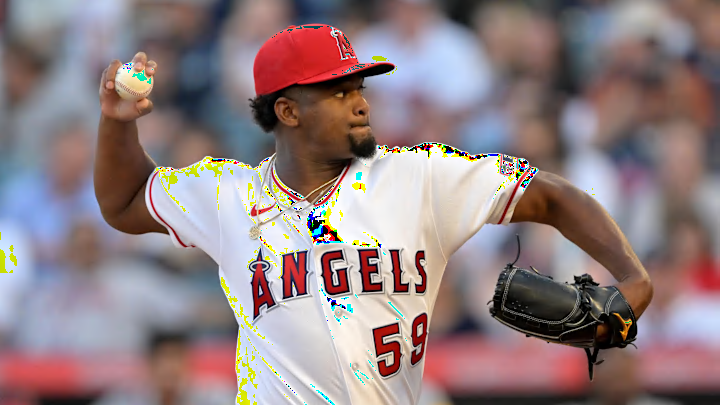
You must go back to Fernandomania to find a pitcher who dominated early in a season the way it’s been done by Angels righthander Jose Soriano.
Best Starts Through Team’s First 21 Games Since 1920 | Year | W-L | ERA |
|---|---|---|---|
T-1. Fernando Valenzuela, Dodgers | 1981 | 5-0 | 0.20 |
T-1. Al Benton, Tigers | 1945 | 5-0 | 0.20 |
T-1. Lefty Grove, Red Sox | 1936 | 5-0 | 0.20 |
4. Jose Soriano, Angels | 2026 | 5-0 | 0.28 |
5. Zack Greinke, Royals | 2009 | 5-0 | 0.50 |
Soriano made 31 starts at a league-average level last year but has made the leap into elite territory. Why? His fabulous power sinker is even better this year. Note from his metrics below how 1) he has moved toward the middle of the rubber from the first base side, 2) lowered his release point and 3) gained more extension.
Soriano Sinker | MPH | Vertical Release | Horizontal Release | Extension | Opponents’ AVG |
|---|---|---|---|---|---|
2025 | 97.2 | 5.83 | -1.26 | 6.6 | .290 |
2026 | 96.8 | 5.62 | -2.48 | 6.8 | .056 |
This breakdown explains how he did so—with the nod to Ohtani.
More Breakout Pitchers
I was quick to peg Mike Soroka, 28, as an early breakout pitcher this season. Soroka (4-0) keeps on humming. Joining Soroka on the breakout list are fellow righthanders Soriano, 27, Braxton Ashcraft, 26, and Emerson Hancock, 26, who show up on this list of the toughest pitches to hit this season:
Toughest Pitches to Hit in 2026 (Min. 100 pitches) | Pitch | AVG |
|---|---|---|
Dylan Cease, Blue Jays | Slider | .040 |
Braxton Ashcraft, Pirates | Curveball | .043 |
Jose Soriano, Angels | Sinker | .056 |
Emerson Hancock, Mariners | Sweeper | .059 |
Yoshinobu Yamamoto, Dodgers | Splitter | .074 |
Freddy Peralta, Mets | Changeup | .074 |
The Mets & 112 Years of History

It is no longer early for the New York Mets, losers of 11 in a row. They have reached a point of urgency, especially needing to take advantage of a favorable schedule coming up (15 straight games against teams that lost 90+ games last year in the Twins, Rockies, Nationals and Angels.)
The Mets are 7–15 after 22 games. That’s only 14% of the season. No big deal, right? Well, good teams don’t start this badly. Only three teams started this badly in a full season and still made the postseason. Most recently, the 2015 Rangers and 2024 Astros rebounded to win weak divisions with 88 wins. They become the beacons of hope for the Mets.
But the Mets are even more of an outlier potential playoff team because their offense has been atrocious. They are scoring 3.27 runs per game.
Only one team ever made the playoffs with a record this bad and an offense this bad after 22 games: the 1914 Boston Braves, who pulled off such a stunning turnaround they were known as the Miracle Braves.
I would not look to baseball from 112 years ago for hope, even though New York is playing the modern version of deadball era baseball. The Mets have some systemic problems that can’t be written off as bad luck. Their lineup has three of the 17 slowest bats in the National League: Marcus Semien (7th at 67.7 mph), Bo Bichette (15th, 69.1) and Jorge Polanco (T-17th, 69.5), all winter acquisitions. Carson Benge, a rookie hitting .143 with a .229 OBP and too much head movement in his swing, somehow hit leadoff for the Mets in losing three straight to the Cubs. Erstwhile leadoff hitter Francisco Lindor is hitting .156 against fastballs (four-seamers and sinkers), including .118 against 95-plus mph.
The Mets are not this bad, of course. And the schedule should help get them right soon (even though they will make their third trip to California in their first 32 games). But they have lost their margin of error. Most playoff teams can survive one bad month. Two? Nope. That’s why urgency has arrived early for the Mets.
Worst 22-Game Starts by Playoff Team (Full Seasons) | W-L | Runs | Final Record |
|---|---|---|---|
1914 Braves | 4-17-1 | 59 | 94-59-5 |
2024 Astros | 7-15 | 96 | 88-73 |
2015 Rangers | 7-15 | 80 | 88-74 |
- | - | - | - |
2026 Mets | 7-15 | 72 | ? |
TV on TV This Week
Yankees @ Red Sox, Thursday, 6 p.m. ET, FS1
This is the finale of a three-game series at Fenway Park. The ancient rivals have met 1,045 times at Fenway, postseason included. So delicious is this rivalry that the two teams are separated by only five games over that sample size of more than a thousand games. The Red Sox hold a 523-518-4 edge. Boston is playing with some early stress due to a lukewarm offense (fifth-worst OPS+).
Aaron Judge has 15 homers in 54 games at Fenway. One more homer there ties him with Yogi Berra and Jorge Posada for ninth on the list of most home runs by a Yankee at Fenway. But Judge is a .217 hitter there. He is one of 43 Yankees with 250 plate appearances at the Fens. Among them only Mark Teixeira has found hits harder to get (.196).
More MLB from Sports Illustrated
 Add us as a preferred source on Google
Tom Verducci is a senior writer for Sports Illustrated who has covered Major League Baseball since 1981. He also serves as an analyst for FOX Sports and the MLB Network; is a New York Times best-selling author; and cohosts The Book of Joe podcast with Joe Maddon. A five-time Emmy Award winner across three categories (studio analyst, reporter, short form writing) and nominated in a fourth (game analyst), he is a three-time National Sportswriter of the Year winner, two-time National Magazine Award finalist, and a Penn State Distinguished Alumnus Award recipient. Verducci is a member of the National Sports Media Hall of Fame, Baseball Writers Association of America (including past New York chapter chairman) and a Baseball Hall of Fame voter since 1993. He also is the only writer to be a game analyst for World Series telecasts. He lives in New Jersey with his wife, with whom he has two children.