
Before Judging Kade Anderson, Remember How Bryce Miller and Bryan Woo Started for the Mariners
In this story:
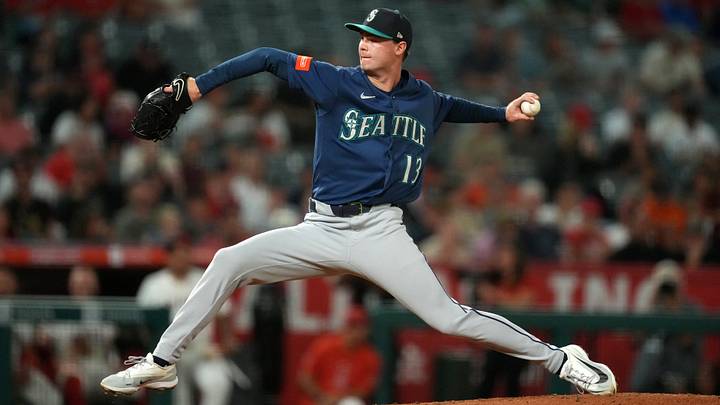
Five starts are barely enough to learn a pitcher’s pregame routine. Quite frankly, Kade Anderson’s routine will change plenty throughout what should be a long baseball career. Somehow, that same five-start sample has already convinced some corners of the Mariners fan base to sour on him. Some of that impatience is understandable after the exhausting season the M’s have given us. The reality is that we should all know better.
Through his fifth start on Sept. 14, Anderson owns a 5.33 ERA. The Angels tagged him for five earned runs on seven hits over 4 1/3 innings in Seattle’s 6-4 loss. Anderson struck out five and didn’t walk anyone, but the contact piled up quickly. It was an ugly night. It also tells us remarkably little about the pitcher he will become.
Bryce Miller’s First Five Starts Set an Impossible Standard
Put Anderson’s starts next to those of Bryce Miller and Bryan Woo — the two most recent Mariners starters to make the jump from Double-A — and his results look much closer to Woo’s.
Anderson has thrown 25 1/3 innings with a 5.33 ERA, 1.42 WHIP, 21 strikeouts, eight walks and four home runs allowed. Woo produced a 4.37 ERA and 1.24 WHIP over 22 2/3 innings, striking out 32, walking six and surrendering three homers.
Then there’s Miller who delivered a statistical fever dream: 31 1/3 innings, a 1.15 ERA, 0.51 WHIP, 28 strikeouts, three walks and zero home runs.
Using that stretch that Miller produced as the standard for any rookie would be ludicrous. In 2023, he became the first pitcher since at least 1901 to work six or more innings while allowing four or fewer hits in each of his first five appearances. Then the Yankees and Rangers brought him down to earth and hammered him for 15 earned runs in seven combined innings over his next two starts.
That didn’t erase Miller’s future any more than his first five starts guaranteed immediate greatness. The following season, he had developed into the pitcher who posted a 2.94 ERA over 180 1/3 innings.
Woo’s introduction was even more instructive. He surrendered six earned runs in two innings during his debut in Texas. Over his next four starts, he allowed five earned runs in 20 2/3 innings.
Anyone who formed a permanent opinion of Woo after that debut missed the pitcher taking shape immediately afterward. Rookie development isn’t linear, no matter how we try to draw it up.
Anderson’s Strikeout Drop Is a Real Concern
We can acknowledge the small sample, but we can’t use it as an excuse. Not everything has gone well for Anderson. He struck out 40.5 percent of Double-A hitters. That rate has fallen to 19.6 percent in the majors. Woo struck out 32 of his first 96 batters; Anderson has struck out 21 of 107.
It’s a dramatic difference. Anderson has yet to find the same two-strike authority he displayed in the minors.
However, his whiff rate offers a reason to investigate further instead of panicking. Anderson has generated a 22.0 percent whiff rate, slightly better than Miller’s 18.5 percent mark through five starts. His stuff can miss bats. The trouble comes in reaching and completing those favorable counts.
Anderson’s first-pitch strike rate sits at 60.7 percent. Miller and Woo were both around 66 percent during their opening stretches. So now we’re talking about a guy who doesn’t blow you away with spin or velo, suddenly forced to climb uphill and give major-league hitters more opportunities to eliminate parts of his repertoire.
That leaves Seattle with a more useful question than whether a 5.33 ERA looks concerning. Can Anderson improve his sequencing and turn scattered whiffs into completed strikeouts, or has he reached the majors without a dependable put-away pitch?
We don’t know the answer to that yet. And we weren’t going to get them this early.
Kade Anderson’s Pitch Mix Gives the Mariners Something Different
The most encouraging part of Anderson’s debut has little to do with his ERA. Miller threw four-seamers 70.5 percent of the time during his first five starts. Woo used a four-seamer or sinker on 76.8 percent of his pitches. Both arrived with premium fastballs and challenged hitters to prove they could catch up.
Anderson has a completely different blueprint. His four-seamer leads his repertoire at 41.5 percent, followed by his slider at 25.6 percent, changeup at 17.8 percent and curveball at 15.1 percent.
Deception matters for a lefty whose fastball has averaged around 93.6 mph. He needs hitters accounting for different speeds, shapes and locations. As his command settles, that variety should create the deception that makes his arsenal play above its raw velocity.
Logan Gilbert’s 2024 pitch mix is a good model. During that campaign,he led with his slider at 32.0 percent while throwing his four-seamer 30.7 percent of the time. His splitter, sweeper and cutter each received at least a 10 percent share. That balance helped him produce a 3.23 ERA, 0.89 WHIP and 220 strikeouts over 208 2/3 innings.
Anderson has miles to cover before that becomes a fair comparison. Gilbert still demonstrated how spreading the workload across several credible pitches can prevent hitters from sitting on one shape.
That evolution plays a big role. Woo has used his four-seamer and sinker on a combined 66.1 percent of his pitches in 2026. His four-seamer remains effective, although hitters have brought it closer to earth. They have batted .232 and slugged .394 against it this season after hitting .153 with a .332 slugging percentage in 2025.
Miller has already started mixing things up. His four-seamer is down to 40.0 percent usage, while his splitter is up to 24.4 percent. That shift makes sense. Hitters have batted .252 and slugged .444 against the heater in 2026, and its average spin has dipped from roughly 2,605 rpm when Miller first came up to 2,513 this season.
His spin is still elite. It’s just no longer hitting alien numbers that kept hitters late on it. Miller has needed to find more answers around it. Which brings us back to Anderson who still has just one fastball shape.
Hitters are batting .342 against his four-seamer through five starts. A different fastball shape could make the same velocity considerably less predictable. Seattle usually gives its starters that option. Woo pairs his four-seamer with a sinker. George Kirby, Emerson Hancock and Miller have each thrown a four-seamer, sinker and cutter this season. Gilbert uses a cutter alongside his four-seamer and has occasionally shown a sinker, though even he admits it’s one of his weaker offerings. Anderson is the outlier among the Mariners’ homegrown starters.
It is fair to wonder why a secondary fastball hasn’t surfaced. The Mariners may already be testing one during bullpen sessions. It has yet to appear in a game, and that absence is surprising for an organization that regularly gives its starters using multiple fastball shapes.
A sinker could play off Anderson’s four-seamer by arriving in a similar velocity range before running farther arm-side and staying closer to the bottom of the zone. A cutter might be even more useful against right-handed hitters, giving him a firmer bridge to the slider.
September is not exactly the time for installing a new grip. That’s what the offseason is for. If the Mariners can add another fastball shape without disturbing Anderson’s feel for his other four pitches, his entire repertoire could take a considerable step forward.
We can be blunt in both directions. A 5.33 ERA and 19.6 percent strikeout rate are not good enough. Writing off a 22-year-old after five starts is even less defensible. Anyone claiming they have shown us what he will become is scouting the box score and taking a loud guess.
 Add us as a preferred source on Google
Tremayne Person is the Publisher for Mariners On SI and the Site Expert at Friars on Base, with additional bylines across FanSided’s MLB division. He founded the Keep It Electric podcast in 2023 and covers baseball with a blend of analysis, context, and a little well-timed side-eye just to keep things honest. Tremayne grew up a Mariners fan in Richmond, Va., and that passion ultimately led him to move to Seattle to cover the team closely and become a regular at home games. Through his writing, he connects with fans who want a deeper, more personal understanding of the game. When he’s not at T-Mobile Park, he’s with his dog, gaming, or finding the next storyline worth digging into.
Follow TremaynePerson