
Why Bubba Chandler's Spring Focus Matters More Than His Results
In this story:
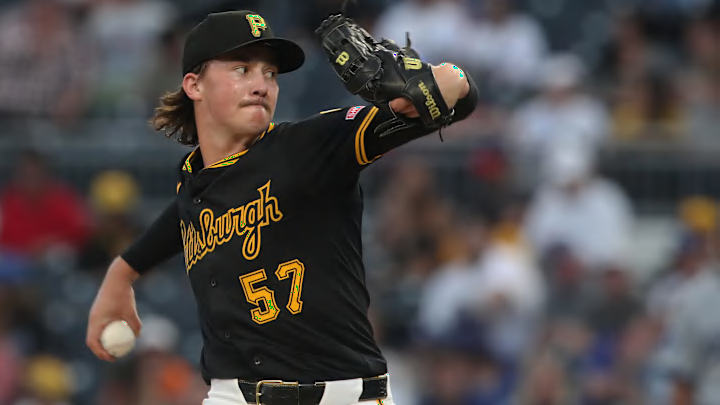
Under the relentless Florida sun that bakes the backfields of Pirate City in Bradenton, the Pittsburgh Pirates' Bubba Chandler is engaged in a silent battle. During these crucial, early weeks of Spring Training, the process matters infinitely more than any Grapefruit League scoreboard.
Chandler, a young arm whose raw talent screams future ace, is routinely considered one of the top pitching prospects in Major League Baseball. But his cup of coffee last fall revealed a crucial truth: in Major League Baseball, velocity alone can be a question, not necessarily an answer. As the Pirates gear up for 2026 with Chandler a likely fixture in their rotation, his spring training narrative is uniquely nuanced.
It is not about winning a job, which Chandler seemingly already has locked up, and it is decidedly not about the superficial results in Grapefruit League box scores. For Chandler, this spring is a sacred, focused workshop with two main objectives: commanding the placement of his explosive fastball and cultivating trust in his devastating secondary pitches. This process-focused spring is the key to transforming him from a talented thrower into the National League Rookie of the Year candidate he is projected to be.
Location, Location, Location!
The statistical portrait from Chandler’s 2025 debut is a tale of two arsenals. His four-seam fastball, a sizzling 98.9 mph on average, is the engine of his potential. Yet, MLB hitters exposed its present flaw, batting .292 with a .492 slugging percentage against it. More telling is the expected batting average (xBA) of .304, indicating hitters could have fared even better over a larger sample. This data underscores a critical point: elite velocity poorly located becomes predictable, hittable, and ultimately exploitable.
Chandler threw 249 fastballs, representing 54% of his pitches, often in counts where big-league hitters could sit on it. Therefore, every fastball thrown this spring must be a purposeful exercise in location. Is it riding above the letters at the top of the zone? Is it painting the black on the inside corner to a right-handed hitter?
The radar gun readings from Bradenton are mostly irrelevant; the catcher’s target is everything. Mastering this command transforms his fastball from a statistical liability into the elite put-away pitch its velocity promises it can be. A 98.9 mph fastball on the edges is virtually unhittable; one over the heart of the plate is a home run waiting to happen, regardless of its speed.

Building Trust in the Arsenal
The second, and perhaps more transformative, focus is the deliberate cultivation of confidence in his off-speed arsenal — a suite of pitches that, in limited use, demonstrated jaw-dropping potential.
According to Statcast, hitters managed a mere .080 batting average against his 91.7 mph changeup and an almost identical .087 against his 89 mph slider. He threw 104 changeups and 80 sliders, a combined total dwarfed by his fastball usage. This disparity reveals the growth opportunity.
For Chandler to navigate a lineup multiple times, he must evolve from a pitcher who has breaking pitches to one who believes in them implicitly. This spring, some goals should be to throw his changeup in fastball counts, to back-foot his slider to lefties with two strikes, and to develop a feel for his curveball as a fourth weapon. The objective is not to get Grapefruit League hitters to swing and miss (though they will), but to build the muscle memory and mental fortitude to throw these pitches in any count when the games matter in April and beyond.
From Potential to Performance
For the Pirates, investing in this process with a pitcher who likely already has a rotation spot secured is a strategic imperative. They are not evaluating if Chandler belongs; they are meticulously constructing the pitcher he must become for their rotation to take a leap forward. His development is a cornerstone of the franchise’s rebuilding timeline. The Pirates already have the best right-handed starting pitcher in the game in Paul Skenes; now imagine the combination of Skenes and Chandler at the height of their powers. It's a potential one-two punch that calls to mind some elite right-handed pitching combos of the past: Justin Verlander and Max Scherzer, Verlander and Gerrit Cole, Pedro Martinez and Curt Schilling, etc.
A Chandler who commands his fastball and wields a full, confident arsenal is a potential frontline starter who can shorten games and anchor one of the best young staffs in MLB. One who remains fastball-reliant and predictable faces the risk of early-inning exits and unfulfilled promise.
Thus, if Buccos fans see Chandler give up a long home run on a 3-1 fastball this spring, don't panic. If that fastball was purposefully aimed in and just missed, the process was correct. If he shakes off a fastball to throw a changeup on a full count and walks a batter, it is a victory in trust-building.
The results that matter for Chandler in Bradenton are invisible to the casual fan: the subtle nod from a catcher after a well-located two-strike slider, the internal confidence to double up on a changeup, and the precise execution of a fastball plan. This is the meticulous, foundational work that turns tools into performances. Chandler’s spring training focus matters infinitely more than his results because it is the dedicated crafting of the blueprint from which his rookie season — and his ceiling as a Pirate —will be built.
- Andrew McCutchen Makes Feelings Clear to Pirates
- Pirates' Paul Skenes Faces Top Prospect in Spring Training
- Pirates Likely Not Trading for Astros Third Baseman
- Pirates Invite Pitching Prospect to Spring Training
- Andrew McCutchen's Pirates Future Murky After Marcell Ozuna Signing
 Add us as a preferred source on Google
Ethan Merrill is from Grand Rapids, MI, and brings with him a diverse background of experiences. After graduating from Michigan State University with a degree in journalism, he worked with the Arizona Diamondbacks for three seasons before settling in the Pittsburgh area in 2020. With a passion for sports and a growing connection to his community, Ethan brings a fresh perspective to covering the Pittsburgh Pirates.