
Did the Tigers Find the Definitive Version of Keider Montero?
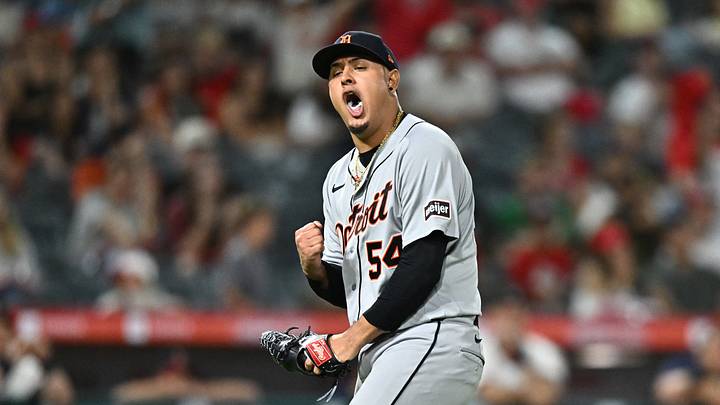
In this story:
After a difficult start to the season, Keider Montero is correcting the factor that had limited his development the most with the Tigers: hard contact.
The Venezuelan right-hander entered 2026 with an uncomfortable label: a talented arm that was vulnerable to the damage hitters could create when they squared up his pitches. In his first two seasons in the Major Leagues, he allowed 1.74 and 1.59 home runs per nine innings, a trend that reduced his margin for error in every start.
His arsenal had velocity and variety, but hitters found a simple approach: wait for the pitch they could attack. In May, opponents posted an xSLG above .500 against both his fastballs and breaking pitches, a sign that an issue was still present. A year earlier, his breaking pitches were punished with a .562 xSLG, while his fastball allowed a .668 xSLG, the worst mark of his career against samples of at least 35 batters faced.
The difference appeared in 2026.

Montero adjusted the way he attacks hitters. His fastball velocity returned to 95.0 mph for the first time since July 2024 (95.2), while his changeup became one of his most effective weapons. Hitters are batting just .123 against that pitch (7-for-57, with three extra-base hits and 11 strikeouts).
With a 3.22 ERA, a 3.62 FIP and 106 innings pitched, the Venezuelan right-hander has gone from being a rotation-filling option to becoming a reliable piece for Detroit.
The improvement did not come from a higher strikeout rate. His strikeout rate has dropped to 17.5%. The key has been controlling the type of contact he allows. The question now is whether this adjustment represents his new level or if there is still room for growth.
The fastball stopped being the target

The four-seam fastball was the pitch that exposed Montero the most.
In 2024, opponents hit .273 against that pitch with a .497 slugging percentage. In 2025, the batting average climbed to .292. Even though he used it roughly one-third of the time, he could not prevent hard contact.
In 2026, the results changed.
Montero is using the fastball at a similar rate (31-32%), but hitters are now batting just .207 against the pitch and its value has gone from negative in his first two seasons to positive.
Year | ERA | FIP | BB% | HR/9 | AVG vs. Fastball | wFA |
|---|---|---|---|---|---|---|
2024 | 4.76 | 5.15 | 7.5% | 1.74 | .273 | -1.1 |
2025 | 4.37 | 4.93 | 8.0% | 1.59 | .292 | -0.6 |
2026 | 3.14 | 3.57 | 5.3% | 0.85 | .207 | 7.4 |
The change was not about throwing harder. It was about execution.
Montero is locating his fastball better and pairing it with a sinker that creates less dangerous contact. The result is a clear reduction in home runs: he went from allowing 1.59 HR/9 in 2025 to 0.85 this season.
He has also improved his control. His walk rate dropped from 8.0% to 5.5%, eliminating another factor that had hurt his outings.
The changeup completed the evolution

The other step forward came from a pitch that was not reliable in the past.
In 2024, hitters batted .324 against his changeup. In 2026, that same pitch has become one of his best weapons, allowing a .127 batting average while producing a +5.3 wCH value.
The changeup allows Montero to alter speeds and prevent hitters from sitting on his fastball. That combination explains why he can succeed without relying on a high strikeout rate.
There are still reasons to view his production with some caution. His .229 BABIP sits below typical levels, and part of his ERA could rise over time. However, his 3.57 FIP and 3.37 xERA support the idea that the improvement is well-founded.
The next test will be maintaining this approach when opponents begin making adjustments.
Montero did not build his improvement around strikeouts. He built it around execution: attacking the zone, mixing his pitches and limiting the type of contact that changes games.
Detroit has found a more efficient version of the Venezuelan right-hander.
Now the question is how much further he can grow.
 Add us as a preferred source on Google
Yirsandy is a baseball writer specializing in MLB coverage with experience across multiple teams and storylines. He currently writes for Diamond Centric, where he covers the New York Mets, San Diego Padres, Chicago Cubs, Milwaukee Brewers, and Kansas City Royals. My work focuses on game coverage, player analysis, and storytelling that connects performance with context. My Substack has also been an important part of my writing development, where I’ve built much of my baseball coverage and storytelling voice over time. I’m passionate about combining reporting, research, and thoughtful analysis to produce engaging baseball content for readers.
Follow Yirsandy