
Javier Báez’s 2027 Contract Year Created a $24 Million Tigers Problem
In this story:
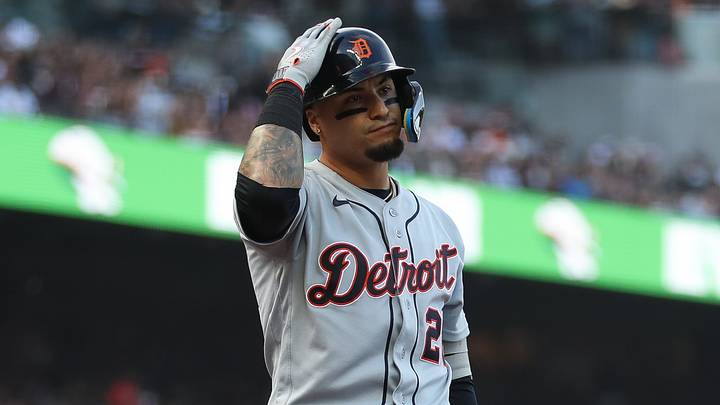
The Detroit Tigers are entering the offseason with an uncomfortable decision regarding Javier Báez.
Báez remained under contract for $24 million in 2027, the final year of the six-year agreement he signed before the 2022 campaign. That commitment became increasingly difficult to separate from his reduced availability and offensive production.
The Tigers originally signed Báez to a six-year, $140 million contract in December 2021. The deal represented the organization’s largest free-agent commitment since Prince Fielder, according to MLB.com’s official announcement.
Detroit envisioned Báez becoming an impact shortstop who could help lead a young roster back into contention. Nearly five years later, the final guaranteed year of that contract instead created a roster-management problem.
The Tigers had to decide whether Báez still provided enough value to warrant a meaningful 2027 role, regardless of the money already committed to him.
Production Made Contract Harder to Ignore

Báez appeared in 55 games during the 2026 campaign and produced a .237/.265/.345 slash line with 11 doubles, two home runs, and 17 RBIs over 185 plate appearances, according to FanGraphs.
His 67 wRC+ indicated that his overall offensive production remained well below the Major League average. Báez also recorded a 2.7% walk rate, limiting his ability to contribute when he was not driving the ball.
Those numbers did not capture everything he offered. Báez retained defensive versatility, experience and the instincts that made him one of baseball’s most entertaining infielders during his best years with the Chicago Cubs.
For Detroit, however, those complementary qualities became difficult to reconcile with a $24 million salary. A Tigers payroll breakdown from Bless You Boys confirmed that Báez’s contract would not come off the books until after the 2027 campaign.
The Tigers could attempt to trade him, but his salary and recent offensive results would likely require them to absorb a substantial portion of the remaining money. Releasing him would create more roster flexibility, although Detroit would still be responsible for the guaranteed salary minus any amount another club paid him.
Keeping Báez remained the simplest financial option, but it would only make baseball sense if manager A.J. Hinch could identify a role that helped the roster.
No credible report had established that the organization was actively shopping or preparing to release Báez. Those possibilities remained potential offseason paths rather than confirmed plans.
Detroit’s Young Infield Raised the Stakes

Detroit’s growing collection of young infielders made the decision more complicated.
Kevin McGonigle, Hao-Yu Lee and John Peck received opportunities on the left side of the infield during the closing weeks. Colt Keith also moved between first and third base as the organization attempted to create sufficient playing time for everyone.
Hinch acknowledged that balancing those opportunities had become challenging. “I don’t want to bury anybody,” he told MLB.com’s Jason Beck while discussing the club’s crowded infield.
The Tigers would face an even more demanding version of that problem in 2027. Every start given to Báez could remove an opportunity from a younger player the organization needed to evaluate.
That did not mean Detroit should discard him simply because prospects arrived. Young players still had to earn Major League roles, and Báez could provide value as a versatile defender or experienced bench option.
The financial commitment could not determine his playing time, though. Paying Báez $24 million did not require the Tigers to treat him as an everyday player if other options gave the club a better chance to win.
Detroit’s choice ultimately involved more than one struggling contract. It would reveal how the organization balanced financial obligations against the development of its young core.
If Báez rebounded, his final year could become a useful bridge while the younger infielders established themselves. If his offensive decline continued, the Tigers would have to determine whether preserving a roster spot created a larger cost than absorbing the money.
The $24 million was already guaranteed. Detroit’s real decision concerned how much playing time and roster flexibility it was willing to commit along with it.
 Add us as a preferred source on Google