Of the 5 stadiums once used for Major Negro League Baseball that are still standing today, Hinchcliff is the only one that regularly hosts pro baseball.
Hinchcliffe Stadium is important because it is a national historic landmark.
We continue to provide local people with a level of entertainment, excitement, and so you want that, um, connection.
Proximity closeness so that it's the dream isn't just something far off that they see on television on the internet, it's something that they see in their community.
It's also about creating new legacies and new traditions.
There will be future Hall of Famers in all these sports who have that played here.
Hinchcliff Stadium in Patterson, New Jersey was once the pride and joy of this industrial city 15 miles from Manhattan.
Opened in 1932, it hosted Negro League baseball games, including home games for the New York Black Yankees and New York Cubans, and saw some of the biggest stars in black baseball pass through its door.
Names like Josh Gibson and Cool Papa Be.
It also serves as the home field for the city's high school athletes, including Patterson native Larry Doby, who went on to break the American League.
Color barrier.
But as the city of Patterson fell on hard times, so too did the stadium.
In 1996, years of neglect and decay caught up with the stadium, and it was forced to close due to a sinkhole in the field.
For nearly three decades, it sat vacant.
The once beautiful Art Deco ballpark deteriorated to the point that trees grew out of the grandstand, and then the comeback began.
After a year-long push to preserve this historic ballpark, funding was finally obtained to begin a renovation.
And restoration.
Construction began in 2021 and was completed two years later.
Finally, Hinchcliff Stadium was something Pattersonians could be proud of again.
Of the five stadiums once used for Major Negro Leagues baseball that are still standing today, Hinchcliff is the only one that regularly hosts pro baseball.
More importantly, it's once again at the heart of the Patterson community, hosting high school sports during the school year.
What was once a blight and an eyesore is now a source of joy.
Preserving an important era of American history while also continuing to serve present and future generations of Patterson residents.
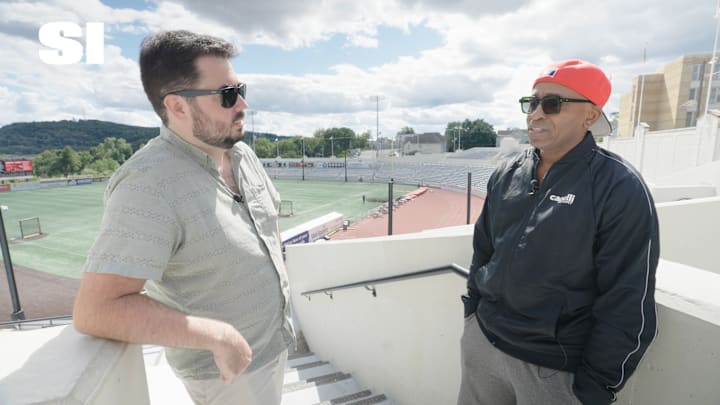
Here with Bayle Adolfo Wilson, co-developer of this here Hinchcliffe Stadium, historic stadium in Patterson, New Jersey.
What makes it such a special place?
Hinchcliffe Stadium is important because it is a national historic landmark.
is one of the few remaining stadiums in the country where Negro League baseball players played.
Uh, Josh Gibson, Monte Irvin, and Palace's own Larry Dolby played here.
So for the cultural aspect is, uh, that historic, but also it was built in 1932.
So it's also, uh, historic in terms of architecture and design.
What was Patterson like in the 1930s when the stadium was built?
I think Patterson's always been a working class town and also always a strong immigrant community.
Patterson, you know, it, it, like I said, it's always been a working class city, right?
Lots of factories and, and things like that.
And really suffered heavily from deindustrialization, right, and the city fell on hard times.
The stadium in turn fell on hard times, and it was shuttered for what, over 25 years.
Uh, so what, what led to the stadium being closed and, and how was it resurrected?
Well, the stadium was closed in 1996, 1997 because a sinkhole developed in the field, uh, and I think it cost $4 million to fix the sinkhole and $4.8 million to tear the stadium down, and neither was done and it was left fallow for 204.
For years it was a fell into hard times.
It was a scene, I think, in The Walking Dead.
It was sort of a, uh, used as a post-apocalyptic space because the because nature had taken over.
So there were trees growing up.
Uh, there was, it was really poor.
There were some homeless families living here and so there was really, it had become relatively tragic.
I had been in Newark for a long time, but I grew up here.
I grew up in Patterson, and so some friends of mine and elected officials asked me if I was able to come back to Patterson and see if I could help revitalize the station, so I assumed.
For the team and we started the restoration of the stadium.
That motivation to, to restore the stadium, was it, you know, there's probably multiple motivations there, right?
Part of it is giving the city something, you know, that, that this is now used by by local schools, right, but also preserving the, uh, the Negro League history, right?
I, I, so I grew up in Patterson and we were always searching for places to play and, um, we would go to the neighboring towns and they would chase us out of the towns and the police would escort us out of the town if we want to play in the neighboring towns so that was part of my experience in Patterson.
The other part was that Patterson does have this history, so it was really the center of culture and.
Um, activity in Patterson.
So when it was closed, it really felt like there was a hole in the town and a hole in the space.
You, you mentioned Larry Doby.
Larry Doby didn't just play, you know, he, you know, legend has it he played here and, you know, it's a fact.
He had his, uh, first professional tryout here with the Newark Eagles, right?
But he also played high school ball here, right?
High school, uh, baseball and football, and, you know, Doby, I think, is an overlooked figure in American sports, right, because Jackie Robinson was the first black player in the majors, but Doby, you know, integrating the American League was a very.
Significant accomplishment at that time and, you know, the National League and the American League were quite separate, so for him to integrate the, the American League, a really big deal.
And so for this to, to stand as it is today, right, you know, I don't know where Jackie Robinson played high school ball, but I doubt his high school stadium is still standing.
And so you get to come here and see this is where this legend of the game, where, where he really began his career.
Well, I think it's really important that Larry Doby played here because, and, and for, for him, but also for future generations, Larry Doby's in high school when the New York Black Yankees and the.
New York Cubans and the New York Eagles are playing here, so he gets to leave high school and walk across town and go to a a professional baseball game in his town in his hometown, and so it's important when you're dreaming about what you can do to be able to see someone in your community do what you're what you wanna do.
This is a place now that you know people from Patterson could come here and see professionals.
Sports, right?
I think that's what makes it the jackals being here.
I think that's a major factor in what makes this, you know, it really elevates the stadium.
It'd be one thing if you, if this place had been renovated and restored and it was only just for high school ball, but having the jackals here, it really increases the, the likelihood that a fan might come from somewhere else and say, hey, I could watch professional baseball in this historic stadium .
I think it's a really great thing that the jackals were able to, to move down here and, uh, and now occupy this space.
Yeah, um, when we're thinking about the operation of the stadium.
Um, in the 1930s, professional teams played here, so whether it was football or, um , baseball, and now soon you're gonna be adding professional soccer.
What can you tell us about that?
Yeah, so, uh, we acquired the, uh, Cosmos.
We will be playing in the United Soccer League, League One.
We start in March.
It's the historic franchise that Pele and Beckenbauer, Giorgio played on.
It's really exciting.
One of the things we made.
Sure to do was design it for multiple sports so we designed it for, uh, baseball and in particular for, um, soccer and so we made that decision because we wanted to capture the demographics of Patterson now and the sports that are relevant in Patterson now and so we didn't, we didn't just wanna renovate it, uh, for as a as a as a monument or, uh, we wanted to make sure that it was used.
By its current population, you know, we have a museum for that.
You know, we have a museum that sort of showcases the history and you can sort of get that glimpse and get that history lesson by going to the youth museum, but we wanted the stadium proper to be active and engaged and really an experience for young people to come to Patterson and for Pattersonians to come here and see, um, high school sports as well as professional sports, you know, a lot of people out there watching.
They might not have heard of the stadium.
They might even heard of Patterson, right?
But there's Watkins here.
Wow, that sounds like a great.
What's, what's your sell on why somebody should make a trip, make it a priority to come, to come see Patterson and come see Hinchcliff?
I might, I think that they're coming to see Patterson and come to see Hinchcliff, it should be a priority because on one level, uh, the falls is right next door, and it's a natural wonder, you know, we have, uh, the 2nd highest waterfalls, um, east of the Mississippi behind the Niagara Falls within hundreds of feet of the stadium.
And we have the youth museum, which is a tribute, a testimony to all the Negro League baseball players who had to endure in, in, in one respect, the stadium, the museum is really a civil rights, social justice museum.
It talks about how these players had to endure Jim Crow and segregation who wanted to show that they were as good at and better than, um, other players.
So that part is important.
But it's also this sort of entertainment that happens when you're at one of these games.
So whether it's a.
A friendly a soccer game or uh a baseball game or a football game or a high school football game or high school baseball game, there's a level of entertainment and excitement that they get.
So you can come to Patterson and get something to eat, go to walk, look at the falls, go to the museum and watch the game.
So it's a good day trip.
%20%20--%3E%0A%3Csvg%20version%3D%221.1%22%20id%3D%22Layer_1%22%20xmlns%3D%22http%3A%2F%2Fwww.w3.org%2F2000%2Fsvg%22%20xmlns%3Axlink%3D%22http%3A%2F%2Fwww.w3.org%2F1999%2Fxlink%22%20x%3D%220px%22%20y%3D%220px%22%0A%09%20width%3D%2239px%22%20height%3D%2240px%22%20viewBox%3D%220%200%2039%2040%22%20enable-background%3D%22new%200%200%2039%2040%22%20xml%3Aspace%3D%22preserve%22%3E%0A%3Cpath%20fill%3D%22%23FFFFFF%22%20d%3D%22M38.5%2C7H28.2v26h10.3V7z%22%2F%3E%0A%3Cpath%20fill-rule%3D%22evenodd%22%20clip-rule%3D%22evenodd%22%20fill%3D%22%23FFFFFF%22%20d%3D%22M26.1%2C25.5c0%2C5.8-4.1%2C7.5-12.9%2C7.5C3.9%2C33%2C0%2C31.2%2C0%2C25.2v-1.1h11.6%0A%09v2.4c0%2C0.7%2C0.1%2C1.4%2C1.2%2C1.4c1%2C0%2C1.2-0.4%2C1.2-1.3v-0.9c0-1.6-0.9-1.6-3.5-2.2C2.2%2C21.7%2C0%2C19.7%2C0%2C15.3v-0.9C0%2C9.3%2C5.5%2C7%2C12.9%2C7%0A%09c10.2%2C0%2C12.8%2C2.6%2C12.8%2C7.4v1.8h-11v-2.9c0-0.6-0.4-1.1-1.2-1.1c-0.6%2C0-1.2%2C0.4-1.2%2C1.1v0.9c0%2C1.5%2C0.9%2C2%2C3.3%2C2.5%0A%09c8%2C1.6%2C10.5%2C3.3%2C10.5%2C7.5V25.5z%22%2F%3E%0A%3C%2Fsvg%3E%0A)