
Payton Pritchard's Celtics Slump Isn't What It Looks Like, and the Numbers Show Why
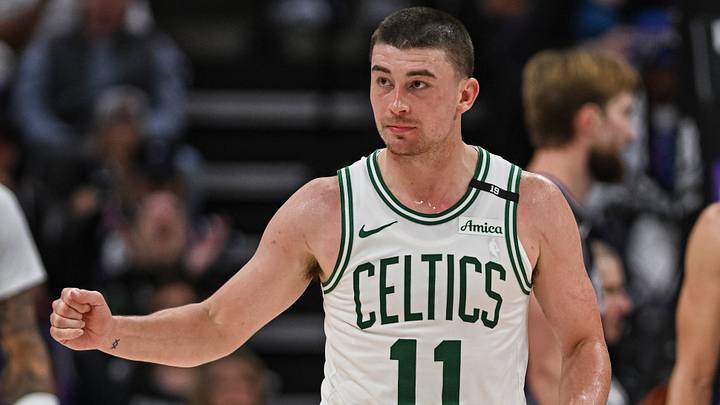
There was a lot of discussion before the season about what Payton Pritchard could become for the Boston Celtics. He got a two-year, $44.2 million contract extension rewarding him for becoming an integral part of the Celtics’ success.
Instead of taking a big step forward, like some people had hoped, he’s taken a little step backward. He’s currently playing about four fewer minutes per game than last season, so if we standardize his numbers, we’ll get a sense of how big an issue this is.
His per-36 numbers this season are not THAT far off from last year. His scoring has dropped from 18.9 to 16.5 points per 36, which is actually not so bad considering his overall shooting has dropped from 46.4% to 38.4% and his three-point shooting has dipped from 37.7% to 33.6%.
He’s getting fewer shots, but his per-36 rebounding and steal numbers are right in line with last year’s. His assists have dipped a bit (5.8 to 5.0 per 36) and his turnovers have ticked up slightly (1.5 to 1.8), but nothing that signals a real problem.
The question, then, becomes simple: What’s wrong with his shooting?
He’s Making Hard Shots and Missing Easy Ones
Normally, Pritchard hurts teams by knocking down open catch-and-shoot threes. So far this season, it’s flipped: the easy catch-and-shoot threes aren’t dropping, while his tough pull-up threes off the dribble are going in at the best rate in three years.
Here’s a look at his field goal percentage breakdown, according to Synergy Sports:
Shot Type | 2024-25 | 2025-26 | 2026-27 |
|---|---|---|---|
Wide-Open Catch & Shoot 3s | 51.0% | 42.6% | 27.3% |
All Catch & Shoot 3s | 44.4% | 40.6% | 27.5% |
Pull-Up 3s Off the Dribble | 34.9% | 32.6% | 42.3% |
So he’s crushing pull-up threes and missing the catch-and-shoot ones. Only hitting 27.3% of wide-open catch-and-shoot threes is a flat-out aberration.
Because catch-and-shoot threes aren’t falling, his spot-up efficiency has dropped to 0.780 points per possession (down from 1.258 in 2024-25 and 1.182 in 2025-26). He’s also only hitting 16.7% of his threes in transition (4-24, compared to 39.5% last year). In the half court, he’s actually shooting 37.9% from three (39-103), a little better than last season.
A shooter who hits wide-open threes at 51.0% and 42.6% over two full seasons doesn’t just forget how to shoot. Once those open shots start falling again, a big part of this slump disappears.
His Role Is Harder Than It Was in 2024-25
Two seasons ago, Pritchard spent more time spotting up (32.4% of his plays) and playing off other creators. Now he has the ball in his hands more and has to create more on his own. Catch-and-shoot looks have fallen from 45% of his shots to about a third, while dribble jumpers have climbed from 35% to 47%.
- More on-ball creation: Running pick-and-rolls (25.4%) and going one-on-one (12.3%) make up 37.7% of his plays this season, up from 25.8% in 2024-25.
- More late-clock shots: He’s taking plenty of bailout shots with four seconds or less on the shot clock (22.6% of his plays), and he’s scoring just 0.673 points per possession on them, down from 0.925 last season.
- Still setting up teammates: Even when his shot isn't falling, his passing keeps Boston’s offense moving. He’s at 1.310 points per possession overall when you include assists, and 1.234 when kicking out to spot-up shooters out of pick-and-rolls.
- More handoffs: They’ve nearly tripled since 2024-25 (3.4% to 9.2% of his plays), and he’s at 1.41 points per possession on stationary handoffs.
Doing more heavy lifting on the ball naturally changes how his efficiency looks compared to when he was mostly catching and shooting.
Where He’s Actually Better
Even with the dip in overall efficiency, Pritchard has gotten noticeably better in a few key spots:
- One-on-one scoring: He’s up to 1.188 points per possession in isolation (from 0.889 in 2024-25 and 1.092 last year), knocking down 60.0% of his iso threes (6-10).
- Pick-and-roll scoring: He’s up to 1.015 points per possession as a pick-and-roll ball handler (after 0.965 last year), and he’s been great when rejecting screens (1.500 points per possession on 12 plays).
- Short pull-ups and off-screen plays: His short jumper inside 17 feet is still a reliable weapon (51.3%), and he’s scoring 1.200 points per possession coming off screens.
A Few Things to Clean Up
If there are real habits to sharpen beyond cold open threes, they’re right here:
Area | 2024-25 | 2025-26 | 2026-27 | What to watch |
|---|---|---|---|---|
Layups | 70.3% | 63.1% | 58.1% | Fewer rim looks and tougher finishes |
Long twos | 33.3% | 31.4% | 14.3% | Low-value shot to keep in check |
Long twos have more than doubled as a share of his shots (2.5% to 6.5%) while he’s 2-14 on them, and trips to the rim have dropped to 14.4% of his attempts.
The Bottom Line
Pritchard’s job is harder than it was two years ago, but it hasn’t changed much since last season, which is why this slump stands out. His rim finishing and long twos need work, and his easy catch-and-shoot threes haven’t been falling. Finishing at the rim and hitting catch-and-shoot threes are places he thrived in the past, and once those wide-open shots start going in again, his numbers will look much closer to what Celtics fans are used to seeing.
 Add us as a preferred source on Google

John Karalis is a 20-year veteran of Celtics coverage and was nominated for NSMA's Massachusetts Sportswriter of the Year in 2019. He has hosted the Locked On Celtics podcast since 2016 and has written two books about the Celtics. John was born and raised in Pawtucket, RI. He graduated from Shea High School in Pawtucket, where he played football, soccer, baseball, and basketball and was captain of the baseball and basketball teams. John graduated from Emerson College in Boston with a Bachelor of Science degree in Broadcast Journalism and was a member of their Gold Key Honor Society. He was a four-year starter and two-year captain of the Men’s Basketball team, and remains one of the school's top all-time scorers, and Emerson's all-time leading rebounder. He is also the first Emerson College player to play professional basketball (Greece). John started his career in television, producing and creating shows since 1997. He spent nine years at WBZ, launching two different news and lifestyle shows before ascending to Executive Producer and Managing Editor. He then went to New York, where he was a producer and reporter until 2018. John is one of Boston’s original Celtics bloggers, creating RedsArmy.com in 2006. In 2018, John joined the Celtics beat full-time for MassLive.com and then went to Boston Sports Journal in 2021, where he covered the Celtics for five years. He has hosted the Locked On Celtics podcast since 2016, and it currently ranks as the #1 Boston Celtics podcast on iTunes and Spotify rankings. He is also one of the co-hosts of the Locked on NBA podcast.
Follow John_Karalis