%20%20--%3E%0A%3Csvg%20version%3D%221.1%22%20id%3D%22Layer_1%22%20xmlns%3D%22http%3A%2F%2Fwww.w3.org%2F2000%2Fsvg%22%20xmlns%3Axlink%3D%22http%3A%2F%2Fwww.w3.org%2F1999%2Fxlink%22%20x%3D%220px%22%20y%3D%220px%22%0A%09%20width%3D%2239px%22%20height%3D%2240px%22%20viewBox%3D%220%200%2039%2040%22%20enable-background%3D%22new%200%200%2039%2040%22%20xml%3Aspace%3D%22preserve%22%3E%0A%3Cpath%20fill%3D%22%23FFFFFF%22%20d%3D%22M38.5%2C7H28.2v26h10.3V7z%22%2F%3E%0A%3Cpath%20fill-rule%3D%22evenodd%22%20clip-rule%3D%22evenodd%22%20fill%3D%22%23FFFFFF%22%20d%3D%22M26.1%2C25.5c0%2C5.8-4.1%2C7.5-12.9%2C7.5C3.9%2C33%2C0%2C31.2%2C0%2C25.2v-1.1h11.6%0A%09v2.4c0%2C0.7%2C0.1%2C1.4%2C1.2%2C1.4c1%2C0%2C1.2-0.4%2C1.2-1.3v-0.9c0-1.6-0.9-1.6-3.5-2.2C2.2%2C21.7%2C0%2C19.7%2C0%2C15.3v-0.9C0%2C9.3%2C5.5%2C7%2C12.9%2C7%0A%09c10.2%2C0%2C12.8%2C2.6%2C12.8%2C7.4v1.8h-11v-2.9c0-0.6-0.4-1.1-1.2-1.1c-0.6%2C0-1.2%2C0.4-1.2%2C1.1v0.9c0%2C1.5%2C0.9%2C2%2C3.3%2C2.5%0A%09c8%2C1.6%2C10.5%2C3.3%2C10.5%2C7.5V25.5z%22%2F%3E%0A%3C%2Fsvg%3E%0A)
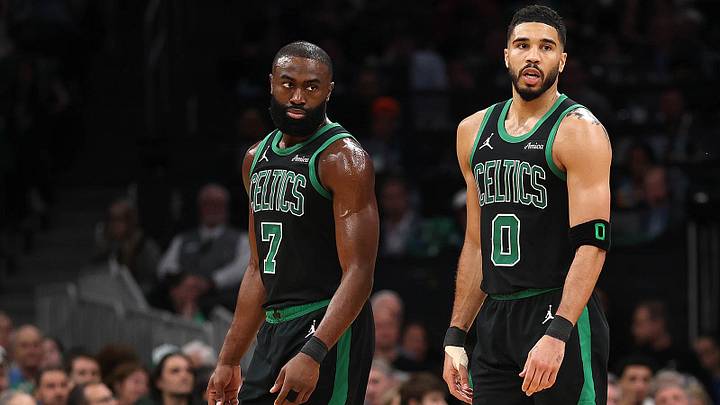
How the Complicated Jayson Tatum-Jaylen Brown Relationship Got to This Point
In this story:
In the summer of 2022, the Celtics had a problem. Weeks removed from an NBA Finals run, the internet was abuzz with a fresh round of Jaylen Brown trade chatter. Boston’s (alleged) target: Kevin Durant. Brown was incensed, sources familiar with the situation said. Over the years, Brown had grown accustomed to trade rumors. For Anthony Davis, for Kawhi Leonard. Hell, on draft night in 2016, a swath of fans wanted the team to trade his rights for Jimmy Butler.
Still, after helping the Celtics to their first Finals appearance in more than a decade, Brown thought his status was secure. The reports bothered him, sources said, so much so that a contingent from the team, led by president of basketball operations Brad Stevens and then head coach Ime Udoka, flew to Los Angeles to meet with him. “You had to address it,” Udoka told Sports Illustrated in 2022, weeks before he was suspended by the team. “When guys like Kevin Durant's name come up, of course our main players, their names are going to come up as well.”
Last July, Boston officially ended the Brown era, shipping the All-NBA forward to Philadelphia for a surprisingly, or perhaps shockingly, light package (Paul George, two first-round picks). Succeeding with Brown and Jayson Tatum had become “more challenging,” Stevens explained, citing the duo's high usage rate and high salaries. There was no animosity, Stevens said. This was a basketball decision, one he insisted Tatum had nothing to do with.
Brown, obviously, believes otherwise. Last week, a clip from a Tatum-produced documentary circulated on social media. In the video, Tatum said he was caught off guard by Boston’s decision to trade Brown. In the comments, Brown responded with a blue hat, the symbol for “cap,” which, for the Gen X’ers out there, is calling something a lie.
Tatum immediately attempted to defuse the situation. “This ain’t no f---ing Shaq and Kobe,” said Tatum, referencing the famously feuding ex-Lakers teammates. Brown said there was no beef “but it might be a little lamb chops and some gravy.” He repeatedly praised Tatum’s PR team, adding that Tatum “should stay ready at all times.”
The drama between the former teammates quickly became the topic du jour. “What does that mean?” asked Draymond Green on his eponymous podcast. “When we play against you, I'm going at your neck when I see you in the streets? What's up? I don't know what that means.” Added Blake Griffin, who played in Boston for one season, “I just feel a little bit disappointed … both of them should keep into perspective what they've accomplished and not be shortsighted about what has happened.” Brian Scalabrine, the longtime local TV analyst, poured gasoline on the situation when he claimed that Brown had asked to be traded. Scalabrine later walked it back (a source close to Brown denied he ever asked for a trade) but declared that Brown “wants to be the victim in all of this, and this is the way he’s doing it.”
Understanding the Tatum-Brown dynamic isn’t all that complicated. Both were college stars. Both were high lottery picks. Both entered the NBA eager to prove they belonged among the NBA’s top wings. Early in their careers, a former Celtics assistant grumbled to me that January was always the most difficult month to coach them. Why? Because both Tatum and Brown went numbers-hunting for All-Star consideration.
Quickly, though, Tatum’s face-of-the-franchise status became apparent. Teams calling about Tatum’s availability were told to kick rocks. And while Boston’s willingness to part with Brown was often overstated—of course the team would be interested in a prime Leonard or Davis—to get something good you had to give something. And Brown was usually it.
The relationship between the two was … complicated. Were they friends? No. They were friendly during most of the nine seasons they played together. But Tatum is your more typical 20-something, who happened to be raising a young son. Brown is more outspoken, eager to tackle complicated issues like systematic racism and economic inequality. In Boston, Brown started the Boston XChange, an initiative that aimed to generate $5 billion in additional wealth for historically marginalized communities in the area. Personality-wise, they could not be more different.
So why didn’t some of these issues surface earlier? “Winning cures all,” said Green. “When you're winning, it can cure the nastiest of diseases.” Indeed. And Boston won a lot. The Celtics made the playoffs every season of the Tatum-Brown era. They made five conference finals. Two NBA Finals. And they won a championship, raising banner 18 to the TD Garden rafters. When you are making deep playoff runs, issues are often overlooked.
In the last year, the fissures became more visible. Last January, Brown was named to the All-Star team. On the same day, Tatum, months into his recovery from a torn Achilles, conducted a 45-minute workout in front of reporters in Detroit. Tatum’s progress, understandably, became the story. That irked Brown, sources familiar with the situation told SI, who felt it overshadowed his accomplishment.
The root of Brown’s ire, and why he has gone so public with it, is still a bit of a mystery. Does Brown wish Boston chose him over Tatum? Surely after nearly a decade with the organization he knew how that discussion was going to go, even after Brown led the team to a 56-win season. Does he wish Tatum backed him more? It is a little pollyannish to believe that Tatum was unaware of what was going on with Brown, especially with the trade talks spilling over so publicly. And superstars can have outsized influence on basketball decisions. Is Brown miffed that another team, like Milwaukee, didn’t step up and make him the face of the franchise? There’s the possibility of that, too.
Both Tatum and Brown continue to contribute to winning. Tatum has scored 36-plus in two of Boston’s four games. He had 40, including the game winner, in a thrilling overtime win over Brooklyn on Tuesday. In Philadelphia, Brown is averaging 21 points per game while connecting on 42.1% of his threes. Tatum punted on a Brown-related question on Tuesday (“I’ve said my piece,” Tatum said) but this new rivalry will rekindle Nov. 10, when Philadelphia and Boston will meet for the first time. Until then, well, stay ready.
PODCAST 🎧: Listen to SI’s NBA podcast, Open Floor, below or on Apple and Spotify. Watch the show on SI’s YouTube channel.
 Add us as a preferred source on Google

Chris Mannix is a senior writer at Sports Illustrated covering the NBA and boxing beats. He joined the SI staff in 2003 following his graduation from Boston College. Mannix is the host of SI’s “Open Floor” podcast and serves as a ringside analyst and reporter for DAZN Boxing. He is also a frequent contributor to NBC Sports Boston as an NBA analyst. A nominee for National Sportswriter of the Year in 2022, Mannix has won writing awards from the Boxing Writers Association of America and the Pro Basketball Writers Association, and is a longtime member of both organizations.
Follow sichrismannix