%20%20--%3E%0A%3Csvg%20version%3D%221.1%22%20id%3D%22Layer_1%22%20xmlns%3D%22http%3A%2F%2Fwww.w3.org%2F2000%2Fsvg%22%20xmlns%3Axlink%3D%22http%3A%2F%2Fwww.w3.org%2F1999%2Fxlink%22%20x%3D%220px%22%20y%3D%220px%22%0A%09%20width%3D%2239px%22%20height%3D%2240px%22%20viewBox%3D%220%200%2039%2040%22%20enable-background%3D%22new%200%200%2039%2040%22%20xml%3Aspace%3D%22preserve%22%3E%0A%3Cpath%20fill%3D%22%23FFFFFF%22%20d%3D%22M38.5%2C7H28.2v26h10.3V7z%22%2F%3E%0A%3Cpath%20fill-rule%3D%22evenodd%22%20clip-rule%3D%22evenodd%22%20fill%3D%22%23FFFFFF%22%20d%3D%22M26.1%2C25.5c0%2C5.8-4.1%2C7.5-12.9%2C7.5C3.9%2C33%2C0%2C31.2%2C0%2C25.2v-1.1h11.6%0A%09v2.4c0%2C0.7%2C0.1%2C1.4%2C1.2%2C1.4c1%2C0%2C1.2-0.4%2C1.2-1.3v-0.9c0-1.6-0.9-1.6-3.5-2.2C2.2%2C21.7%2C0%2C19.7%2C0%2C15.3v-0.9C0%2C9.3%2C5.5%2C7%2C12.9%2C7%0A%09c10.2%2C0%2C12.8%2C2.6%2C12.8%2C7.4v1.8h-11v-2.9c0-0.6-0.4-1.1-1.2-1.1c-0.6%2C0-1.2%2C0.4-1.2%2C1.1v0.9c0%2C1.5%2C0.9%2C2%2C3.3%2C2.5%0A%09c8%2C1.6%2C10.5%2C3.3%2C10.5%2C7.5V25.5z%22%2F%3E%0A%3C%2Fsvg%3E%0A)
Why the Lakers Actually Will Be Better Off Without LeBron James This Season
In this story:
The Lakers will take the court this season with one rather famous name missing from their starting lineup. One that had been at the center of the franchise since Kevin Durant was a Warrior and nobody had ever heard of COVID.
That name, of course, is LeBron James. The King played in Los Angeles for eight NBA seasons—the longest single stretch of time he spent with any one team in his career. But this offseason he departed, heading east to Philadelphia in search of one last title run at the age of 41 to cap off an incredible career. He leaves behind a strong legacy in purple and gold, with a banner hanging in the rafters after saving the organization from its floundering state of the late 2010s.
James is no longer the most dominant basketball player on the planet, but he did put up All-Star numbers last season. Usually when teams lose that kind of player, they are worse off. Sometimes significantly so. It’s harder in the NBA than in other professional sports to fill the roster holes left by an elite player choosing to leave town, particularly when they walk in free agency and don’t net anything in return (as in this case with James).
But these Lakers will prove to be an exception.
It isn’t some bold claim to believe they can withstand the loss of James without much trouble. He was their second-best player last year (and third, on some nights) due to the presence of Luka Dončić. The Slovenian superstar averaged 33.5 points per game last year and was making a serious MVP case before a hamstring injury kept him under the 65-game minimum, as well as out of L.A.’s playoff run entirely. If the 27-year-old can follow up that tremendous campaign with another in the same ballpark, the Lakers should match or exceed their 53-win mark from last season and expect at least one playoff series.
That will remain true as long as Dončić remains healthy. But can the Lakers be better than last year’s team, even after losing LeBron freaking James?
Yes, they can. And the reason has nothing to do with talent—but everything to do with fit.
Lakers replaced LeBron with players who complement Dončić
The thesis of any argument that the Lakers will be better without James this season is his skill set drastically overlapping with that of Dončić’s at this point in the 41-year-old’s career. They both need the ball in their hands to maximize their impacts, aren’t terribly active off the ball and offer little defensively. At a more granular level, there are important differences, like Dončić’s elite shot-making beyond the arc, but in general their preferred methods of contributing to winning are nearly identical.
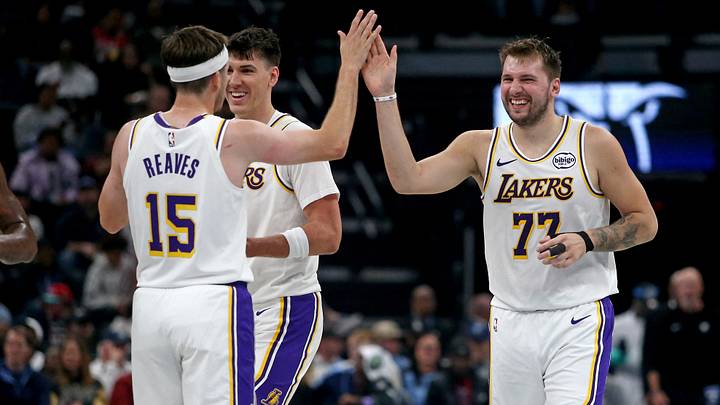
Which isn’t a problem, per se, hence L.A.’s 50-win season. But having two guys who are great at the same thing doesn’t work as well as it once did. It really doesn’t work well with three guys of the same ilk, as the Lakers really had last year when taking Austin Reaves into account. In the modern NBA, complementary basketball is the name of the game. It’s the foundational concept that many teams operate upon nowadays; on the other coast the Celtics traded away Jaylen Brown for the same basic reason. The Knicks just won a title by building out the most complementary team we’ve seen in ages. Talent still rules supreme as the deciding factor most nights, but the skills of that talent have to resemble a Venn Diagram to compete for championships. Last year, the Lakers had something closer to a circle.
The front office appeared to recognize that. They gave Reaves a big new deal but otherwise used the money James earned last year to add three players who will emphasize what Dončić does best while covering up for his weak spots.
The process began with the biggest swing of the bunch—a sign-and-trade for Walker Kessler that cost the Lakers four first-round picks (two unprotected selections and two swaps). The new deal he signed with L.A. will pay the 24-year-old center $130 million over four years and should result in the most easy-to-see impact. Kessler is a huge upgrade over last year’s starting center, Deandre Ayton, as both a rim protector and consistent lob threat. In his last healthy season with the Jazz, Kessler ranked fourth in the league in blocks while shooting over 70% in the restricted area. It’s not a deal without risk given he missed all but four games last year with a shoulder injury, but he’s a top-10 center in the NBA when everything is going well.
General manager Rob Pelinka followed up with two smaller splashes in free agency who figure to be nearly as impactful, signing Quentin Grimes and Sandro Mamukelashvili. Grimes is another archetypical Dončić teammate who can guard multiple positions and hit open three-pointers. Mamukelashvili is more of an offensive Swiss Army knife at power forward who gives coach JJ Redick a much greater variety of lineup combinations to work with. Most importantly, he’s a good shooter with enough size to offer some resistance on the defensive end.
All three players are talent upgrades over last year’s options, even if they cannot replace James. But above all, L.A. acquired them because they’re all notably more dangerous playing alongside Dončić while making sure his weak points don’t sink the whole ship. LeBron, for all his greatness, couldn’t say the same last year.
Will it lead to a better team?
Yes, it will.
Last year’s Lakers team felt like it was good in spite of the roster; the aggregate talent overcame clunky fits and a top-loaded lineup. James, Dončić and Reaves took some time to mesh but eventually did and their lineup numbers were strong by season’s end. Their redundant skill sets actually wound up advantageous with the three all taking turns missing long stretches of games due to injury. But the final numbers reflect a middling team statistically (the Lakers ranked 14th in net rating by season’s end) who bludgeoned opponents over the head with the simple mantra of “our best players are better than yours.” To win games, that’s fine. To win titles? The team needs to be better, not just the talent.
The Lakers should have both this season. Dončić and Reaves figure to be two of the three most talented players on the court most nights, and now they’re flanked by role players who can punish defenses to the fullest extent based on how they cover the superstars. James learned how to do that eventually last year but it’s far from his natural role, whereas all these new additions have built careers off doing so.
Kessler is exactly what Dončić needs at the five: a big man who will clean up his defensive mistakes and constantly loom around the rim for alley-oop opportunities. It forces opponents into the impossible choice of leaving Dončić open for a layup or giving up the lob. And if they manage to toe the line by covering both options, Grimes or Mamukelashvili are waiting on the wing ready to shoot. If none of that works? Here comes Reaves to force the defense into the same conundrum, and all it takes is one mistake for Los Angeles to take advantage.
Last year, the order of operations was pretty simple. If Dončić couldn’t break down the defense, Reaves tried. If he couldn’t do it, LeBron tried. And that was it. It was extremely hard to stop because they’re all such great scorers but it didn’t require an advanced scheme to cover. And if all Los Angeles did was subtract James from the equation, there’s no doubt the team would be worse.
But they did not. Instead they added talent who, while not as singularly great as James, offer different ways to win each possession. That’s what the best NBA teams aim for: a roster capable of offering a different look every time down the court so opponents are always on the back foot.
That’s a granular view of it. From a thousand feet up, the new-look Lakers have a much higher floor than last year’s squad, and the ceiling remains the same because Dončić is one of the best players in the world who gives his team a championship ceiling every season. Is it enough to hang with the Thunder, Spurs or Knicks? Maybe not. But they're much closer to that level now than when L.A. got swept by OKC back in May.
James is gone and the way he can make things happen on the court will be missed. But the Lakers have filled his hole on the roster with smart moves who will make the team better next season and offer more than a puncher’s chance of knocking off the big dogs of the West.
Listen to SI’s NBA podcast, Open Floor, below or on Apple and Spotify. Watch the show on SI’s YouTube channel.
 Add us as a preferred source on Google
Liam McKeone is a senior news writer for the NBA team at Sports Illustrated. He has been in the industry covering the NBA and other sports as a content creator starting in 2017. Prior to joining SI, McKeone worked for NBC Sports Boston and The Big Lead. In addition to his work as a writer, he has hosted the Press Pass Podcast covering sports media and The Big Stream covering pop culture. A graduate of Fordham University, he is always up for a good debate and enjoys loudly arguing about sports, rap music, books and video games. McKeone has been a member of the National Sports Media Association since 2020.
Follow liam_mckeone