%20%20--%3E%0A%3Csvg%20version%3D%221.1%22%20id%3D%22Layer_1%22%20xmlns%3D%22http%3A%2F%2Fwww.w3.org%2F2000%2Fsvg%22%20xmlns%3Axlink%3D%22http%3A%2F%2Fwww.w3.org%2F1999%2Fxlink%22%20x%3D%220px%22%20y%3D%220px%22%0A%09%20width%3D%2239px%22%20height%3D%2240px%22%20viewBox%3D%220%200%2039%2040%22%20enable-background%3D%22new%200%200%2039%2040%22%20xml%3Aspace%3D%22preserve%22%3E%0A%3Cpath%20fill%3D%22%23FFFFFF%22%20d%3D%22M38.5%2C7H28.2v26h10.3V7z%22%2F%3E%0A%3Cpath%20fill-rule%3D%22evenodd%22%20clip-rule%3D%22evenodd%22%20fill%3D%22%23FFFFFF%22%20d%3D%22M26.1%2C25.5c0%2C5.8-4.1%2C7.5-12.9%2C7.5C3.9%2C33%2C0%2C31.2%2C0%2C25.2v-1.1h11.6%0A%09v2.4c0%2C0.7%2C0.1%2C1.4%2C1.2%2C1.4c1%2C0%2C1.2-0.4%2C1.2-1.3v-0.9c0-1.6-0.9-1.6-3.5-2.2C2.2%2C21.7%2C0%2C19.7%2C0%2C15.3v-0.9C0%2C9.3%2C5.5%2C7%2C12.9%2C7%0A%09c10.2%2C0%2C12.8%2C2.6%2C12.8%2C7.4v1.8h-11v-2.9c0-0.6-0.4-1.1-1.2-1.1c-0.6%2C0-1.2%2C0.4-1.2%2C1.1v0.9c0%2C1.5%2C0.9%2C2%2C3.3%2C2.5%0A%09c8%2C1.6%2C10.5%2C3.3%2C10.5%2C7.5V25.5z%22%2F%3E%0A%3C%2Fsvg%3E%0A)
Sean Sweeney Q&A: What the Magic’s New Coach Loves About His Roster and How Orlando Can Improve
In this story:
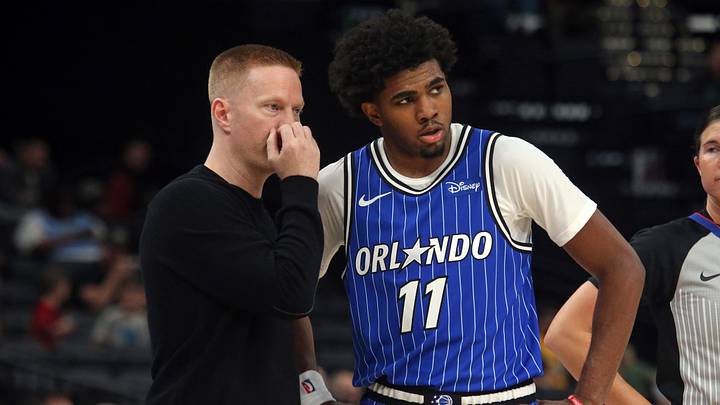
Last spring, Sean Sweeney was a coach in demand. A San Antonio assistant, who was coming off a successful stint on Jason Kidd’s staff in Dallas, had just helped steer the Spurs to its first Finals appearance since the Tim Duncan Era. Suddenly, teams were interested in moving him over one seat on the bench.
Sweeney, though, was determined to be selective. “I was fortunate with how good things were going in San Antonio,” Sweeney said on the Open Floor podcast. He made a short list of jobs he would jump at if one opened up. Orlando was on it. The Magic had John Hammond, who Sweeney worked with in Milwaukee, in the front office. They had Arnie Kander, who Sweeney worked alongside in Chicago, running its medical staff. And they had a roster that, from afar, Sweeney admired.
“The players and the talent was something that really stood out to me,” says Sweeney. “When Orlando opened, this was the job that I wanted to go after.”
Sweeney sat down with Open Floor to discuss his journey to the NBA, connecting with Kidd, his two trips to the Finals, last season’s heartbreak, his expectations for the Magic and more. Read on, and listen to the Open Floor podcast here, here and here.
This interview has been lightly edited for clarity.
Sports Illustrated: So you have been an assistant with the Nets, Pistons, Mavericks and Spurs. But it all began at Anoka Ramsey Community College. First off, where is Anoka Ramsey Community College and how did you get your start there?
Sean Sweeney: Anoka Ramsey Community College is in the Twin Cities, just north of Minneapolis, up in Minnesota. How did I wind up there? I needed a job when I finished college and that was the only one that would take me. And yeah, it was a fun time, fun time. Not a lot of wins, but a fun time.
SI: You played a little college ball. Was coaching always a dream?
SS: When I was playing in high school, I always knew that I wanted to be in basketball in some way, shape or form. And when the shape and form was not going to be as a player, I knew I wanted to get into coaching. So I started immediately. Anoka Ramsey, went there right away. Actually, my high school coach was the head coach there, a guy named Bill McKee. And so he, right when I finished playing, offered me a job and I went there. And then from there went to University of Evansville and bounced around for a while until I got to the New Jersey Nets.
SI: Always wanted to get to the pros?
SS: When I was at Evansville, I worked for a guy named Marty Simmons, and it was a really good start for me with how much he taught me. But even then, I always talked to him about if I ever get a chance to coach in the NBA, that's what I wanted to do. The competition standpoint stood out to me, the highest level of players, the highest level of coaches, and that was always something that was in the back of my mind or a goal or whatever you want to call it. And so very fortunate to be here now.
SI: You started with the Nets working for Avery Johnson. After that, Jason Kidd, who you developed a close relationship with. Did the two of you click right away?
SS: We clicked pretty early. Jason, with me, he did a really good job of trying to help me grow just as a young coach. And I owe him a huge debt of gratitude and a lot for what he did for me in my career. I owe him a lot. And from a coaching standpoint, he taught me a ton on how to operate, how to coach great players, how to see the game, creativity.
SI: What did he teach you about how to coach great players?
SS: What he was really good about was he was a great listener, one. And the other thing he really did a good job of was he made sure that everybody knew that you're here to service the players. Your job is to help the players, regardless of who it is, be as efficient and as impactful as you can possibly be. And so as coaches, your job is to serve. And I think the thing about J, and it was the same way he was as a player, he leads as a guide, not as a hero. He's a servant to leadership from that standpoint, not only as a player and how he set up his teammates, but as a head coach, he did the same thing. He didn't take credit for anything and really wanted to see guys do well.
SI: Jason was a Hall of Fame player. He had instant credibility. How did you earn it? Because you have had great relationships with everyone from Giannis Antetokounmpo to Luka Dončić to Victor Wembanyama.
SS: As a coach, our job is to be direct communicators. Our job is to know what we're talking about, to be really prepared, to be really consistent. And then at the end of the day, our leadership is intention-based and our attention is active because our job is to help the players get as much as they can out of themselves and ultimately the team. And from our standpoint, from my standpoint, we want them to have individual success as well as team success. And the best job they do with their individual execution means the best job we're going to do with our team execution. And so we try to really put an emphasis on that each and every day.
SI: When you got to Milwaukee, Giannis was this stringy kid with a ton of potential. Could you tell right away that he had something?
SS: You could see internally he had way more than people grasped on the outside. His drive was incredible. And then I think his mind was really stronger than people probably understood. You’re a young player coming from overseas trying to learn the language, trying to figure out what to do, and so you can make some mistakes early on, but you could tell he was a smart player, he was a driven player, and he had a level of competitiveness that was singular. And then obviously on top of that, he had size, he had a skill set that kept getting better and better and better.
SI: That level of competitiveness probably defined all the stars you coached.
SS: The competition piece for those guys is huge. I mean, Luka, as you probably saw in Slovenia, he'll compete in anything. Cards, checkers, tiddlywinks, guessing numbers. He doesn't care. He wants to compete. You put a scoreboard on and he's trying to win. But that's all those guys, I think to a certain extent, they all have that desire to compete and the hate of losing and the love of winning. And the other thing I think with those guys that stands out to me is they're willing to do every day what most are not. Their consistency day in and day out, whether the lights are on or not, it's different than most. And that's what separates so many of those guys that are great is they're willing to do what others aren't.
SI: What stood out to you about Victor? Something most people couldn’t see.
SS: The thing to me right off the bat, when I got there and asked him, “How can I help you get what you and the team want?” And the two things he asked me for was to hold us accountable and make sure we don't waste time. And this is like a 21-year-old. And I remember thinking to myself, “Holy cow, that's impressive.” But who he was every day, how thoughtful he was, the kind of teammate he was, the inner drive to be great, the pride in his own performance and the team performance were second to none. I mean, it was pretty special to see that. And I think being there, seeing how Mitch Johnson operated with him, it was really helpful for me in a number of ways, but definitely learned a lot from being there and being around those guys.
- NBA Championship Power Rankings: Where Does Your Favorite Team Stack Up?
SI: You went to two Finals. In 2024 with Dallas and last spring with the Spurs. Which was the tougher loss?
SS: They were both really tough, but ‘26, I mean, all those games went right down to the wire. You felt like each game, they could have gone either way. But the Knicks were a phenomenal team all year. They had great players. I was fortunate enough when we were in Dallas my first year, got to coach Jalen Brunson, see how special he was at that time. And so credit to them, but yeah, ‘26 was a tough one.
SI: From afar, what did you think of Orlando’s roster?
SS: I loved the talent and I liked the size and versatility of a number of the players. And there's certain guys that stand out that have more name, value or whatever, but just when you look it up and down the roster, and as I've gotten to know these guys, I’m really impressed with all of them, whether it's Desmond Bane and his leadership or Franz Wagner and his skill set and his commitment to winning, Wendell Carter and his ability to make the invisible plays. Jalen Suggs, who I've known since he was a little kid. We grew up about 10 minutes from each other. Obviously I grew up at a different time period than he did, but he used to play in the AAU program I used to coach in, and then Paolo Bachero and how he's been with carrying the torch for attacking each day. And on down the line, there's a number of players here that are talented and I'm excited to coach.
SI: Paolo is the star. What do you think his ceiling is?
SS: Well, I love his ability to compete. He's done a great job this summer with his work ethic and how he's really worked to get his body where it needs to be to handle attacking each day and attacking all 82 games. And I think he's a guy that can drive your team in a number of ways. He can drive offensive success. You can leverage his size and physicality on the defensive side and his rebounding. He's got a diversified skill set. But the thing I've been really impressed with is he's carried the torch for who we want to be since I got the job. His level of competitiveness is high. He's got a high level of toughness. He's committed to the connection side of things with his teammates. And just in general, he's done a great job of being open in his communication and great with his effort.
SI: I’ve felt this team has underachieved in recent years. But there’s talent there. What kind of team do you want this to be? How do you want to play?
SS: There's a foundation that's been laid here. I mean, this team over the last several years has had a lot of wins and more than people probably grasp. Defensively, we want to be a team that dominates the ball. We want to punish our opponent with some physicality and what I would term as appropriate violence, which we've got to get a little better at here because we've been fouling too much in our first couple preseason games. But we want to do a great job with our physicality, and then we want to be ready to attack the play. And the more we can do all that together, I think we're going to have a chance to be a pretty good defense.
And then offensively, it starts with being aggressive with balance. We really want to attack, but we want to have some balance and control while we do it. We want to do a great job of creating together that it's us together against the other team and making sure that we make the right play when the right play presents itself. And then the third thing is we want to weaponize our screening. We've got guys that are versatile, and so we want to put them in different spots that are advantageous for their skillset, so that way we can leverage what we do have and really look to attack on the offensive end.
SI: Excuse me … appropriate violence?
SS: It means you want to do a great job of moving your feet, playing with your bodies and using your hands as the situation dictates.
SI: Two criticisms of this team are a lack of shooting and if Jalen is the kind of playmaker you need. Your thoughts?
SS: When I talk about creating together, it starts with, “do we make the right decision to get the ball in the paint or to pass it to an open teammate?” We've got to do a great job with our spacing after that. So that way when we are in a situation where a pass is dictated, we're ready for it. And then part of it is the shot prep, being down and ready to shoot the basketball. And the last part is the shot selection, making sure we take the right shots. And I think the more that we can educate ourselves on what great shots are, the numbers are going to go up just in general.
And Jalen's got a great skill set, man. And just in general, who he is as a person, he has a level of competitiveness and positive energy. He can really uplift those around him. And just in general with him, he's a guy who can dribble, he can pass, he can shoot, he can guard at a high level. And we need him to be 100% of himself. We don't need him to be 80% of somebody else or 150% of something. We just need to be him because when he's been out there and he's been showing that level of consistency, he impacts winning.
SI: So I know you are not going to give me a win total or playoff round or whatever. But tell me what success looks like this season?
SS: I think the biggest thing to me, and this is one of the things when we talked this summer with a number of the players is we want to get the most out of what we have. I think that was a common theme when I talked to the guys this summer about what they are looking for from the coaching staff and just from the season is we want to get everything we can out of our team, out of ourselves. And I see it the same way. And it starts with building great habits and getting great fundamentals and then getting individual team fundamentals built so that way you do have a chance when the pressure goes up to be at your best. But just in general for us, we want to get the most out of what we have.
PODCAST 🎧: Listen to SI’s NBA podcast, Open Floor, below or on Apple and Spotify. Watch the show on SI’s YouTube channel.
 Add us as a preferred source on Google
Chris Mannix is a senior writer at Sports Illustrated covering the NBA and boxing beats. He joined the SI staff in 2003 following his graduation from Boston College. Mannix is the host of SI’s “Open Floor” podcast and serves as a ringside analyst and reporter for DAZN Boxing. He is also a frequent contributor to NBC Sports Boston as an NBA analyst. A nominee for National Sportswriter of the Year in 2022, Mannix has won writing awards from the Boxing Writers Association of America and the Pro Basketball Writers Association, and is a longtime member of both organizations.
Follow sichrismannix