
Pelicans Starting to Find Some Lineup Clarity, But More Questions Remain
In this story:
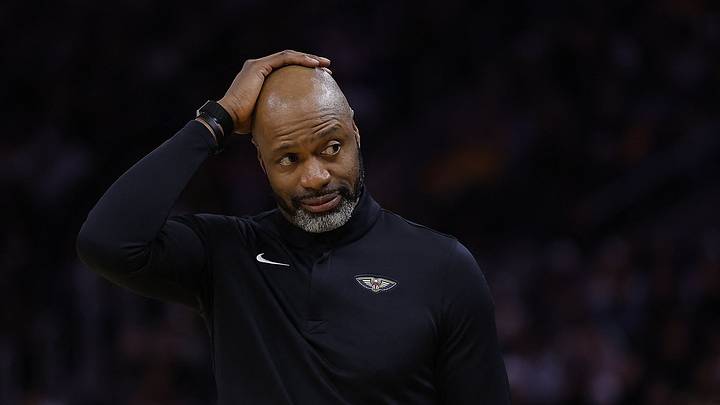
Jamahl Mosley is trying to level a table that keeps wobbling. Shore up one corner of the Pelicans' rotation, and another starts to tilt.
Herb Jones can help stabilize the defense, but his struggling shot makes life harder for the offense. Saddiq Bey supplies scoring, yet several combinations featuring him have struggled to get stops. Dejounte Murray's disappointing production had already complicated the point guard rotation. His trade request now leaves Mosley preparing to move forward with few reliable alternatives.
Through 12 games, some promising lineups have emerged around Zion Williamson and Trey Murphy III. The challenge is building a rotation that supports them without repeatedly trading one weakness for another.
A Foundation Worth More Minutes
One of Mosley's most encouraging groups features Williamson, Murphy, Jeremiah Fears, and Karlo Matkovic. Those four have produced a 125.6 offensive rating and a plus-9.6 net rating in 106 minutes together.
Beyond the numbers, the group is balanced. Fears provides a ball-handler alongside the Pelicans' two leading scorers, while Matkovic provides frontcourt shooting that can create room for Williamson.
Matkovic has made 44.4% of his threes on 3.3 attempts per game, yet averages only 18.6 minutes. His shooting results while playing alongside several core players give Mosley a reason to play him more.
Adding Jones to that group has produced a plus-30.6 net rating in 39 minutes. That small sample, fueled by exceptional shooting, doesn't give the Pelicans a guarantee, but there's a strong case to see more.
The Right Role Matters
Jones' role is one of the Pelicans' most difficult calculations. He's averaging 5.7 points while shooting 37.3% overall and 26.7% from distance. His offensive struggles increase the scoring burden on the players around him.
Nevertheless, New Orleans has a +16.8 net rating in the 120 minutes Jones and Williamson have shared. Several productive larger combinations also include Jones, meaning Mosley has to keep him on the court even while needing more from him offensively.
Bey presents the reverse problem. His 15.4 points per game, efficient scoring, and low turnover rate make him an offensive weapon. Finding the best setting for that production has been less straightforward.
The Williamson-Murphy-Fears trio is nearly even in 204 minutes. With Bey, that quartet has a -20.4 net rating in 56 minutes, driven by a 143.0 defensive rating.
Those results aren't Bey's alone to claim. Different opponents, fifth players, and game situations influence every combination. His success with reserves also argues against treating his numbers as a final judgment.
Bey, Jones, Trendon Watford, Bennedict Mathurin, and Derik Queen have a +16.5 net rating in 45 minutes. The contrast raises a question for Mosley: where does Bey's scoring help most, and which teammates provide the support those groups need?
Murray's Trade Request Changes the Calculation
Murray requested a trade Friday, with ESPN's Shams Charania reporting that agent Rich Paul and Pelicans officials have begun working toward a resolution. With Murray reportedly unavailable for the time being, Mosley's immediate task is organizing the backcourt without him.
Over the season's first 12 games, all five of his two-player combinations that reached 100 minutes have negative net ratings.
His pairing with Fears has produced a -11.3 mark in 148 minutes. Alongside Murphy, the Pelicans are -8.6 in 164 minutes. The defensive struggles in both pairings make this a broader concern than the offensive rhythm alone.
Murray is averaging 13.4 points and 4.4 assists while shooting 29.6% from three. Last season offered a brief improvement in efficiency, but limited availability and uneven production have defined his time in New Orleans.
His recovery from a ruptured Achilles deserves consideration when evaluating that production. Even so, the Pelicans didn't have any evidence that keeping them together would produce the improvement they needed. His request accelerates a decision the lineup results already warranted.
Fears leads the rotation in usage but has struggled with shooting efficiency and turnovers. Jordan Poole and Mathurin have not supplied dependable shooting. Bryce McGowens has yet to establish himself as a consistent offensive option.
Murray's absence gives Fears full control of the offense, but it also exposes the shortage of dependable playmaking behind him. Poole will have to help organize possessions, and Queen's passing could become more important with the reserves. Neither adjustment guarantees the second unit will run smoothly.
A trade could eventually bring a better-fitting replacement, but until a deal is completed, Mosley has to work with the options available.
Put Zion and Trey at the Center
Whatever Mosley changes, Williamson and Murphy should remain important parts of the solution.
Williamson has a 69.1% true shooting percentage with a 22.8% usage rate. Murphy's usage is 18.5%, below Murray, Bey, and Mathurin. Together, Williamson and Murphy average only 23.5 field-goal attempts.
Why can't the offense consistently create opportunities for its best scorers? That responsibility extends from Mosley's play design to the guards' decisions and the assertiveness of Williamson and Murphy themselves.
Murray's absence creates an opportunity to redistribute those possessions. Fears needs to use his greater responsibility to generate chances for Williamson and, when healthy, Murphy. Simply replacing Murray's shots with attempts from other guards wouldn't fix the main problem.
Availability has complicated the process. With injuries to Yves Missi and Murphy, Mosley has had limited opportunities to evaluate a complete roster.
He still controls the minutes available now. More time for Matkovic, clearer playmaking responsibilities for Fears and the reserves, and more deliberate choices around Williamson and Murphy are good places to start.
Murray's request adds urgency, but the front office still has to address the roster's shortage of shooting, defense, and dependable ball-handling. Mosley, meanwhile, has enough evidence to give his most promising combos a longer look.
The Pelicans can't spend the season waiting for everyone to find their games before establishing who makes their best players better. Mosley's rotations should reflect the evidence already in front of him.
 Add us as a preferred source on Google
