
Projecting Timberwolves' Rotation Before Opening Game vs. Heat
In this story:
The regular season is finally here. The Minnesota Timberwolves begin their season against the Miami Heat on Wednesday, an immediate test of Minnesota's lack of frontcourt size as well as their new-look starting five's ability to punish teams with poor perimeter defense.
The preseason has a lot of noise to it. Trying to find meaningful takeaways can often be a dubious task, especially when looking at player or team stats. An area that can be telling about what the regular season will hold is the rotations.
Who plays the most minutes and who they play them with are often an indication of what opening night will bring. For this year's Timberwolves team, they have a solidified starting lineup and a bench unit that will likely change as the season goes along.
How many minutes will the starters play?
The question for the Wolves' starting five isn't who will be included. That was solidified when Minnesota added Jonathan Kuminga to fill their power forward void. What is a bit up in the air is how many minutes each player will get.
For the returning members of the Wolves' starting unit, Anthony Edwards, Jaden McDaniels, and Rudy Gobert, their minute load will likely remain unchanged from the past few seasons. Edwards will lead the team in minutes per game and likely play between 35 and 36 minutes per game, as he has in each of the past four seasons.
McDaniels, who had an outstanding preseason, might see a small bump in minutes if he can limit his foul trouble better than he has in the past, but he still projects to be around 32 minutes a night. Gobert, on the other end, might see a small dip in minutes with age, but will still be above 30 per game.
Kuminga has been fitting in well so far, but will get the fewest minutes of the Wolves' starters and projects to be the only one who may not be in the closing lineup every night. Even if Kuminga isn't closing games, he will still receive a large number of minutes for a somewhat thin Wolves front court. Look for Kuminga's minutes total to fall in the mid-20s.
For Ball, many wondered if the Timberwolves' new point guard, following one of the healthiest seasons of his career, would stick at 28 minutes per game. The Timberwolves, with one of the best training staffs in the NBA, have made it clear that Ball is going to play as much as possible when healthy, which likely sets his minutes expectation around 32 on an average night.
One interesting aspect of the Wolves' rotations to watch to begin the season is whether or not Chris Finch will stagger the minutes of Edwards and Ball so that one of them is on the court at all times, or if Finch will look to maximize the amount of time the two starting guards play together.
There are a lot of factors to think about, and the Timberwolves will likely change their rotations back and forth as the season goes along, but possibly the largest consideration is who will play coming off the bench and if that unit can succeed on its own with both Edwards and Ball on the bench.
Who will play off of the bench?
While the starting unit is locked in in terms of minutes and rotation, the bench has a lot more to figure out. Ayo Dosunmu is lined up to be the team's sixth man again, likely playing 28-30 minutes per game like he did last season, but after that, there are a ton of question marks.
Joan Beringer will certainly receive a permanent role in the rotation, but will likely be limited to the 18 or so minutes Gobert is not on the court. Beringer could play fewer minutes than that on some nights if the Wolves look to experiment with lineups that do not have a traditional center.
The next player off the bench appears to be Terrence Shannon Jr., who has had an underwhelming preseason after thriving in the playoffs for the second straight year. Shannon Jr. will likely receive a double-digit minutes role, but could see that shrink if his regular-season struggles continue.
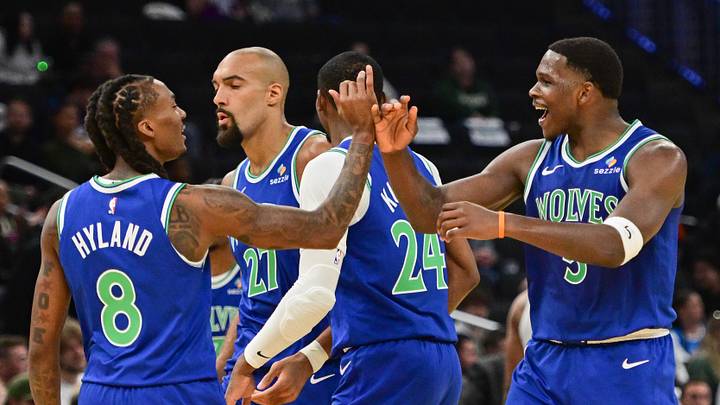
Bones Hyland will be Minnesota's primary backup point guard as well as a scoring option from the bench. The role may not be there every night for Hyland, as it may be matchup-dependent, but there should be plenty of opportunity throughout the season for him to come in and provide a scoring punch as he did a season ago.
Trey Lyles is projected to be the tenth and final member of the rotation on opening night. Lyles provides a combination of rebounding, defense, and floor-spacing that is somewhat lacking on the Wolves roster. Lyles will get his shot early on in the season and will need to prove his value as the rotation naturally shrinks after this first month of the season.
Jaylen Clark projects to start the season outside of the team's rotation, but will see plenty of playing time down the road, as Clark is one of Minnesota's top perimeter defenders and has shown the ability to completely throw off opposing offenses with his relentless effort on the ball.
Cody Williams will likely also be out of the rotation on opening night, but he has shown promise during the preseason after being traded away by the Utah Jazz. If and when the Wolves need frontcourt help, Williams could see his name called.
It is also important to keep in mind that Donte DiVincenzo will miss the first few months of the Wolves' season, but he is attempting to return to the court by the end of the season. If he does, that will give Minnesota another weapon off the bench.
Get Timberwolves On SI straight to your inbox: sign up for our free newsletter here.
 Add us as a preferred source on Google

Ryan Eichten is a credentialed sports writer and data journalist living in Minneapolis, MN. Eichten has been covering the Timberwolves since 2019 providing data and information-driven analysis of the Wolves and the NBA. Along with his written work at Timberwolves On SI, Eichten breaks down all things Timberwolves on the podcast Two Words: Wolves Pod, which publishes twice-weekly episodes with a rotating cast of expert guests.
Follow REichten