%20%20--%3E%0A%3Csvg%20version%3D%221.1%22%20id%3D%22Layer_1%22%20xmlns%3D%22http%3A%2F%2Fwww.w3.org%2F2000%2Fsvg%22%20xmlns%3Axlink%3D%22http%3A%2F%2Fwww.w3.org%2F1999%2Fxlink%22%20x%3D%220px%22%20y%3D%220px%22%0A%09%20width%3D%2239px%22%20height%3D%2240px%22%20viewBox%3D%220%200%2039%2040%22%20enable-background%3D%22new%200%200%2039%2040%22%20xml%3Aspace%3D%22preserve%22%3E%0A%3Cpath%20fill%3D%22%23FFFFFF%22%20d%3D%22M38.5%2C7H28.2v26h10.3V7z%22%2F%3E%0A%3Cpath%20fill-rule%3D%22evenodd%22%20clip-rule%3D%22evenodd%22%20fill%3D%22%23FFFFFF%22%20d%3D%22M26.1%2C25.5c0%2C5.8-4.1%2C7.5-12.9%2C7.5C3.9%2C33%2C0%2C31.2%2C0%2C25.2v-1.1h11.6%0A%09v2.4c0%2C0.7%2C0.1%2C1.4%2C1.2%2C1.4c1%2C0%2C1.2-0.4%2C1.2-1.3v-0.9c0-1.6-0.9-1.6-3.5-2.2C2.2%2C21.7%2C0%2C19.7%2C0%2C15.3v-0.9C0%2C9.3%2C5.5%2C7%2C12.9%2C7%0A%09c10.2%2C0%2C12.8%2C2.6%2C12.8%2C7.4v1.8h-11v-2.9c0-0.6-0.4-1.1-1.2-1.1c-0.6%2C0-1.2%2C0.4-1.2%2C1.1v0.9c0%2C1.5%2C0.9%2C2%2C3.3%2C2.5%0A%09c8%2C1.6%2C10.5%2C3.3%2C10.5%2C7.5V25.5z%22%2F%3E%0A%3C%2Fsvg%3E%0A)
Albert Breer’s NFL Takeaways: Mike Vrabel’s Patriots Vision Takes Center Stage
In this story:
Jump to a topic
- New England Patriots
- San Francisco 49ers
- Buffalo Bills
- Chicago Bears
- Los Angeles Rams
- Atlanta Falcons
- Miami Dolphins
- Baltimore Ravens
- Pittsburgh Steelers
- Quick-hitters
We have one more NFL wild-card game to go, and so much to get to in the takeaways this week. Let’s dive in.
New England Patriots
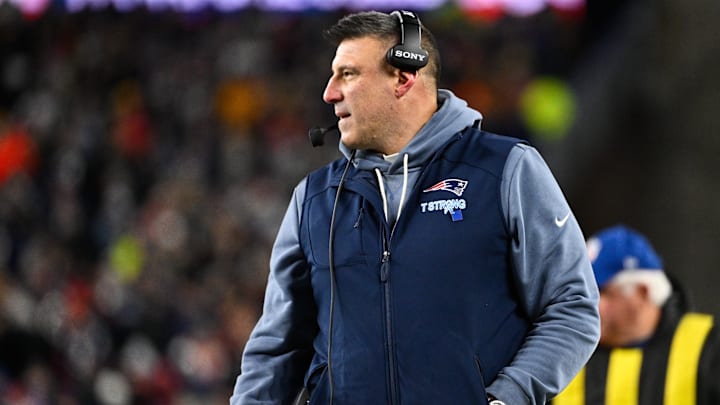
Monday is the one-year anniversary of when Mike Vrabel’s hire in New England was announced, and there’s no other way to describe that decision than as a grand slam for a revitalized brand. And there was no clearer proof of that than what played out Sunday night, two decks of stands below the Patriots’ atrium in which he was formally introduced Jan. 13, 2025.
Sunday night’s 16–3 wild-card round win over the Chargers at home in front of Patriots fans was no work of art, and it didn’t need to be. It wasn’t Drake Maye’s best game. It was, for a while at least, played on the visitor’s terms. It was also, more importantly, another example of what Vrabel’s built over the past year.
Maye threw an interception, one that was tipped at the line, inside his own 10-yard line on the team’s second possession. He was also sacked and fumbled on New England’s first possession of the second half.
Neither yielded points for the Chargers—and the Patriots kept chipping away until the dam broke, controlling the action for the better part of the game, riding out sloppy moments, and leaning on each other, as they had in the 14 wins they notched before this one.
And that, the guys here will tell you, is no mistake. In fact, Milton Williams, who was perhaps the Patriots’ second-best player this year, saw what he believes is now shining through for everyone to see early on. The Patriots had to pay a tax to get him to back away from a big offer he was close to taking from the Panthers in March. As that was happening, though, something else was tugging on him to go north, rather than south, from Philly, where he won a Super Bowl last year.
It was Vrabel’s vision for where he wanted to take the Patriots.
“He would ask me about my family, how I was doing, how everything was going,” Williams told me, in a quiet corridor of Gillette Stadium after the win. “He wanted to let me know that he wanted me to be out here. But the main thing is, he was just focused on my family. It just showed he really cared about you, not just as a football player, but as a person.”
Williams was the most significant addition, but one of a slew. The Patriots also added Carlton Davis III at corner, Robert Spillane at linebacker, Morgan Moses at tackle, Stefon Diggs at receiver, and Harold Landry III on the edge, to name a few. The draft brought Will Campbell, TreVeyon Henderson, Craig Woodson and Jared Wilson (all starters or starting-level), among others, aboard.
Half the team’s starters against the Chargers weren’t on the team a year ago. And the hit rate for Vrabel and, de facto, GM Eliot Wolf was apparent in all of them.
“There’s not one guy that our front office didn’t hit on,” Moses said. “Hats off to them, building this roster and having a great owner, and having great leadership throughout the building. Our job is to play football, and when you align great players and great people together, it makes it a lot easier.”
As Williams said, the people part of this has been as central to what Vrabel and Wolf, and Vrabel’s top lieutenants, John Streicher and Ryan Cowden, have looked to build, as the player part. It’s clear to all of them now where the vision then was going now, and it continues to be what and who that brass has decided to put in the locker room.
“Nobody’s bigger than anyone else,” Moses said. “Stef’s come in here and been an unbelievable teammate and unbelievable leader on this team. What he’s done has been unselfish. You don’t find a lot of people in this league like that. So to be able to get guys like that—high-caliber guys that have a lot of football left in front of them, and play unselfish football, it’s been huge for us.”
That much was obvious Sunday.
Maye kept fighting, as you’d expect, through the aforementioned mistakes, and made massive plays along the way—a 37-yard run to set up a go-ahead field goal at the end of the first half was one, and his picturesque throw to Hunter Henry for the game’s only touchdown in the fourth quarter was another. And all the same as he relied on vets like Henry, he got huge plays from rookies Kyle Williams (on fourth-and-4) and Efton Chism III (and second-and-18) on the team’s first scoring drive, too.
Meanwhile, the defense was off the charts, constantly in Justin Herbert’s lap with a disciplined rush plan and sticky, relentless coverage that held the star quarterback to 159 yards and a 74.5 passer rating and saw him sacked six times.
Each time, it seemed, it was someone else making the play, which was, again, a sign of how many guys the Patriots were right on in March and April and of their collective play style.
That play style, Vrabel himself would say, wasn’t something coached into these guys.
More so, it was what he and his team were looking for.
“Heart—[the 2025 additions] got heart,” Williams told me. “They went and got some dogs. Everybody they brought in, some f---ing dogs. And you see that.”
Everyone, including the Chargers, sure did.
San Francisco 49ers
Part of being a great coach is knowing what your team needs, and very clearly, back in the offseason, Kyle Shanahan did. The 2025 49ers were always going to be different from their predecessors that made Super Bowls. A calculated cap purge meant moving on from a whole host of established vets. As the team took on over $90 million in dead money, cheaper, younger guys would be in their spots.
So Shanahan invited the remaining vets who’d been around for three or more years to his house to try to explain what was ahead and what he needed from them.
“He just wanted to talk about changing our expectations of what the season was going to be like, and how we could get to where we want to be,” Kyle Juszczyk told me. “It was just going to come down to leadership, and getting these young guys to come along and play at a high level quickly—faster than they probably even should.”
The message was received by the guys in the room, and it was more necessary than they could have ever known.
Since the Niners lost Nick Bosa and Fred Warner for the year (though Warner’s trying to return now from a fractured ankle). Brandon Aiyuk failed to return from his torn ACL, landing in a dispute with the team that kept him off the field. George Kittle missed six weeks in September and October, with Brock Purdy out for the bulk of that time as well. Ricky Pearsall missed about half the season, and Jauan Jennings and Trent Williams fought injuries, too.
And there the Niners were on Sunday, putting together a 10-play, 66-yard touchdown drive, after Kittle went down again, to dethrone the Eagles, 23–19. Purdy hit Christian McCaffrey to cap it with 2:54 left, his second score of the day. Vet Eric Kendricks, playing his first game with the team, closed it out in coverage on the fourth down to follow.
It was, in sum, the payoff of that pact Shanahan made with his veterans.
He told them back then that they’d have to practice in pads more than anyone in the league, and that they’d have to take young guys under their collective wing. The quicker they came along, Shanahan reasoned with the guys, the faster the team would get back to its standard.
“We had a long stretch there where we had expectations every year—we should be a Super Bowl–contending team,” Juszczyk said. “It was not that we couldn’t get there. But we weren’t there yet. And we needed to continue to focus on getting better every single week.”
The slog was hard enough that Shanahan acknowledged as much to his players at the team hotel in Philly on Saturday night. He thanked them not just for buying in, but also for not grumbling about the amount he and his staff put on them, though he joked, “I’m sure you guys probably were all complaining behind my back.”
The results have followed. Juszczyk pointed to second-round pick Alfred Collins coming back from injury. The defensive tackle was a key player on Sunday. As was slot corner Upton Stout. And fourth-year tight end Jake Tonges, in Kittle’s place. And so many others.
Of course, there was plenty of reason to doubt this was ever possible, even before all those injuries. Now, the Niners are one win away from a fifth NFC title game in seven years.
In fact, Juszczyk conceded that if he heard this story ahead of time, he wouldn’t have believed it.
“I probably would’ve laughed at you,” he said. “And then I would’ve switched modes. I’m just an eternal optimist. I always believe there’s a way. It’s unfortunate, but in this league, most everyone, unless you’re a first-round pick, got their opportunity because somebody got hurt. That’s just the reality of it. And guys have gotten their opportunities.”
Clearly, they’ve taken advantage of those. And they’ve done it, with a bit of help along the way.
Buffalo Bills
Two things about the Bills’ gutsy 27–24 win over the Jaguars jumped out to me. Both are things you can tuck away for the divisional round—and the conference championship after that, and the Super Bowl if they keep winning.
One, Sean McDermott took a decidedly old-school approach to game management.
Personally, I think the going-for-it-on-fourth-down thing has gone too far. Too often, teams lean on analytics that, I believe, are devoid of human elements like momentum and the regular ups and downs players experience in a game. And what I saw, under a lot of pressure on Sunday, was McDermott taking advantage of that.
Three situations stick out. The first was in the first quarter, when he lined up for a 45-yard field goal with a banged-up kicker (Matt Prater) on fourth-and-4, then took a penalty and kicked the 50-yarder. The second came with a decision to take a delay on fourth-and-4 from the Jags’ 45, then punt from the 50 with 1:14 left in the half. The third was a call to kick a 47-yard field goal on fourth-and-4 from the Jags’ 29 right after the half.
In the end, we’re talking about six points and preventing the Jaguars from getting a good shot at scoring before halftime. But in a game that went into the final two minutes, that counts.
On the flip side, Liam Coen—who’s done a ridiculous, unbelievable job in his first year in Jacksonville—went for it on fourth-and-2 on the Buffalo 9 in the second quarter, leading 7–3 and with momentum. Trevor Lawrence, after McDermott challenged the spot, was ruled to have gone down inches shy of the line to gain. So instead of Jacksonville being up 10–3, the Bills got the stop, went 92 yards, and the Jaguars never got control of the game the way they had over the first quarter and a half, when it felt like everything was on their terms.
In a way, it seemed, at least to me, to be a good sign of McDermott’s feel and instincts in a big game, in that he didn’t feel the need to gamble and to “lay it all on the line.” Which, to me, is something to watch with the Bills at top-seeded Denver on Saturday.
Then, there’s Josh Allen’s brilliance. He came in with a foot injury, seemed to sustain a knee injury in-game, and continued to make every throw and grind out every run the team needed. Against a Jaguars defense determined to make the Bills earn every yard, Allen was coldly efficient, completing 28-of-35 throws for 273 yards. Excluding kneeldowns, he carried the ball nine times for 35 yards and two touchdowns.
And 10 of those yards came on a game-defining fourth-and-1 from the Jags’ 11, when his teammates literally shoved him, on a called push play, to the doorstep of the game-winning touchdown, which he scored on another sneak on the next play.
Add all this together, in its first road playoff win since 1992, and you get a Buffalo team looking battle-tested and ready, pulling out all the stops with the sport’s best player.
Which is to say, no, this isn’t Allen’s best Buffalo team.
However, it might be the hardest one to kill, and that’s a good quality to have in the playoffs.
Chicago Bears
The Bears’ furious comeback Saturday night foreshadowed what looks like a very bright future in Chicago. This time of year, we’re reminded about how vital the coach and quarterback are. Both Ben Johnson and Caleb Williams showed, in no uncertain terms, why so many NFL teams were in hot pursuit of them before the two landed in Chicago, Williams nine months before Johnson.
And it showed most with the Bears trailing the Packers, 21–3, at halftime of their NFC wild-card game on Saturday night, with their season slipping away.
In the locker room, no one was flipping the Gatorade over, or giving some firebrand speech you’d see in a movie. Instead, it was about figuring out what went wrong, and how to fix it. Because there was real genuine belief it’d get fixed, the kind you can only have if you have a coach and quarterback capable of bringing you back in that kind of setting.
The conversation, wide receiver DJ Moore told me postgame, “That we’re better than what we did in the first half, and we just need to go out there and execute and be detailed.”
That may be boring, but it also worked in a tangible way in the Bears’ wild 31–27 win.
On the coaching side, the players believed that Johnson and his staff would find a way to generate plays that would bring them back. One example was the two-point conversion in the fourth quarter that cut Green Bay’s lead to 27–24. Chicago came out in a jumbo set, forcing the Packers to put their bigger people on the field. The Bears then spread out to isolate fast-rising rookie tight end Colston Loveland on linebacker Nick Niemann.
Another example was the game-winning touchdown. The Bears got the Packers to bite on a fake tunnel screen to Luther Burden III, forcing a scrambling defense to pick between covering Loveland or Moore down the field, as defenders came up to cover Burden.
“We’ve been practicing that play for a minute now,” Moore said. “It was my time for the touchdown. In moments like that, [Johnson] goes with players, not plays. The players make the plays come to life. And as he calls them, we have to go out there and execute. Whoever’s the primary has to win, and if he doesn’t, everyone else is winning.
And where that one was put on a plate for Williams, so many other throws weren’t. Like in the fourth quarter, with the score 21–9, when he put the ball in a tiny window on a corner route to Loveland, with linebacker Quay Walker giving chase. Or the throw he made in a scramble situation to Rome Odunze on fourth-and-8 with 5:37 left, down 27–16, and the season on the line. I don’t think there are five guys on the planet capable of making that sort of off-platform, across-your-body throw. But just as vital to it was the poise to make it.
“He just stayed calm, cool and collected,” Moore said. “And when we needed him to shine bright, he did. It’s always coming through him, and it trickles down throughout the offense.”
The scary thing about all this? It sure seems like the Bears are just scratching the surface of where Johnson and Williams can take a talented, balanced team.
“Yeah, it definitely feels that way,” Moore said.
And you didn’t need to be wearing a uniform to see that the other night.

Los Angeles Rams
Matthew Stafford’s greatness was on full display in Charlotte on Saturday. The Rams’ season, with so much expected, was on the ropes. The Panthers led 24–20 and 31–27 in the fourth quarter. Stafford answered the bell.
And he did it after a finger injury that he conceded “wasn’t pleasant” after the game rendered him not near the quarterback he usually is. Consider:
• Stafford hit on his first nine throws for 118 yards, as the Rams took advantage of a Carolina turnover and a turnover on downs to race to a 14–0 lead.
• From that point through the end of the third quarter, he was 3-of-18 for 53 yards. And if you pinpoint where his right hand crashed into Panthers pass rusher D.J. Wonnum, and the finger bent back, through the end to the third quarter, he was 2-of-12 for 34 yards. The final of those throws was intercepted by Mike Jackson, setting up a Chuba Hubbard touchdown run that gave the Panthers their first lead two plays into the fourth quarter.
So everything was going wrong. The Rams’ defense was starting to bend. The Panthers were gaining confidence. And from that point on, Stafford—one of the favorites to win league MVP—clearly showed his value to the team.
He was 12-of-15 for 143 yards and two touchdowns in the fourth quarter. He led drives of 67 and 71 yards playing from behind. He was 5-of-6 for all 71 yards on the drive that won it.
And here’s the coolest part: He didn’t say a word about it to his offensive teammates.
“I wasn’t aware of anything; I saw he kind of banged his hand, but I wasn’t aware of any injury,” tight end Colby Parkinson told me, as he boarded the team plane. “And, obviously, we had complete trust in him going into that final drive. And he came through. He delivered.”
That included the game-winning throw on a wheel route that required Stafford, with that finger injury, to put the ball into a razor-thin window. The Panthers had it covered. But you can’t cover the perfect throw, this one to Parkinson’s back shoulder, hitting what little opening Carolina gave him to make it.
“It was kind of an out-and-up—the defender played over the top a bit, so I knew I was going to have to get back to the ball,” Parkinson said. “I don’t think Matthew could’ve walked up and placed the ball in my hands any better than he threw it. It was an amazing throw, amazing play, amazing thing to be a part of.”
Now, we’ll see if the Rams can be the amazing team they’ve been at points this year.
Stafford’s finger issue could affect that. But the important part is that they’re still alive, thanks to their MVP.
Atlanta Falcons
Matt Ryan is more than a figurehead for the Falcons. There was a reason Atlanta named him the team’s new president of football, and a need that someone like the 40-year-old had to fill in Atlanta. That begins with where Rich McKay, who’s been with the team since 2003, stood. His role within owner Arthur Blank’s sports conglomerate has fluctuated over the years, and recently, he’s been involved with his boss’s MLS team, the bid for an NWSL expansion team, and Atlanta’s upcoming commitments to host the World Cup next summer and Super Bowl LXII in 2028.
Meanwhile, the football team had its issues. There were the quarterback investments in Kirk Cousins and Michael Penix Jr. in 2024 that failed to pay off as a 6–3 start melted away in an 8–9 season. Then, there was a 3–2 start this year that crumbled under a five-game losing streak, during which Blank acted—asking Sportology to conduct a health-check on the team, while reconsidering McKay’s role in the bigger picture against what the longtime CEO did for the Falcons.
The result: Along with other changes necessary in football operations, there needed to be more oversight and accountability. Blank’s not in the office every day, and with McKay stretched thin across so many areas, Sportology and the owner agreed that bringing a senior football officer aboard—with the coach and GM reporting to him, rather than the owner—would create greater alignment and accountability across the board.
Around that time, team president Greg Beadles approached Ryan to gauge his interest in serving in such a role, having seen the quarterback’s ability to lead, galvanize and hold people accountable over Ryan’s 14 years as a player in Atlanta. The Falcons didn’t know how he’d respond. He’d told people while he was playing that he didn’t have any designs on coaching. But when they asked about an executive role, he was intrigued.
Bottom line: Blank felt the organization needed a spark. He’s 83 and saw three of his best friends pass away this year. It’s now been nearly a decade since the team’s historic loss in Super Bowl LI. He didn’t want to wait on anything. He knew he had to do something bold.
That meant moving McKay over to be CEO of AMBSE—which encompasses all of Blank’s sports properties—full-time, promoting Beadles to Falcons CEO to oversee the team’s business and hiring Ryan to be in charge of football. Next will come the hires of a new general manager and a coach. Ian Cunningham (who works for one of Ryan’s best friends, Bears GM Ryan Poles) is the favorite to be the GM. But right now, the Falcons are the only team looking for a GM, so they can take their time and find the fit that’s right with a new coach.
And the first good sign has come, as I’ve heard it, in Ryan’s humility. As a strong leader, and as much as the team needs that, he knows what he doesn’t know. He’s already talked to those in the organization about where he needs to catch up, and has shown a willingness to be all-in on learning, which is how John Elway was (and Tom Brady has a ways to go in this area) when he got back to Denver in 2011.
Of course, they’ve got to get the coach and GM hires right, and then get the quarterback position right, too, whether it’s Penix or someone else. That said, hiring Ryan is a good start in getting the organization aligned after certain elements were patched together over the past decade.
Miami Dolphins
The Dolphins got what they were looking for in new GM Jon-Eric Sullivan, a dyed-in-the-wool scout with executive traits. Miami’s had two months to work on it. And when former GM Chris Grier and the team mutually decided to part ways on Halloween, the first order of business was to look inward and see how things had fallen apart.
The structure was the first piece. The setup, for some time, had the coach (Mike McDaniel) and the cap chief (Brandon Shore) reporting to the GM (Grier), who reported to the owner (Stephen Ross). And, over the years, as Miami looked more closely at it, the result was an erosion of the team-building process.
When Mike Tannenbaum was in charge (2015 to ’18), the Dolphins built aggressively. When Brian Flores arrived (’19) and was paired with Grier, Miami went the other way and amassed draft assets. Then, McDaniel arrived in 2022, and Miami reverted to aggression to try to take advantage of the window left while quarterback Tua Tagovailoa was on his rookie contract, bringing in vets such as Tyreek Hill, Bradley Chubb and Jalen Ramsey.
As a result, the Dolphins have had the fewest draft picks in the league over the past four years, with only one player left from the 2022 and ’23 classes. That player, De’Von Achane, was someone that McDaniel himself insisted the Dolphins take.
So Miami intended to lean into scouting. Shore’s now in an elevated role, not unlike Mike Disner’s in Detroit, Brandt Tilis’s in Carolina or Tony Pastoors’s with the Rams. That, the Dolphins figured, would allow them to hire a more pure evaluator into the GM role. And while the reporting structure still needs to be worked out, it at least has the look of that three-headed model, with coach, GM and football ops czar reporting to ownership.
Sullivan fits perfectly into that. His reputation mirrored that of his old boss, Brian Gutekunst, in Green Bay before he became the Packers’ GM—and that was apparent as the Dolphins did their background work. All of it came back mind-bendingly consistent, with Sullivan someone who’d been ready for a couple of years, with the sort of values Miami was looking for in a leader who’d work collaboratively and with the bigger picture in mind.
Ross, his son-in-law Danny Sillman, team president Tom Garfinkel and Shore saw it in the interview, too, where Sullivan showed his passion for player evaluation and team building in a way that wasn’t performative.
The results helped, too. One story, in particular, encapsulated the whole thing. The young exec was the first Packers scout on Jordan Love and became Love’s biggest advocate as the 2020 draft drew closer. The Dolphins liked that part of it. But as much as the evaluation, they liked Sullivan’s vision and conviction, and the Packers’ resolve, in making a call for the long term, that wouldn’t help in the short term, and could (and did) rankle Aaron Rodgers.
Now, Sullivan will jump in on a head coach search that got underway over the weekend, which is just one of a number of things he and Miami have to get right this offseason.

Baltimore Ravens
It was time for the Ravens and John Harbaugh to part ways. I’ve said this unendingly the past week, and I stand by it: Harbaugh is very much a players’ coach. As such, I was disappointed to see him go on Tuesday.
But that doesn’t mean he was reaching them the same way he used to.
To me, the more I’ve dug into this, the more apparent it’s become that ownership questioned how well Harbaugh fit with the roster. For a decade and a half, the team was built in his image. He runs a demanding program, and the leaders the team brought in wouldn’t have had it any other way. They were his torchbearers.
However, I’m not sure the roster the Ravens have now, still loaded with talent, is quite like that anymore. I heard a story about one prominent veteran who was hesitant to sign an extension because of Harbaugh’s challenging program. That one didn’t come across as a shot at the player or a shot at Harbaugh. It was more so an illustration of where things stood, even though, by all accounts, Harbaugh still loved the group he had.
Then, this year, the Ravens entered the season with what, internally, they believed was one of the most talented rosters they’ve fielded in the past couple of decades.
Yes, there were injuries, including Lamar Jackson, Kyle Hamilton, Roquan Smith, Marlon Humphrey, Patrick Ricard and Ronnie Stanley all out at once. Still, they withstood that to enter December at 6–6, getting close to full health. From there, they were swept by the Steelers, missing on chances to win both games at the end, and blew an 11-point lead in the final 10 minutes against New England, finishing 8–9 and missing the playoffs. And falling that far short of expectations usually leads to bigger questions.
It certainly did in this case.
So the Ravens move on, with the most attractive job on the market, though one requiring a new coach to fit the franchise, as much as the franchise will accommodate him. And Harbaugh spent the weekend assembling a staff and preparing for interviews this week. All seven teams with openings contacted his camp. He’ll take interviews with a few, with the Giants, Dolphins, Falcons and Titans likely to get a real shot at landing him.
Regardless of what’s next for either party, this is the end of a significant era. Harbaugh’s name will be in the Ring of Honor in Baltimore someday, and we’ll remember the first 16 years or so far more than we’ll remember the last couple. And the impact he’s had will live on, for sure.
Pittsburgh Steelers
The Steelers’ situation Monday night bears watching. There’s a reality to the spot Pittsburgh enters the playoffs in, same as the reality they faced entering their must-win Week 18 game at home against the Ravens.
Seven of Pittsburgh’s 22 starters for that one were 30-or-older, and an eighth will be there in March. The quarterback, Aaron Rodgers, is 42. The highest-paid player on the team, T.J. Watt, is 31. The roster isn’t devoid of youth—Zach Frazier, Mason McCormick and Troy Fautanu give the team a nice, young core on the offensive line, and players such as Joey Porter Jr., Keeanu Benton, Derrick Harmon and Darnell Washington look like pieces, as well.
But there’s a retooling coming with so many major parts of the operation close to aging out.
That will lead, in an organic way, to bigger questions (and fair ones) being asked about Mike Tomlin’s future. Next year would be his 20th in Pittsburgh. So, considering that, I think it makes sense to wonder whether Tomlin would rather go through a significant rebuild in Pittsburgh, with no long-term answer at quarterback, or go do television for a year and then find a more ready-made situation as the hottest coach on the market in 2027.
If Rodgers and Watt, and even guys like Cam Heyward and Isaac Seumalo, return next year, maybe the dilemma will get delayed. But the conversation is coming at some point.
And it may even be affected, just a bit, by what happens Monday night against the Texans.
Quick-hitters
There’s a lot to dig into in the quick-hitters this week. Let’s go!
• My feeling is that fit, both ways, will be important with John Harbaugh. Miami, for example, isn’t looking for an all-powerful coach. So how Harbaugh fits into that, through the interview process, will be key. Ditto in Atlanta with Matt Ryan, though Harbaugh was with Ian Cunningham in Baltimore. The Titans and Giants might have a little more flexibility structurally, but in both places he’d be joining a sitting general manager. There also may be another opening or two that change the paradigm.
• Two notes on the Ravens’ search. One, I do think Brian Flores is viewed there as a strong fit, and that’s a job (like the Steelers’ job) where the coach is going to have to fit the franchise as much as the franchise will morph to the new coach. Two, I think Klint Kubiak is a fascinating name, because his father Gary was so well-liked and respected there. And Gary Kubiak liked Baltimore so much that he told Harbaugh that he could see himself coaching the rest of his career there, before Elway and the Broncos called to bring him home in 2015.
• The Packers still love Matt LaFleur, who’s a really good coach and representative of that organization. That said, Green Bay’s situation is one where his contract could come into play. New team president Ed Policy punted on extending LaFleur over the summer, and now LaFleur’s going into a contract year. The market says he should get a deal in the $15 million per year range. Will the Packers be willing to go that far? If they aren’t, would they let LaFleur go preemptively, or try to trade him to a place where he has connections (he coached Ryan in Atlanta and worked with Jon-Eric Sullivan in Green Bay)? We’ll see.
• The Browns like both of their coordinators, Tommy Rees and Jim Schwartz, but enough to force them on a new head coach? I don’t think so. But it might be a plus for a candidate to be open to keeping one or the other.
• On Tua Tagovailoa, my feeling is the Dolphins, based on the quarterback’s play, won’t be looking for a coach who wants to keep him. If a good candidate does, that’s fine. But I don’t think wanting to move on will work against anyone in the chase for that job. And that makes this year different from where they were in 2022.
• Speaking of McDaniel, his bond with Robert Saleh, and potential to be OC for Saleh, could enhance the 49ers defensive coordinator’s candidacy for some jobs, as Saleh enters the head coach interview process this week.
• You’re seeing some new, young offensive names in the coaching cycle, such as Kubiak, Broncos QBs coach Davis Webb, and Rams assistants Mike LaFleur and Nathan Scheelhaase getting multiple requests. Who’s next? I’d say two young OCs to keep an eye on going forward would be Jacksonville’s Grant Udinski and Denver’s Declan Doyle, who are both 30. Neither calls plays yet, but each is from a coaching tree that teams will keep plucking from. So, I’d say with both of those guys that it feels like it’s a matter of time.
• The Raiders have a big quarterback decision coming with the No. 1 pick, with Indiana’s Fernando Mendoza and Oregon’s Dante Moore (if he declares) in the equation. I’d expect their coaching hire will reflect that. I don’t think it has to be a coach with an offensive background. But if it’s not, whomever the coach is will have to have a plan for an offensive coordinator, and then replacing that offensive coordinator if the team has success and he’s eventually hired away.
• Finally, it stunk to see two good, young left tackles, in Carolina’s Ickey Ekwonu and Chicago’s Ozzy Trapilo, go down with ruptured patellar tendons this weekend. That’s a tough one for a big man to come back from, but Kansas City rookie Josh Simmons is an example of one player who was able to return in roughly six months. We’ll see whether either guy can make it back for training camp.
More NFL From Sports Illustrated
 Add us as a preferred source on Google
Albert Breer is a senior writer covering the NFL for Sports Illustrated, delivering the biggest stories and breaking news from across the league. He has been on the NFL beat since 2005 and joined SI in 2016. Breer began his career covering the New England Patriots for the MetroWest Daily News and the Boston Herald from 2005 to ’07, then covered the Dallas Cowboys for the Dallas Morning News from 2007 to ’08. He worked for The Sporting News from 2008 to ’09 before returning to Massachusetts as The Boston Globe’s national NFL writer in 2009. From 2010 to 2016, Breer served as a national reporter for NFL Network. In addition to his work at Sports Illustrated, Breer regularly appears on NBC Sports Boston, 98.5 The Sports Hub in Boston, FS1 with Colin Cowherd, The Rich Eisen Show and The Dan Patrick Show. A 2002 graduate of Ohio State, Breer lives near Boston with his wife, a cardiac ICU nurse at Boston Children’s Hospital, and their three children.
Follow AlbertBreer