%20%20--%3E%0A%3Csvg%20version%3D%221.1%22%20id%3D%22Layer_1%22%20xmlns%3D%22http%3A%2F%2Fwww.w3.org%2F2000%2Fsvg%22%20xmlns%3Axlink%3D%22http%3A%2F%2Fwww.w3.org%2F1999%2Fxlink%22%20x%3D%220px%22%20y%3D%220px%22%0A%09%20width%3D%2239px%22%20height%3D%2240px%22%20viewBox%3D%220%200%2039%2040%22%20enable-background%3D%22new%200%200%2039%2040%22%20xml%3Aspace%3D%22preserve%22%3E%0A%3Cpath%20fill%3D%22%23FFFFFF%22%20d%3D%22M38.5%2C7H28.2v26h10.3V7z%22%2F%3E%0A%3Cpath%20fill-rule%3D%22evenodd%22%20clip-rule%3D%22evenodd%22%20fill%3D%22%23FFFFFF%22%20d%3D%22M26.1%2C25.5c0%2C5.8-4.1%2C7.5-12.9%2C7.5C3.9%2C33%2C0%2C31.2%2C0%2C25.2v-1.1h11.6%0A%09v2.4c0%2C0.7%2C0.1%2C1.4%2C1.2%2C1.4c1%2C0%2C1.2-0.4%2C1.2-1.3v-0.9c0-1.6-0.9-1.6-3.5-2.2C2.2%2C21.7%2C0%2C19.7%2C0%2C15.3v-0.9C0%2C9.3%2C5.5%2C7%2C12.9%2C7%0A%09c10.2%2C0%2C12.8%2C2.6%2C12.8%2C7.4v1.8h-11v-2.9c0-0.6-0.4-1.1-1.2-1.1c-0.6%2C0-1.2%2C0.4-1.2%2C1.1v0.9c0%2C1.5%2C0.9%2C2%2C3.3%2C2.5%0A%09c8%2C1.6%2C10.5%2C3.3%2C10.5%2C7.5V25.5z%22%2F%3E%0A%3C%2Fsvg%3E%0A)
Albert Breer’s NFL Takeaways: It’s Time to Believe in Mike Vrabel’s Patriots
In this story:
Jump to a topic
- New England Patriots
- Seattle Seahawks
- Denver Broncos
- Los Angeles Rams
- Pittsburgh Steelers
- Philip Rivers
- Cleveland Browns
- Baltimore Ravens
- Miami Dolphins
- Quick-hitters
DENVER — Super Bowl LX is set, and it’ll be Seahawks-Patriots. How did we get here? That and a whole lot more in takeaways …
New England Patriots
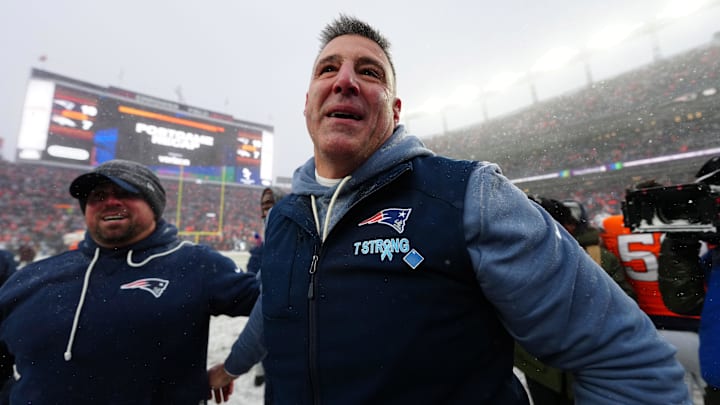
With the wind still whipping, the snow still falling, and the stage from which the Patriots took their 12th Lamar Hunt Trophy still set up, big-ticket DT Milton Williams had a few things to get off his chest. I’d asked him, as we walked off the frozen grass at a hollowed-out Empower Field at Mile High, if he felt like the style of game New England had played said something about who his team had become. But he had something else to address first.
“I mean, we’ve been hearing about that [Denver] O-line all week,” Williams yelled. “Nobody gave us a chance. Nobody believed in us. Everybody was talking about what we can and can’t do. I want to hear something about that today. We’re going back to the Super Bowl, and them boys are going home.”
Unbelievably, inexplicably, that’s the truth.
Only a few months ago, no one believed in the Patriots, and rightfully so. The roster had been in decay for years. The team went 4–13 in Bill Belichick’s final season, and 4–13 again in Jerod Mayo’s only year in charge. Mike Vrabel’s arrival brought hope, sure, but by any reasonable premise, something like this was going to take time.
Until it didn’t.
Until the Patriots ran off a 14–3 regular season. Until the Patriots’ young quarterback, Drake Maye, ascended to an MVP level. Until the Patriots batted much closer to 1.000 on player acquisition in the offseason than any team should expect to. And until Vrabel galvanized the entire organization in a way few could.
New England’s 10–7 win in the AFC championship game over a tough, but wounded, Denver team showed all of that.
But maybe more than anything else, it showed just what Vrabel’s built—a team that, as Williams’s words illustrated, wasn’t playing on anyone else’s schedule for it.
“He’s the best coach I’ve ever had,” center Garrett Bradbury, one of those free-agent acquisitions, told me postgame. “He understands when to be hard on us and when to have a good time with us. This player-friendly term gets thrown around. But it looks a lot of different ways. And he’s just himself. We all know who he is and what he wants from us. Everything is black and white. There’s not a lot of black and white in the NFL.
“So I love playing for him.”
There was a lot of that going around after this one, and during the game, as well, in how the players were bringing to life Vrabel’s vision for the team—one that, again, came together in a more spectacular way than you can imagine.
And that really started right away when Vrabel arrived just over a year ago.
In fact, on the day of his introductory press conference, with a few minutes to spare, the Patriots’ coach retreated to a meeting room inside Gillette Stadium, where he found de facto GM Eliot Wolf and a group of pro scouts going over free-agent tape. The personnel guys were taken aback—and a little on edge. Vrabel quickly cut through that by talking football with everyone in the room, explaining what he was looking for.
As he was leaving to do more media, he asked if he could come back the next day to watch more with them, and show them what he wanted in every position, and that only grew as a productive offseason moved along.
“He’s a tremendous worker,” Wolf said. “He’s really galvanized the team, that’s obvious. But he’s also galvanized the scouting department in a way, because it’s great to work with his coaching staff.”
He’s done it with his personality, yes, but also in finding guys who would fit his mold and help to forge that identity, rather than just fit into it. Williams was already that way coming in as a big-ticket free agent. Stefon Diggs, Robert Spillane and Morgan Moses were, too, as were draftees Will Campbell, TreVeyon Henderson, Craig Woodson and Jared Wilson.
“We got a bunch of dogs,” Williams said. “We don’t care what nobody says—we’re gonna come out and prove that s--- on the field every time we get out there.”
They certainly did Sunday because the identity Vrabel’s looked to build was necessary to get through a weather-whipped AFC title game.
Denver, even with Jarrett Stidham at quarterback, was in command early. When Stidham and the offense lined up for fourth-and-1 with 9:28 to go in the second quarter, the Broncos had outgained the Patriots 125–12, had seven first downs while allowing New England only one, and had possessed the ball for 13:56 to the Patriots’ 6:42. It looked like the Patriots couldn’t block the Broncos, like Stidham was outplaying Maye, and like Denver could break it open.
Then, Williams blew up Sean Payton’s fourth-down call, which had Stidham rolling right, to keep the score 7–0. Soon after, the Patriots capitalized on the game’s only turnover to draw even at the half, which only set the stage for the game’s biggest drive.
That’d be the 16-play, 64-yard slog to a go-ahead field goal that took 9:31 off the clock, and once again leaned into the aforementioned identity.
“It’s a street fight,” right tackle Morgan Moses said. “We knew every possession wasn’t going to lead to a score. We just told ourselves, ‘Hey, as long as we don’t turn over the ball and we have an opportunity to punt, we’re going to be good.’ Our defense came out and played phenomenal.”
After that, a Patriots season that seems to have been charmed in so many ways got another blessing—with the snow coming down harder than anyone predicted it would pregame, which hamstrung any shot Denver had of rallying behind Stidham for the win. Every possession thereafter started with the officials announcing “74 is eligible,” signifying third tackle Thayer Munford Jr. was entering the game, and the Patriots were going big.
The Patriots finished the job, appropriately, with Maye ad-libbing with his legs, taking a run call and bootlegging to his left for the clincher—on an afternoon when the Patriots were fine doing whatever it took. Their quarterback was, too, rushing for nearly as many yards (65) as he threw for (86).
Maye’s had his ups and downs in the playoffs, to be sure, playing against the vaunted defenses of the Chargers, Texans and Broncos, and that’s O.K., because of how his own defense has played at a high level when few believed that was possible.
Some are still having trouble processing the totality of it all. In pregame, a Broncos front-office official told a Patriots staffer how impressed he was with that defensive group, asking who New England even had on defense. Walking off the field at the end of warmups, the staffer passed it along to a couple of the defensive starters. And they heard it, for sure.
Then, they did something about it. Just like, unbelievably, they have all year.
Seattle Seahawks
Mike Macdonald said Sunday that Sam Darnold shut a lot of people up with the Seahawks’ convincing win over the Rams—and that’s true. But what I really respect about the 28-year-old quarterback, discarded by team after team, is how he views that as something that, well, really isn’t relevant.
He was at Lumen Field to win a game and get his team to a Super Bowl. Check and check.
He’ll let everyone else discuss whether the Seahawks’ NFC title vindicates him.
“I mean, I’m going to be completely honest with you, Albert—that thought doesn’t even cross my mind ever,” he told me, about an hour after the game. “I’ve always just lived my life one day at a time. And I think being in this position, playing the position I do, being with such a great group, I think I would be doing everyone in this building a disservice if I thought about it that way. And so for me, I’m just going to continue to be me and do everything I can every single day to help this team win football games.
“And at the end of the day, I’ll look up, and I can be proud of that. So that’s my mindset, just with, I guess, life in general.”
It’s good perspective to have for a guy who was traded by the Jets, and let go by the Panthers, Niners and Vikings. Some viewed New York dealing him, or the Panthers bringing in Baker Mayfield to replace him, as some sort of funeral for his viability as a franchise QB. More saw his final two games in Minnesota, losses to Detroit and these Rams, as proof that his breakout 2024 season was a Kevin O’Connell–generated mirage.
Darnold saw that differently, too. As he saw it, those were all learning experiences.
So, having played against the Rams four times in the past two years before Sunday, he found new ways to attack Chris Shula’s defense. First, there were times and places to take them on. Second, he’d noticed they’d try to push plays to the sideline, where they could swarm the ballcarrier, leaving room for checkdowns underneath. If he could balance that, he figured there’d be room to move the ball.
“Finding that balance was huge today,” he said.
It led to a lot of big throws. He hit a shot to star receiver Jaxson Smith-Njigba for 42 yards in the final minute of the first half, to key a crucial touchdown drive that put Seattle up at the break and changed the complexion of the game. Later, the Seahawks’ final touchdown was, indeed, over the middle underneath to Cooper Kupp.
In the end, the results added up 346 yards and a 127.8 passer rating on 25-of-36 passing, with three touchdowns and not a single turnover.
And that, to Darnold anyway, was about learning from all the failures that preceded this particular Sunday—and his success, too—rather than trying to get back at people for what they might’ve said over the past eight years.
“What does Natasha Bedingfield say? It’s unwritten? Something like that,” Darnold said. “There’s always more work to be done. And as long as I have belief in myself, and I believe in my teammates to go out there and do their job every single play, there’s nothing that you can’t do. And for me, I’ve always believed in myself. I understand my talent. I think it was just a matter of time before everything kind of fell into place.
“I think coming here, being able to be with coach Mike and his defense, the way that those guys roll, and then having great coaches on our offensive staff and having great players around me, I just come into work every single day and I don’t expect anything. I just go through my reads, do what I’m supposed to do and do my job.”
And, clearly, there’s enough satisfaction in that alone for Darnold.
Everyone else can say what they want. He’s going to the Super Bowl.
Denver Broncos
I watched Bo Nix board the elevator, on a scooter, with his surgically repaired ankle covered in an Ace bandage—and that was a vivid image of the opportunity the Broncos lost here. It’d been only eight days since Denver vanquished the Bills, whom most believed would be their most significant hurdle to returning to the Super Bowl for the first time in 10 years. There was no Patrick Mahomes, Joe Burrow or Lamar Jackson in the AFC bracket. The coast was clear, and then Nix broke his ankle on the game-winning drive, and the complexion of a season that would end Sunday changed.
We’ll never know if Nix would’ve made the difference between winning and losing against the Patriots. But what seems wildly unlikely is that the Broncos will have things line up again for them the way they just did. The Chiefs were off this year, and Patrick Mahomes got hurt. The Chargers were missing both of their starting tackles, the foundation of their identity.
That made the AFC West winnable. Add in the time missed by Jackson and Burrow, and the No. 1 seed was attainable. And you get my drift.
Now, Denver still has Sean Payton, and it will get Nix back going into his third year. The foundation along the lines of scrimmage is set, with key pieces such as Garett Bolles, Quinn Meinerz, Nik Bonitto and Zach Allen at the top of their game. Patrick Surtain II is still the best in the world. The Broncos could use a receiver who can separate from man coverage, and maybe another back if J.K. Dobbins doesn’t return.
Bottom line: Many pieces are in place.
But there might not be another opportunity like this one, rugged as the AFC West is, and as loaded with quarterbacks as the entire conference has been, which is probably why you could see the frustration and lament Payton had after this one.
Los Angeles Rams
The Rams are in a really healthy place, presuming Matthew Stafford returns. On that last part, Sean McVay did address Stafford’s future, which is always a question at the end of the season because of his age (38 in two weeks) and his injury history (extensive).
He was asked whether Stafford would be back.
“Yeah, if he still wants to play,” McVay said. “What the hell kind of question is that?”
McVay then calmly added, “He’s the MVP of the league. And if he’s not ... I got respect for everybody else, but this guy played at a level that’s just different.”
Anyway, until Stafford’s decision is final, that’ll be the big question facing the 2026 Rams, coming out of a season that had such promise, but fell two wins short of the very realistic goal of winning a Super Bowl. Presuming Stafford returns, a lot of other things are in place.
Byron Young and Alaric Jackson are 27, Kobie Turner and Braden Fiske are 26, Jared Verse and Kyren Williams are 25, and Puka Nacua is 24. Davante Adams (33) and Kevin Dotson (29) are the greybeards, but are still capable. They should have close to $50 million in cap space and have two first-round picks.
Of course, and again, getting the most out of that group will require the presence of No. 9, and we should know soon enough whether they’ll have him.
Pittsburgh Steelers
This is a very, very different hire by the Steelers. Mike McCarthy, a native son, is coming home, and completely breaking the Rooney mold for hiring a head coach. Just consider …
• Chuck Noll was hired at 37 years old in 1969. Bill Cowher was 34 when he came aboard in ’92. Mike Tomlin was 34 when he was hired in 2007. McCarthy is 62.
• Noll, Cowher and Tomlin were all defensive coaches by trade. McCarthy’s background is wholly on offense.
• Noll, Cowher and Tomlin arrived without a single game of head coaching experience at any level. McCarthy has, including the playoffs, 310 games of experience as an NFL head coach, served over 18 seasons with two franchises.
The Steelers hired McCarthy even with qualified candidates on their list that fit their tried-and-true formula. Rams defensive coordinator Chris Shula is 39, a strong leader, and shares a side of the ball with the three aforementioned Steeler coaches. Nathan Scheelhaase doesn’t, but has their presence and youth at 35 years old. Both were expected to get second looks from Pittsburgh this coming week.
Instead, the Steelers played it uncharacteristically safe.
Let me be clear: McCarthy’s a way better football coach than people make him out to be. His record is very similar to Sean Payton’s and John Harbaugh’s, even if public perception doesn’t reflect that. He deserves credit for maximizing the end of Brett Favre’s career, rebuilding Aaron Rodgers’s mechanics and helping to develop him into a four-time MVP, and getting the best out of Dak Prescott. He won 12 games three times in Dallas, made the playoffs eight consecutive years in Green Bay and won Super Bowl XLV.
That said, it’s more than fair to question why the Steelers strayed from their old methods. Seven of the team’s 22 starters from the wild-card playoff loss to Houston were 30 or older, and another four were 28 or 29. The quarterback, if McCarthy can get Rodgers to come back, is 42. The highest-paid player, T.J. Watt, is 31. The team’s third-highest-paid player, Jalen Ramsey, is also 31.
Now seems like the time for a roster reset and a chance to start over. But, this feels like a move made to keep the team competitive now.
Of course, there’s no need to indict anyone for something that hasn’t happened yet. The new coach is certainly capable of onboarding draftees and leading a youth movement. Micah Parsons, CeeDee Lamb, Trevon Diggs, Osa Odighizuwa, Tyler Smith, Jake Ferguson and DeMarvion Overshown all came into the league on McCarthy’s watch and grew into cornerstone players for the Cowboys.
Maybe the Steelers will get going on that now. They need to. Last year’s signing of Rodgers was their swing at trying to put an aging core over the top. It didn’t work out, but it was a worthy swing. And if fans are worried that hiring McCarthy is another swing at making what’s already on hand competitive, then I’d understand the concern.
We’ll see if that’s the case.
Philip Rivers
Philip Rivers interviewing for the Bills’ head coaching job isn’t as ludicrous as you think. And it also isn’t the manifestation of some lifelong dream, as far as I can tell.
In the summer of 2019, near the end of Rivers’s decorated 16-year run with the Chargers, I sat with him, and he took me through his timeline for retirement. He acknowledged that when to hang up the cleats isn’t always up to a player. But he also had a personal deadline that he planned to adhere to.
“I know what I’m gonna do when I’m done, which I think I’ve told you—I wanna coach high school football,” he said. “And my oldest boy is gonna be a fifth-grader, so I certainly have a little bit of time. And I don’t really see that as one of those—All right, he’s a 10th-grader, I gotta go right now. I’m not gonna run it right up to that. But he’s a fifth-grader, that leaves you not quite a handful … I really don’t know. I feel great. I love it. I love playing.”
Rivers was on the doorstep of his final season with the team that drafted him. He spent one more year in the NFL after that, as a Colt, and then became the head coach at St. Michael Catholic in Fairhope, Ala. Gunner, his oldest son, was a seventh-grader then. He’s now a junior at St. Michael Catholic, heading into his senior year as the sixth-ranked quarterback recruit nationally in the Class of 2027, with dad as his coach. Rivers has another son, Peter, who’s 14 and could play for his father soon as well.
So why dive back into the NFL as a coach now, were it to happen? A couple of reasons.
First, because his career ended (the first time) amid the COVID-19 season, Rivers never really got a send-off. He was playing in mostly empty stadiums, marking the end of his final memories of the league. Conversely, this year, when he came back to try to save the Colts’ season, he felt the energy of pro football again, and it got his blood flowing. He got to play in a prime-time game against his friend John Lynch’s team. He got to see the reaction of his family and friends. He got to lead an NFL locker room again.
All of this led him to believe he could make it work. He’d been a head coach, albeit at a much, much, much lower level, the past five years. In his later playing years, he served more or less as a coach, imparting his knowledge of the run game and protections. He was at the point where he helped the staff run blitz meetings. All of that applies to the job and would help bridge the preps-to-pros gap with the head coaching experience he does have.
Second, there’s the job that he agreed to interview for, after getting feelers from a few teams. The Bills’ job was different, given the challenge of taking a really good team and making it great (a hump he couldn’t clear as a player), and also because of Josh Allen. Rivers and Allen share an agent, and Allen worked with Rivers, both in the classroom and on the field, in spurts ahead of the 2018 draft. They’ve maintained a relationship, and over that time, it’s become clear what kind of player Allen is.
So Rivers’s hat is in the ring. The next big question will be staffing, but he’s been working on that for a while. He has guys he’s close with from playing (Frank Reich, Chris Harris, Nick Hardwick, etc.), and head coaches he’s stayed in constant communication with (Shane Steichen, Nick Sirianni).
All that said, it’d be a big leap of faith, particularly for a Buffalo team that’s on the cusp.
But, as I see it, this is not the Colts’ Jeff Saturday situation of a few years ago. And if this Bills nibble doesn’t lead to a job, I think there’s still a good chance it’ll eventually happen, because it sure seems like Rivers’s fire for pro football is back.
Cleveland Browns
The Browns are certainly doing things their own way. So my buddy Tom Pelissero created a stir during his spot—which was right on—with our mutual friend Rich Eisen.
The news was that the Browns are handing out preinterview tests to coaching candidates.
I figured I’d dig a little more into it to give everyone an idea of what Cleveland’s done here, which is part of the overall effort the team has made, over the past decade-plus, to become more and more data-driven. And this particular piece of it, which sitting GM Andrew Berry actually went through when he was hired in 2020, is to try to make what’s generally qualitative information from an interview a little more quantitative.
The Browns phased it in during the 2019 and ’20 hiring cycles, in large part because what came across in home run interviews with Hue Jackson and Freddie Kitchens simply wasn’t translating on to the field.
There are three phases to it. There’s a cognitive test. There’s a personality test. Then (and this part is new this year), there are a half-dozen questions relating to the role of the head coach, some general ones about the candidate himself, some specific to the Browns. The questions require more than just off-the-cuff thought, and serve as the foundation for the first interview, which under the current rules has been a three-hour Zoom for Cleveland.
There’s logic to it, too. The head coach might wind up making $50 million or $75 million on his first contract with the team, with as much as $20 million per year committed to staffing for that new boss. Obviously, that’s a massive investment for an organization to make. And when the Browns started doing this, there was an obvious question they were trying to answer: Why is it that guys like Mike Tomlin and Andy Reid only got one interview request before landing their first jobs? What was everyone missing?
Kevin Stefanski actually wound up being like that, too, only getting an interview with the Browns before landing that job, in 2020, as was Nick Sirianni with the Eagles in ’21.
Now, I get the skepticism. I also understand where, if a coach had eight or nine interview requests, and was still in the playoffs, he could view having to go through this extra step as a put off. But you can also see where they are taking the path less traveled, with a less conventional list—Bengals OC Dan Pitcher, Seahawks DC Aden Durde and Jaguars OC Grant Udinski all got their first head coach interview requests from the Browns this month.
The other reason to be cynical, of course, is the track record. The current ownership group’s list of hires, before Stefanski, looked like this: Rob Chudzinski, Mike Pettine, Jackson and Kitchens. But the market for Stefanski would indicate that they did get one right there (as would his two Coach of the Year trophies) and at least allow for the possibility that the process that really got going with his hire will turn up another diamond in the rough.
One thing’s for sure: How this is perceived will be dictated by the numbers in the left column versus those in the right column. If the Browns’ next coach wins, it’ll look innovative and like a product of thinking outside the box. If he loses, it’ll be seen as same-old Browns.
Baltimore Ravens
The Ravens hit a home run. And as I see it, they knocked it out of the park by acting decisively when they needed to—with even the hint that they could lose Jesse Minter.
Minter, who was then the Chargers’ defensive coordinator, interviewed on Tuesday with the Raiders in the exclusive Indian Creek neighborhood of Miami, where Las Vegas minority owner Tom Brady resides. Minter hit it off quickly with the future Hall of Famer and Raiders GM John Spytek. Both are Michigan football alumni and, as such, were familiar with Minter’s work under Jim Harbaugh over the past four years (the first two in Ann Arbor, then in Los Angeles).
Vegas wasn’t quite ready to pull the trigger, but Brady’s gravitational pull—a pull that Ben Johnson felt last year before taking the Bears’ job—was there as Minter flew to Baltimore on Tuesday night. The Raiders could see him as their head coach. He knew it.
And then Minter was home again, in the Ravens’ facility, where his NFL life began as a quality control coach on defense in 2017 under John Harbaugh. When John Harbaugh was let go a couple of weeks ago, we ran a column on the learning lab that he and Wink Martindale birthed to reinvent their defense, with Minter, Mike Macdonald and Zach Orr as star pupils.
Minter’s four years there were formative, as he rose to assistant secondary coach in 2019, then secondary coach in ’20, before going to be Clark Lea’s DC at Vanderbilt in ’21, and then replacing Macdonald as Michigan DC in ’22. Jim Harbaugh knew what he had, joking at the time that Macdonald and Minter were his defensive answer to what Washington once had in Sean McVay and Kyle Shanahan. Since then, it’s kind of played out that way.
So there Minter was, going through the interview Wednesday with GM Eric DeCosta and his crew, with both sides checking boxes. Afterward, he didn’t know he was getting the Baltimore job, but had a feeling either the Ravens or Raiders were the place for him. So he called the Browns, canceled an interview scheduled for Thursday (he was scheduled to visit the Cardinals on Friday), and decided to stay the night in Baltimore.
The Ravens interviewed Bills OC Joe Brady (who, interestingly enough, could very well become Minter’s OC in Baltimore) on Thursday morning, knowing of the Raiders’ interest in Minter. And after sitting down with Brady, whom they’d liked, they moved on Minter.
Familiarity helped, for sure. But it wasn’t just that. Through the interview, and their own experience with him before that, Minter clearly showed himself to be smart, creative, a really good leader (like Macdonald, in his own way) and capable of building lasting relationships with players and staff. And the Ravens very clearly also liked his plan for constructing that staff—something that’s always key for coaches with defensive roots.
Anyway, sometimes the obvious hire is the correct one.
This looks like a great example of it.
Miami Dolphins
Jeff Hafley put a lot of thought into not only keeping Bobby Slowik, but promoting him to offensive coordinator. To be clear, I don’t think it was an easy choice for the new Dolphins coach. Mostly because he was also considering Packers offensive coordinator Adam Stenavich, whom Matt LaFleur likely would’ve let go for a play-calling opportunity in Miami.
In the end, the call, in large part, came down to Hafley’s offensive philosophy as a defensive-rooted coach. And I’ve always been interested in that topic—how guys from one side of the ball view the other when they become head coaches.
So I called Hafley on Sunday morning, and we dove into it. A few things I got from our talk …
• Yes, familiarity with guys such as Slowik and Stenavich helps, but it’s more than that. “It has a lot to do with the people I’ve been around, and then people I’ve defended,” Hafley said. “There’s certain schemes that I think are really hard to defend. Then there’s certain play-callers that I’ve been around, that have a system and a belief of what they run, and it’s all tied in together. And I really saw that with Kyle [Shanahan] in San Francisco, and then I saw it again with Matt. I was around two really good play-calling coaches. And obviously Bobby has been influenced by those guys. He’s got the pedigree. And that really was my starting point with Bobby.”
• How Shanahan prepared Slowik—starting him on defense—really appealed to Hafley. It also helped that Hafley was there for that, as the 49ers’ defensive backs coach in 2017 and ’18. “It was really me, Bobby and [Robert] Saleh, the three of us together constantly,” Hafley said. “Bobby was in my office half the day working with me. So I got a really good working relationship with Bobby—brilliant mind, incredible human. And then I leave to go to Ohio State, and Kyle steals him to go on offense, which I’m guessing was Kyle’s plan the whole time. Bobby is Kyle’s type of guy. Fast processing, highly, highly intelligent. And I could see he was setting it up, ‘All right, learn the defenses, learn the rules, and then I’m going to bring it over to offense and train you to be my next guy.’ It was really cool to see.”
• As for what Hafley specifically likes about the Shanahan offense, it’s not too complicated. Every look gives a defense a handful of things to worry about. And what looks complex to the defensive players is relatively simple for the offensive guys. “Everything is set up. Everything is set up,” Hafley said. “And the plays all play off of each other. So you run this, and it sets up a play pass off of it. You run this, and it sets up a keeper off of it. You run this, and it sets up a screen off of it. And the formations and the balance of the run in the past game, the play-action pass game, they do such a good job of creating. Like the way I look at it, think about defenses in terms of levels. Like level one at the line of scrimmage, level two, your linebackers, level three, your safeties. It creates a huge separation between the second and third levels, and it creates holes because the run action gets the backers down. And then there’s a huge separation between your linebackers and your secondary, and that’s where they hit plays that lead to explosives.”
And then there’s how involved he’ll be. In Green Bay, Hafley says, “Matt let me do my thing. I think it’s important that I let Bobby do his thing, but I also think where I can help is I can give him thoughts and ideas from a defensive perspective.”
The best part is he’s not guessing how it’ll fit together. He saw the schemes work hand in hand in San Francisco between Shanahan and Saleh—ditto for him and LaFleur in Green Bay.
There’s a proven formula there. Now, we’ll get to see how it works with the head coach on the other side of the ball.
Quick-hitters
Let’s get to our quick-hitters. And then, let’s get you out of here …
• I like Jonathan Gannon going to Green Bay to replace Hafley as defensive coordinator. His scheme is zone-heavy, which should cover the Packers’ issues at corner. How he uses Micah Parsons will be interesting, too.
• The Raiders still have Seahawks OC Klint Kubiak and Broncos QBs coach Davis Webb on their list, and Sunday’s action does impact their ability to move on either. Las Vegas can interview but not hire Kubiak (until after the Super Bowl), while they could move forward and hire Webb now if they choose to.
• It might be worth mentioning that Raiders minority owner Tom Brady got a chance to see Kubiak on Sunday, as he was in Seattle to call the NFC title game. (Kubiak put on quite a show for him.)
• Also, Broncos DC Vance Joseph is now available for the Cardinals, who had him as DC from 2019 to ’22, if they want to make a move on him (or at least bring him in for a second interview).
• Because of a quirk in the rules—this week is only for second interviews—the Bills can’t interview any Seahawks or Patriots assistants until after the Super Bowl.
• Dennard Wilson was on John Harbaugh’s radar all along, whether it was going to be as defensive coordinator or in another role. So, from here, it’ll be interesting to see how Harbaugh and Wilson work through filling the rest of the defensive staff.
• Sean Payton’s first-half decision will be picked apart plenty in the coming days and weeks. As I see it, there are too many cases like this in general, where coaches don’t take the points in a close game.
• Amid all the C.J. Stroud questions, it’s at least interesting that the Texans signed Davis Mills to a one-year, $7 million extension through 2026 back in September. That’s a good chunk of money for a backup.
• New Cowboys DC Christian Parker is undoubtedly one to watch. He’s learned under Vic Fangio (first in Denver, then the past two years in Philly), and he’s seen by many as having the personality and presence to become a head coach. And Dallas’s defense has some intriguing talent, particularly with Overshown returning.
• For what it’s worth, word was that Mike McDaniel may have felt a little uneasy about interviewing for the Bills’ job so soon after taking the Chargers’ OC job.
More NFL on Sports Illustrated
 Add us as a preferred source on Google
Albert Breer is a senior writer covering the NFL for Sports Illustrated, delivering the biggest stories and breaking news from across the league. He has been on the NFL beat since 2005 and joined SI in 2016. Breer began his career covering the New England Patriots for the MetroWest Daily News and the Boston Herald from 2005 to ’07, then covered the Dallas Cowboys for the Dallas Morning News from 2007 to ’08. He worked for The Sporting News from 2008 to ’09 before returning to Massachusetts as The Boston Globe’s national NFL writer in 2009. From 2010 to 2016, Breer served as a national reporter for NFL Network. In addition to his work at Sports Illustrated, Breer regularly appears on NBC Sports Boston, 98.5 The Sports Hub in Boston, FS1 with Colin Cowherd, The Rich Eisen Show and The Dan Patrick Show. A 2002 graduate of Ohio State, Breer lives near Boston with his wife, a cardiac ICU nurse at Boston Children’s Hospital, and their three children.
Follow AlbertBreer