
5 Things Aaron Glenn Got Completely Wrong in Jets' Loss to Patriots
In this story:
FOXBOROUGH, M.A. — There is no denying it.
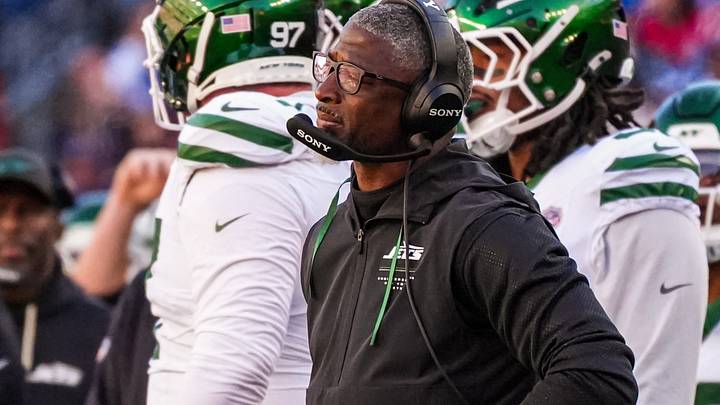
Jets head coach Aaron Glenn needs to wear Sunday's loss to the Patriots on the chin. His coaching decisions throughout the game directly resulted in holding the team back in a competitive 26-19 loss.
Was Glenn the only reason the Jets lost? Of course not. But as head coach, his decisions held the team back more than any failed execution throughout the game.
Here are five of the worst decisions he made on Sunday, beginning with...
5. Challenging an A.J. Brown completion
Talk about making an in-game decision that not only didn't matter, but actually hurt you in the long run despite winning it.
The situation: New England had a first-and-10 at the Jets' 42. New York held a 3-0 lead. The Patriots recorded a nine-yard completion to A.J. Brown that appeared to be an incomplete pass. Glenn challenged the call, won it, and the Patriots responded on 2nd and 10 with a 42-yard touchdown pass to Romeo Doubs (h/t NFL).
42-yard touchdown from Maye to Doubs!
— NFL (@NFL) October 18, 2026
NYJvsNE on CBS/Paramount+
Stream on @NFLPlus pic.twitter.com/tKpDzX136o
In short, Glenn challenged a low-leverage play and ended up getting burned on the very next play anyway.
Making matters even worse is the fact that, by using his first challenge in the game, Glenn basically couldn't use it for a couple of close plays in the second quarter, including a failed quarterback sneak that was challenge-worthy for the team at the time. Had Glenn challenged that play and failed, the team would have been down a timeout and a challenge. It altered how he coached the rest of the half.
And it was a mistake from the get-go.
4. David Bailey in coverage
Remember that 42-yard touchdown the Jets gave up that we just talked about? That play was a disaster from the beginning because 1) the team had busted coverage deep and 2) only had three players rushing the quarterback.
After the game, Glenn said that there was a miscommunication.
That's not really our plan to be able to do something like that. I've got to do a better job of making sure the communication is right when it comes to something like that.Aaron Glenn, Jets HC
Here's the problem: it wasn't the only time the team dropped David Bailey in coverage. Late in the first half, New York put Bailey over former All-Pro wide receiver Brown. Drake Maye naturally saw the mismatch and instantly targeted Brown for a first-and-goal situation. It led to a touchdown drive.
Does New England probably score on that drive anyway? Sure.
But New York is not getting the most out of their second overall pick if they are putting him over wide receivers. They need him to do the one thing he was drafted to do: Rush the quarterback.
3. Not kicking a FG to start second quarter
I will never truly understand the reason behind teams choosing to take points off the board early in games for the sake of going for touchdowns. In the case of Glenn's decision, he went against kicking a field goal twice in the first half: once from what would have been a 48-yard kick and another from 57 yards out.
These aren't easy kicks, of course, but if Sanders had made just one, it would have changed how the Patriots and Jets operated in the first half. Instead of a 10-3 game, for example, it could have been a 10-6 or 10-9 game going into the half.

Instead, New York missed on back-to-back third downs and was playing from down two scores for most of the contest.
There's being aggressive, and taking points off the board for your team. Glenn took points off the board on Sunday.
2. Defensive alignment
Last season, stopping the run was a major problem for the Jets. They finished fourth-worst in the league in that mark. To correct that, New York brought in run-stoppers like T'Vondre Sweat. Instead, the run defense has remained at a disadvantage, and the front alignment is all out of whack.
Glenn has done a great job this season of making the most of this defensive unit. They held the Patriots to a league-average point total on Sunday and forced two turnovers. But when the team needed stops, the Jets failed miserably to get them. A big reason for that is that their alignment and execution struggled throughout the game.
New York needs to do a better job of getting its defensive line to match the personnel it is going up against. In part, Glenn must adjust to the personnel he has and not force pieces into the defense he wants.
1. Offensive stubbornness
There is such a thing as being too prideful in who you want to be across the NFL. Coaches try to make their teams look a certain way instead of adjusting to the roster they currently have. Glenn is a prime example of that, especially on offense.
New York wants to run the football. The Jets have made that clear over the last two seasons. In fact, before going into Sunday's contest, Glenn again talked about wanting to run the football. It doesn't matter that Gang Green had success in targeting the middle of the field on Sunday.
It didn't even matter that the Jets were able to get big plays across the board.
When the team was in short-yardage situations, the team tried to run the ball. And got stuffed each time.
Glenn's pride in how he wants the team to be, in many ways, cost the Jets dearly all game. None more than the offensive side of the ball. Until that changes, this unit will seem capped as fans wait to see whether it becomes more of a passing unit going forward.
Get Jets On SI straight to your inbox: sign up for our free newsletter here.
 Add us as a preferred source on Google

Nick covers the NFL for Sports Illustrated/FN. He was previously on the New York Jets' beat for AM New York with prior experience reporting on the New York Islanders and the Philadelphia Eagles. The New York City resident is also an Adjunct Professor at LIU Brooklyn.
Follow nick_faria1720