%20%20--%3E%0A%3Csvg%20version%3D%221.1%22%20id%3D%22Layer_1%22%20xmlns%3D%22http%3A%2F%2Fwww.w3.org%2F2000%2Fsvg%22%20xmlns%3Axlink%3D%22http%3A%2F%2Fwww.w3.org%2F1999%2Fxlink%22%20x%3D%220px%22%20y%3D%220px%22%0A%09%20width%3D%2239px%22%20height%3D%2240px%22%20viewBox%3D%220%200%2039%2040%22%20enable-background%3D%22new%200%200%2039%2040%22%20xml%3Aspace%3D%22preserve%22%3E%0A%3Cpath%20fill%3D%22%23FFFFFF%22%20d%3D%22M38.5%2C7H28.2v26h10.3V7z%22%2F%3E%0A%3Cpath%20fill-rule%3D%22evenodd%22%20clip-rule%3D%22evenodd%22%20fill%3D%22%23FFFFFF%22%20d%3D%22M26.1%2C25.5c0%2C5.8-4.1%2C7.5-12.9%2C7.5C3.9%2C33%2C0%2C31.2%2C0%2C25.2v-1.1h11.6%0A%09v2.4c0%2C0.7%2C0.1%2C1.4%2C1.2%2C1.4c1%2C0%2C1.2-0.4%2C1.2-1.3v-0.9c0-1.6-0.9-1.6-3.5-2.2C2.2%2C21.7%2C0%2C19.7%2C0%2C15.3v-0.9C0%2C9.3%2C5.5%2C7%2C12.9%2C7%0A%09c10.2%2C0%2C12.8%2C2.6%2C12.8%2C7.4v1.8h-11v-2.9c0-0.6-0.4-1.1-1.2-1.1c-0.6%2C0-1.2%2C0.4-1.2%2C1.1v0.9c0%2C1.5%2C0.9%2C2%2C3.3%2C2.5%0A%09c8%2C1.6%2C10.5%2C3.3%2C10.5%2C7.5V25.5z%22%2F%3E%0A%3C%2Fsvg%3E%0A)
The Marvin Harrison Jr. Trade Is Going to Have a Clear Winner
In this story:
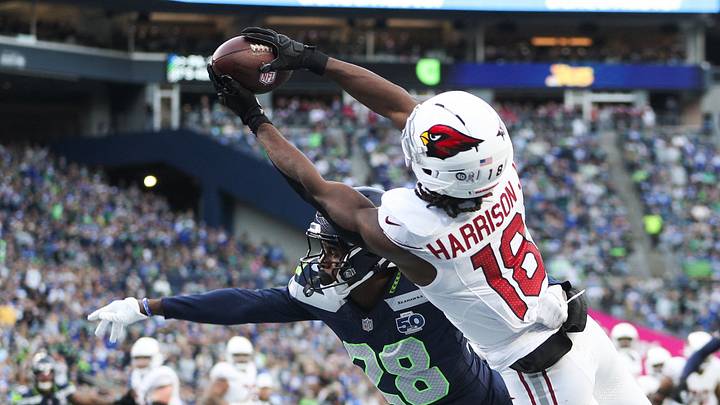
When Texans coach DeMeco Ryans effusively announced the Marvin Harrison Jr. trade at the postgame podium Sunday (an unusual occurrence to say the least), it was either buoyed by the relief he felt from clubbing the Titans or from the excitement he felt in a deal that could potentially end up as a complete and total fleecing.
While Houston always seemed like Harrison’s eventual destination, thanks to the Texans’ need at wide receiver and the relationship between Harrison and his former collegiate quarterback, C.J. Stroud, it was also surprising to anyone who knows the Texans and the ethos their roster was built on.
Ryans and general manager Nick Caserio specifically grade their players in part on effort levels during adverse situations. A primary part of Caserio’s and Ryans’s formula is dependent on how a player acts on the sidelines, how a player acts when a team is trailing and how a player executes a given play when he is not the featured performer. Generally speaking, the Texans also pride themselves on performing in adverse conditions. For example, the oppressive heat, which forces the team to practice early in the mornings, is often a calling card for the team to tout their relative toughness.
You can see this clearly in the types of players Houston has kept over the years, the ones they’ve traded away and the ones they have acquired via trade. It doesn’t mean that every acquisition is a success; it just means Caserio and Ryans certainly have a “type” and that the roster is built on the foundation of hypercompetitive alpha types (who, by the way, can take on different forms; some are silent and stoic, some are loud and headbanging, etc.). And, I don’t think it’s controversial to say that Harrison does not profile as Houston’s type on the surface. That—to me—is why this trade is fascinating, because either the Cardinals are getting hosed by losing a player who didn’t want to perform for them or the Texans are moving off their mark in a desperate attempt to salvage their Super Bowl aspirations. Either of those would be incredibly significant developments. I don’t think there is a middle ground on this deal in particular.
First, let’s be as fair to Harrison as possible. I think, to begin with, he is the type of player who can make the wide receiver position look effortless. There are certain NFL players—think Isiah Pacheco, even though he’s a running back—who make every route look like they are running away from an avalanche, which, by nature, leads us to believe they are high-effort players. There are others, like Derrick Henry, who move like a 250-pound gazelle. Harrison is closer to the latter. I don’t think his former head coach in Arizona, Mike LaFleur, was completely covering for Harrison when he said his running style is just different, which can sometimes imply a lack of effort to the outside.
Of course, there are some plays where it looks like Harrison is not operating close to 100%, or is struggling to stave off physical coverage, or is losing more than other top-tier talent in contested-catch situations. That is difficult to argue when looking at the totality of his targets from 2025 and 2026. Again, I am not saying he lacks toughness or physicality. I’m not saying it’s a ton of snaps. And there’s no doubt that Harrison is being placed under a much more stringent microscope given his lineage and draft slot (which is unfair!). I am saying that, knowing how the Texans operate, if Harrison were to copy-and-paste some of these plays into a Texans practice, it would be immediately noticed. Now, I am also willing to concede this to Harrison: The gravity of his situation in Arizona, which could, understandably, start to compound and feel hopeless, could have also swirled into a head-spinning couple of seasons. After all, he just turned 24. He was asked to take on a ton of responsibility and the burden of his family legacy very early in his career and has seldom had consistently above-average QB play. This could have also contributed to his lower-end play speed (interestingly enough, Caserio does have a history of throwing out certain speed metrics, like cornerback Kamari Lassiter’s infamous 40-yard dash).
Ryans, during his press conference on Monday, specifically mentioned how hard of a worker he heard Harrison was. Backing that is an interesting story from the Arizona Republic, which noted that Harrison purchased himself a $50,000 specialty machine to aid him in additional post-practice workouts. I am curious what intel Caserio and Ryans had on Harrison, who was the No. 4 pick in a year when the Texans did not have a first-round pick and—my guess—would likely not be doing a ton of work on a wide receiver prospect everyone labeled as generational and far too talented to drop into the second round.
We’ll soon find out. And while every trade deserves the benefit of nuanced analysis, it would seem that Harrison is either going to develop into a player worthy of a pretty generous pick compensation or he isn’t.
I don’t mean this to sound conspiratorial or controversial, but if Harrison plays up to his potential, we would have to ask serious questions about his tenure in Arizona, and what he, specifically, relayed to friends like Stroud about the situation with the Cardinals and why it would be different in Houston. Again, I would find it hard to believe that, on its face, Harrison presented the kind of tape that made Caserio and Ryans scream “that’s my guy,” although I could be dead wrong (it wouldn’t be the first time). They are leveraging information and betting on the potential arising from a change in scenery.
If this is merely a blind asset value play—Houston plans on continuing to pick late in drafts and has to acquire top-end talent the only way it knows how, which is to bet on failing assets from other clubs—my argument is that it will be more noticeable in Houston, particularly. You can read more about the Texans in my cover story in our season preview magazine, but my hope is that you’ll take away how staunchly competitive and ruthless this roster is. Caserio, Ryans and multiple coaches asserted how difficult it would be to “fake” being the type of player who would work on the Texans.
Undermining a culture is the fastest way to dissolve years of progress. Of course, the opposite is true. The bones of truly great rosters can be built by seeing the potential and culture fit where others miss it. The most famous example, of course, being Caserio’s mentor Bill Belichick cutting through the noise and finding Randy Moss not only the perfect evolution of his offense, but the kind of affable personality the Patriots’ locker room needed. I’m not comparing Harrison to Moss. The upside of this trade won’t be nearly as high. Moss already had several of the greatest seasons in the history of the position. But, given the stakes, the gamble itself is probably as significant. Similarly, there are plenty of examples of teams that just missed the mark from a roster construction standpoint and started bringing in “almost there” players or high-upside swings in an effort to mitigate the quality of players they were able to consistently land in the bottom half of the first round.
Houston is betting that Harrison is a Texan at heart. It’s also willing to stake its entire ethos on that bet. The Cardinals, in turn, believe he is not, and are willing to ship a potential star wideout at a discount in order to rid themselves of the project and stockpile more draft assets more in line with their current philosophy. Some trades can be win-win, but it’s easy to see why this one will not be.
 Add us as a preferred source on Google
Conor Orr is a Senior Writer for Sports Illustrated with more than 15 years of experience covering the NFL. His work has been cited in Best American Sportswriting and has won a PFWAA award. Prior to Sports Illustrated, he covered both the Giants and Jets for The Star-Ledger. Conor lives in New Jersey with his amazing wife and three children.
Follow author