%20%20--%3E%0A%3Csvg%20version%3D%221.1%22%20id%3D%22Layer_1%22%20xmlns%3D%22http%3A%2F%2Fwww.w3.org%2F2000%2Fsvg%22%20xmlns%3Axlink%3D%22http%3A%2F%2Fwww.w3.org%2F1999%2Fxlink%22%20x%3D%220px%22%20y%3D%220px%22%0A%09%20width%3D%2239px%22%20height%3D%2240px%22%20viewBox%3D%220%200%2039%2040%22%20enable-background%3D%22new%200%200%2039%2040%22%20xml%3Aspace%3D%22preserve%22%3E%0A%3Cpath%20fill%3D%22%23FFFFFF%22%20d%3D%22M38.5%2C7H28.2v26h10.3V7z%22%2F%3E%0A%3Cpath%20fill-rule%3D%22evenodd%22%20clip-rule%3D%22evenodd%22%20fill%3D%22%23FFFFFF%22%20d%3D%22M26.1%2C25.5c0%2C5.8-4.1%2C7.5-12.9%2C7.5C3.9%2C33%2C0%2C31.2%2C0%2C25.2v-1.1h11.6%0A%09v2.4c0%2C0.7%2C0.1%2C1.4%2C1.2%2C1.4c1%2C0%2C1.2-0.4%2C1.2-1.3v-0.9c0-1.6-0.9-1.6-3.5-2.2C2.2%2C21.7%2C0%2C19.7%2C0%2C15.3v-0.9C0%2C9.3%2C5.5%2C7%2C12.9%2C7%0A%09c10.2%2C0%2C12.8%2C2.6%2C12.8%2C7.4v1.8h-11v-2.9c0-0.6-0.4-1.1-1.2-1.1c-0.6%2C0-1.2%2C0.4-1.2%2C1.1v0.9c0%2C1.5%2C0.9%2C2%2C3.3%2C2.5%0A%09c8%2C1.6%2C10.5%2C3.3%2C10.5%2C7.5V25.5z%22%2F%3E%0A%3C%2Fsvg%3E%0A)
Did Argentina Let Lionel Messi Down in 2026 World Cup Final Defeat?
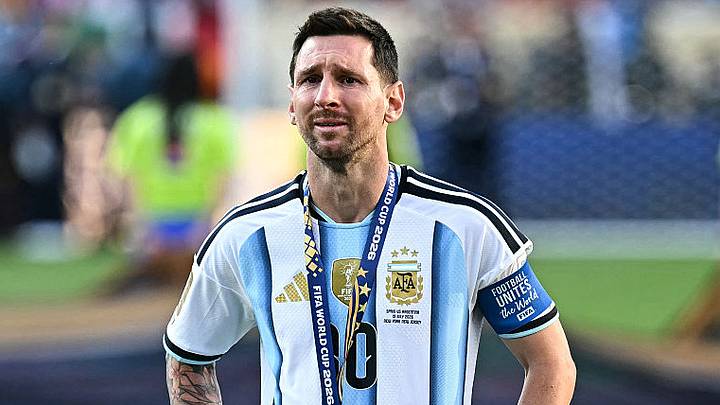
Spain defeated Argentina 1–0 in the 2026 World Cup final, and Lionel Messi was emphatically contained in what was most certainly his last-ever World Cup appearance—but it was not entirely his fault.
Argentina was vastly outplayed by a superior Spain that dominated the title match from start to finish. La Roja lived up to its status as favorite and deservedly dethroned La Albiceleste to win its second-ever World Cup title. Although extra time was required, Luis de la Fuente’s side categorically outclassed Argentina, and the scoreline could’ve easily been more lopsided.
There’s enormous merit to Argentina getting within 90 minutes of back-to-back world titles, but it’s also true that the 2026 version of La Albiceleste didn’t get close to reaching the collective level of the side that won the 2022 World Cup. Argentina was a flawed team that required multiple miraculous comebacks to even reach the final.
It also took Messi delivering the most productive World Cup campaign of his career at 39 years old, bagging eight goals and four assists during the tournament—both career-highs across his record-six World Cup appearances.
In the final, though, Messi was rather anonymous and was unable to write a fairytale ending to his illustrious World Cup career. Still, it became pretty obvious that any hope of Messi producing yet another magical performance was unrealistic from the moment the starting whistle blew.
Argentina’s Game Plan Doomed Lionel Messi

As great, productive and influential as Messi was all summer, it’s impossible to deny the fact that, at 39, he’s no longer able to overcome every scenario to succeed. He needs a specific context to thrive. In Sunday’s final, manager Lionel Scaloni’s Argentina made sure to do the opposite, opting to play in a style that didn’t maximize Messi’s strengths, but rather exposed his weaknesses.
Scaloni opted to drop Leandro Paredes from the starting lineup in favor of wide-man Nicolás González, hinting at Argentina acknowledging that the midfield would be dominated by Spain. Once La Albiceleste relinquished the central areas—usually its most dangerous—without a fight, their main avenues to generate danger were playing long balls behind the defense for runners to collect or winning second balls. As unglamorous and ineffective as that may seem, that was Argentina’s gamble.
Spain controlled possession from the start, but even when it lost it, La Roja didn't press Argentina’s backline, it settled in a mid-block to obstruct passing lanes. As a result, Argentina’s midfielders had to either drop deep to get involved or were not involved at all. La Albiceleste preferred to jump the line with long balls aimed at González or Julián Álvarez—none were successful.
But Argentina didn’t seem to care about its own inoperativeness and lack of attacking threat, totally prioritizing destroying Spain’s advances rather than creating danger for itself. From the moment the game started, Scaloni’s side played in a manner which screamed that it felt like the only way it could potentially win the game was surviving until an eventual penalty shootout. Without the ball and with an ineffective midfield, Messi was another spectator for much of the match.
Argentina as a whole completed just 74 passes inside Spain’s half through 90 minutes—and only a further five during the first period of extra time. It might’ve been aided by Thomas Tuchel and England’s DNA, but to put this in perspective, Argentina completed 229 passes inside England’s own half in the final 45 minutes of the semifinal four days earlier, and it was Messi who inspired the late comeback.

When Ferran Torres scored the match winner in the 106th minute, Spain had 20 total shots with 12 of them on target, meanwhile, Argentina had an xG of zero without a single shot attempt. The conservative, reactionary and almost fearful style Argentina opted to utilize for 107 of the 120-minute final made Messi a hostage of his own context. His touches came far from the dangerous areas, often with more red shirts than teammates around him, leading to him losing possession 15 times.
Argentina’s game-plan bordered on cowardly, and Messi wasn’t the only victim of it. Alvarez is widely considered one of the best strikers in the world, yet he only registered 29 touches and 12 successful passes without a single shot attempt as he unsuccessfully led the line alongside Messi. He was no longer on the pitch when La Albiceleste finally decided to attack.
Once Argentina fell behind, it discarded its conservative style out of necessity in search of an equalizer and, to no one’s surprise, those were Messi’s most influential minutes. Messi nearly took Mikel Merino’s head off with his side’s first shot of the final in the 117th minute. He then slid a clever pass for Giuliano Simeone who whipped a low cross that Marcos Senesi nearly tapped-in to level the scoring a minute past the 120 mark.
Messi needs an front-footed game plan where Argentina applies pressure on its rivals and actively looks to generate danger in order to succeed. Against Spain, Argentina was largely uninterested in finding the back of the net until it became necessary, and it was only then that it looked for Messi to pull off yet another a miracle. This time, though, it was too little, too late.
Lionel Messi’s Stats at the World Cup Final
Statistic | Tally |
|---|---|
Touches | 54 |
Shots | 1 |
Shots on Goal | 0 |
Chances Created | 0 |
Touches in the Opposition Box | 0 |
Acurate Passes | 27 |
Passes Into Final Third | 7 |
Passing Accuracy | 79% |
Successful Dribbles | 3/3 |
Expected Goals | 0.03 |
Expected Assists | 0.04 |
Argentina’s World Cup Messi-Dependence Was Alarming

If there’s one Argentina player that can hold his head up high despite the heartbreaking defeat, then it’s Messi. At 39, he produced a simply sensational World Cup campaign and was the biggest reason—if not the only—why Argentina’s title defense lasted as long as it did.
Incredibly, Argentina’s reliance on Messi was more significant in 2026 than it was when it lifted the trophy in 2022. It’s a testament to Messi’s everlasting brilliance that, at 39 years old and three years removed from elite competition at the club level, he’s still capable of putting a team on his back and carrying it all the way to a World Cup final.
On the other hand, though, it’s an indictment of the rest of the Argentina squad. The majority of Scaloni’s men play in some of the biggest clubs teams and best leagues in the world, yet they were all vastly outperformed by Messi.
It will be interesting to see what comes next for Argentina. This was most likely Messi’s last major international tournament and Scaloni could also be headed to the exit door, marking the end of the greatest era in Argentina’s history.
Without Messi and the manager that helped Argentina rediscover its winning mentality, it’s hard to envision Argentina truly challenging the best national teams in the world for major silverware in the near future.
Stats Lionel Messi Led Among All Argentina Players in 2026 World Cup
Statistic | Messi’s Tally | Second Best |
|---|---|---|
Goals | 8 | Lautaro Martínez (3) |
Assists | 4 | Six Players (1) |
Expected Goals | 5.3 | Lautaro Martínez (2.8) |
Expected Assists | 4.2 | Rodrigo De Paul (1.2) |
Shots per 90 mins | 4.3 | Lautaro Martínez (2.9) |
Chances Created | 25 | Nicolás González (6) |
Big Chances Created | 8 | Lautaro Martínez (3) |
Successful Dribbles per 90 mins | 3.4 | Thiago Almada (1.5) |
READ THE LATEST WORLD CUP NEWS, ANALYSIS AND INSIGHT FROM SI FC
 Add us as a preferred source on Google
Roberto Casillas is a writer for SI FC, focusing primarily on FC Barcelona, the Mexico National Team, Liga MX and all things Latin American football. Born and raised in Mexico City, he developed a deep passion for football from an early age and fell in love with Cruz Azul. The once future star of Mexican football still likes to showcase what’s left of his talent on the Sunday league pitch. He’s also a big fan of the New England Patriots—so much so he moved to the region for four years—, Chicago Cubs and is a life-long Formula 1 follower. When he takes a break from sports, he enjoys traveling the world, watching the latest great TV show, going to concerts and spending plenty of time with friends and family.