%20%20--%3E%0A%3Csvg%20version%3D%221.1%22%20id%3D%22Layer_1%22%20xmlns%3D%22http%3A%2F%2Fwww.w3.org%2F2000%2Fsvg%22%20xmlns%3Axlink%3D%22http%3A%2F%2Fwww.w3.org%2F1999%2Fxlink%22%20x%3D%220px%22%20y%3D%220px%22%0A%09%20width%3D%2239px%22%20height%3D%2240px%22%20viewBox%3D%220%200%2039%2040%22%20enable-background%3D%22new%200%200%2039%2040%22%20xml%3Aspace%3D%22preserve%22%3E%0A%3Cpath%20fill%3D%22%23FFFFFF%22%20d%3D%22M38.5%2C7H28.2v26h10.3V7z%22%2F%3E%0A%3Cpath%20fill-rule%3D%22evenodd%22%20clip-rule%3D%22evenodd%22%20fill%3D%22%23FFFFFF%22%20d%3D%22M26.1%2C25.5c0%2C5.8-4.1%2C7.5-12.9%2C7.5C3.9%2C33%2C0%2C31.2%2C0%2C25.2v-1.1h11.6%0A%09v2.4c0%2C0.7%2C0.1%2C1.4%2C1.2%2C1.4c1%2C0%2C1.2-0.4%2C1.2-1.3v-0.9c0-1.6-0.9-1.6-3.5-2.2C2.2%2C21.7%2C0%2C19.7%2C0%2C15.3v-0.9C0%2C9.3%2C5.5%2C7%2C12.9%2C7%0A%09c10.2%2C0%2C12.8%2C2.6%2C12.8%2C7.4v1.8h-11v-2.9c0-0.6-0.4-1.1-1.2-1.1c-0.6%2C0-1.2%2C0.4-1.2%2C1.1v0.9c0%2C1.5%2C0.9%2C2%2C3.3%2C2.5%0A%09c8%2C1.6%2C10.5%2C3.3%2C10.5%2C7.5V25.5z%22%2F%3E%0A%3C%2Fsvg%3E%0A)
How Arsenal Fared in the Premier League After Every Previous Community Shield Victory
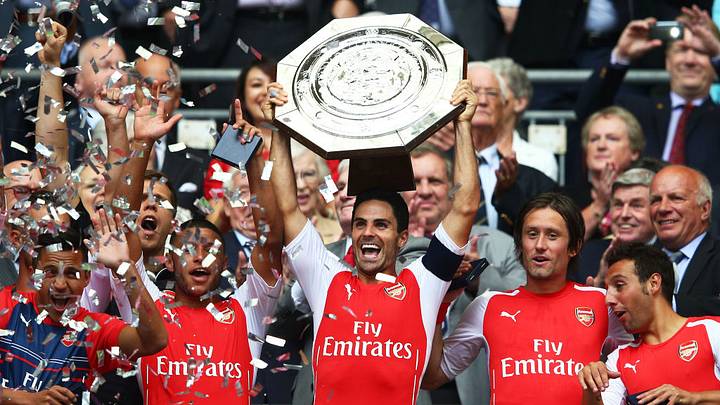
Only Manchester United (21) have claimed more Community Shield wins than Arsenal, who were victorious for the 18th time in Sunday’s 2026 edition.
The Gunners’ 3–0 victory over an Enzo Maresca-led Manchester City has sparked belief that back-to-back titles are inevitable for the current Premier League champions, who fought off the Cityzens last season to win the English top flight for the first time in 22 years.
Arsenal may not have evolved drastically over the summer (yet), but there‘s an assurance surrounding Mikel Arteta’s unit that their most likely title rivals simply don’t boast. The unknowns and concerns about Man City were laid bare in Cardiff, with the aura of Pep Guardiola and his stalwarts no longer able to mask potential deficiencies.
However, this certainly isn’t the first time lofty expectations have been thrust upon the Gunners off the back of an impressive Community Shield triumph.
Arsenal are nine-time winners of England’s sorry answer to what those on the continent dress up as their “Super Cup” since 1992, and here’s how they’ve fared in the subsequent Premier League campaigns.
1998–99

Arsenal’s first Community Shield victory of the Premier League era came via a comprehensive 3–0 victory over Manchester United.
The Gunners had been the previous Premier League champions, although not dominant. They notched 78 points and lost their final two games of the season, which meant United finished just a point adrift.
Arsenal were in the midst of their foreign revolution, while United were regenerating from within. One would subsequently embark on a historic season, but it wasn’t the Community Shield victors.
While the Red Devils shook off their defeat at Wembley to claim an unprecedented treble, Arsenal were pipped to the post by a point domestically. A 1–0 defeat at Leeds United on the penultimate matchday of the season proved costly.
Ultimately, the Gunners were made to rue an indifferent start to their title defense, drawing four of their first five games and winning three of their opening eight.
1999–00

Arsenal returned to the Premier League’s unofficial curtain-raiser the following year, once again defeating the Red Devils. They were 2–1 winners this time around.
Thierry Henry joined the club from Juventus in August after the Gunners suffered in Ian Wright’s absence the season prior, and the new addition quickly got to work in north London. The swaggering Frenchman ended his debut campaign as Arsenal’s top scorer with 26 goals, including 17 in the Premier League.
However, Henry’s arrival was unable to catapult Arsène Wenger‘s side beyond United. The Red Devils waltzed to back-to-back titles with the second-highest points haul in Premier League history at the time (91).
Arsenal won eight straight games between March and May, but a run of three wins in 11 on either side of New Year’s Day meant they were unable to mount a serious challenge.
2002–03

Lee Dixon and Tony Adams’s retirements left gaping voids in the Arsenal locker room, with Patrick Vieira succeeding Adams as captain ahead of the 2002–03 season.
The Gunners were the reigning champions, and in Henry, they boasted the division’s most electrifying performer. Their primary challengers, United, fought fire with fire by signing Ruud van Nistelrooy in 2001, but the poaching Dutchman was outgunned by Golden Boot winner Henry in year one.
The tables turned the following year, with United’s center forward beating Arsenal’s swashbuckling superstar to the individual honor. Van Nistelrooy’s 25 Premier League goals proved crucial in the Red Devils regaining the Premier League title, as the Gunners let a precarious advantage slip down the stretch.
Wenger’s men led the way from mid-November until early April, spurning the chance to retake control of the title race when they drew 2–2 with United at Highbury. Their hopes were dealt a final blow by the struggling Leeds United, who famously beat the Gunners 3–2 to confirm their survival and all but hand the title to their historic rivals.
2004–05

Expectations couldn’t have been loftier for Arsenal in 2004–05. Lauding themselves as ’Invincible’ the season prior, despite failing to bypass the semifinals in both domestic cups and losing to Chelsea in the Champions League quarterfinals, the Gunners struggled to see who could possibly usurp them.
Arsenal had gone at it with United for the best part of a decade, and it was the Red Devils who brought the Gunners’ 49-match unbeaten run to a close in October.
However, it wasn’t Sir Alex Ferguson’s team that dethroned the ’Invincibles’. An alternative threat had emerged closer to home, with José Mourinho disrupting the competition’s aristocracy.
Chelsea cantered to their first Premier League title, attaining a then-record 95 points and conceding just 15 goals. Mourinho’s counterattacking Blues were revolutionaries, with the ideals of Wenger and Ferguson suddenly appearing noticeably antiquated.
Arsenal recovered late in the season to beat United to second, but they were 12 points off the champions.
2014–15

A prolonged trophy drought meant Arsenal had a 10-year wait between Community Shield appearances. However, they certainly made up for lost time at Wembley in 2014, thumping the champions Man City 3–0.
The Gunners had struggled to fiercely compete for the title since the end of the 2000s, and spent the start of the 2010s fighting for Champions League soccer.
Wenger was hugely encouraged by his team’s emphatic win over City, given their issues against the Premier League’s best the season before, and the arrival of a genuine star, Alexis Sánchez, from Barcelona allowed supporters to dream of an unlikely title push.
Sánchez hit the ground running, and ended the season with 16 Premier League goals, but a 2–0 defeat to Chelsea in October highlighted the gulf in class between the eventual champions and an Arsenal team that did well to finish third.
There was no dogged fight to finish above north London rivals Tottenham Hotspur to fourth spot, even if they did notch four fewer points compared to 2013–14.
2015–16

The Leicester City season.
Arsenal twice defeated the miraculous champions, including a dramatic 2–1 victory at the Emirates Stadium on Valentine’s Day, yet still finished 10 points off the Foxes.
Danny Welbeck’s stoppage-time winner in their second outing against Leicester closed the gap to just two points, but Arsenal criminally failed to build on that momentum. Back-to-back defeats to Man Utd and, inexplicably, at home to Swansea City, meant north London rivals Spurs emerged as the most likely team to compromise Leicester’s fantasy.
The Gunners enjoyed an unbeaten end to the season, but the damage had already been done. It was a two-horse race down the stretch, yet Arsenal still found a way to finish the season in second. Spursy.
2017–18

Factions of an increasingly toxic fanbase had long turned on Wenger, and 2017–18 would prove to be the Frenchman’s last at Arsenal after 22 years.
Wenger’s final season in charge started with a penalty shootout victory over Chelsea in the Community Shield, but would return the club’s lowest Premier League points haul since 1995–96.
Arsenal mustered just 63 and finished sixth, despite spending almost $140 million to reinvent their attack via the signings of Alexandre Lacazette and Pierre-Emerick Aubameyang.
The pair combined for 24 Premier League goals, impressive considering that Aubameyang didn’t arrive until January, but a poor defensive record meant they succumbed to 13 defeats, still the joint-third most they’ve suffered in the competition.
2020–21

Arsenal’s performance against Liverpool at Wembley pointed towards potential competence for the season ahead. However, 2020–21 proved to be another bleak campaign in north London, with Mikel Arteta almost losing his job less than a year in the position.
A 2–1 defeat to Everton in December meant Arsenal had gone seven games without a win, slipping to 15th in the table. Had the Gunners suffered again on Boxing Day, Arteta, still viewed with suspicion by much of the fanbase, surely would’ve been sacked.
But the Spaniard changed tack. He pivoted to Hale End, and Emile Smith Rowe inspired a crucial 3–1 victory over Chelsea at an empty Emirates. They won four of their next five, allowing the under-fire manager to breathe again.
There was no drastic resurgence during the second half of the season, but a five-game winning run to end the year meant they crept up to eighth. Arteta’s project would continue.
2023–24

By this point, Arsenal were re-emerging as a serious Premier League force. 2022–23 proved pivotal in reshaping perceptions, and they may well have beaten a treble-winning Man City to the title had William Saliba not picked up a back injury in the spring.
Declan Rice’s $131 million arrival from West Ham United depicted their newfound might, and they went toe-to-toe with the Cityzens again.
There was a novelty about the previous season’s Arsenal team that rendered them endearing. This iteration operated with the ruthless swagger of a cold-hearted champion. However, their single blemish down the stretch (a 2–0 defeat to Aston Villa in April) proved fatal, as City were perfect when it mattered most.
Arsenal’s 89-point haul was their biggest since the ’Invincibles’, but never before have they gone on to lift the Premier League title after starting the season by winning the Community Shield.
 Add us as a preferred source on Google
James Cormack is a writer for SI FC. Opting against a football coaching undergraduate degree at the last minute, he instead decided to take on a six-month internship with 90min in 2019 and hasn't looked back. Cormack's current SEO focus means he tends to venture to the land of match previews and predicted lineups, but he also has a wealth of experience in news and feature writing. A passion for soccer's history and the European game often takes his work beyond the familiarity of the Premier League, but it's with Tottenham Hotspur where his strongest allegiance lies.