%20%20--%3E%0A%3Csvg%20version%3D%221.1%22%20id%3D%22Layer_1%22%20xmlns%3D%22http%3A%2F%2Fwww.w3.org%2F2000%2Fsvg%22%20xmlns%3Axlink%3D%22http%3A%2F%2Fwww.w3.org%2F1999%2Fxlink%22%20x%3D%220px%22%20y%3D%220px%22%0A%09%20width%3D%2239px%22%20height%3D%2240px%22%20viewBox%3D%220%200%2039%2040%22%20enable-background%3D%22new%200%200%2039%2040%22%20xml%3Aspace%3D%22preserve%22%3E%0A%3Cpath%20fill%3D%22%23FFFFFF%22%20d%3D%22M38.5%2C7H28.2v26h10.3V7z%22%2F%3E%0A%3Cpath%20fill-rule%3D%22evenodd%22%20clip-rule%3D%22evenodd%22%20fill%3D%22%23FFFFFF%22%20d%3D%22M26.1%2C25.5c0%2C5.8-4.1%2C7.5-12.9%2C7.5C3.9%2C33%2C0%2C31.2%2C0%2C25.2v-1.1h11.6%0A%09v2.4c0%2C0.7%2C0.1%2C1.4%2C1.2%2C1.4c1%2C0%2C1.2-0.4%2C1.2-1.3v-0.9c0-1.6-0.9-1.6-3.5-2.2C2.2%2C21.7%2C0%2C19.7%2C0%2C15.3v-0.9C0%2C9.3%2C5.5%2C7%2C12.9%2C7%0A%09c10.2%2C0%2C12.8%2C2.6%2C12.8%2C7.4v1.8h-11v-2.9c0-0.6-0.4-1.1-1.2-1.1c-0.6%2C0-1.2%2C0.4-1.2%2C1.1v0.9c0%2C1.5%2C0.9%2C2%2C3.3%2C2.5%0A%09c8%2C1.6%2C10.5%2C3.3%2C10.5%2C7.5V25.5z%22%2F%3E%0A%3C%2Fsvg%3E%0A)
Arsenal Reminded of the One Thing Even Mikel Arteta Can’t Control
LONDON — The famed chess grandmaster Savielly Tartakower once said: “Chess, that game of logic par excellence, consists of luck, luck and more luck.” The same could very much be said about soccer, perhaps without the logic.
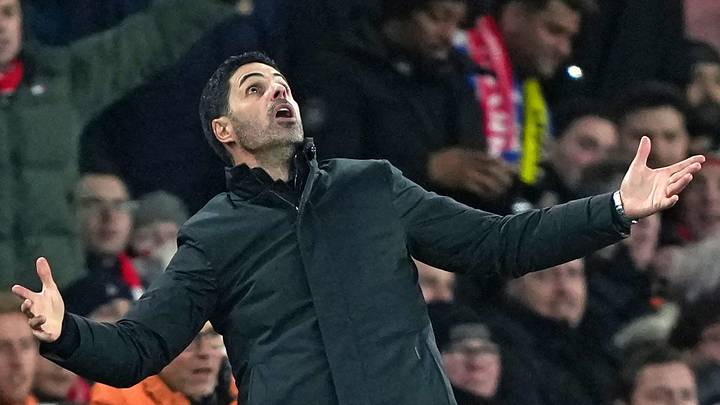
Mikel Arteta is a manager who strives to diminish the role of fortune, good or bad, with every action he takes from the helm of Arsenal. This is a coach who prepared his players for real world travel delays by deliberately disrupting their preseason schedule, forcing the team bus on circuitous routes and holding back team meals so that everyone is on their toes at all times, even for dinner.
Yet, try as he might, even Arteta cannot bend the cosmic fates to his will. He cannot stop David Raya picking up an injury from an innocuous fall or guarantee that Viktor Gyökeres converts a header from point-blank range with the Borussia Dortmund goal at his mercy. All he can do is put his players in a position to have the best chance of succeeding, cross his fingers and hope.
Despite the frustrations which will come from a second successive draw in the Champions League on Tuesday night, Arteta can take pride in the way he presented his team at the altar of the gods of good luck. As the manager claimed himself, that sense of steeliness which usually accompanies anything other than a win distinctly lacking, it was “a brilliant performance.” Sometimes, the gods simply don’t smile upon you.
Arsenal Did Enough to Win the Game

There was a snarl and snap to the way Arsenal started against Dortmund in this Champions League league phase clash, charging around with the same crispness as the air in north London. Two Dortmund players hadn’t completed a single pass by the time Gyökeres thumped the hosts into a thoroughly deserved 10th-minute lead.
That vicious dipping effort which looped over Gregor Kobel with a crackle in the night sky was comfortably Arsenal’s hardest chance of the evening. They would squander far more presentable openings.
Gyökeres himself was guilty of the most glaring miss, stooping in the 75th minute to steer a header wide of goal from five yards out. That was one of 30 efforts that Arsenal racked up against the current Bundesliga leaders, yet only four were on target.
The Gunners amassed an xG of 2.32—Dortmund couldn’t get past one—and took an outrageous 56 touches in their visitors’ penalty box. Noni Madueke and Gyökeres alone had more possession in the opposition 18-yard area (24 touches) than the entire visiting team combined (23).
"We could have won the game in many different ways,” Gyökeres fairly surmised post-match. “We played well and created a lot of chances, we deserved to win the game, but sometimes it is like that.”
As Arteta repeatedly throughout his postmatch press conference: “There is an element of luck.”
Dizzying Carousel Responsible for Attacking Blitz
Dortmund’s rise to the summit of the Bundesliga, sitting above the imperious Bayern Munich with an unbeaten record from 10 matches, is built on their defensive solidity. Only one team in Europe’s top five leagues can match their miserly record of just seven goals conceded: Arsenal.
Yet, the parsimonious outfit was flummoxed by the dizzying rotation of personnel from their hosts. Gyökeres’s opener serves as a perfect example.
Dortmund captain Nico Schlotterbeck is left to lament the room Arsenal’s striker was afforded on the edge of the box, but he and his fellow center back, Waldemar Anton, had been forced to drop off by Ben White’s run into the box. That’s the same Ben White who started the evening as Arsenal’s right back making a typical center forward’s run.

White’s opposite fullback Piero Hincapié also spent much of the contest bursting beyond Dortmund’s backline, stretching the vertical height of the visitors like a black and yellow accordion at full extension. This created ample room between the lines for Gyökeres and, in particular, Martin Ødegaard to wreak havoc; Arsenal’s captain racked up a prodigious nine chances created—yet none of them were converted.
Madueke skewed wide on multiple occasions, Declan Rice clanked the post, and a meaty wall of Dortmund shirts managed to guard the goal line on the rare occasions when Kobel was bypassed. Somehow, the ball only found the net once.
Hincapié and White were simply fulfilling the same versatile briefs that Riccardo Calafiori and Jurriën Timber carried out so well against Newcastle United on Saturday. Much like in midweek, Arsenal’s attacking dominance was only rewarded with a draw.
“It was unbelievable that sometimes the ball doesn’t end up in the back of the net,” Arteta sighed on Tuesday. “How in hell, some of the balls haven’t gone inside, I don’t know.”
Arteta’s Brilliant 11-Player Solution to Goalkeeper Conundrum

Arsenal’s wastefulness in front of goal has been a feature of the season, but Arteta was presented with a new problem to solve against Dortmund: his goalkeeper. David Raya
The absence of Arsenal’s injured first-choice goalkeeper had prompted much hand-wringing about the prospect of the Gunners being forced to turn to their distinctly inferior No. 2, Kepa Arrizabalaga.
Arteta has spent the last few years steadily building the deepest roster on the continent, putting himself in a position where he can replace every single outfielder with someone invariably as good. Bukayo Saka, for instance, hasn’t appeared for more than a month, yet Arsenal have scarcely noticed. Raya was upheld as the exception to this rule. Until now.
Raya is an average shot-stopper but an utterly elite passer. The goalkeeper with the most line-breaking passes of any custodian in the division was once hailed by Jürgen Klopp as a player who “should have No. 10 on his back.” Arrizabalaga, by comparison, is not famed for his footwork. In fact, this was a specific weakness openly targeted by Pep Guardiola when Manchester City romped to the 2026 Carabao Cup title.
During Arrizabalaga’s last full campaign as a first-choice starter, he averaged 0.6 line-breaking passes per game for Bournemouth. He completed 10 against Borussia Dortmund.
Rather than undergoing a career-defining transformation of skillset, Arrizabalaga was given the perfect passing lanes to pick out those penetrative balls—thanks again to Arsenal’s dizzying rotations. When White wasn’t bursting into the box, he was tucking into central midfield, filling the gap vacated by one of Declan Rice or Myles Lewis-Skelly, who were constantly pinwheeling around in an attempt to receive the ball. Hincapié also rotated into a center back position just to confuse Dortmund that much more.
Arrizabalaga’s limitations were still prevalent; he looked as shaky as ever from crosses and spilled a tame shot to the feet of Jobe Bellingham who was denied the winning goal by the offside flag. Yet, five days before Arsenal take on Manchester City again, the concerns about Arrizabalaga’s passing aren’t quite so piercing any more.
“It was a brilliant performance,” Arteta gushed, “the way we played, we deserve to be very, very pleased. There is very little more we can do as a team.”
 Add us as a preferred source on Google

Grey Whitebloom is an Associate Editor for SI FC. He has more than half a decade of experience in sports media across all its various guises, from the fast-paced demands of news articles and match reports to in-depth research required for features. Whitebloom graduated with a First Class Honours from University College London and found himself named on the Dean’s List—which, despite his initial fears, was a form of praise rather than a punishment. He specialises in the Premier League and Champions League, while also boasting an extensive track record of La Liga coverage.