%20%20--%3E%0A%3Csvg%20version%3D%221.1%22%20id%3D%22Layer_1%22%20xmlns%3D%22http%3A%2F%2Fwww.w3.org%2F2000%2Fsvg%22%20xmlns%3Axlink%3D%22http%3A%2F%2Fwww.w3.org%2F1999%2Fxlink%22%20x%3D%220px%22%20y%3D%220px%22%0A%09%20width%3D%2239px%22%20height%3D%2240px%22%20viewBox%3D%220%200%2039%2040%22%20enable-background%3D%22new%200%200%2039%2040%22%20xml%3Aspace%3D%22preserve%22%3E%0A%3Cpath%20fill%3D%22%23FFFFFF%22%20d%3D%22M38.5%2C7H28.2v26h10.3V7z%22%2F%3E%0A%3Cpath%20fill-rule%3D%22evenodd%22%20clip-rule%3D%22evenodd%22%20fill%3D%22%23FFFFFF%22%20d%3D%22M26.1%2C25.5c0%2C5.8-4.1%2C7.5-12.9%2C7.5C3.9%2C33%2C0%2C31.2%2C0%2C25.2v-1.1h11.6%0A%09v2.4c0%2C0.7%2C0.1%2C1.4%2C1.2%2C1.4c1%2C0%2C1.2-0.4%2C1.2-1.3v-0.9c0-1.6-0.9-1.6-3.5-2.2C2.2%2C21.7%2C0%2C19.7%2C0%2C15.3v-0.9C0%2C9.3%2C5.5%2C7%2C12.9%2C7%0A%09c10.2%2C0%2C12.8%2C2.6%2C12.8%2C7.4v1.8h-11v-2.9c0-0.6-0.4-1.1-1.2-1.1c-0.6%2C0-1.2%2C0.4-1.2%2C1.1v0.9c0%2C1.5%2C0.9%2C2%2C3.3%2C2.5%0A%09c8%2C1.6%2C10.5%2C3.3%2C10.5%2C7.5V25.5z%22%2F%3E%0A%3C%2Fsvg%3E%0A)
FIFA Rules on USMNT’s Bizarre Water Break Strategy for 2026 World Cup
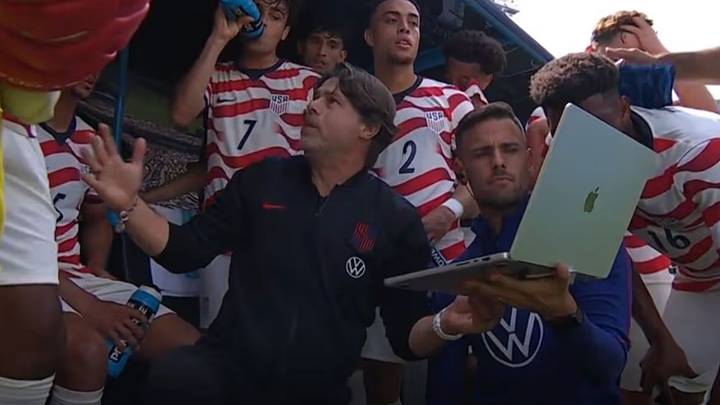
The U.S. men’s national team made waves on Sunday when manager Mauricio Pochettino pulled out his laptop just 22 minutes into the international friendly against Senegal, beckoning his players to huddle around the screen to review tactics and film during the first half’s brief water break—a strategy that is now likely to revolutionize the World Cup this summer.
The sight of nearly 30 sweaty grown men crouched in front of a small screen quickly became a viral laughing matter online, with even the national team joining in on the fun.
The USMNT went on to defeat No. 14 globally-ranked Senegal 3–2, though, and the laughter quickly turned into genuine pondering: “Wait a minute, are the U.S. on to something?”
Dialing up a dub. 💻 pic.twitter.com/eSvZs1iOIA
— U.S. Soccer Men's National Team (@USMNT) May 31, 2026
FIFA has implemented two mandatory, three-minute hydration breaks per World Cup match this summer, which will come midway through each half. Hydration breaks were first introduced to the game ahead of the 2022 World Cup in Qatar as a method to combat rising temperatures. Often, they are used only when temperatures reach unbearable levels, but at the 2026 World Cup, they will also serve as three-minute advertising breaks, effectively splitting the game into four quarters rather than two halves.
Historically, these water breaks have been used simply as a chance for players to catch their breath, stretch a little and receive a few words of encouragement from the coaching staff; however, Pochettino has since proven that it is possible to host an entire coaching session within that short timeframe.
“I think it’s very helpful for the players to see actions,” Pochettino said after the match. “It’s not only to tell what you want (them) to improve, or what they need to do. When they see the image, it’s really important now.”
Although it proved beneficial in the international friendly, Pochettino was uncertain if FIFA would allow him to continue with this water break tactic in official matches, stating, “We’ll see now in the World Cup if they can allow that.” It has since been determined that Pochettino’s antics are permissible—and, thus, likely to be adopted by other countries this summer; however, the unorthodox strategy does come with some limitations.
Rules Regarding Laptops on the Sidelines

It is commonplace to see team’s analysts using tablets on the bench. FIFA does not prevent a head coach from utilizing technology on the sideline during a match, and that permissibility will extend to water breaks even for a pseudo-coaching session, an anonymous source from soccer’s governing body told The Athletic, stating that laptops can be used at all times.
The electronic equipment must be “mobile and handheld,” though, so it can be no bigger than a laptop, according to the regulations of the International Football Association Board (IFAB).
This means that the vision of 30 sweaty men crowded around a single tablet or laptop is far from over this summer, a strategy likely to be adopted by other nations seeking any means to stay ahead in soccer’s most competitive affair.
The one rule Pochettino broke on Sunday, though, was allowing the USMNT’s on-field players to step over the touchline and into the dugout. Those currently in the match will have to remain on the field at all times during water breaks, forced to hover from just beyond the touchline to see a screen.
The 2026 FIFA World Cup kicks off on June 11 across the U.S., Canada and Mexico, the first time the tournament is co-hosted by three countries. It is also the first edition of the tournament to include 48 teams, and now it is likely to be the first to see teams hold tactical coaching sessions at each quarter-mark of a game.
READ THE LATEST WORLD CUP NEWS, ANALYSIS AND INSIGHT FROM SI FC
 Add us as a preferred source on Google
Sophia Vesely is a writer, reporter and editor for SI FC, with an emphasis on North American coverage. Her experience comes from regional journalism as a former sports reporter for the Orlando Sentinel, Dallas Morning News and Seattle Times. Vesely graduated from Swarthmore College, where she played collegiate soccer as a wingback. She specializes in MLS, NWSL and NCAA soccer.