%20%20--%3E%0A%3Csvg%20version%3D%221.1%22%20id%3D%22Layer_1%22%20xmlns%3D%22http%3A%2F%2Fwww.w3.org%2F2000%2Fsvg%22%20xmlns%3Axlink%3D%22http%3A%2F%2Fwww.w3.org%2F1999%2Fxlink%22%20x%3D%220px%22%20y%3D%220px%22%0A%09%20width%3D%2239px%22%20height%3D%2240px%22%20viewBox%3D%220%200%2039%2040%22%20enable-background%3D%22new%200%200%2039%2040%22%20xml%3Aspace%3D%22preserve%22%3E%0A%3Cpath%20fill%3D%22%23FFFFFF%22%20d%3D%22M38.5%2C7H28.2v26h10.3V7z%22%2F%3E%0A%3Cpath%20fill-rule%3D%22evenodd%22%20clip-rule%3D%22evenodd%22%20fill%3D%22%23FFFFFF%22%20d%3D%22M26.1%2C25.5c0%2C5.8-4.1%2C7.5-12.9%2C7.5C3.9%2C33%2C0%2C31.2%2C0%2C25.2v-1.1h11.6%0A%09v2.4c0%2C0.7%2C0.1%2C1.4%2C1.2%2C1.4c1%2C0%2C1.2-0.4%2C1.2-1.3v-0.9c0-1.6-0.9-1.6-3.5-2.2C2.2%2C21.7%2C0%2C19.7%2C0%2C15.3v-0.9C0%2C9.3%2C5.5%2C7%2C12.9%2C7%0A%09c10.2%2C0%2C12.8%2C2.6%2C12.8%2C7.4v1.8h-11v-2.9c0-0.6-0.4-1.1-1.2-1.1c-0.6%2C0-1.2%2C0.4-1.2%2C1.1v0.9c0%2C1.5%2C0.9%2C2%2C3.3%2C2.5%0A%09c8%2C1.6%2C10.5%2C3.3%2C10.5%2C7.5V25.5z%22%2F%3E%0A%3C%2Fsvg%3E%0A)
Four Takeaways From Gianni Infantino’s Head-Turning World Cup Press Conference
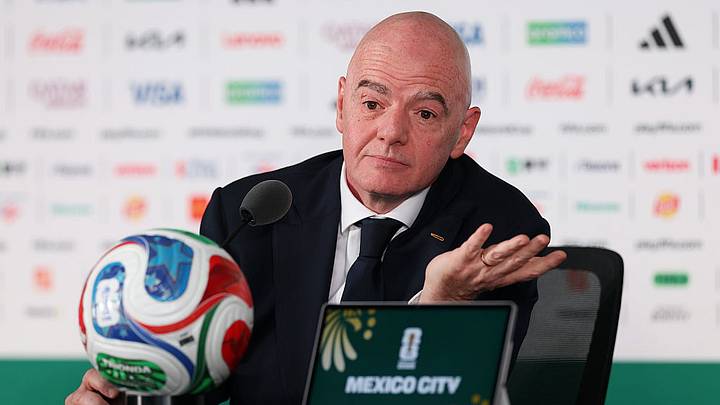
FIFA president Gianni Infantino sat down for a rare press conference on the eve of the 2026 World Cup, where he fielded question after question about Iran, ticket prices and visas, among other controversies, ahead of this summer’s showpiece event.
Infantino’s responses to such concerns were not as poor as his infamous comments ahead of the Qatar edition four years ago, but they still downplayed major issues overshadowing the biggest World Cup in history, none more so than when he urged the public to just “chill” over Somali referee Omar Artan’s visa troubles.
The 56-year-old also took the time to heavily praise—and defend—FIFA, while showing love to the United States, Canada and Mexico, even if all three host nations come with “issues” the governing body must deal with in order to put on soccer’s grandest spectacle.
Here’s four major takeaways from Infantino’s head-turning press conference on Wednesday evening.
Infantino Reacts to Artan’s Denied U.S. Visa

The most important—and telling—part of Infantino’s media availability centered around Artan, the Somali referee who was denied entry to the United States due to an “association with suspected members of terror organizations.”
Artan was turned away at Miami International Airport despite believing he had the correct and necessary documentation and visa to enter the country, where he was supposed to become the first referee from Somalia at a World Cup.
Instead, he was interviewed for 11 hours before he was ultimately banned by U.S. Customs and Border Protection and then put on a plane to Istanbul.
“It is unfortunate what happened to the referee from Somalia,” Infantino said. “But we don’t control everything. We try, we will discuss, we will speak, we will see. Sometimes it’s good to chill, relax. We work on everything, we try to solve everything. Sometimes to immediately start screaming and shouting has the opposite effect of finding a solution.
“Believe me when I tell you, we always try to find solutions. But we need to respect we are not the kings of the world who can rule over governments and police forces. We are a sports organization.”
Iran’s Involvement Heavily Celebrated

Along with President Donald Trump’s widespread immigration crackdown, the United States’s military conflict with Iran also brought more political controversy to a tournament Infantino reiterates is supposed to “unite” the world.
Iran previously ruled out competing at the tournament after the U.S. military launched air strikes against the nation, one of which killed leader Ayatollah Ali Khamenei. President Trump also discouraged the team from participating, but Infantino remained steadfast that Iran was welcome to take part in the competition they rightfully qualified for.
“Let me say that on Iran, I am very happy because I went to see the Iranian team in Türkiye in March this year,” Infantino revealed.
“People were saying Iran couldn’t come to the World Cup. I promised them they will come and if I have to go on a bus to Tehran and drive them here I will do that. Their answer was, ‘We will take the bus and drive ourselves if needs be. We qualified and we want to play.’
“This is the spirit of football. There are challenges; it’s not easy, but I don’t know who else would have been able to ensure in these circumstances ... that Iran could come and play. When Iran plays, the stadium will be full and I hope there will be a positive atmosphere because this is football; it’s about people forgetting their realities and focusing on a match and a team.
“I am very happy we managed to get Iran to come and play. I am proud of the work of my team.”
Infantino Has No Regrets About Partnering With the U.S.

Much of the controversy looming over this summer’s World Cup would not exist—at least to such an extent—if the United States was not one of the host nations. Yet Infantino continued to publicly back the U.S., set to host 78 of the competition’s 104 matches, when asked if he regrets partnering with the host nation.
“No, I don’t regret anything,” he said. “I have been organizing events for the last 30 years. I am used to dealing with issues. The press conference [from 2022] I made you all remember that. The issues there were different, probably bigger. I was feeling I had to give a voice to all those unheard. There are issues; it’s normal for an event of this magnitude.
“I would always hope there are no issues, but hey, that’s what we have to deal with. Some come from the United States, some from Canada, some from Mexico. We deal with all of them and we have the same positive spirit. Hopefully, we can solve all of them. Probably not, but we still do our best.”
There were even shouts to boycott the World Cup due to President Trump’s immigration policies, previous tariff threats and desire to annex Greenland, but the tournament will unfold with 48 teams as planned, competing largely across the U.S.
Ticket Prices Continue to Demand Explanations

Even without the political backdrop of the 2026 World Cup, there would still be one pressing issue dominating the headlines: ticket prices. Infantino and FIFA have come under fire for months over their outrageous prices for this summer’s tournament, pricing out many fans across the globe.
Certain host cities have taken the initiative to try and ensure supporters get to attend matches for affordable prices, with New York City mayor Zohran Mamdani leading the way. He secured 1,000 tickets priced at $50 for city residents, earning praise from Infantino ... though the FIFA president quickly followed it with praise for his own team’s efforts.
“Let me say one thing. Let me congratulate Mayor Zohran Mamdani from New York. He put on sale 1,000 tickets at $50 and since then, he got fantastic news [coverage]. We put on sale 130,000 at $60 and we don't get great news. Probably he has better communication people than us. I want to congratulate him for that initiative.” Infantino said.
“The starting price at $60; the market is what it is. If you sell it at a lower price point, it would have gone on secondary markets at much higher prices. Where would the money go then? To those who organized secondary or black market activities and not to football.
“Every dollar that comes in goes back to the development of football. We have one competition every four years. The 47 other months out of the 48, we are investing this revenue in growth. Nobody else is doing that.”
READ THE LATEST WORLD CUP NEWS, ANALYSIS AND INSIGHT FROM SI FC
 Add us as a preferred source on Google
Amanda Langell is a writer and editor for SI FC. Born and raised in New York City, her first loves were the Yankees, the Rangers and Broadway before Real Madrid took over her life. Had it not been for her brother’s obsession with Cristiano Ronaldo, she would have never lived through so many magical Champions League nights 3,600 miles away from the Bernabéu. When she’s not consumed by Spanish and European soccer, she’s traveling, reading or losing her voice at a concert.
Follow AmandaLangell