%20%20--%3E%0A%3Csvg%20version%3D%221.1%22%20id%3D%22Layer_1%22%20xmlns%3D%22http%3A%2F%2Fwww.w3.org%2F2000%2Fsvg%22%20xmlns%3Axlink%3D%22http%3A%2F%2Fwww.w3.org%2F1999%2Fxlink%22%20x%3D%220px%22%20y%3D%220px%22%0A%09%20width%3D%2239px%22%20height%3D%2240px%22%20viewBox%3D%220%200%2039%2040%22%20enable-background%3D%22new%200%200%2039%2040%22%20xml%3Aspace%3D%22preserve%22%3E%0A%3Cpath%20fill%3D%22%23FFFFFF%22%20d%3D%22M38.5%2C7H28.2v26h10.3V7z%22%2F%3E%0A%3Cpath%20fill-rule%3D%22evenodd%22%20clip-rule%3D%22evenodd%22%20fill%3D%22%23FFFFFF%22%20d%3D%22M26.1%2C25.5c0%2C5.8-4.1%2C7.5-12.9%2C7.5C3.9%2C33%2C0%2C31.2%2C0%2C25.2v-1.1h11.6%0A%09v2.4c0%2C0.7%2C0.1%2C1.4%2C1.2%2C1.4c1%2C0%2C1.2-0.4%2C1.2-1.3v-0.9c0-1.6-0.9-1.6-3.5-2.2C2.2%2C21.7%2C0%2C19.7%2C0%2C15.3v-0.9C0%2C9.3%2C5.5%2C7%2C12.9%2C7%0A%09c10.2%2C0%2C12.8%2C2.6%2C12.8%2C7.4v1.8h-11v-2.9c0-0.6-0.4-1.1-1.2-1.1c-0.6%2C0-1.2%2C0.4-1.2%2C1.1v0.9c0%2C1.5%2C0.9%2C2%2C3.3%2C2.5%0A%09c8%2C1.6%2C10.5%2C3.3%2C10.5%2C7.5V25.5z%22%2F%3E%0A%3C%2Fsvg%3E%0A)
The Great Alphonso Davies Obsession Distracts From Canada’s True Strength
INGLEWOOD, Calif. — There surely cannot have been another World Cup as obsessed with individuals as this summer’s tournament.
Every Portugal game is reduced to a debate about Cristiano Ronaldo’s mobility; Argentina’s players have deliberately made Lionel Messi the central focus while Brazil’s success on the pitch feels like a sideshow to season 27 of the Neymar Jr soap opera. Canada’s campaign thus far has been dominated by a player who hadn’t even played for the country in 15 months.
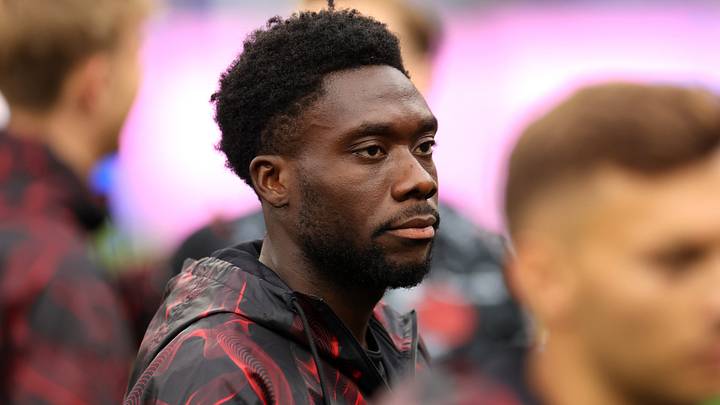
The great obsession with Alphonso Davies is fascinating. The jet-heeled Bayern Munich wide man is undoubtedly the most successful and technically gifted player of his Canadian generation, if not any other. As Jesse Marsch freely admits, Davies is his team’s “best player.” Yet, availability is a quality to laud—and something that Davies has not been blessed with.
WIN FIFA WORLD CUP 2026™ FINAL TICKETS

It was 463 days prior that Davies last appeared for Canada, tearing the cruciate ligament in his knee on the very same SoFi Stadium pitch which served as the setting for his return in the round of 32 against South Africa on Sunday. A hamstring injury sustained on the eve of the tournament had limited Davies to the role of “decoy” during Canada’s group stage, with Marsch admitting to deliberately lying about the left-footer’s fitness to make Switzerland “think about him.”
Davies was little more than a decoy even when he got onto the pitch for the final 15 minutes. There was a sharp burst to begin his cameo, pirouetting past a cluster of yellow shirts with the sort of skill which belies his inherent quality, and he prodded a deft pass through for Jonathan David to fire a rare shot on target from inside the penalty area. But Davies was clearly playing within himself. He looked afraid of sprinting—which is a major issue for a player whose greatest strength is his speed.
When Marsch turned to his anointed talisman in the 75th minute, Stephen Eustáquio raced across to the touchline to hand Davies the captain’s armband he had been wearing. Ironically enough, it would be the selfless stand-in skipper who led Canada to its first ever World Cup knockout win.
Davies’s Spotlight Stolen by Canada’s Heartbeat

Eustáquio used the word “crazy” four times when he was once asked to describe his journey as a Canada player.
Much like Davies, the industrious midfielder has endured his own injury struggles, missing the best part of 2019 year a torn knee ligament only to make his debut in a 4–1 thrashing from the U.S. But the well-traveled ratter at the base of midfield didn’t wilt, establishing himself as a regular under John Herdman before retaining Marsch’s trust.
Eustáquio’s teammate Richie Laryea captured the understated impact of his compatriot best: “He does a lot of the dirty work that people don’t really recognize.” A crisp volley swept into the bottom corner makes Eustáquio’s impact much easier to recognize, but his influence stretches far beyond his first international goal in two-and-a-half years.
Even this summer, Eustáquio wasn’t fit enough to start against Switzerland, with his absence sorely felt in a 2–1 reverse. Despite a bruising encounter on top of the existing issue he was carrying, the 29-year-old pushed through the pain barrier to get his deserving glory against South Africa.
“In a group of incredible human beings,” Marsch gushed after the final whistle, “maybe Steph is the most deserving to have a moment like that.”
Canada’s True Strength Lies in the Collective

South Africa boss Hugo Broos is not an individual to dish out praise lightly. This is a manager who claimed Czechia “don’t like to play football” and is no stranger to lambasting his own players. Yet, in the eyes of the demanding Dutchman, Canada is a “modern team.”
“Modern football is more than technique,” Broos argued, “modern football is also power and speed.” As he lamented, Canada boast that in abundance.
This high-intensity identity is the single greatest example of Marsch’s impact. The U.S. coach trained in the Red Bull school of furious energy proudly declared: “Some teams press to win the ball back, we press to punish.”
South Africa’s inherent approach is to draw on that pressure, relying on the technical excellence of all 11 players on the pitch to find a way through the waves of sprinting figures. It worked on occasion on Sunday, but Canada is not a headless chicken running around blindly. As Marsch reflected, the team “kept our patience,” deliberately letting goalkeeper Ronwen Williams put his foot on the ball to hold a compact shape before jumping forward when South Africa gave in to the boos of the crowd.
It was fitting that Eustáquio’s first touch to set himself before scoring the game’s only goal in stoppage time was the act of winning back possession on the edge of South Africa’s box.
“Our structure, our discipline and our commitment to make the game hard on them, was what won us the match,” Marsch insisted. Not any single player, least of all Davies.
READ THE LATEST WORLD CUP NEWS, ANALYSIS AND INSIGHT FROM SI FC
 Add us as a preferred source on Google
Grey Whitebloom is an Associate Editor for SI FC. He has more than half a decade of experience in sports media across all its various guises, from the fast-paced demands of news articles and match reports to in-depth research required for features. Whitebloom graduated with a First Class Honours from University College London and found himself named on the Dean’s List—which, despite his initial fears, was a form of praise rather than a punishment. He specialises in the Premier League and Champions League, while also boasting an extensive track record of La Liga coverage.