%20%20--%3E%0A%3Csvg%20version%3D%221.1%22%20id%3D%22Layer_1%22%20xmlns%3D%22http%3A%2F%2Fwww.w3.org%2F2000%2Fsvg%22%20xmlns%3Axlink%3D%22http%3A%2F%2Fwww.w3.org%2F1999%2Fxlink%22%20x%3D%220px%22%20y%3D%220px%22%0A%09%20width%3D%2239px%22%20height%3D%2240px%22%20viewBox%3D%220%200%2039%2040%22%20enable-background%3D%22new%200%200%2039%2040%22%20xml%3Aspace%3D%22preserve%22%3E%0A%3Cpath%20fill%3D%22%23FFFFFF%22%20d%3D%22M38.5%2C7H28.2v26h10.3V7z%22%2F%3E%0A%3Cpath%20fill-rule%3D%22evenodd%22%20clip-rule%3D%22evenodd%22%20fill%3D%22%23FFFFFF%22%20d%3D%22M26.1%2C25.5c0%2C5.8-4.1%2C7.5-12.9%2C7.5C3.9%2C33%2C0%2C31.2%2C0%2C25.2v-1.1h11.6%0A%09v2.4c0%2C0.7%2C0.1%2C1.4%2C1.2%2C1.4c1%2C0%2C1.2-0.4%2C1.2-1.3v-0.9c0-1.6-0.9-1.6-3.5-2.2C2.2%2C21.7%2C0%2C19.7%2C0%2C15.3v-0.9C0%2C9.3%2C5.5%2C7%2C12.9%2C7%0A%09c10.2%2C0%2C12.8%2C2.6%2C12.8%2C7.4v1.8h-11v-2.9c0-0.6-0.4-1.1-1.2-1.1c-0.6%2C0-1.2%2C0.4-1.2%2C1.1v0.9c0%2C1.5%2C0.9%2C2%2C3.3%2C2.5%0A%09c8%2C1.6%2C10.5%2C3.3%2C10.5%2C7.5V25.5z%22%2F%3E%0A%3C%2Fsvg%3E%0A)
How Tom Brady Inspired Harry Kane to the Ballon d’Or
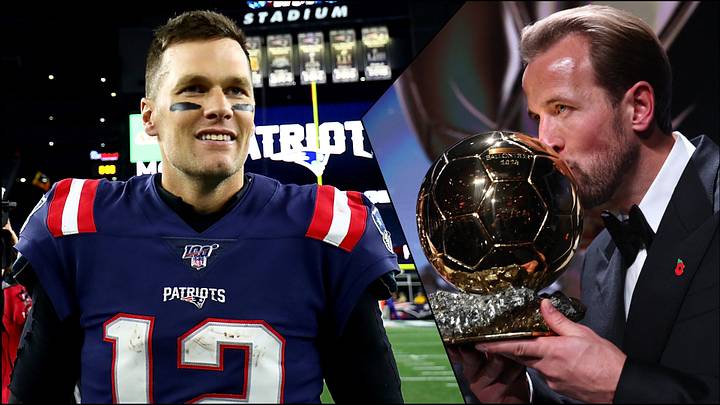
Tumbling down dark YouTube rabbit holes can lead to founts of useless knowledge, inane conspiracy theories and, in the case of Harry Kane at least, the ultimate individual accolade soccer has to offer.
Thirteen years before Kane was stood in London, his home city, fighting off tears to accept the Ballon d’Or as the best men’s player on the planet, he had been sat on his couch in a rented apartment in Leicester contemplating his future in the sport.
A bright academy prospect at Tottenham Hotspur, the then-teenager was in the midst of his fourth loan spell in three years. It was not going well. Leicester City were in England’s second tier and locked in a sequence of one win in 13 games yet Kane still couldn’t force himself into the starting lineup.
“That was the first time in my career, I’d say, that the doubt crept in,” Kane would later tell The Players’ Tribune. “I just remember sitting in my flat and having this terrible realization of, like, If I can’t play for Leicester in the Championship ... how am I supposed to play for Spurs in the Premier League?”
Away from home in an unfamiliar city, Kane sank his spare time into his new hobby: NFL. The New England Patriots had caught the attention of the English forward who stumbled across an NFL Films documentary about star quarterback Tom Brady which had been illegally uploaded to YouTube. It would change his life.
📝 • Ballon d’Or 2026 Winners: Full List
The Parallels Between Brady and Kane
.@HKane 🤝@TomBrady
— NFL Films (@NFLFilms) July 5, 2026
Kane credits his American football idol as his inspiration to be great. pic.twitter.com/wtKaP9329j
The Brady Six followed the careers of the six quarterbacks drafted before Brady, who was infamously selected 199th overall before becoming the greatest in the history of the sport. Kane could not believe it.
“It just blew my mind—but in a good way. The film really struck a chord with me. Everyone was doubting Tom his whole life,” the striker reflected years later. “He reminded me of me. People were always making the same assumptions about me. [Saying:] ‘Well, you know, he doesn’t look like a proper striker.’”
Brady’s scouting report coming out of college read: “Poor build, skinny, lacks a really strong arm, can’t drive the ball downfield.” Kane was at the other extreme having been let go from Arsenal’s academy as an 8-year-old for being “a bit chubby.”
That rejection lit a flame in Brady—when the report is recanted to the quarterback in the documentary, he snipes: “That kind of gets me fired up.” It also sparked something in Kane.
“It was genuinely inspiring to me,” he recalled. “Brady believed in himself so much—and he just kept working and working, almost obsessively, in order to get better. It really connected with me. This might sound strange, but it really was like this light flicked on inside my head that day, right there on my sofa in Leicester—and all of a sudden, I said, ‘You know what? I’m going to do it. I’m going to work as hard as possible, and my chance is going to come, and I’m going to grab it.’”
It was an easy motivational tool for a player who has always prided himself on his work ethic. “I’m not a believer in it all being natural,” Kane’s former youth team coach at Spurs, Alex Inglethorpe, told BBC Sport when his former pupil first broke through. “I believe in working talent, and Harry is a working talent.” That attitude is why Inglethorpe described Kane as “his own best coach.” Although the player himself would point to a different manager.
Mauricio Pochettino’s Role in Kane’s Fairytale

Kane returned to Tottenham a few months after his Brady epiphany with an entirely new mindset. When manager André Villas-Boas suggested another loan away, he was stunned to hear his scarcely used youth team player say no.
“I’m gonna prove to you that I should be starting on this team,” Kane told the perplexed coach. “And you can tell me every Friday before the game that I don’t deserve that, and that I’m not going to play. And that’s fine. But I don’t want to go.”
It would not be until the final month of the season, following Villas-Boas’s departure, that Kane was belatedly given his chance. He scored in his first three Premier League starts for the club but was still considered third-choice when Mauricio Pochettino took over in 2014.
“When we arrived to Tottenham, when we saw Harry Kane, we said, ‘No, it’s a player that we need. He’s young. He needs to stay with us,’” Pochettino would later reveal. It still took 10 games of the new season for the current U.S. men’s national team coach to give the 20-year-old a regular run in the team but, as ever, Kane’s head never dropped. A 90th-minute winner against Aston Villa convinced Pochettino to take the gamble which would eventually present Tottenham with a new all-time top scorer and England with their first Ballon d’Or winner in 25 years.
As much as Brady lit the match, Pochettino stoked the flames of Kane’s talent. “No one has had a bigger impact on my career than Mauricio,” he would claim, name-checking the Argentine in his Ballon d’Or acceptance speech.
Brady, intriguingly, did not get a mention, although the pair have since met on several occasions, exchanging tales of their battles against adversity. Such is Kane’s enduring admiration for Brady, there is talk of him even taking a turn in the NFL as a kicker once his soccer career concludes.
Perhaps even more credit should be saved for that anonymous YouTube account which flouted copyright regulations to put Brady’s documentary within Kane’s grasp. Where was their shout-out?
 Add us as a preferred source on Google

Grey Whitebloom is an Associate Editor for SI FC. He has more than half a decade of experience in sports media across all its various guises, from the fast-paced demands of news articles and match reports to in-depth research required for features. Whitebloom graduated with a First Class Honours from University College London and found himself named on the Dean’s List—which, despite his initial fears, was a form of praise rather than a punishment. He specialises in the Premier League and Champions League, while also boasting an extensive track record of La Liga coverage.