%20%20--%3E%0A%3Csvg%20version%3D%221.1%22%20id%3D%22Layer_1%22%20xmlns%3D%22http%3A%2F%2Fwww.w3.org%2F2000%2Fsvg%22%20xmlns%3Axlink%3D%22http%3A%2F%2Fwww.w3.org%2F1999%2Fxlink%22%20x%3D%220px%22%20y%3D%220px%22%0A%09%20width%3D%2239px%22%20height%3D%2240px%22%20viewBox%3D%220%200%2039%2040%22%20enable-background%3D%22new%200%200%2039%2040%22%20xml%3Aspace%3D%22preserve%22%3E%0A%3Cpath%20fill%3D%22%23FFFFFF%22%20d%3D%22M38.5%2C7H28.2v26h10.3V7z%22%2F%3E%0A%3Cpath%20fill-rule%3D%22evenodd%22%20clip-rule%3D%22evenodd%22%20fill%3D%22%23FFFFFF%22%20d%3D%22M26.1%2C25.5c0%2C5.8-4.1%2C7.5-12.9%2C7.5C3.9%2C33%2C0%2C31.2%2C0%2C25.2v-1.1h11.6%0A%09v2.4c0%2C0.7%2C0.1%2C1.4%2C1.2%2C1.4c1%2C0%2C1.2-0.4%2C1.2-1.3v-0.9c0-1.6-0.9-1.6-3.5-2.2C2.2%2C21.7%2C0%2C19.7%2C0%2C15.3v-0.9C0%2C9.3%2C5.5%2C7%2C12.9%2C7%0A%09c10.2%2C0%2C12.8%2C2.6%2C12.8%2C7.4v1.8h-11v-2.9c0-0.6-0.4-1.1-1.2-1.1c-0.6%2C0-1.2%2C0.4-1.2%2C1.1v0.9c0%2C1.5%2C0.9%2C2%2C3.3%2C2.5%0A%09c8%2C1.6%2C10.5%2C3.3%2C10.5%2C7.5V25.5z%22%2F%3E%0A%3C%2Fsvg%3E%0A)
Ranking the 16 FIFA World Cup Stadiums
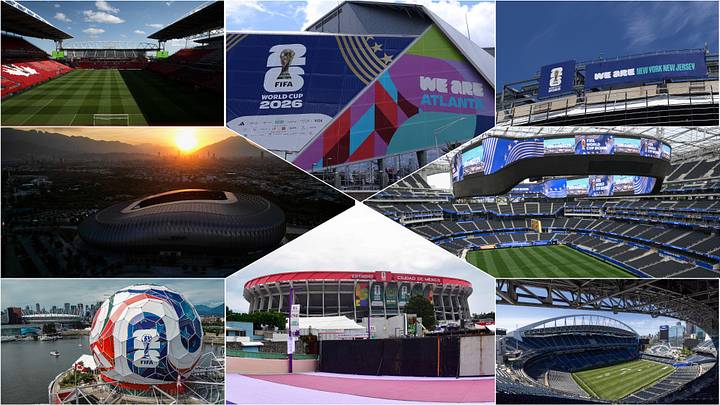
With 48 competing teams set to kick off across three countries and 16 cities, the 2026 FIFA World Cup stands as the largest edition in the tournament’s 96-year history and will feature a wide range of stadiums, as well.
Each city will feature a single stadium, and teams are generally located near those cities as well. While some locations are better than others, the stadia themselves couldn’t be more different either.
From historic soccer stadiums to modern and old NFL behemoths, as well as soccer-specific stadiums and partially temporary builds, this World Cup offers little in the way of venue consistency.
Already, Sports Illustrated has ranked each of the cities hosting the tournament. Here, we break down each stadium, set to welcome some of the world’s best soccer players.
16. MetLife Stadium (New York New Jersey Stadium)

MetLife Stadium, the home of the 2026 World Cup final, is one of the worst venues on the list. With most fans and tourists expected to stay in the tourist hotbed that is New York City, they will be subjected to several hours of transit to get to the venue, which sits in the converted swamplands of East Rutherford, N.J.
The venue itself, home to the NFL’s New York Giants and New York Jets, offers largely basic amenities compared to its NFL counterparts and has no roof, leaving fans to roast in the heat and humidity of a New York-New Jersey summer.
While the 82,000-capacity venue sits just across the Hudson River from New York City, it offers little in the way of outstanding elements and even the food has been poorly reviewed, leaving it among the bottom of many NFL stadium rankings.
15. Levi’s Stadium (San Francisco Bay Area Stadium)

The sun is going to be a massive challenge for fans in the San Francisco Bay Arena, as many will make their long journey from the city only to sit under a blazing Californian sky without any cover. In the past, heat stress-related issues among fans have been flagged.
The stadium itself features strong sightlines from three sides and hospitality suites on one end, offering a closer perspective than most, but it also breaks up the all-encompassing atmosphere.
14. Gillette Stadium (Boston Stadium)

The biggest gripe on Gillette Stadium, home to the NFL, MLS and NWSL, is that it’s simply not in Boston. Rather, it’s in the small town of Foxborough, Mass., forcing any fans staying in Boston into a lengthy travel day for matches.
As a stadium, though, it’s not terrible, but it offers little in standout qualities. There is no roof to block the Northeastern summer sun, the fans are quite far from the field, and the lack of an all-encompassing bowl limits its sound potential.
All that said, the stadium generally offers strong viewpoints and the lighthouse at the end of the ground serves as a fun identifying factor—even as it falls behind the other World Cup venues in the ranking.
13. BMO Field (Toronto Stadium)

BMO Field is the only MLS soccer-specific stadium that will host the World Cup, and it has been expanded from its usual 28,100 capacity to 45,000, with towering metal scaffolding stands on the ends to enclose the now four-sided stadium.
While the scaffolding has been wrapped in World Cup-branded designs, both stands will bask in the southern Ontario sun and summer humidity, without any cover for fans. Should rain come down or winds blow off nearby Lake Ontario, fans at the ends could also be caught in uncomfortable situations. Over $158 million was spent on improving the stadium, including its hospitality areas.
Yet, for as much as the expanded stands may not be ideal, the atmosphere will be intense, particularly for Canada’s first home match at a men’s World Cup. The fanbases of Senegal, Germany, Croatia and more will also be welcomed over the six games. At the same time, the fans will be closer to the pitch than in any other stadium, and many on the longer ends will be covered, making it likely the most intimate environment of the tournament.
12. Lincoln Financial Field (Philadelphia Stadium)

Lincoln Financial Field is linked to the city by public transit and is surrounded by food and drink options as part of Philadelphia’s stadium district, flanked by NHL/NBA and MLB venues. The 69,000-seat venue was built in 2003 and offers an exposed metal design and mismatched seating sections. However, its bowl and angled construction should allow significant noise to build up.
Philadelphia Eagles NFL fans are some of the most famous for tailgating, and the famous American practice will be allowed at the venue, even though it will be different than an NFL gameday due to the security perimeter. Still, Philadelphia fans at Lincoln Financial Field will offer their unique twist on the World Cup this summer—but don’t forget the sunscreen, there aren’t many covered seats.
11. BC Place (BC Place Vancouver)

BC Place Stadium has the best location of all World Cup stadiums, situated in the middle of downtown Vancouver near hotels, restaurants, bars and even beaches. The stadium itself, built in 1986, has undergone a $200 million renovation for the World Cup, the venue’s latest overhaul since it hosted the 2010 Winter Olympics.
The home of MLS and CFL teams, it is also the spot where the U.S. women’s national team won the 2015 Women’s World Cup and offers an outstanding atmosphere when full, as it will be for most World Cup matches—especially with at least two Canada home matches.
While the venue doesn’t have a bad sightline and features the largest video screen in Canada, it's going to be a toasty spot to catch a game. The retractable roof will not be open during matches due to the shadow it casts on the field, making hotter days a struggle for players and fans with no air conditioning.
From the outside, the venue will be one of the most spectacular as well. Fans will have easy access via rapid transit and its proximity to downtown, as well as a view of the mountains, the ocean and the Science World ball, decked out as the official World Cup match ball.
10. Arrowhead Stadium (Kansas City Stadium)

Completed in 1972, Arrowhead Stadium is one of the older venues at the World Cup and is nearing the end of its life cycle, with the NFL’s Kansas City Chiefs eyeing a new stadium in Kansas, across the state line from Arrowhead Stadium in Missouri.
The stadium is widely regarded as one of the best in-game atmospheres in the NFL, and that has been helped in recent years by the team’s success and the star power of the Travis Kelce-Taylor Swift relationship.
With the wide, tall oval design, the stadium offers clear sightlines of the action from anywhere, all beneath immense views of the big midwestern sky, with its primary detractors being the small video board for soccer and the lack of a roof.
9. NRG Stadium (Houston Stadium)

NRG Stadium has become a fixture in the soccer space, hosting the Concacaf Gold Cup final and Copa América several times. The 72,000 capacity facility also hosted the USMNT and Mexico’s final competitive game before the World Cup, when Mexico won the 2025 Gold Cup in front of a largely partisan crowd.
It featured the first retractable roof in the NFL, and the roof meets the field at different heights along the sidelines and at the ends, giving it a more square, boxy feel than most. However, it is anticipated that the roof, which allows natural sunlight when closed, will be closed for most of the tournament.
8. Hard Rock Stadium (Miami Stadium)

Of all the NFL-specific venues, Miami’s Hard Rock Stadium stands out for its intimate atmosphere, with fans closer to the pitch than at many other football-focused venues.
While it opened in 1987, it has become a key part of the U.S. sporting landscape, welcoming six Super Bowls, countless concerts and the 2024 Copa América final—which was an organizational disaster, with fans sneaking in through air vents and large delays amid searing heat. The events have prepared the venue for the grandeur of the World Cup. It has also welcomed baseball games and F1 races in its history.
The roof keeps most fans out of the sun and is one of the finest parts of the stadium, which has been renovated and touched up many times. In addition, the turquoise seats will make it one of the more identifiable venues of the tournament
7. Estadio Akron (Estadio Guadalajara)

The second-smallest stadium of the 2026 World Cup, the 2010-built Estadio Akron will offer an intimate and intense atmosphere and a unique construction, with the rim of the stadium open at the sides but still under a roof.
Home to Chivas Guadalajara in Liga MX, the 46,000-capacity venue features five levels of grandstands, ensuring less crowding in the bowl and concourse, as well as guaranteed strong sightlines.
A host for the 2011 Pan Am Games, it was built with major international events in mind—but the smaller, soccer-focused size makes the modern facility one of the best. The Mexico vs. South Korea match could be one of the best days the tournament has ever hosted.
6. AT&T Stadium (Dallas Stadium)

They say everything is bigger in Texas, and AT&T Stadium in Arlington, Texas, certainly fits that bill with its 94,000 capacity towering above the rest of the 15 venues across the World Cup.
Opened in 2009 as the home of the NFL’s Dallas Cowboys, it has hosted several key Mexico and USMNT matches in Concacaf competitions, often creating one of the most intense atmospheres when it is full.
Featuring a glass exterior, it will have its infamous window covered for the entire tournament. It will be air-conditioned throughout, offering a key respite for fans and players who will otherwise battle the Texas heat.
To top it all off, the stadium features a massive screen measuring 272 feet high and 160 feet wide, making it one of the largest jumbotrons in the world.
5. Estadio BBVA (Estadio Monterrey)

The Estadio BBVA serves as the home of CF Monterrey in Liga MX and is known for its intense atmosphere, modern amenities and a mountain view from one end behind the goal.
Built in 2015, it is one of the newest stadiums in Mexico, and, as part of the tournament, its design ensures strong sightlines from nearly every angle. Nicknamed “the steel giant” for its futuristic feel, the building’s roof blocks many elements and also keeps sound in.
While it won’t host a home match for Mexico, the fan experience for those who make it there will be among the best.
4. Lumen Field (Seattle Stadium)

The best noise at the World Cup will come from Lumen Field in Seattle. Located right in the downtown core, close to the water and other entertainment options, it will be among the easiest to get to and from during the tournament and also features one of the best sporting experiences in the United States.
The metal stands at each end, and the overall architecture, helps create a threateningly loud atmosphere that can sometimes register as seismic activity. The roof also shields large parts of the stand from the elements.
While the usual end-zone bleachers have been replaced by seats, the sound should still be immense, considering the stands remain metal.
Seattle and Lumen Field know how to host big events and have created an impressive atmosphere, most recently during the Seattle Seahawks’ run to the 2026 Super Bowl title and the Seattle Sounders’ 2025 Leagues Cup victory over Inter Miami.
3. SoFi Stadium (Los Angeles Stadium)

SoFi Stadium’s selection prevented FIFA from using Los Angeles’ famous Rose Bowl—and that’s too bad. Luckily, the home of the NFL’s LA Chargers and LA Rams is one of the nicest stadiums in the world and will be the perfect home for two of the USMNT’s group stage games, a round of 32 match and a quarterfinal.
While FIFA wanted the final to be in the Eastern Time Zone and under the New York spotlight, SoFi would likely have been the better venue for the event.
With a capacity of over 70,000, it offers a covered yet open-air experience, and the flowing roof architecture allows the breeze to come through, helping manage some temperature concerns.
It also features a circular 70,000-square-foot video board, the largest ever designed for a sports venue, which has hosted epic crowds for the Mexico national team in past Concacaf competitions.
2. Estadio Azteca (Mexico City Stadium)

If you’re looking for the best vibes and history from a World Cup stadium, you’ll find it at the Estadio Azteca in Mexico City. The venue for the World Cup opening match will host its third tournament, having previously staged the finals in 1970 and 1986.
While capacity has been limited by past renovations and the requirements needed to make it a potential NFL venue in the future, the touch-ups have also restored it to elite status.
Adding to an already strong and historic soccer venue, the flags of every participating nation are hung around the edge of the ground, as in past tournaments, bringing a touch of nostalgia to a tournament largely featuring newer venues.
1. Mercedes-Benz Stadium (Atlanta Stadium)

Mercedes-Benz Stadium is one of the newest World Cup stadiums, built in 2017, and offers plenty of marquee features. Its retractable roof, unlike some, casts no glaring shadows, and its 75,000 capacity offers very few poor sightlines.
Atlanta United are often lauded for having one of the best atmospheres in MLS, and when the team is among the league’s best, it will stand out among the World Cup venues.
After a push from Arthur M. Blank, Atlanta United’s owner, the venue will also feature several affordable concession options, with hot dogs, pretzels, popcorn, nachos and pizza all priced below $4 and the cheapest beer at $9.
READ THE LATEST WORLD CUP NEWS, ANALYSIS AND INSIGHT FROM SI FC
 Add us as a preferred source on Google
Ben Steiner is an American-Canadian journalist who brings in-depth experience, having covered the North American national teams, MLS, CPL, NWSL, NSL and Liga MX for prominent outlets, including MLSsoccer.com, CBC Sports, and OneSoccer.
Follow BenSteiner00