%20%20--%3E%0A%3Csvg%20version%3D%221.1%22%20id%3D%22Layer_1%22%20xmlns%3D%22http%3A%2F%2Fwww.w3.org%2F2000%2Fsvg%22%20xmlns%3Axlink%3D%22http%3A%2F%2Fwww.w3.org%2F1999%2Fxlink%22%20x%3D%220px%22%20y%3D%220px%22%0A%09%20width%3D%2239px%22%20height%3D%2240px%22%20viewBox%3D%220%200%2039%2040%22%20enable-background%3D%22new%200%200%2039%2040%22%20xml%3Aspace%3D%22preserve%22%3E%0A%3Cpath%20fill%3D%22%23FFFFFF%22%20d%3D%22M38.5%2C7H28.2v26h10.3V7z%22%2F%3E%0A%3Cpath%20fill-rule%3D%22evenodd%22%20clip-rule%3D%22evenodd%22%20fill%3D%22%23FFFFFF%22%20d%3D%22M26.1%2C25.5c0%2C5.8-4.1%2C7.5-12.9%2C7.5C3.9%2C33%2C0%2C31.2%2C0%2C25.2v-1.1h11.6%0A%09v2.4c0%2C0.7%2C0.1%2C1.4%2C1.2%2C1.4c1%2C0%2C1.2-0.4%2C1.2-1.3v-0.9c0-1.6-0.9-1.6-3.5-2.2C2.2%2C21.7%2C0%2C19.7%2C0%2C15.3v-0.9C0%2C9.3%2C5.5%2C7%2C12.9%2C7%0A%09c10.2%2C0%2C12.8%2C2.6%2C12.8%2C7.4v1.8h-11v-2.9c0-0.6-0.4-1.1-1.2-1.1c-0.6%2C0-1.2%2C0.4-1.2%2C1.1v0.9c0%2C1.5%2C0.9%2C2%2C3.3%2C2.5%0A%09c8%2C1.6%2C10.5%2C3.3%2C10.5%2C7.5V25.5z%22%2F%3E%0A%3C%2Fsvg%3E%0A)
Six Takeaways From PSG Achieving European Glory at Expense of Arsenal Heartbreak
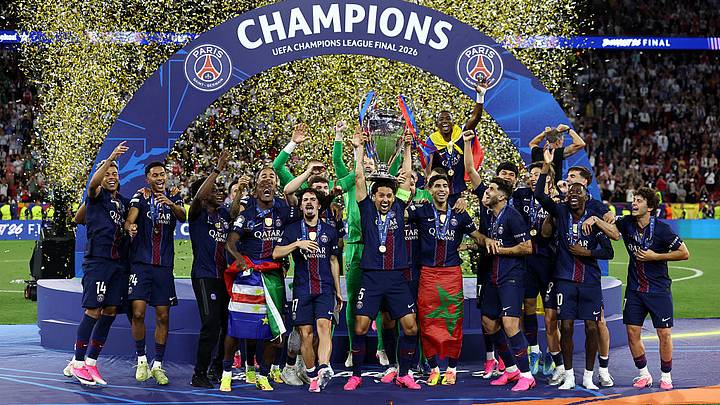
Paris Saint-Germain are back-to-back Champions League winners after defeating Arsenal in a dramatic penalty shootout.
The Gunners struck early with a rocket of a hit from Kai Havertz, putting the Premier League champions in the driver’s seat to secure their first Champions League crown. PSG struggled to find a way past Arsenal’s stout defense, but eventually their insistence paid off, winning a penalty that Ousmane Dembélé dispatched to even the score at one in the second half.
Drama and nerves ensued as the game went into extra time, with players falling victim to exhaustion in such an intense affair. Tension reached its climax when the whistle blew after 120 minutes, determining that the European champion would be decided in a penalty shootout.
Eberechi Eze and Nuno Mendes squandered their penalties, and the shootout was all squared until the 10th penalty, when Gabriel sent his kick over the crossbar to crown PSG champions of Europe and break Arsenal’s heart.
Luis Enrique’s side have conquered the most prestigious club trophy on the planet for the second-straight season, a just reward for one of the best teams the sport has seen in recent times. It’s a painful end for Mikel Arteta’s side, who were within touching distance of putting the cherry on top of an already fairytale campaign
Here are six takeaways from a thrilling 2025–26 Champions League final.
Kai Havertz Makes Arteta Look Like Genius

Viktor Gyökeres was one of the heroes of Arsenal’s semifinal triumph over Atlético Madrid, but on the final, Arteta decided to do without the Swede and instead deploy Havertz as his starting striker. It took just five minutes for the German to validate his manager’s decision.
Havertz was perfectly positioned to pounce on a lucky rebound behind PSG’s backline, going off to the races with only the goalkeeper to beat. For a moment it looked like he taken too long and had closed the angle on himself, but he then unleashed a rocket into the roof of the net to give the Gunners an early lead.
It was déjà vu for Havertz, who five years ago scored the winner for Chelsea in the Champions League final. Two of the German’s 15 career Champions League goals have come in a final, saving his best in front of goal for the biggest of occasions.
He now has as many Champions League final goals as Lionel Messi, and he joined Cristiano Ronaldo and Mario Mandžukić as the only three players to score in the final for two different clubs.
Not content with scoring the winner against Burnley that set the stage for Arsenal to win the Premier League title, Havertz made sure to also leave his mark in the biggest game of the season.
Arsenal’s Backline Lives Up to Hype

Arteta and Arsenal danced with the one that brought them this far all season, prioritizing a stout defensive block above all else. Four natural center backs were included in the XI, and left-back Myles Lewis-Skelly partnered Declan Rice in midfield.
Grabbing an early lead was all Arsenal needed for Arteta’s defensive game-plan to come completely alive. The Gunners were comfortable sitting back and allowing PSG to dominate possession. But once the Parisians reached the final third, their potent attack was stifled by the best defensive side in world soccer.
Arsenal had 42 completed passes by the time PSG had already completed 200 late in the first half. Still, the Gunners never looked overwhelmed, containing the most powerful front line in the world over the past two seasons to an xG of 0.26 and one shot on goal—a weak attempt from Fabián Ruiz—in the opening 45 minutes.
Gabriel and William Saliba were as advertised, reaffirming their status as the best center back partnership. Piero Hincapié was exceptional all game, dancing with Ousmane Dembélé and Désiré Doué. It was a defensive soccer masterclass from the Gunners.
Christian Mosquera had done brilliantly all game against Khvicha Kvaratskhelia, but a clumsy challenge on the Georgian inside the penalty area led to PSG’s equalizer from the spot. The young Spaniard had been excellent, but one mistake proved costly, or else Arsenal could’ve continued to frustrate PSG the entire match.
The Brilliance of PSG’s Midfield

With Arsenal’s defense frustrating PSG’s talented forward line, it was the brilliance of their midfield trio, particularly Vitinha and João Neves, who took over the game and commanded the Parisian revolution early in the second half.
PSG tirelessly passed the ball sideways during the entirety of the first half, unsuccessfully trying to carve open a compact block.
That all changed in the second half when Neves and Vitinha seemingly got the order to start carrying the ball forward with speedy runs that allowed PSG to start probing with more intent, pushing Arsenal even deeper into their own penalty area. Those carries, combined with a tense, progressive passes between the lines started putting a previously impenetrable backline on its back foot.
What were slow, horizontal and unimaginative possessions in the first half became incisive, vertical dynamic and fluid in the second half, even allowing the previously constrained attackers to start operating more freely, leading to the action that resulted in a penalty that Dembélé converted into the equalizer.
PSG’s midfield dominated when they needed it most. When they were obligated to take over the game, they did just that and guided the team’s reaction.
War of Attrition

Clear goalscoring opportunities might have been scarce during the final, but what the game lacked in action in both penalty areas it made up for in intensity. Both teams tirelessly covered ground and left it all on the pitch, which ended up taking a toll late in the game and certainly once extra time came around.
Between the impossibly high levels of intensity on display plus the weight of a marathon of a season, soldiers from each battalion started falling.
PSG finished the game without arguably their three best players in Kvaratskhelia, Dembélé and Vitinha, who were all forced to leave the game with muscular issues. Arsenal had to withdraw an exhausted Bukayo Saka and Lewis-Skelly, and with Arteta out of substitutions deep into extra time, Hincapié finished the match on one leg.
Both teams played extra time trying not to lose rather than taking risks in search of a winner, and it was all because of the monumental effort every player on the pitch delivered during the final.
The Cruelest of Ends For Arsenal

An argument could be made that no player was more important for Arsenal’s Premier League title-winning campaign than their dominant center back and set-piece specialist, Gabriel. But under the unmatched pressure of a penalty shootout in the Champions League final, the Brazilian missed the decisive kick.
Gabriel had to score his penalty to send the shootout to sudden-death, but it all went wrong for the defender, who sent his shot into orbit way above the crossbar to sentence Arsenal to continue waiting for their maiden Champions League crown. It was shades of Sergio Ramos for Real Madrid in the 2012–13 semifinal.
It was a very cruel ending for the Gunners and especially for one of the best players in the world throughout 2025–26. The image of international teammate and PSG captain, Marquinhos, immediately going to console a distraught Gabriel said it all.
The penalty miss will be difficult to overcome, but Gabriel was still sensational all game and all season. Him ending up being the villain is simply the latest example of the cruel nature of the sport.
A Parisian Dynasty

As incredible as it may seem, PSG are now the only team not named Real Madrid to win back-to-back titles since the start of the Champions League era in 1992.
PSG spent over a decade trying to unsuccessfully spend their way to a maiden European crown, obsessed with validating their project and Ligue 1 dominance with Champions League glory.
Then, the Parisians shifted strategy and handed the keys to Enrique, allowing him to spearhead a project that wasn’t interested with having the biggest stars in the world, but rather having the best team in the world.
Three years into the project, and PSG have undoubtedly achieved their mission. After spending years waiting for their first Champions League title, they’ve now conquered Europe in consecutive years.
Matvéi Safónov replacing Gianluigi Donnarumma between the posts was the only difference between today’s XI and the one Enrique deployed in last season’s 5–0 thrashing of Inter Milan in the final. Make no mistake about it, this PSG team is already one of the best teams in tournament folklore. And with a third career Champions League crown, Enrique has already cemented his status as an all-time great manager.
PSG are champions of Europe for the second season in a row ... and they unquestionably have the pieces in place to make it three on the bounce next season.
READ THE LATEST CHAMPIONS LEAGUE NEWS, ANALYSIS AND INSIGHT FROM SI FC
 Add us as a preferred source on Google
Roberto Casillas is a writer for SI FC, focusing primarily on FC Barcelona, the Mexico National Team, Liga MX and all things Latin American football. Born and raised in Mexico City, he developed a deep passion for football from an early age and fell in love with Cruz Azul. The once future star of Mexican football still likes to showcase what’s left of his talent on the Sunday league pitch. He’s also a big fan of the New England Patriots—so much so he moved to the region for four years—, Chicago Cubs and is a life-long Formula 1 follower. When he takes a break from sports, he enjoys traveling the world, watching the latest great TV show, going to concerts and spending plenty of time with friends and family.