%20%20--%3E%0A%3Csvg%20version%3D%221.1%22%20id%3D%22Layer_1%22%20xmlns%3D%22http%3A%2F%2Fwww.w3.org%2F2000%2Fsvg%22%20xmlns%3Axlink%3D%22http%3A%2F%2Fwww.w3.org%2F1999%2Fxlink%22%20x%3D%220px%22%20y%3D%220px%22%0A%09%20width%3D%2239px%22%20height%3D%2240px%22%20viewBox%3D%220%200%2039%2040%22%20enable-background%3D%22new%200%200%2039%2040%22%20xml%3Aspace%3D%22preserve%22%3E%0A%3Cpath%20fill%3D%22%23FFFFFF%22%20d%3D%22M38.5%2C7H28.2v26h10.3V7z%22%2F%3E%0A%3Cpath%20fill-rule%3D%22evenodd%22%20clip-rule%3D%22evenodd%22%20fill%3D%22%23FFFFFF%22%20d%3D%22M26.1%2C25.5c0%2C5.8-4.1%2C7.5-12.9%2C7.5C3.9%2C33%2C0%2C31.2%2C0%2C25.2v-1.1h11.6%0A%09v2.4c0%2C0.7%2C0.1%2C1.4%2C1.2%2C1.4c1%2C0%2C1.2-0.4%2C1.2-1.3v-0.9c0-1.6-0.9-1.6-3.5-2.2C2.2%2C21.7%2C0%2C19.7%2C0%2C15.3v-0.9C0%2C9.3%2C5.5%2C7%2C12.9%2C7%0A%09c10.2%2C0%2C12.8%2C2.6%2C12.8%2C7.4v1.8h-11v-2.9c0-0.6-0.4-1.1-1.2-1.1c-0.6%2C0-1.2%2C0.4-1.2%2C1.1v0.9c0%2C1.5%2C0.9%2C2%2C3.3%2C2.5%0A%09c8%2C1.6%2C10.5%2C3.3%2C10.5%2C7.5V25.5z%22%2F%3E%0A%3C%2Fsvg%3E%0A)
Stadium Wonders: How Atlanta’s Mercedes-Benz Stadium Became World Cup-Ready
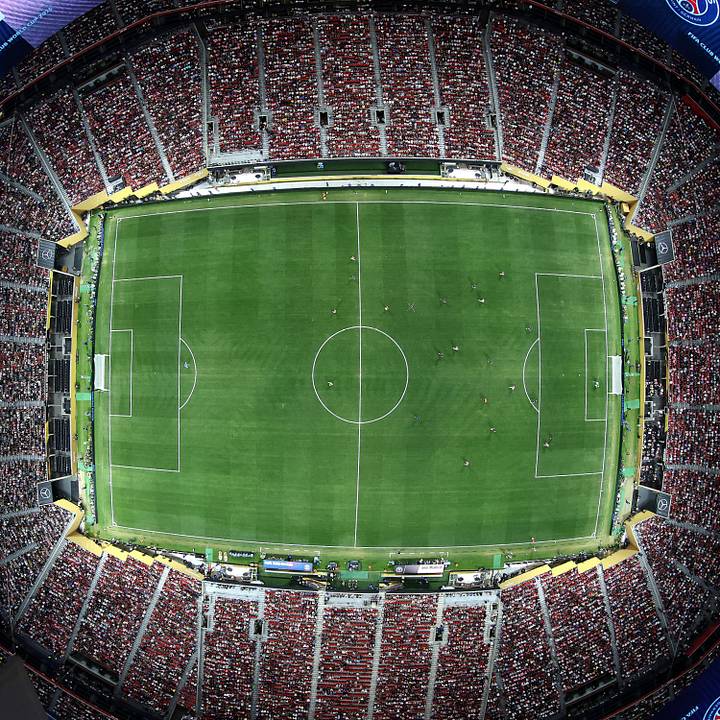
ATLANTA — Field level at Mercedes-Benz Stadium smells a little different these days.
The home of the Falcons is one of 11 stadiums in the United States that will host World Cup matches this summer, and it got a brand new playing surface installed for the occasion. Gone is the usual artificial turf, having been replaced by the FIFA-mandated grass pitch.
It’s one of many changes the stadium underwent in preparation for the tournament. Sports Illustrated traveled to Atlanta in early May to get an up close look at Mercedes-Benz Stadium and learn more about the World Cup preparations as part of our Stadium Wonders video series. The man overseeing the project is Adam Fullerton, the vice president of stadium operations.
“I do take moments each day and come out here in this quiet bowl. It’s kind of my zen,” Fullerton says. “It’s really fun when the irrigation system’s going or the lawnmowers are going, you kind of get that little hum. But event day, there’s no other way to replicate it. That's why I do what I do. I love event day.”

There hasn’t been much time for zen before the first event day of the World Cup. There’s a lot that needs to get done before Spain and Cabo Verde square off at noon local time on June 15. The most important task is ensuring that the playing surface is worthy of the biggest soccer tournament in the world. That hasn’t always been the case.
Mercedes-Benz also hosted matches during the 2024 Copa América and the ’25 Club World Cup, using a temporary sheet of real grass. The reviews were less than stellar, but this time will be different.
“The state of the pitch was a disaster,” Argentina goalkeeper Emiliano Martínez said after his team’s Copa América opener in Atlanta two years ago. “Very bumpy. We must improve in this aspect; otherwise, Copa América will always appear at a lower level than the European Championship.”

There is no such concern for a sub-par playing surface this time around. The entire process has been overhauled literally top to bottom. The stadium sub-surface was completely renovated, a process that began two years ago and finalized in February. It now features a brand-new irrigation and aeration system. On top of that is a thick layer of sand, and above that is the pitch itself—a 21st-century hybrid of natural grass interwoven with synthetic fibers.
The grass, itself, was grown in Colorado. Because the stadium is climate-controlled with an opaque roof, the grass needs to be equipped to handle cool temperatures and reduced sunlight. Once put in place, the grass is kept alive by a collection of grow lights. But natural grass can’t survive forever under a dome. The original grass field that was installed at the start of the Atlanta United season was torn out in early May and replaced with a fresh pitch for the World Cup. Playing MLS matches on grass served as a sort of dress rehearsal for the World Cup, and the pitch received positive reviews.
“This is a difficult thing to do, grow grass indoors without sun,” Fullerton says. “So we've learned quite a bit in the last month and a half that this [MLS pitch] has been down.”

With the pitch issues resolved, Mercedes-Benz is a perfect host for World Cup matches. The stadium was designed with soccer in mind because it was part of Falcons owner Arthur Blank’s bid for an MLS team, and features retractable seating in each corner of the stadium that allows the playing field to be widened for soccer matches. (The pitch for the World Cup will be the FIFA-standard 105 meters by 68 meters, about 20 yards wider and five yards shorter than an NFL field.)
The stadium will host eight matches during the World Cup: five group stage matches (including two featuring Spain and one featuring 2022 semifinalist Morocco), a round of 32 knockout stage match, a round of 16 match and one of the two semifinals.
Several logistical factors also make it an attractive host. Atlanta’s airport—the busiest in the world—is 20 minutes away. The stadium is located in between two stations on Atlanta’s subway system, the MARTA, which makes gameday access a breeze. The stadium is also walking distance from downtown Atlanta and its many hotels. Compare that to AT&T Stadium in Arlington, Texas, the site of the other semifinal game. Arlington is the largest city in the United States without any form of public transportation. Fans not driving their own cars to attend games there will either make a one-mile walk from the rideshare dropoff point or take an eight-mile charter bus trip from the nearest train station.
“The city sets itself up very well for these types of events,” Fullerton says.
The other big change that Mercedes-Benz must undergo before the World Cup is stripping it of all sponsorship logos that conflict with FIFA partnerships. That includes changing the very name of the stadium. Hyundai/Kia is the “official ground transportation provider” (aka “car”) of FIFA, so the Mercedes-Benz name has to go. The building will officially be known as “Atlanta Stadium.” Even non-sponsored stadiums are getting new names for the tournament, though. Arrowhead Stadium, for example, will become Kansas City Stadium.
Atlanta Stadium’s pervasive Coca-Cola branding can stay, but logos for Delta, AT&T and, of course, Mercedes must go. The stadium’s Chick-fil-A concession stand also won’t be allowed to operate during the tournament, due to FIFA’s partnership with McDonald’s.

All told, there are more than 1,000 logos inside the stadium that need to be obscured, a task that Fullerton says is “a lot of work.” It would be a lot more work, though, if not for the way the stadium’s naming rights deal was structured a decade ago.
“When we cut the deal with Mercedes, they’re the only brand that can be bowl-facing. And I love that now because that results in a whole lot less cover-up in-bowl, where some other venues have a lot of internal sponsorship,” he says. “Other than our LED ribbons, we’ve got four Mercedes-Benz logos to cover up inside the bowl.
“The remainder of the stadium is a little bit of a different story. There’s probably close to 1,500 logos that have to be covered of other brands that conflict with FIFA partners.”

Mercedes-Benz’s signature feature is its one-of-a-kind retractable roof. The opening is composed of eight panels that sit on rails and fan out to expose a circular opening. Inside the stadium, the opening is ringed by a unique round scoreboard, known as the “halo board.” When closed, the roof forms the logo of the building’s title sponsor. (FIFA has granted several U.S. stadiums an exemption from its strict sponsorship rules and will not force them to cover rooftop corporate logos.)
The ability to close the stadium off from elements is another reason why Mercedes-Benz is an attractive World Cup host. Much has been made in the buildup to the tournament about summer heat in the United States, but that won’t be a factor in Hotlanta, nor will the summer thunderstorms that often strike the South. The matches at Mercedes-Benz will be climate-controlled and dry. (There will still be “cooling” breaks midway through each half, though, as FIFA has decided to implement stoppages in every game to provide consistency for all teams.)
“We want to control the environment as best we can, to just omit any other variables,” Fullerton says. “I would like to open it for the semifinal. That would be really cool. But weather is going to be a challenge with just heat and rain during the summer in Georgia.”
From an aesthetic standpoint, the roof is an impressive feat of architecture and perhaps the most recognizable feature of any stadium in the NFL, but the practical advantages of having a roof are more important. It allows the stadium to be in use year-round, rain or shine. In addition to Falcons and Atlanta United home games, the stadium also hosts college football (including the SEC championship game and Peach Bowl), high school football, six to eight concerts and numerous private events (like Coca-Cola’s company holiday party and Delta’s annual employee summit). The stadium will have another full-time tenant in 2028 when Atlanta’s new NWSL team begins play.
“I say we’re a big arena,” Fullerton says. “We’re truly a multi-purpose venue. We’re one of the busiest venues in the world, certainly the country. And it’s because we have that roof.
“Because of the roof and because of the flexibility we have, the pace at which we operate is probably more events than most venues. You look at Hard Rock [Stadium in Miami] that shuts down for Formula 1, which is a huge event. No knock on them, but that shuts them down for a long time. Similar to what World Cup’s doing [for Mercedes-Benz]. This is not our normal business model. Our normal business model is to to turn as many events as we possibly can, and that’s why the turf is so critical and important. It allows us that flexibility. I think there’s a stat that our main kitchen was closed for six days last year, and that was not six consecutive days. So that means we’re operating some sort of event almost every day in the venue, and that’s led to a lot of efficiencies.”

If you’ll allow me to brag for a moment, I’ll say that the roof looks even cooler the closer you get to it. On our trip to Atlanta this spring, I had the opportunity to climb all the way to the top of the stadium and step out on top of the roof.
The exact path up there is a closely guarded secret (stadium officials don’t want any well-lubricated fans trying to get a bird’s-eye view of the action) but I can tell you that it takes about 20 minutes to reach from field level. The latter portion entails traversing a long catwalk that leads to a tall set of narrow stairs at least as high as the ones in the fifth-floor walkup apartment where I lived in Manhattan nearly a decade ago.
From the top landing, you must climb a set of steep, narrow steps (like you might find leading to an attic). Emerging from the small hatch, you find yourself standing inside one of the roof’s eight petals. The rails that move the segments of the roof are on the floor, and you can look up and see the tightly woven spiderweb of steel that forms the petal itself. From there, you can walk out a door and step into the open air on the exterior of the roof where the petal slides as the aperture is retracted.
Standing outside on the top of the stadium is a great way to visualize what Fullerton had told me about the stadium’s location. Look to the south and you can see how close the airport is. To the north and east are the high-rises of downtown. It was calm and quiet below on that afternoon in early May. Inside, the stadium was mostly empty, aside from the school tour groups and the flurry of construction activity. But for eight days this summer, it’ll be a hive of activity at the center of the sports world.
More World Cup on Sports Illustrated
 Add us as a preferred source on Google
Dan Gartland writes Sports Illustrated’s flagship daily newsletter, SI:AM, and is the host of the “Stadium Wonders” video series. He joined the SI staff in 2014, having previously been published on Deadspin and Slate. Gartland, a graduate of Fordham University, is a former Sports Jeopardy! champion (Season 1, Episode 5).
Follow Dan_Gartland