%20%20--%3E%0A%3Csvg%20version%3D%221.1%22%20id%3D%22Layer_1%22%20xmlns%3D%22http%3A%2F%2Fwww.w3.org%2F2000%2Fsvg%22%20xmlns%3Axlink%3D%22http%3A%2F%2Fwww.w3.org%2F1999%2Fxlink%22%20x%3D%220px%22%20y%3D%220px%22%0A%09%20width%3D%2239px%22%20height%3D%2240px%22%20viewBox%3D%220%200%2039%2040%22%20enable-background%3D%22new%200%200%2039%2040%22%20xml%3Aspace%3D%22preserve%22%3E%0A%3Cpath%20fill%3D%22%23FFFFFF%22%20d%3D%22M38.5%2C7H28.2v26h10.3V7z%22%2F%3E%0A%3Cpath%20fill-rule%3D%22evenodd%22%20clip-rule%3D%22evenodd%22%20fill%3D%22%23FFFFFF%22%20d%3D%22M26.1%2C25.5c0%2C5.8-4.1%2C7.5-12.9%2C7.5C3.9%2C33%2C0%2C31.2%2C0%2C25.2v-1.1h11.6%0A%09v2.4c0%2C0.7%2C0.1%2C1.4%2C1.2%2C1.4c1%2C0%2C1.2-0.4%2C1.2-1.3v-0.9c0-1.6-0.9-1.6-3.5-2.2C2.2%2C21.7%2C0%2C19.7%2C0%2C15.3v-0.9C0%2C9.3%2C5.5%2C7%2C12.9%2C7%0A%09c10.2%2C0%2C12.8%2C2.6%2C12.8%2C7.4v1.8h-11v-2.9c0-0.6-0.4-1.1-1.2-1.1c-0.6%2C0-1.2%2C0.4-1.2%2C1.1v0.9c0%2C1.5%2C0.9%2C2%2C3.3%2C2.5%0A%09c8%2C1.6%2C10.5%2C3.3%2C10.5%2C7.5V25.5z%22%2F%3E%0A%3C%2Fsvg%3E%0A)
The Art of Savoring a World Cup—From ‘We’ll Deep-fry Your Paella’ to the Law of Jante

On a freezing November evening last year, a gang of soccer players skipped into a bus heading to downtown Oslo.
They were going to the town hall to celebrate Norway’s first World Cup ticket since 1998, a big deal on this five-and-a-half-million-strong strip of snowy mountains, oil rigs, salmon farms, high taxes and caramelized brown cheese.
But a Swede had tried to spoil the party.
Earlier that day, the columnist Olof Lundh had called the party “strange” and “borderline pathetic.” Sweden is Norway’s neighbor and brotherly rival, with a richer soccer history, and Lundh added, “Save the celebration for when you’ve eventually done something at the World Cup.”

Confident soccer nations would have brushed off the jibe, but as the bus lurched toward the center of the capital, a sliver of doubt spread on social media about whether this was the right thing to do. It was early on a dark Monday evening, and a lot of people were still working. Live on TV, pundits were trying to explain the small turnout, masking fears that, having waited 28 years for this moment, Norway would not even know how to recognize it.
Yet by the time the bus arrived, the crowd had grown to 45,000.
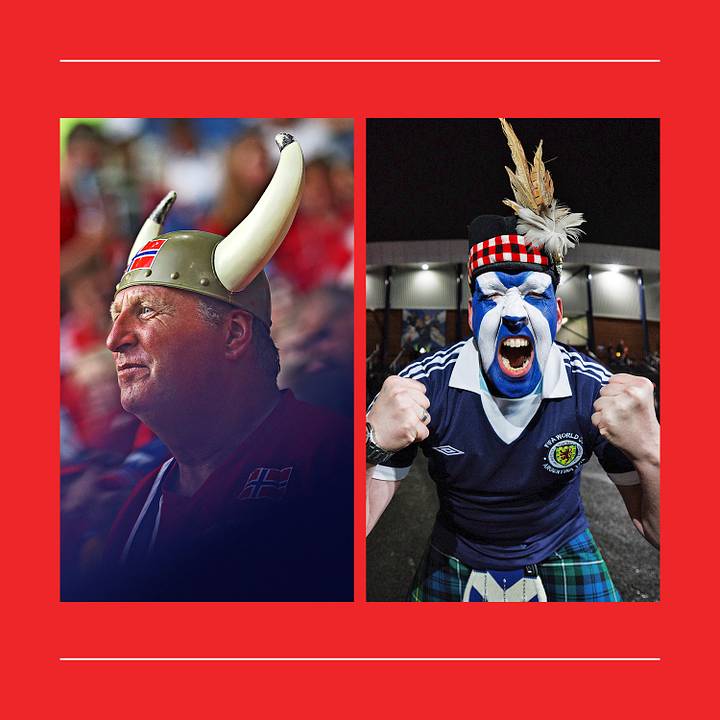
One by one, the players skipped out onto the balcony wearing khaki puffer jackets. The town hall facade was lit up in red, white and blue. Forward Aron Dønnum did the most un-Norwegian thing possible by attracting extra attention, leading a rendition of “Pump It Up” while wearing sunglasses and a white fleece balaclava cap. In the sea of smiling faces, kids wore face paint. Adults grinned under plastic Viking helmets. At some point, assistant coach Brede Hangeland, the team’s 6' 5" former defender and captain, broke down in tears.
“I’m a man, so I’m not supposed to cry,” he told reporters. “But that was too much.”
Finally, the staff could see what this meant to the people in the streets.
After cutting a cake and greeting the prime minister, the players moved on to a bar, where fans drank long into the night. Even Swedes admitted that this time, Norway deserved a proper party.

For Norway, the celebration was a victory in its own right. On a normal day, the carousing would have been halted by the unwritten rule that pervades Scandinavian culture. In fact, it’s a law. Janteloven. The Law of Jante.
It was written as satire by the Danish-Norwegian author Aksel Sandemose in 1933. There are 10 rules, but the first one sums it up: Do not think you are anything special.
If you did well, don’t say it. Got a fancy car? Hide it. With one of the strongest social security nets in the world, Norway tries to make sure nobody falls behind. The Law of Jante hauls back anyone who’s getting too far ahead.
Which is a problem in soccer, where winners rarely follow the herd. Not even in the glorious ’90s, when Norway made back-to-back World Cups, did they have a mercurial star who broke all the rules.
That guy turned up in Sweden.
Zlatan Ibrahimović elbowed his way to the top with flicks, tricks and a hard-nosed Balkan mentality. When asked about comparisons to the Norwegian striker John Carew, he said, “Whatever [he] can do with a soccer ball, I can do with an orange.”
Watching him on TV was a young Erling Braut Haaland.
“I know he was a big inspiration for Erling,” Leif Smerud, who coached Haaland at the youth national team level, told the British newspaper The Times last year. “Zlatan was a bit un-Scandinavian, being more confident, more outspoken, more eccentric, and that’s anti-Jante. But Zlatan had an incredible work ethic and was a good teammate, which is very Jante.”
Even before leaving Norway, Haaland teamed up with Mino Raiola, the late Italian-Dutch agent who was a walking protest against the Law of Jante. At Dortmund, Haaland appeared on Instagram wearing Dolce & Gabbana clothes decorated with flamingos, zebra stripes and leopard print. His watch collection seemed to expand by the week, and we all got to see it. If Haaland was to be abnormally good, it made no sense to act like everyone else.

Nobody in Norway minded too much until March 2022, when Haaland turned up at a national team camp in a private jet and asked not to face the media. A national debate questioned the “special treatment” of a star who appeared to think he was better than the rest. Which, of course, he was. But in a country where even the king was pictured taking the tram in the 1970s, Haaland was not supposed to show it.
The nadir came in October 2024, when Norway lost 5–1 away to Austria, and Haaland, as captain, refused to talk to the press. He apologized, but not before being slammed. Just over a year later, Norway delivered one of the best World Cup qualifying campaigns in European history.
When Norway beat Italy in its final game, commentators were tearing up live on air. The team had won all eight of its games. Haaland had played so well that one Norwegian columnist said he was “exempt from the Law of Jante.” He was right, and it gave a rough answer to what justifies a little brag in Norway: 16 goals in eight matches.
Later, it emerged that the idea for the town hall party was his.
Norwegians are still trying to process who they have become. For the group draw in December, they obsessed about avoiding the underdogs, forgetting that the greatest dark horse was them. They were shocked when Canada coach Jesse Marsch named Norway as the one team he wanted to avoid, and when bookmakers made Norway the ninth favorite to win the whole thing.
Norway is the butterfly that spent 26 years as a larva, transformed overnight and is now looking in the mirror asking, “Is that really me?”
Still, the World Cup craze is real. Norway is planning to ease its strict alcohol laws during the tournament, and a group of fans has seriously considered crossing the Atlantic in a Viking ship.
This summer, the Norwegians are special. For a few weeks, they might just allow themselves to believe it. —Thore Haugstad
Scotland
“You can mark down 25 June 1978 as the day Scottish football conquers the world.”Ally MacLeod
Scotland’s complicated relationship with the World Cup didn’t start in 1978, but for many it remains shaped by it. We think of the images of the players on an open-top bus parade in the national stadium, and along the streets to the airport. Manager Ally MacLeod filling a nation with confidence. Flags waving and tens of thousands of fans joyous. But this wasn’t a celebration of Scotland winning the World Cup. This was the level of anticipation and expectation as the team was merely setting off for the tournament in Argentina.
Spoiler alert: Scotland did not conquer the world in 1978.
A loss to Peru and a draw with Iran left Scotland in a big tartan hole, having to beat the Netherlands, one of the tournament favorites, by three goals to advance. Scotland actually won the game, 3–2, and for a fleeting moment, after Archie Gemmill scored one of the greatest goals in the history of the World Cup, the fans had hope and expectation restored.
Another iconic World Cup moment.
— TV Football 1968-92 (@1968Tv) November 17, 2022
Archie Gemmill against Holland in 1978.
Commentator David Coleman #WorldCup2022 pic.twitter.com/pJof1Mhf0R
But Scotland exited at the group stage again, in a particularly Scottish manner, now recognized as a “glorious defeat.” To many, it was a defining lesson in never allowing themselves to believe in the Scotland football team again. For the rest of us, it was even more personal.
It’s difficult to understate the significance of football in daily life in Scotland. Legendary Liverpool coach Bill Shankly, a native of the small mining community of Glenbuck, once contended with the belief that football was a matter of life and death. “I can assure you it is much, much more important than that,” he said. It’s a sentiment that most Scots can still relate to.

The attendance of Scotland’s top league per capita is more than 70% higher than any other league in Europe. If we are not playing football, we are watching it. The passion of the Scots for the game is undeniable. For whatever reason though, this has never translated into national team success. Maybe because we won’t let ourselves believe again.
“Oh, no no. Eighteen minutes gone and Scotland stupidly take the lead against the greatest team in the world. Don’t celebrate! You’ll only make them angrier!”Allaster McKallaster
Four years after 1978, Scotland traveled to Spain for the 1982 World Cup and came up against a Brazilian team still regarded as one of the best ever. Watching that game with my dad and his friends is one of my first memories of what it is like to be a Scotland fan. I was 6 years old at the time.
To the surprise of everyone, Scotland took the lead in Seville. An almost apologetic toe poke by defender Dave Narey flew into the top corner of the Brazilian net. This 6-year-old celebrated a little too hard singing, “We’re going to win the World Cup,” before I was sternly told to shut up by my dad’s pals, to whom the shame of 1978 was still fresh. When Scotland eventually lost 4–1, I got the blame.
Scotland exited in 1982 at the group stage on goal difference, as we had done in 1974, and in 1978. And so began the bookmarks of my childhood, where Scotland would qualify for World Cups, but we were constantly reminded not to expect anything other than more pain and glorious failure.
And that is exactly what Scotland got at Mexico 1986 and Italy 1990. In 1994 we didn’t qualify for the field in the United States. This was merely a glitch, we assumed, and in 1998 we returned to the world stage in the opening game against Brazil. But 13 days later we lost 3–0 to Morocco and, yet again, we exited at the group stage. We’ll be back soon for another glorious failure, we assumed. We were wrong. Twenty-eight empty years passed.
“We’ll deep-fry your paella. We’ll deep-fry your tapas. We’ll deep-fry your gazpacho soup. You come to Scotland, you’re getting battered.”Allaster McKallaster
I was a fanatical Scotland fan as a 22-year-old in 1998, but I didn’t go to the World Cup. Now I’m 50 and I’ve never been to a World Cup. But Scotland is back and I’ll be there with Allaster McKallaster, the country’s most unbiased commentator who uttered those now famous words about Spanish cuisine as Scotland defeated Spain on their way to qualification for the 2024 Euros. It’s a viral video that has been viewed by more than 35 million people. Or perhaps seven times by all five million Scots.
Of course, McKallaster is anything but unbiased. He is the most impartial, most Scottish, most over-the-top sports commentator you’ve ever heard. I should know. Because I am Allaster McKallaster.
I left Scotland and immigrated to the U.S. in 2002, but I’ve always tried to keep a connection with my homeland. The McKallaster videos started as a joke for my friends here in Austin. How biased could a commentator be yet still sound authentic? The answer is there is no limit, and people seem to get the joke. McKallaster now has more than 850,000 followers across social media (@McKallaster on Instagram, TikTok and YouTube), and more than 500 million views on hundreds of videos.
After the Spain victory, we—and by that I mean McKallaster and I—went to the 2024 Euros in Germany along with an estimated 200,000 Scots starved for major tournament action. Unbelievably, people recognized McKallaster, wanted selfies with him, and told me how watching my videos made them happy when they were depressed. It felt like my connection to home had been restored. I loved every second of my two weeks in Germany. Apart from the three times when Scotland was playing football. Once again, Scotland exited at the group stage. This time there was only failure, no glory.
So now, with a new generation of Scottish fans, untarnished with the disappointments of the past, and an older generation with fading memories, how does this proud nation feel about our chances in 2026?

I would say that everyone is happy to be there. I would say that virtually no one expects Scotland to win it. Getting out of the group stage for the first time ever would probably be deemed a success. Much will depend on our results against two familiar foes. After an opening game against Haiti, Scotland will again face Morocco and Brazil, and the demons of 1998.
Would we accept glorious failure again? Perhaps. Failure, no, but give us a sniff of glory, a glimmer of hope, a moment or two to remember what it feels like to believe, and I think we would take that.
As for Allaster McKallaster though, his expectations remain undiminished. His unbiased and factual opinion is clear:
“You can mark down 19 July 2026 as the day Scottish football conquers the world.” —Pete Reid
More World Cup from Sports Illustrated
 Add us as a preferred source on Google